
製品概要 マスター PoE 電源変圧器: 必要なのはこの 1 つの記事だけです — VOOHU Electronics
PoE 電力システム設計では、PSE および PD コントローラーの選択が最も注目を集めます。しかし、実際のエンジニアリングでは、電源トランスと LAN トランスのマッチングが適切かどうかが、電源効率、熱性能、長期信頼性に直接影響します。さまざまな IEEE 標準 (af/at/bt) は、さまざまな電力レベル、電流容量、および熱要件に対応しています。トランスのコア材質、巻線構造、絶縁耐圧、DCバイアス特性は使用条件に厳密に適合する必要があります。選択を誤ると、効率の低下、過度の温度上昇、さらには機器の損傷につながる可能性があります。
VOOHU Electronics は、検証済みのリファレンス設計とデバイスマッチングの推奨事項とともに、af/at/bt の電力レベルの全範囲をカバーする、PoE アプリケーション向けの完全な変圧器ソリューションを提供します。これにより、エンジニアは電力の安定性と EMC パフォーマンスのバランスをとり、システムのデバッグのリスクを軽減できます。
PoE電源トランスとは何ですか?
定義
PoE 変圧器は、Power over Ethernet (PoE) システムのコア コンポーネントです。リモートデバイスに安定した電力を供給すると同時に、標準のイーサネットケーブルを介してデータを送信します。
主要コンポーネント
PSE(電源供給装置)
PSE は DC 電力供給を開始します。規格 (af/at/bt) に応じて、データ ペア (1/2、3/6) またはスペア ペア (4/5、7/8) に電力を供給します。
主な用途: PoE スイッチ、PoE インジェクター、PoE 光ファイバー トランシーバー。
PD (受電装置)
PD は DC 電力を受動的に受け取ります。 PD コントローラーと DC-DC コンバーターを介して、2 次側からの 37V ~ 57V DC をデバイスが必要とする動作電圧 (5V、12V、3.3V など) に変換します。
主な用途:PoEネットワークカメラ、無線AP、VoIP電話、PoE照明器具。
PSEコントローラーの主な機能
PSE コントローラーは、接続された負荷が電源条件を満たしていることを検出した後のみ 48V を出力します。このメカニズムは、デバイスの実際のニーズに基づいて適切な電力を供給し、電力不足や過負荷によるデバイスの損傷やパフォーマンスの低下を効果的に防ぎながら、安定した動作を保証します。
PDコントローラーの主な機能
PD コントローラはホットスワップをサポートしているため、電源を落とさずに新しい PD デバイスを直接接続できます。接続されると、PD コントローラーは自動的に標準 PoE 負荷として構成され、最大の効率で電源から内部回路に電力を転送し、電力システムの柔軟性と拡張性を強化します。
PoE電源トランスの動作原理
基本的に、LAN 変圧器と電源変圧器はそれぞれの役割を果たし、共同してデータの分離と電圧変換を実現します。
ネットワーク機器では、一般的な変圧器は LAN 変圧器と電源変圧器の 2 つのカテゴリに分類され、それぞれ場所と機能が異なります。
-
LANトランス PHY チップと RJ45 コネクタの間のネットワーク インターフェイスにあります。その機能は 2 つあります。(1) フィルタリング、電気的絶縁、インピーダンス整合を実行しながら高周波データを送信します。 (2) 内部のセンタータップを介して DC 電力を結合し、DC 電力と高速データ信号の同時伝送を可能にします。
-
電源トランス デバイスの内部電源回路の DC-DC ステージにあります。その中心的な機能はエネルギー変換です。スイッチがオンになると、一次コイルは磁場にエネルギーを蓄えます。スイッチがオフになると、磁気エネルギーが二次コイルに放出され、最終的にデバイスが必要とする低電圧 DC (5V、12V など) に変換されます。
PSE/PDへの対応
PoE 電力システムでは、PSE デバイス (PoE スイッチなど) には主に LAN 変圧器が含まれており、データを同時に送信しながら 48 V DC をイーサネット ケーブル (データ ペアまたはスペア ペア) に接続します。一方、PD デバイス (PoE カメラなど) には、LAN 変圧器と PoE 電源変圧器の両方が含まれています。LAN 変圧器はデータ ラインから 48 V DC を抽出し、PoE 電源変圧器はさらに 48 V を 5 V または 12 V に降圧してチップに電力を供給します。
PoE電源規格
PoE 電源変圧器には、3 つの主要な IEEE 802.3 標準に対応するさまざまな電力レベルがあります。変圧器を選択するときは、デバイスの電力要件に基づいて適切な規格を選択する必要があります。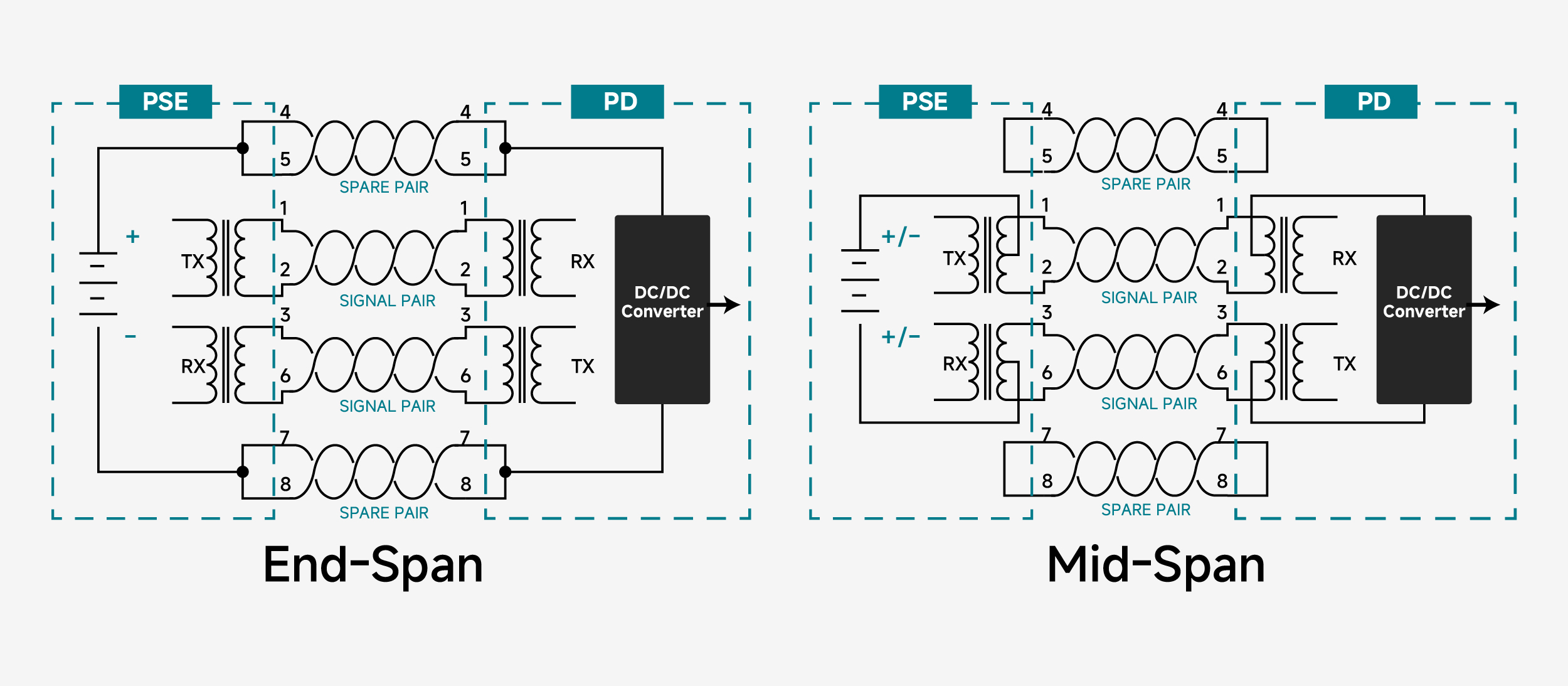
ミッドスパン (代替 A および B)
イーサネット ケーブルの予備ペア (4/5 および 7/8) を使用して DC 電力を伝送します。データ伝送と電流配信の多重化を実現するために、データ信号には異なる周波数が使用されます。
PoE+ (IEEE 802.3at) は、PoE (IEEE 802.3af) の 2 つの配線方式を変更することなく完全に継承し、互換性があります。
エンドスパン (代替案 A)
データ ペア (1/2 および 3/6) を使用して DC 電力を同時に送信します。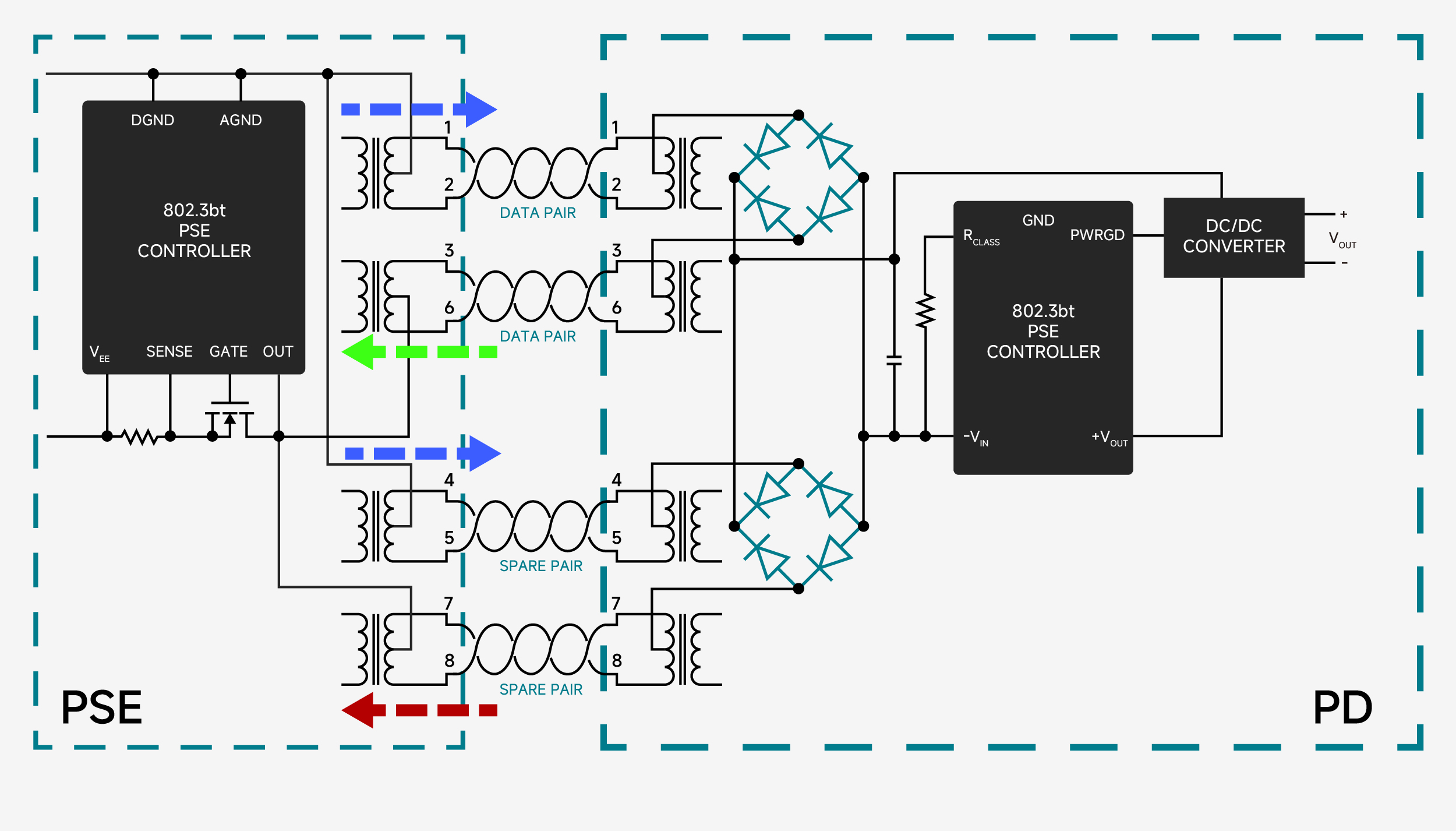
IEEE 802.3bt 規格では、電圧出力にツイストペア ケーブルの 8 本すべてのワイヤを使用することが定義されており、より強力で効率的な PoE 機能を求める市場の需要に対応しています。それは以下を達成します:
-
10GBASE‑Tとの最大速度互換性。
-
PD で利用可能な電力は最小 40 W、最大 90 W。
PoE 電源規格の概要
-
PoE 規格と電力レベル
-
タイプ 1 (802.3af)
クラス1:PSE 4W、PD 3.84W
クラス2:PSE 7W、PD 6.49W
クラス3:PSE15.4W、PD13W -
タイプ 2 (802.3at)
クラス4:PSE30W、PD25.5W -
タイプ 3 (802.3bt)
クラス5:PSE45W、PD40W
クラス6:PSE60W、PD51W -
タイプ 4 (802.3bt)
クラス7:PSE75W、PD62W
クラス 8: PSE 90W、PD 71.3W (注: 元の図の「713 W」はタイプミスです。標準値は 71.3W です)
-
給電方法
-
タイプ 1 およびタイプ 2: 2 ペア給電のみをサポート
-
タイプ 3 およびタイプ 4: 2 ペアまたは 4 ペアの給電をサポート
-
クラス 5 以上 (タイプ 3/4): 常に 4 ペア給電を使用
推奨PoE電源トランス
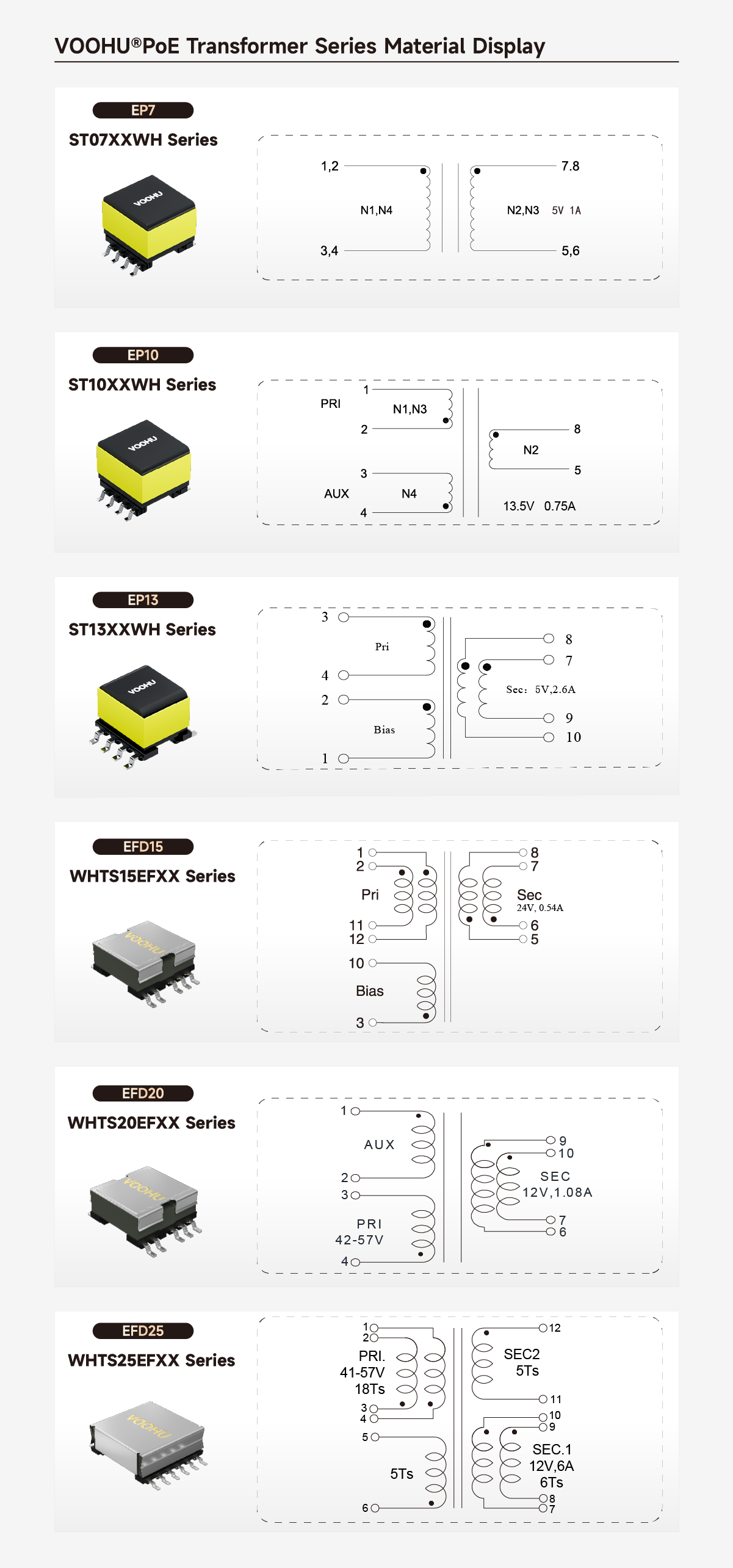
さまざまな電力レベルとアプリケーション シナリオに対応するために、VOOHU は EP7、EP10、EP13、EFD15、EFD20、EFD25 の 6 シリーズの PoE 電源変圧器を提供しています。これらは、IEEE 802.3af/at/bt 標準の全範囲をカバーし、IP 監視、ワイヤレス AP、産業用ゲートウェイからデジタル サイネージに至るまで、さまざまな電力要件を満たします。
-
EP7シリーズ(ST07XXWH): 小型、低消費電力。標準出力は5V/1A。 VoIP 電話やシングルポート PoE インジェクタなどのコンパクトな PD デバイスに適しています。
-
EP10シリーズ(ST10XXWH): 中程度のパワー。標準出力 13.5V/0.75A。小型ワイヤレス AP、屋内カメラ、その他の AF/AT アプリケーションに適しています。
-
EP13シリーズ(ST13XXWH): 電力は 13W ~ 25W に増加し、出力は 5V/2.6A などに設定可能です。 PTZ カメラや産業用センサーで広く使用されています。
-
EFD15シリーズ (WHTS15EFXX): 薄型のフラットコア設計。標準出力 24V/0.54A。高さに敏感な産業用ゲートウェイおよび PLC に適しています。
-
EFD20シリーズ(WHTS20EFXX): より高い電力 (最大 100W) をサポートします。出力12V/1.08A。 bt-standard の大画面デジタル サイネージおよびマルチポート PD デバイスに適応します。
-
EFD25シリーズ (WHTS25EFXX): 12V/6A出力可能なハイパワーモデル。車載充電パイルおよび AI エッジ コンピューティング ノードの bt Type 4 (90W+) 要件を満たしています。
典型的なアプリケーションシナリオ
IP監視(屋外PTZカメラ)
-
PSE 側: ポート電力 ≥30W (標準時)、電力低下なしで 100 メートルの長距離をサポートします。
-
PD 側: 広い UVLO 範囲、サージ保護 ≥6kV、効率 >85%。
ワイヤレス AP (高密度展開)
-
PSE 側: 十分な総電力バジェット、at/bt 標準、ポートごとの独立したリセットをサポートします。
-
PD 側: 正確なシグネチャ抵抗、正確な分類電流 (クラス 4 以上)。
VoIP電話
-
PSE 側: ポート電力 ≥15.4W (AF 標準)、レガシー AF デバイスと互換性がある必要があります。
-
PD 側: 低い UVLO しきい値 (古い PSE で動作するため)、低いスタンバイ電力。
PoE照明
-
PSE側:bt Type 3/4、Autoclass機能をサポートします。
-
PD 側: ショート MPS (電源署名の維持)、高速調光応答をサポートします。
デジタルサイネージ(大画面)
-
PSE 側: シングルポート ≥60W (BT 標準)、総電力マージン ≥30%。
-
PD 側: DC-DC 効率 >90%、堅牢な熱設計 (金属ハウジングなど)。
産業用ゲートウェイ/PLC
-
PSE 側: 工業グレードの幅広い温度、強化されたポート絶縁、高いサージ耐性。
-
PD側:広い入力電圧範囲(60Vまで拡張可能)、広い温度動作。
よくある質問 (FAQ)
Q1: PSE および PD デバイスにおける VOOHU の PoE 電源トランスの役割は何ですか?
PSE デバイス (PoE スイッチなど) では、VOOHU の LAN トランスは 48V DC をイーサネット ケーブル (データ ペアまたはスペア ペア) に結合し、データと電力の同時伝送を可能にします。 PD デバイス (PoE カメラなど) では、VOOHU の LAN 変圧器はデータ ラインから 48V DC を抽出しますが、VOOHU の PoE 電源変圧器は 48V を 5V/12V に降圧して内部チップに電力を供給します。 VOOHU は、巻数比をカスタマイズできる、すべての PSE/PD シナリオ向けの EP7 ~ EFD25 シリーズ変圧器を提供します。
Q2: IEEE 802.3 af/at/bt 標準の主な違いは何ですか? VOOHU は選択にどのように役立ちますか?
-
af (PoE): 最大 15.4 W – VoIP 電話、低電力センサーに適しています。
-
at (PoE+): 最大 30W、af との下位互換性 - PTZ カメラ、ワイヤレス AP に適しています。
-
bt (PoE++): 最大 90 W (タイプ 4)、10GBASE‑T をサポート – 大画面サイネージ、AI エッジ デバイスに適しています。
VOOHU は 3 つの規格すべてをカバーするフルレンジのトランスを提供しており、EFD20/EFD25 シリーズは bt 規格 (90W+ 出力) を完全にサポートしています。選択については、エンジニアは VOOHU Web サイトの電力比較表を参照するか、FAE に連絡してカスタマイズされたアドバイスを得ることができます。
Q3: VOOHU は PoE 変圧器用にどのようなパッケージ シリーズを提供しており、どの電力レベルをサポートしていますか?
VOOHU は 6 つのシリーズを提供しています。
-
EP7 (ST07XXWH): 小型、標準 5W – VoIP 電話に適しています。
-
EP10 (ST10XXWH): 中電力 (13.5V/0.75A) – 小型 AP 用。
-
EP13 (ST13XXWH): 13-25W、設定可能な 5V/2.6A – PTZ カメラ、センサー用。
-
EFD15 (WHTS15EFXX): 薄型、24V/0.54A – 産業用ゲートウェイ、PLC 用。
-
EFD20 (WHTS20EFXX): 最大 100W、12V/1.08A – bt 標準大画面デバイス用。
-
EFD25 (WHTS25EFXX): 高電力、12V/6A – 車載充電パイル、AI エッジ ノード用の bt Type 4 (90W+) に適合します。
すべてのシリーズは 42 ~ 57V の幅広い入力電圧とカスタマイズ可能な巻数比をサポートしています。
![[New Product Recommendation] CAT6A 10 Gigabit Waterproof RJ45 Coupler Male and Female](/upload/image/20260717/4694ba2c3b52b9d273512e3777f53f84.jpg)