

Port notation
A figure such as 5+1 means five external ports plus one host uplink. A single figure such as 5 or 8 means external ports only, with no separate uplink.
イーサネットインターフェースIC製品
JL5110 provides eight external 100M ports plus two MII uplinks in a QFN88 package at 10 by 10 millimetres. Two uplinks allow one link to the host and one to cascade a second switch, extending the port count.
型番検索・選定
この表では、海外サイトの現行製品データ、公開済みの選定項目、型番別の技術資料リンクを使用しています。
※画像列と型番列は固定されています。横にドラッグしてすべての仕様を確認できます
| 画像 | データシート | 比較 | ダウンロード |
シリーズ
|
データレート
|
ポート数
|
インターフェースモード
|
MACインターフェース電圧
|
外部電源電圧
|
銅線ポート
|
光ポート
|
温度
|
パッケージ
|
サイズ
|
サンプル |
|---|
| 画像 | 型番 | データシート | 比較 | ダウンロード | シリーズ | データレート | ポート数 | インターフェースモード | MACインターフェース電圧 | 外部電源電圧 | 銅線ポート | 光ポート | 温度 | パッケージ | サイズ | サンプル |
|---|---|---|---|---|---|---|---|---|---|---|---|---|---|---|---|---|
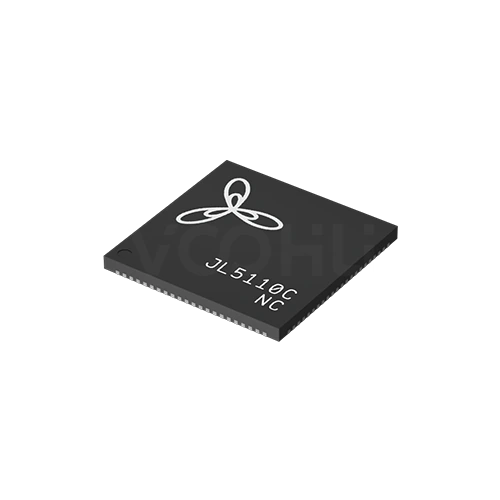 |
JL5110C-NC | SPEC | JL5110シリーズ | 100M | 8+2 | MII | 3.3V | 3.3V(1.1V)¹ | 10 Base-T | NA | 0~70℃ | QFN88 | 10*10 mm |
|
選択した条件を広げるか、現在の検索条件をクリアしてください。
By port topology
Port notation such as 5+1 means five external ports plus one host uplink.
選定方法
Topology first, then speed, then the supply rails, then package and thermals.
Count the external ports you need, then decide whether the host has to send and receive traffic. If it does, you need a device with an uplink port.
The range covers 100M and gigabit. There are no 2.5G or faster devices here, so if the design needs those speeds, say so at enquiry.
Most devices need a low voltage core rail alongside the main supply. Confirm the rails and their sequencing before the power tree is fixed.
Packages run from QFN48 at 6 by 6 up to TQFP176 at 20 by 20 millimetres. Higher port counts concentrate more heat in one device.
Parameters
Port notation and the supply requirement are the two figures most often misread.
A figure such as 5+1 means five external ports plus one host uplink. A single figure such as 5 or 8 means external ports only, with no separate uplink.
100M on the JL51xx series, gigabit on the JL61xx series. Every device also supports 10Base-T on copper for legacy links.
MII on most devices with an uplink, RMII on the JL5104. Devices listed as NA have no dedicated host interface at all.
Typically a 3.3 volt main supply with a 1.1 volt core rail, or 1.1 volt alone on some gigabit parts. Missing a rail prevents the device starting.
1000Base-X appears on the JL6110 and on the S variants of the JL6107. Other devices in the range are copper only.
NC and PC suffixes cover 0 to 70 degrees; NI and PI cover minus 40 to 85. Not every series offers both grades.
比較
Port count and uplink presence separate the series more than speed does.
選定表に戻る ↑| シリーズ | 型番数 | データレート | ポート数 | インターフェースモード | MACインターフェース電圧 | 外部電源電圧 | 銅線ポート | 光ポート | 温度 | パッケージ | サイズ | 操作 |
|---|---|---|---|---|---|---|---|---|---|---|---|---|
| JL5104シリーズ | 2 | 100M | 3+1 | RMII | 3.3V | 3.3V(1.1V)¹ | 10 Base-T | NA | 0~70℃, -40~85℃ | QFN48 | 6*6 mm | 絞り込み → |
| JL5105シリーズ | 2 | 100M | 5 | NA | NA | 3.3V(1.1V)¹ | 10 Base-T | NA | 0~70℃, -40~85℃ | QFN48 | 6*6 mm | 絞り込み → |
| JL5106シリーズ | 2 | 100M | 5+1 | MII | 3.3V | 3.3V(1.1V)¹ | 10 Base-T | NA | 0~70℃, -40~85℃ | QFN64 | 9*9 mm | 絞り込み → |
| JL5108シリーズ | 2 | 100M | 8 | NA | NA | 3.3V(1.1V)¹ | 10 Base-T | NA | 0~70℃, -40~85℃ | QFN64 | 9*9 mm | 絞り込み → |
| JL5109シリーズ | 1 | 100M | 8+1 | MII | 3.3V | 3.3V(1.1V)¹ | 10 Base-T | NA | 0~70℃ | QFN88 | 10*10 mm | 絞り込み → |
| JL5110シリーズ | 1 | 100M | 8+2 | MII | 3.3V | 3.3V(1.1V)¹ | 10 Base-T | NA | 0~70℃ | QFN88 | 10*10 mm | 絞り込み → |
| JL6105シリーズ | 1 | 1G | 5 | NA | NA | 1.1V | 10 Base-T | NA | 0~70℃ | QFN88 | 10*10 mm | 絞り込み → |
| JL6107シリーズ | 6 | 1G | 5+2 | MII | 1.8V | 1.1V, 3.3V(1.1V)¹ | 10 Base-T | NA, 1000 Base-X | 0~70℃, -40~85℃ | LQFP128 | 14*14 mm | 絞り込み → |
| JL6108シリーズ | 1 | 1G | 8 | NA | NA | 1.1V | 10 Base-T | NA | 0~70℃ | LQFP128 | 20*14 mm | 絞り込み → |
| JL6110シリーズ | 2 | 1G | 8+2 | MII | 3.3V | 1.1V | 10 Base-T | 1000 Base-X | 0~70℃, -40~85℃ | TQFP176 | 20*20 mm | 絞り込み → |
用途別確認
Confirm the port topology, whether the host must manage traffic, and the environment.
Documents
Datasheets carry the supply sequencing, pinout and reference schematic per device.
代表的な入手可能資料を表示しています。特定のSKUは検索して確認してください。
VOOHUが公開する製品情報は、エンジニアリングチームが確認しています。仕様、ダウンロード資料、技術サポート情報は型番ごとに紐付けられているため、サンプルや見積もりを依頼する前に確認できます。
カテゴリー概要
Almost every selection question on switch ICs comes down to the port notation and whether the host controller needs to be on the network.
型番が決まっている場合は、サンプルまたは見積もりを依頼。
The first figure is external ports facing the outside world. The figure after the plus is a host uplink, a dedicated interface for the controller on the same board. A device listed as 5 has five external ports and no uplink, so the host cannot send or receive traffic through it. That distinction eliminates half the range.
If the product only has to move traffic between its own front panel ports, a device with external ports only is simpler and cheaper to lay out. If the host has to participate, for management, for remote access or because it originates data, you need an uplink and the host must provide the matching MII or RMII interface.
Most devices here need more than one rail: commonly 3.3 volts for the main supply and around 1.1 volts for the core, and some gigabit parts run the core alone. Missing a rail, or sequencing them wrongly, prevents the device starting. Confirm the rails and sequence before the power tree is committed.
よくあるご質問
Answers cover port notation, uplinks, supply rails and fibre support.
The common arrangement is one link to the host controller so it can join the network, and one cascading to a second switch device to extend the port count. Whether specific combinations are supported is defined in the datasheet, so confirm the intended topology rather than inferring it from the port count.
It can be. All traffic crossing between the two devices passes through that single link at its interface speed. If your traffic pattern sends a lot across the boundary, the cascade becomes the limit for the whole design. Estimate the cross-device traffic before choosing this topology.
They share the port count, uplink type, package and temperature grade. The only difference is the number of uplinks: JL5109 has one, JL5110 has two. If you need both a host connection and a cascade, JL5110 is required; if one link is enough, JL5109 is simpler.
Often that is the better answer. A single device with enough ports avoids the cascade bottleneck and simplifies the design. Cascading makes sense when port count exceeds what one device offers, or when the physical arrangement of the product requires two separate boards.
With a complete part number, send the part number, quantity, delivery region and the date you need it. If you are still selecting, describe the port topology including any cascade, and the expected traffic pattern across the devices.
エンジニアサポート
候補型番と、確認が必要な条件をお送りください。候補が明確になった後にサンプル支援を追加でき、商取引に関するご質問も同じ技術相談の中でご相談いただけます。
資料のリビジョンも記載してください
温度、絶縁電圧、PoE電流の条件
ピン数、ピッチ、ピン列間隔
サンプルと評価の優先度確認に使用します
候補と相違点の比較が必要な時期
エンジニア確認により候補型番を選び、相違点をご説明します。
選定表またはエンジニア確認で選んだ型番
試作/パイロット生産/量産
サンプルと量産の時期を分けて記載してください
適合資料、材料宣言、第三者機関レポートなど
サンプル数量、リードタイム、費用は、プロジェクト段階と型番によって異なります。営業担当者より営業日にご回答します。