
< img height="1" width="1" style="display:none" src="https://www.facebook.com/tr?id=778179321215791&ev=PageView&noscript=1" />
News Center
Application Solution RS485 Communication Circuit Design — VOOHU
NEWS >

2024.Dec.02

Application Solution RS485 Communication Circuit Design — VOOHU

RS-485 (EIA/TIA-485 Standard) is a balanced differential bus standard for serial communication, published by the Electronic Industries Alliance in 1983. The RS-485 bus features long-distance transmission, multi-node networking, and strong common-mode rejection capability, making it widely used in industrial automation, data acquisition, instrumentation, building control, and other fields.

VOOHU Electronics (VOOHU) provides reliable physical layer supporting components for RS-485 communication nodes, and can also work with customers to provide RS-485 interface reference circuits and device selection recommendations, improving system anti-interference capability and communication reliability.


1. RS-485 Transceiver

The RS-485 transceiver is the core chip that implements the physical interface between the MCU and the RS-485 bus, performing bidirectional conversion between TTL/CMOS logic levels and differential bus signals. It implements the electrical interface between the MCU and the bus, completes level conversion and direction control, and provides bus fault protection. It also enhances noise immunity, effectively suppresses common-mode interference, and has a common-mode voltage range of -7V to +12V.

Main functions include:

  1. Level conversion: Converts the single-ended logic signals (DI, RO) from the controller into differential bus signals (A, B) for transmission; during reception, converts the differential bus signals into single-ended logic levels recognizable by the MCU.

  2. Bus driving: The differential driver has sufficient drive capability to support communication distances up to 1200 meters.

  3. Transmission direction control: RS-485 operates in half-duplex mode. The transceiver uses enable pins (DE, RE#) to control the switching between transmit and receive states, achieving bus direction management. Common practice: each RS-485 device is normally in receive mode and switches to transmit mode only when it has data to send.

  4. Receiver sensitivity: The receiver has an input sensitivity of ±200mV. That is, when the differential voltage between A and B is ≥ +200mV, the output is logic high; when ≤ -200mV, the output is logic low.

2. Digital Isolator

A digital isolator isolates the logic signals (DI, RO, DE, RE#) between the RS-485 transceiver and the controller, breaking ground loops and common-mode noise. Capacitive isolation technology is commonly used, coupling signals across the isolation barrier via capacitors, offering low power consumption, small size, and high data rate advantages. It eliminates ground potential differences between the controller and the bus circuit, blocks conducted noise introduced by ground loops, and improves system reliability and long-distance communication feasibility.

Integrated isolated transceivers combine a digital isolator and an RS-485 transceiver into one package, which is the mainstream solution. Integrating the isolator, driver, and differential input receiver into a single package, isolated differential line transceivers are suitable for long-distance transmission lines.


3. TVS

Role of TVS in RS-485 communication: Suppresses electrostatic discharge (ESD) and electrical fast transients (EFT), absorbs transient energy caused by lightning-induced surges or power supply surges, and protects the transceiver bus pins from damage.

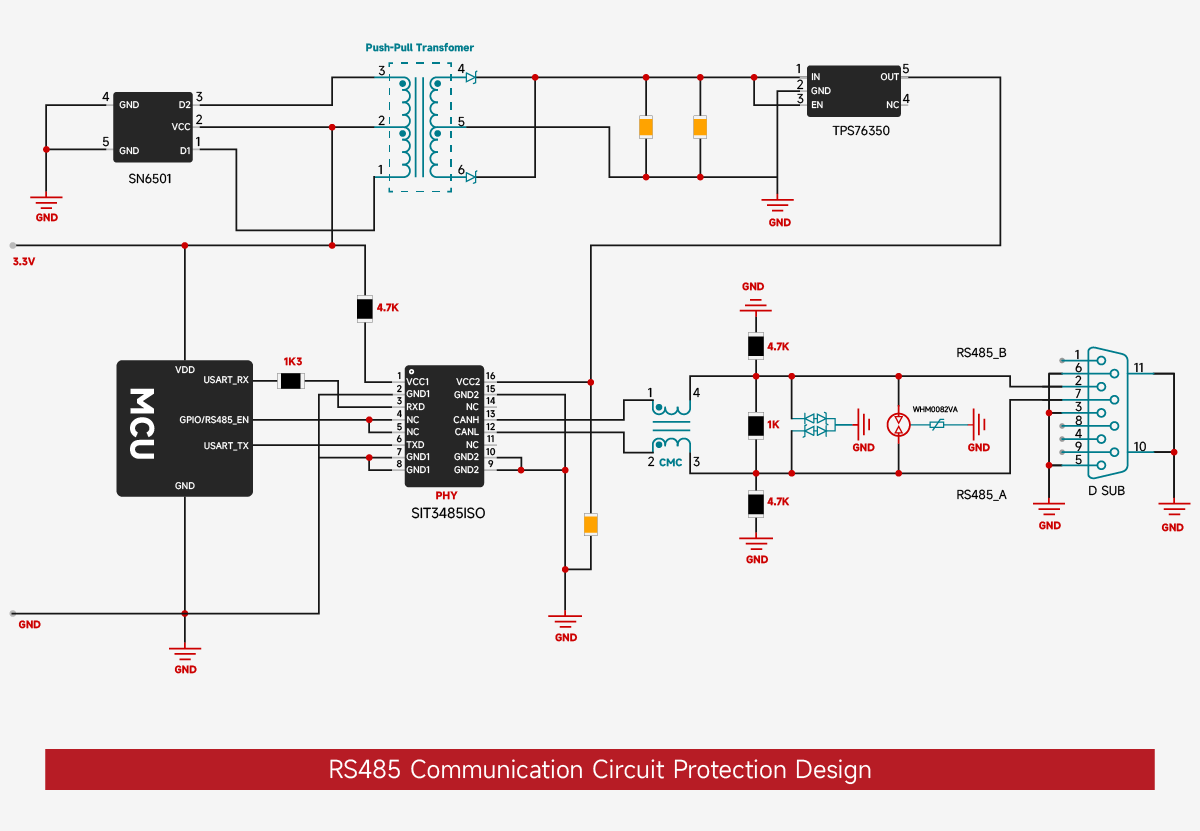
TVS diodes should be placed as close as possible to the bus connector or transceiver pins, with short and wide traces. Recommendation: connect one TVS in parallel between the A and B lines for differential-mode protection, and additionally connect one TVS from each signal line to ground for common-mode protection.

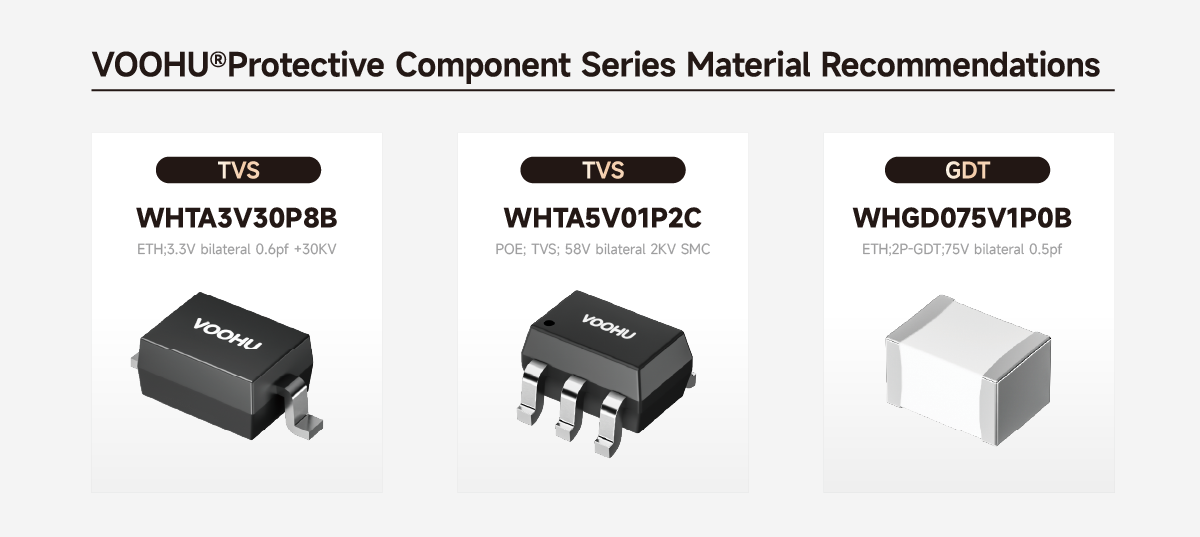
Recommended devices: For the RS-485 bus, VOOHU recommends bidirectional TVS diodes with operating voltage from 6.5V to 24V (selected according to the transceiver's common-mode voltage range). Typical models: WHTA6V5B, WHTA12V05B, WHTA24V10B. Key parameters: low clamping voltage, response time <1ns, peak pulse power 400W~1500W. In layout, TVS should be placed first between A and B (differential-mode protection), then from each line to ground (common-mode protection), as close to the bus connector as possible. VOOHU offers SOD123, SOD323, SOT23, and other packages to meet different power and space requirements.


4. Common-Mode Choke (CMC)

Device principle: A common-mode choke consists of two coils with the same number of turns wound on the same core, with opposite winding directions. It presents very low impedance to differential-mode signals (typically <10Ω) and high impedance to common-mode signals, effectively attenuating common-mode current and improving system EMC performance.

Role in RS-485 communication:

  • Suppresses common-mode radiated interference from external environments (e.g., variable frequency drives, switching power supplies, motors), improving electromagnetic compatibility (EMC) performance.

  • Reduces common-mode noise radiated from the bus cable acting as an antenna, helping to pass electromagnetic interference (EMI) tests.

  • Works together with TVS and termination resistors to form a complete immunity protection network.

Recommended common-mode chokes for RS-485 communication:

Select common-mode chokes optimized for differential signal lines, focusing on low DCR, low differential-mode impedance, and high common-mode rejection. Typical impedance: 1000Ω @ 100MHz, inductance about 1mH~10mH, ensuring effective suppression within the RS-485 communication frequency band.

Device selection:

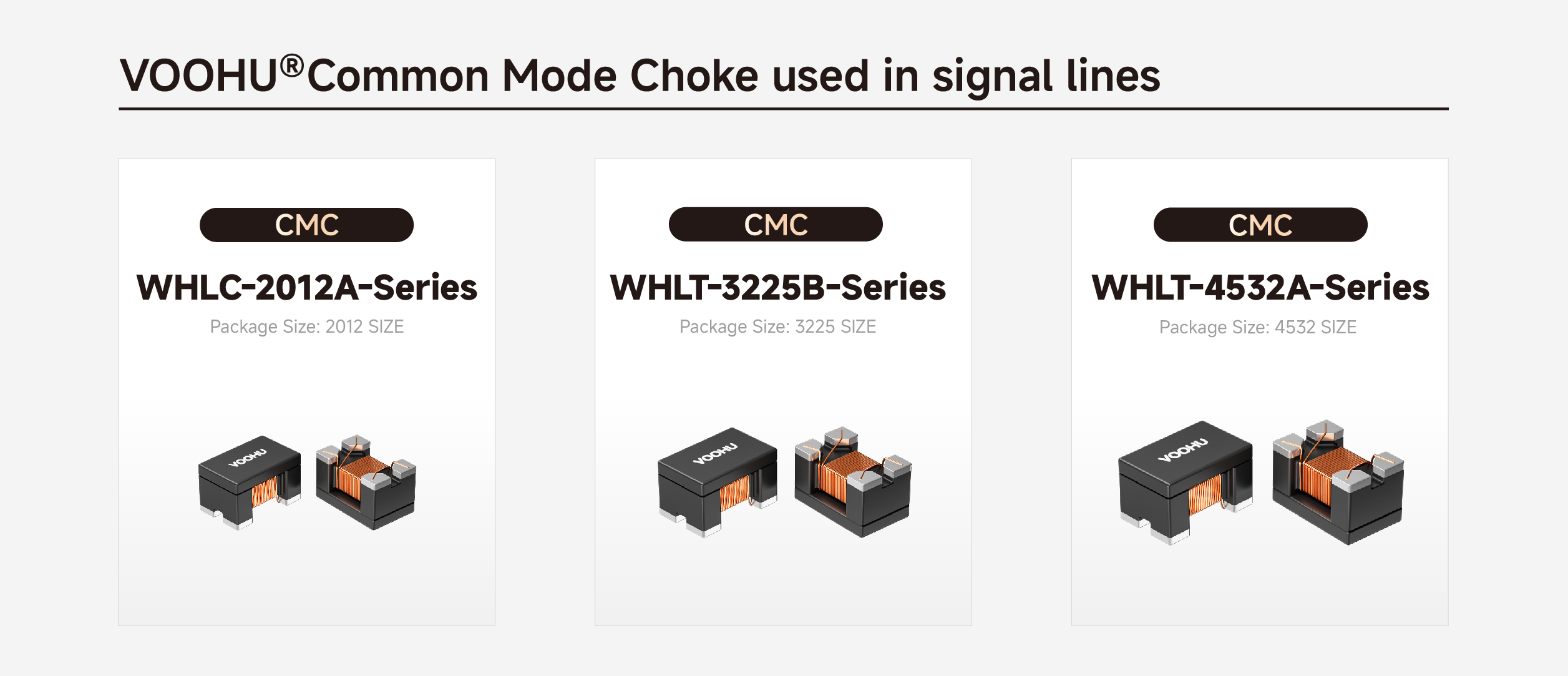
VOOHU signal-line common-mode chokes are optimized for differential buses such as RS-485, with emphasis on common-mode impedance at 100MHz, DC resistance (DCR), and differential-mode impedance. The following series are recommended:

  • 2012 Series (e.g., WHLC-2012A-900T0): 90Ω @ 100MHz, 0.35Ω, 300mA – suitable for compact nodes.

  • 3225 Series (e.g., WHAC-3225B-110U0): 550Ω @ 100MHz, 0.8Ω, 300mA – general industrial nodes.

  • 4532 Series (e.g., WHAC-4532A-220U0): 1200Ω @ 100MHz, 1.4Ω, 200mA – for high-interference scenarios (e.g., near variable frequency drives).


5. Termination Resistor and Biasing Resistor

Termination resistor – eliminates signal reflections:

The RS-485 bus uses twisted-pair cable as the transmission medium, with a characteristic impedance of typically 120Ω. When a signal reaches the end of the bus, impedance mismatch will cause reflections, leading to signal ringing and overshoot, resulting in bit errors. The termination resistor is connected between the A and B lines, with a value equal to the cable's characteristic impedance (typically 120Ω). It absorbs reflected energy and suppresses standing waves, ensuring signal integrity. Termination resistors should be placed at both ends of the bus; intermediate nodes must not have termination resistors, otherwise communication errors may occur.

Biasing resistor – maintains a defined state when the bus is idle:

The RS-485 standard specifies a receiver input threshold of ±200mV. When the differential voltage is between -200mV and +200mV, the receiver output is undefined. When the bus is idle (all nodes are in receive mode), the termination resistors cause the A-B differential voltage to be 0V. Without special measures, the receiver may output an indeterminate level, causing communication anomalies. In this case, either select a transceiver with built-in fail-safe input thresholds, or use external biasing resistors to create a fixed bias voltage on the idle bus (typically making the A line voltage 200mV higher than the B line), ensuring that the bus idle state is recognized as a logic high level.


6. Complete Circuit Design

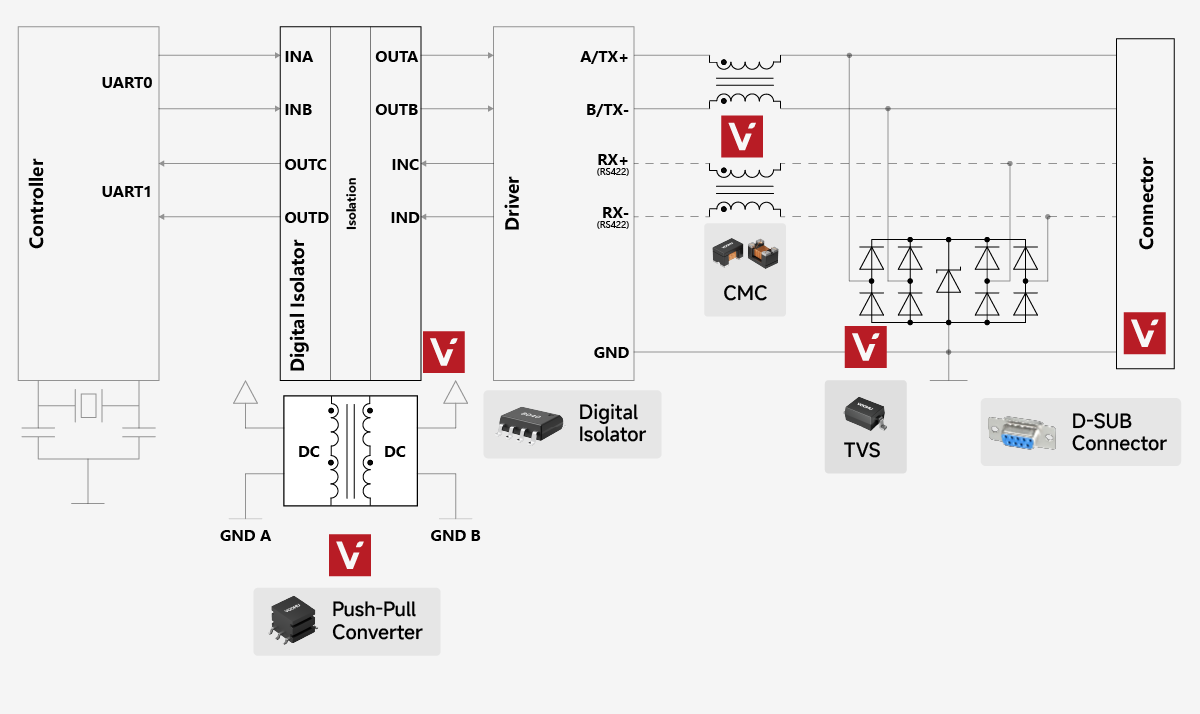
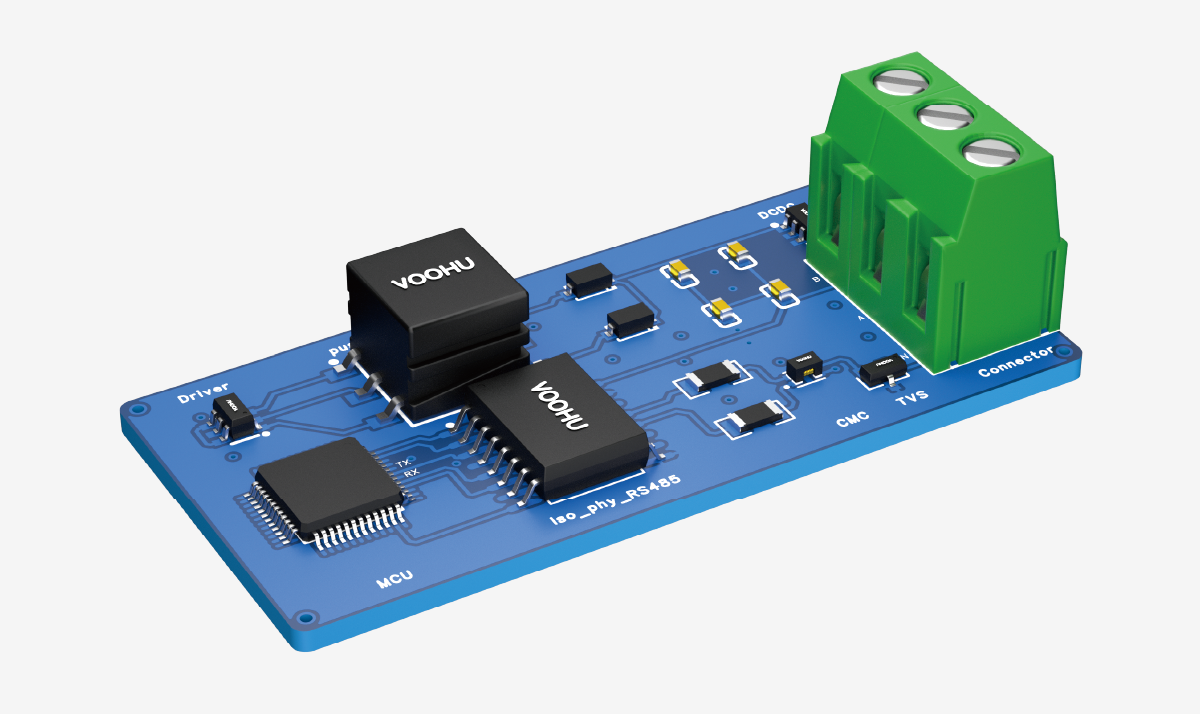
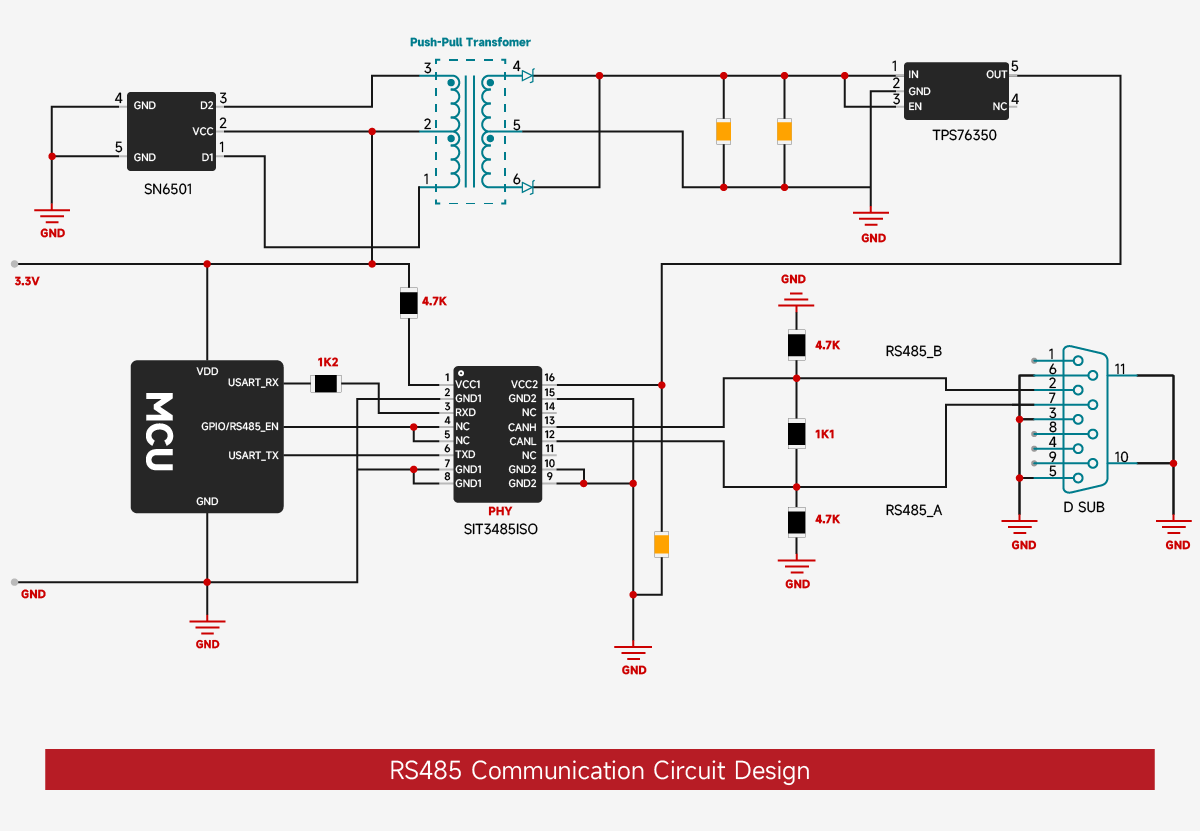
Combining the modules above, a typical high-reliability isolated RS-485 communication circuit is designed as follows:

Layout principles:

  • Place the isolated transceiver close to the MCU to shorten the digital signal traces on the primary side.

  • Keep the traces from bus pins A and B to the connector differential, symmetrical, and equal in length, with impedance controlled to approximately 120Ω.

  • Primary side (controller side): system 3.3V or 5V directly supplies the MCU, isolator primary, and other low-voltage logic circuits.

  • Secondary side (bus side): use an isolated power module (DC-DC) to generate 5V_ISO, dedicated to the RS-485 transceiver VCC and the isolator secondary.

  • Ground planes: primary GND and secondary GND_ISO are completely isolated. Connect them to chassis ground (or protective earth PE) via a 1MΩ resistor in parallel with a 10nF high-voltage capacitor to discharge static electricity and high-frequency noise, preventing floating potential accumulation.

  • Protection device order: bus connector → common-mode choke → TVS → transceiver A, B pins. Protect first, then filter. Protection devices and filters should be laid out tightly and as close to the interface as possible.

  • Install 120Ω termination resistors at both ends of the bus. Add pull-up resistors on the A line and pull-down resistors on the B line at a single point (usually on the master device side) to ensure a defined logic level when the bus is idle.


Frequently Asked Questions (FAQ)

Q1: Why does the RS-485 bus need termination resistors? How to choose the value?

A1: Termination resistors match the cable's characteristic impedance, eliminate signal reflections, and prevent ringing and overshoot. The RS-485 bus typically uses twisted-pair cable with 120Ω characteristic impedance, so termination resistors should be 120Ω, 1% tolerance surface-mount resistors, placed at the two farthest ends of the bus. VOOHU offers 120Ω ±1% termination resistors (0805/1206 packages) and can also provide dual-resistor arrays to simplify BOM.

Q2: How to select appropriate TVS protection devices for the RS-485 bus?

A2: For ESD, EFT, and lightning surges, VOOHU recommends bidirectional TVS diodes. Select the operating voltage based on the transceiver's common-mode voltage range (typically 6.5V~24V). Common models:

  • WHTA6V5B (6.5V, suitable for 3.3V systems)

  • WHTA12V05B (12V, suitable for 5V systems)

  • WHTA24V10B (24V, for high surge protection)

In layout, place TVS first for differential mode (between A and B), then for common mode (each line to ground), as close to the bus connector as possible. VOOHU TVS diodes have response time <1ns and peak pulse power 400W~1500W, meeting IEC 61000-4-5 standards.

Q3: What role does a common-mode choke play in RS-485 communication? What does VOOHU recommend?

A3: The common-mode choke suppresses common-mode interference from external devices such as variable frequency drives and switching power supplies, reduces common-mode radiation from the bus, and helps pass EMI tests. VOOHU offers three series of signal-line common-mode chokes:

  • 2012 Series (e.g., WHLC-2012A-900T0): 90Ω @ 100MHz, suitable for compact nodes.

  • 3225 Series (e.g., WHAC-3225B-110U0): 550Ω @ 100MHz, general industrial nodes.

  • 4532 Series (e.g., WHAC-4532A-220U0): 1200Ω @ 100MHz, for high-interference scenarios.

All models support -40~125°C wide temperature and are AEC-Q200 compliant.

Q4: When is an isolated RS-485 transceiver necessary? What solutions can VOOHU provide?

A4: An isolated transceiver must be used when there is a ground potential difference between the controller and the bus, or when safety isolation is required. VOOHU offers two solutions:

  • Discrete: digital isolator (e.g., Si86xx/ISO77xx series) + non-isolated transceiver (e.g., MAX485).

  • Integrated: single-chip isolated transceiver (e.g., ISO3082, ADM2483), simplifying design.

Additionally, VOOHU can provide push-pull isolated transformers (e.g., WHST06D02A0) to generate isolated power, enabling a complete isolated RS-485 node with isolation withstand voltage up to 5000Vrms.

Q5: How to avoid an undefined receiver output state when the RS-485 bus is idle?

A5: When the bus is idle, termination resistors bring the A-B voltage close to 0V, and the receiver may output an undefined level. Solutions:

  • Use a transceiver with built-in fail-safe input thresholds (e.g., chips with ±200mV threshold compensation).

  • Add external biasing resistors: pull up the A line to the power supply and pull down the B line to ground, ensuring A-B voltage ≥ +200mV when idle.

VOOHU provides biasing resistor selection calculation services and can supply 1kΩ~10kΩ chip resistors and reference designs to help you quickly determine the appropriate resistance values.

share to
You may also like
Prev article
Next article
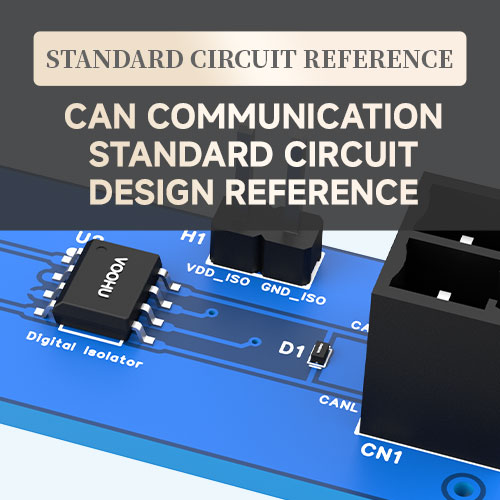
【Standard Circuit Design】VOOHU Electronics — Standard Circuit Design Reference for CAN Communication
2026-05-09
Standard Circuit DesignVOOHU Electronics — Standard Circuit Design Reference for CAN Communication

Newsletter subscription

Subscribe to our newsletter and stay updated on the latest information of our company and product.

Name

|

Email

Subscribe

I agree that the information that I provide will be used in accordance with the terms of Voohu International Inc. Privacy & Cookies Policy