

Link speed
100M, 1G or 2.5G depending on series. All devices also support 10Base-T on the copper side, so legacy links remain available.

Gamme de circuits d’interface Ethernet
JL2308 provides eight gigabit ports aggregated to the host over QSGMII, in an LQFP128 package at 14 by 14 millimetres. Confirm the host offers QSGMII and enough bandwidth, then plan the layout for eight pairs and the serial lanes.
Recherche et sélection de références
Le tableau utilise les fiches produits actuelles du site anglophone, les critères de sélection publiés et les liens vers les fichiers techniques propres à chaque référence.
* Colonnes Image et Référence figées · faites glisser horizontalement pour consulter toutes les caractéristiques
| Image | Fiche technique | Comparer | Téléchargements |
Série
|
Débit de données
|
Ports
|
Interface MAC
|
V(if)
|
Port cuivre
|
Port optique
|
Mode
|
Température
|
Boîtier
|
Taille
|
Échantillon |
|---|
| Image | Référence | Fiche technique | Comparer | Téléchargements | Série | Débit de données | Ports | Interface MAC | V(if) | Port cuivre | Port optique | Mode | Température | Boîtier | Taille | Échantillon |
|---|---|---|---|---|---|---|---|---|---|---|---|---|---|---|---|---|
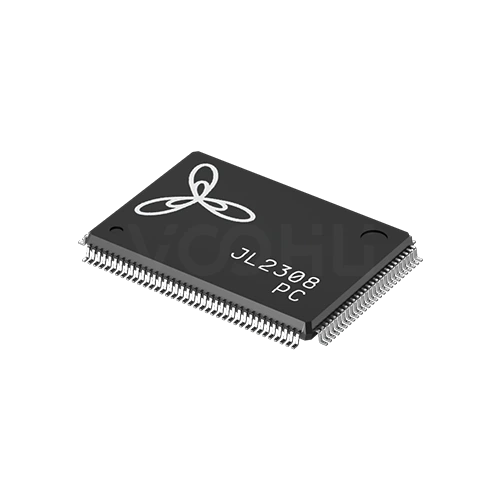 |
JL2308-PC | SPEC | Série JL2308 | 1G | 8 | QSGMII | NA | 10 Bsae-T | NA | QSGMII-COP | 0~70℃ | LQFP128 | 20*14 mm |
|
||
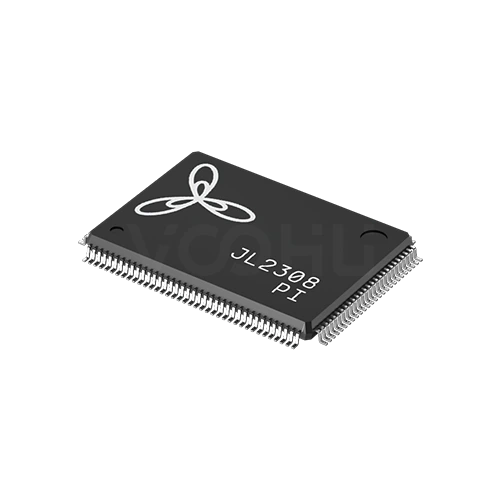 |
JL2308-PI | SPEC | Série JL2308 | 1G | 8 | QSGMII | NA | 10 Bsae-T | NA | QSGMII-COP | -40~85℃ | LQFP128 | 20*14 mm |
|
Élargissez les filtres sélectionnés ou effacez la recherche en cours.
By series
Series are separated by link speed, port count and the MAC interface they present.
Comment sélectionner
MAC interface first, then speed and ports, then fibre, then temperature and package.
Confirm what your host controller provides: RMII, MII, RGMII, SGMII or QSGMII. These are not interchangeable, and the wrong choice cannot be fixed in software.
100M, 1G or 2.5G, and one port or eight. Eight-port devices aggregate to the host over QSGMII, so confirm the host has that bandwidth.
Some series support 100Base-FX or 1000Base-X, others are copper only. If the design needs a fibre port, check the specific part number rather than the series.
Suffixes separate 0 to 70, minus 40 to 85 and minus 40 to 105 degrees. Choose against the enclosure's internal temperature, not the room.
Parameters
The MAC interface and the temperature suffix decide compatibility more than speed does.
100M, 1G or 2.5G depending on series. All devices also support 10Base-T on the copper side, so legacy links remain available.
Single port for most series, or eight ports on the JL2308 and JL2388. Eight-port devices need a QSGMII-capable host.
RMII, MII, RGMII, SGMII or QSGMII. This has to match the host controller exactly; no external conversion makes two of them equivalent.
100Base-FX on parts of the 100M range, 1000Base-X on JL2201 and 2500Base-X on JL4201. Several series are copper only, marked NA.
The suffix carries it: NC for 0 to 70, NI for minus 40 to 85, NE for minus 40 to 105 degrees. Confirm the grade on the exact part number.
From QFN24 at 4 by 4 millimetres up to LQFP128 at 14 by 14. Pin count rises with port count and interface width.
Comparer
Speed, port count and MAC interface together define which series fits a design.
Revenir au sélecteur ↑| Série | Références | Débit de données | Ports | Interface MAC | V(if) | Port cuivre | Port optique | Mode | Température | Boîtier | Taille | Action |
|---|---|---|---|---|---|---|---|---|---|---|---|---|
| Série JL1101 | 1 | 100M | 1 | RMII | 1.8V | 10 Bsae-T | 100 Base-FX | RMII-COP | -40~85℃ | QFN24 | 4*4 mm | Filtrer → |
| Série JL1111 | 4 | 100M | 1 | MII | 1.8V | 10 Bsae-T | NA, 100 Base-FX | MII-COP | 0~70℃, -40~85℃, -40~105℃ | QFN32 | 5*5 mm, Non spécifié | Filtrer → |
| Série JL2101 | 5 | 1G | 1 | RGMII | 1.8V | 10 Bsae-T | NA | RGMII-COP | 0~70℃, -40~85℃, -40~105℃ | QFN40 | 5*5 mm | Filtrer → |
| Série JL2201 | 2 | 1G | 1 | RGMII | 1.8V | 10 Bsae-T | 1000 Base-X | RGMII-COP | 0~70℃, -40~85℃ | QFN48 | 6*6 mm | Filtrer → |
| Série JL2308 | 2 | 1G | 8 | QSGMII | NA | 10 Bsae-T | NA | QSGMII-COP | 0~70℃, -40~85℃ | LQFP128 | 20*14 mm | Filtrer → |
| Série JL2388 | 2 | 1G | 8 | QSGMII | NA | 10 Bsae-T | NA | QSGMII-COP | 0~70℃, -40~85℃ | LQFP128 | 20*14 mm | Filtrer → |
| Série JL4201 | 2 | 2.5G | 1 | SGMII | NA | 10 Bsae-T | 2500 Base-X | (H)SGMII-COP | 0~70℃, -40~85℃ | QFN48 | 6*6 mm | Filtrer → |
Analyse de l’application
Confirm the host interface, the link speed and the environment the board runs in.
Documents
Datasheets carry the pinout, reference schematic and layout guidance for each series.
Affichage de jeux de fichiers disponibles représentatifs. Recherchez un SKU précis.
Le contenu produit publié par VOOHU est vérifié par son équipe technique. Les caractéristiques, les téléchargements et les informations d’assistance technique sont associés à des références précises afin que vous puissiez les vérifier avant de demander des échantillons ou un devis.
Présentation de la catégorie
The most common selection error here is starting from link speed. The MAC interface is the constraint that cannot be worked around.
Discuter d’une nouvelle conception
Contacter l’équipe FAE pour une évaluation de remplacement.
Vous avez déjà une référence ? Demander des échantillons ou un devis.
RMII, MII, RGMII, SGMII and QSGMII are different electrical and timing arrangements, not tiers of the same thing. A host that provides RGMII cannot drive an RMII device, and no software setting bridges them. Establish what your controller offers first, because it eliminates most of the range before speed is even considered.
Every device here supports copper, including 10Base-T. Fibre is selective: 100Base-FX appears on parts of the 100M range, 1000Base-X on the JL2201 and 2500Base-X on the JL4201. Fibre support is stated per part number rather than per series, so one variant of a series may have it and another may not.
The letters after the base number carry the rating. NC covers 0 to 70 degrees, NI covers minus 40 to 85, NE covers minus 40 to 105. Select against the temperature inside the enclosure at the highest ambient the product is rated for, not against room temperature.
FAQ
Answers cover interface choice, fibre support, temperature grades and layout.
Over QSGMII, a serial interface that carries several links on one pair rather than running eight parallel interfaces. Your host controller must provide QSGMII and enough aggregate bandwidth for eight gigabit links. Confirm both before selecting an eight port device.
Controlled impedance, length matching and a continuous reference plane under the serial lanes. It is a high speed serial link, so it is less forgiving than a parallel interface. Follow the datasheet layout guidance and verify link quality on a prototype board.
Both are eight port gigabit devices with QSGMII in an LQFP128 package at 14 by 14 millimetres and the same temperature grades. Feature level differences are defined by their respective datasheets, so send your requirement and our engineers will set out which differences apply.
Each copper port needs its own magnetics, either discrete LAN transformers or RJ45 jacks with integrated magnetics. Plan the board area and the panel arrangement early, and follow the device reference circuit for the centre tap connection on each port.
With a complete part number, send the part number, quantity, delivery region and the date you need it. If you are still selecting, send the host controller, confirmation that it provides QSGMII, the port count and the temperature range.
Assistance technique
Envoyez la référence candidate et la condition à examiner. Vous pourrez demander des échantillons une fois la sélection précisée ; les questions commerciales peuvent être abordées au cours du même échange technique.
Indiquez la révision du document
Température, tension d’isolement et conditions de courant PoE prises comme référence
Nombre de broches, pas et espacement entre les rangées de broches
Pour faciliter la priorisation des échantillons et de l’évaluation
Date à laquelle vous avez besoin de références candidates et d’un comparatif des différences
L’analyse technique identifie les références candidates et explique les différences.
Issues du sélecteur ou de l’analyse technique
Prototypage / présérie / production
Précisez séparément les délais des échantillons et de la production
Documents de conformité, déclarations de matières ou rapports de tiers
La quantité d’échantillons, le délai et le coût dépendent de la phase du projet et de la référence. L’équipe commerciale répond les jours ouvrés.