

[Revolutionizing the Future of Industrial IoT] SPE Single Pair Ethernet Technology: An Efficient Communication Revolution from Sensors to the Cloud
[Revolutionizing the Future of Industrial IoT] SPE Single Pair Ethernet Technology: An Efficient Communication Revolution from Sensors to the Cloud
1. Les problèmes de l’industrie et la naissance de la SPE
Although traditional Ethernet has been widely used in the upper system of automation architecture, it still faces challenges when connecting the most basic field device layer, mainly manifested in high installation complexity and limited effective transmission distance. Single-pair Ethernet (SPE) technology has significantly improved the adaptability of Ethernet in industrial scenarios by breaking through the physical layer design.
Compared with traditional Fast Ethernet (100Mbps) and Gigabit Ethernet, which require two or four pairs of twisted pairs for data transmission, SPE only requires a single pair of twisted pairs to complete signal transmission. This technological innovation has brought a revolutionary connection solution for micro sensors, actuators and other devices at the field level: it not only eliminates the redundant lines required for traditional wiring, but also eliminates the intermediate conversion gateway and subsystem through direct Ethernet connection. The lightweight design of its cable structure not only reduces material consumption, but also provides underlying connection support with both high efficiency and cost advantages for emerging fields such as smart manufacturing and the Internet of Things.
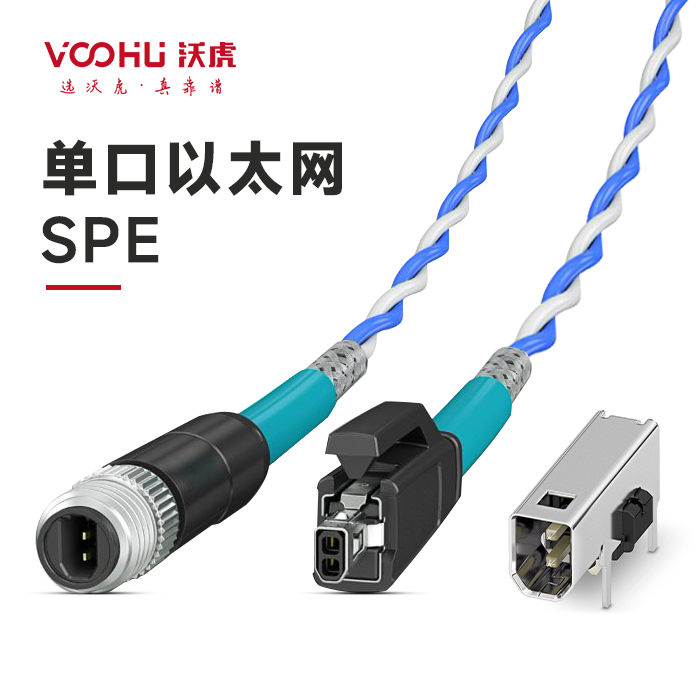
Dans la vague de l’Industrie 4.0 et de l’Internet industriel des objets (IIoT), l’intelligence industrielle est confrontée à deux défis majeurs :
1. Dilemme de câblage complexe
Traditional Ethernet requires 2-4 pairs of twisted pair cables (such as 4 pairs of cables for Gigabit Ethernet), which results in thick cable diameter and heavy weight, making it difficult to meet the miniaturization requirements of smart devices.
With the surge in industrial field sensors, the cost of M12 connector + multi-cable management has soared, and the troubleshooting efficiency is low.
2. Fragmentation du protocole et restrictions d'alimentation électrique
Field-level devices often rely on non-IP protocols (such as RS-485), which require gateway conversion, resulting in data delays and high integration complexity.
Sensor power supply relies on independent power lines, making it difficult to achieve a simple design of "one line for the world".
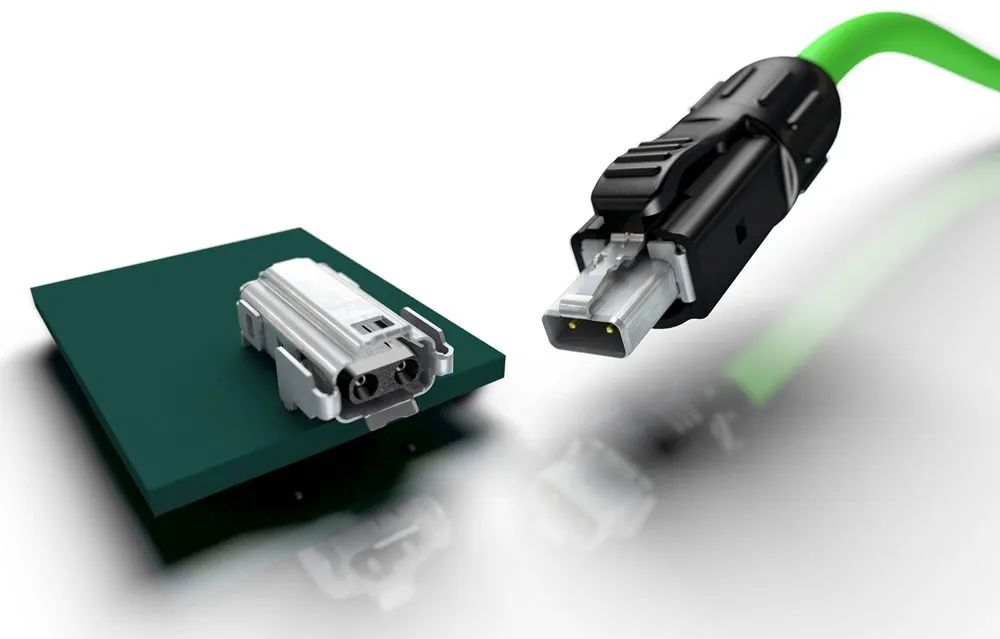
Breakthrough of SPE Single Pair Ethernet: Only 1 pair of twisted pair cables can achieve Ethernet data transmission + up to 50W power transmission (PoDL), while supporting kilometer-level transmission and IP-based end-to-end communication, completely reconstructing the industrial network architecture.
2. Analyse de la technologie de base SPE
1. Innovation au niveau de la couche physique : un câble aux fonctions multiples
Câbles et connecteurs
Cable specifications: minimum 26 AWG (IP20) to 22 AWG (M12 interface, IP67), weight reduction of 40%, bending radius ≤ 5 times the wire diameter.
Normes de connecteur :
Niveau IP20 : conforme à la norme CEI 63171-2, adapté aux armoires de commande intérieures.
Niveau M8/M12 : conforme à la norme IEC 63171-5/7, protection IP67, résistant à l'huile et aux vibrations (test de vibration 20g).
Interface hybride : contacts SPE+alimentation/signal intégrés, réduisant la densité des ports de l'appareil.
Performances de transmission
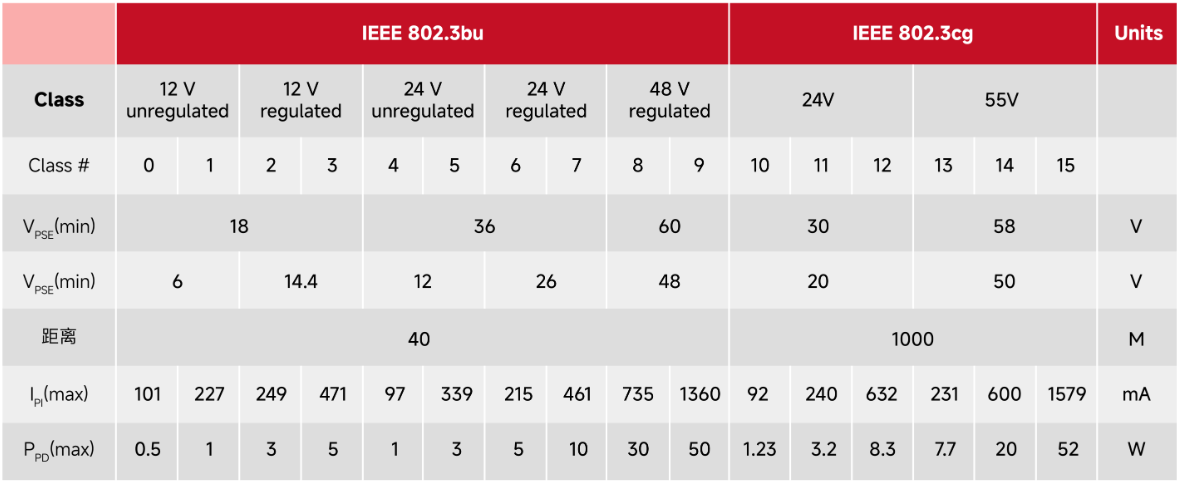
2. Power over Data Line (PoDL) : intégration approfondie de l'alimentation et des données
Technical principle: Separate data and power signals on the same pair of lines through frequency division multiplexing (FDM).
Principaux avantages :
Densité de puissance : prend en charge une alimentation jusqu'à 50 W (24 V/2,08 A), couvrant 90 % des besoins en capteurs industriels.
Safety protection: Overcurrent/short circuit detection response time <1μs, compatible with IEC 62368-1 safety standard.
3. Communication Full IP : briser les silos de protocoles
TCP/IP de bout en bout : les capteurs prennent directement en charge les protocoles HTTP/MQTT sans passerelles de conversion de protocole.
TSN (réseau sensible au temps) :
Retard déterministe <10 μs, prenant en charge le contrôle synchrone des robots multi-axes.
La planification du trafic est réalisée via la norme IEEE 802.1Qbv pour répondre aux besoins de contrôle en temps réel.
3. Six avantages fondamentaux du SPE
Révolution du câblage
The number of cables is reduced by 75%, the weight is reduced by 50%, and the installation efficiency is increased by 60% (compared with traditional 4-wire Ethernet).
Miniaturisation extrême
The diameter of the M12 SPE connector is only 16mm, which is suitable for micro sensors (such as photoelectric switches with a size of ≤10mm³).
Résistance aux environnements difficiles
La couverture de la couche de blindage est ≥85 %, réussissant les tests de surtension CEI 61000-4-5 4kV et de vibrations EN 61373.
The finished cable assembly supports oil resistance (ISO 1817), flame retardant (UL94 V-0), and halogen-free (IEC 60754).
Bande passante Gigabit
The 1Gbps rate supports millisecond-level image transmission of 4K industrial cameras, and the defect detection efficiency is increased by 30%.
Couverture longue distance
Under the 10BASE-T1L standard, 1000 meters of transmission supports remote monitoring of mining areas and reduces the deployment of repeaters.
Branchez et jouez
Pre-assembled cable assemblies (such as Molex T1 SPE series) reduce 90% of on-site crimping steps and support hot plugging.
4. Panorama des applications industrielles SPE
1. Usine intelligente
Wireless replacement scenario: In radio frequency interference areas such as high-temperature furnace areas, SPE replaces Wi-Fi to transmit temperature data.
2. Robots mobiles
Optimisation dynamique du câblage :
AGV uses M12 SPE interface, which can withstand 100,000 plug-in and pull-out cycles and supports motion jitter environments.
L'alimentation électrique et les données de navigation sont intégrées pour prolonger la durée de vie de la batterie
3. Automatisation des processus
Intrinsically safe scenario: Chemical explosion-proof areas achieve Ex ia certification through SPE+ isolation fence, replacing traditional 4-20mA.
4. Internet des objets énergétiques
Kilometer-level transmission: Oilfield well site sensors transmit pressure data back through 10BASE-T1L, reducing repeaters by 80%.
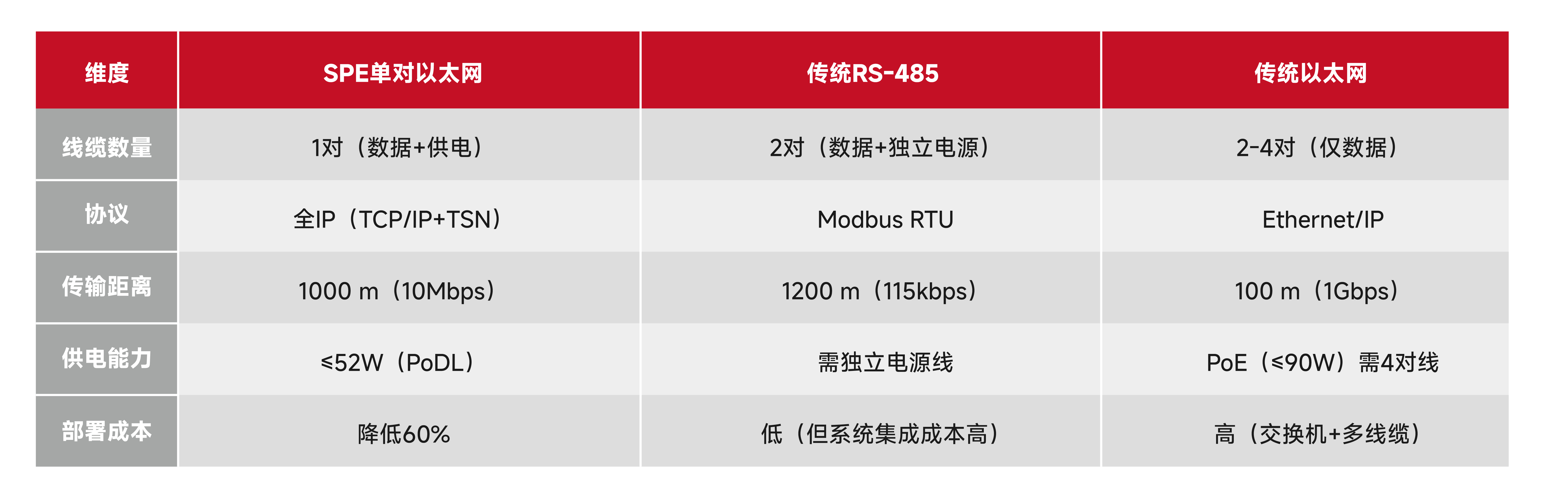
5. SPE vs solutions de communication industrielle traditionnelles
6. Écologie et normalisation de la technologie SPE
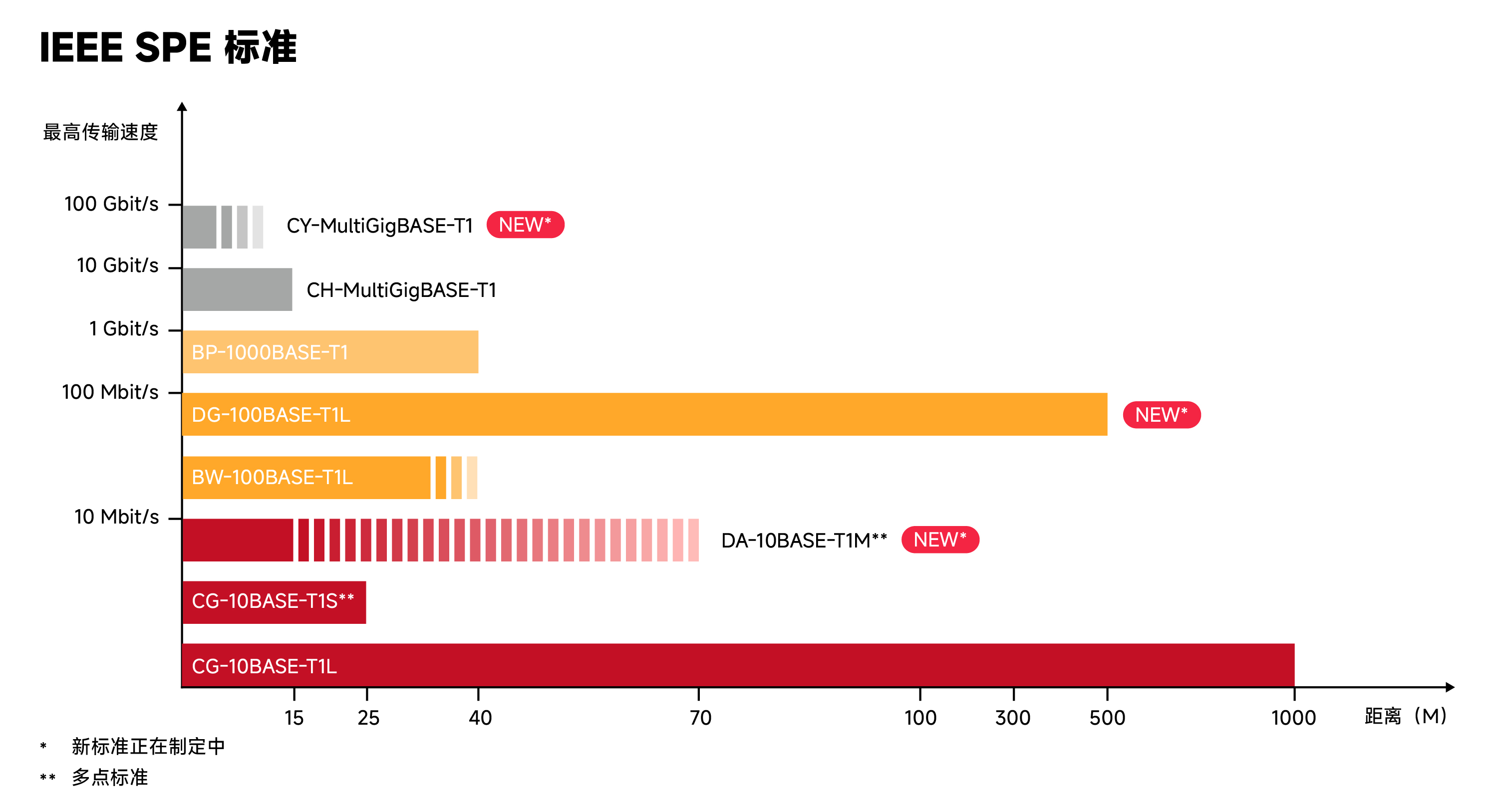
VII. Guide de mise en œuvre et analyse des coûts
1. Chemin de transformation et de mise à niveau
Compatibilité des anciens systèmes : mettez à niveau le SPE à l'aide de câbles dual-core existants (tels que les câbles de bus CAN) pour économiser 60 % de matériaux.
Hybrid Network Architecture: The upper layer still uses Gigabit Ethernet, and the edge-side SPE is connected to the TSN switch.
2. Calcul du retour sur investissement
Investissement initial : capteur SPE (environ 35 $/pièce) par rapport au module IO Ethernet traditionnel (120 $/pièce).
TCO (période de 5-ans) : 1 000 nœuds déployés en usine, coût total réduit de 42 % (source de données : ABI Research).
VIII. Perspectives d'avenir
Simple-à-10G: Le projet IEEE 802.3 prévoit la norme SPE 10 Gbit/s pour prendre en charge le métaverse industriel AR/VR.
SPE sans fil: Combinez Wi-Fi 7 et SPE pour créer un réseau redondant hybride « filaire + sans fil ».
Conception native de l'IA: La puce SPE intègre le moteur d'accélération de l'IA pour réaliser l'informatique de pointe et le prétraitement des données.
IX. Conclusion
SPE single-pair Ethernet is not only a technology upgrade, but also a paradigm revolution in industrial communications. Through the ultimate design of lightweight, full IP, and long-term power supply, it will become the core artery of Industry 4.0 and IIoT, driving the leap from "device networking" to "data intelligence connection".
Although traditional Ethernet has been widely used in the upper system of automation architecture, it still faces challenges when connecting the most basic field device layer, mainly manifested in high installation complexity and limited effective transmission distance. Single-pair Ethernet (SPE) technology has significantly improved the adaptability of Ethernet in industrial scenarios by breaking through the physical layer design.
Compared with traditional Fast Ethernet (100Mbps) and Gigabit Ethernet, which require two or four pairs of twisted pairs for data transmission, SPE only requires a single pair of twisted pairs to complete signal transmission. This technological innovation has brought a revolutionary connection solution for micro sensors, actuators and other devices at the field level: it not only eliminates the redundant lines required for traditional wiring, but also eliminates the intermediate conversion gateway and subsystem through direct Ethernet connection. The lightweight design of its cable structure not only reduces material consumption, but also provides underlying connection support with both high efficiency and cost advantages for emerging fields such as smart manufacturing and the Internet of Things.
Dans la vague de l’Industrie 4.0 et de l’Internet industriel des objets (IIoT), l’intelligence industrielle est confrontée à deux défis majeurs :
1. Dilemme de câblage complexe
Traditional Ethernet requires 2-4 pairs of twisted pair cables (such as 4 pairs of cables for Gigabit Ethernet), which results in thick cable diameter and heavy weight, making it difficult to meet the miniaturization requirements of smart devices.
With the surge in industrial field sensors, the cost of M12 connector + multi-cable management has soared, and the troubleshooting efficiency is low.
2. Fragmentation du protocole et restrictions d'alimentation électrique
Field-level devices often rely on non-IP protocols (such as RS-485), which require gateway conversion, resulting in data delays and high integration complexity.
Sensor power supply relies on independent power lines, making it difficult to achieve a simple design of "one line for the world".
Breakthrough of SPE Single Pair Ethernet: Only 1 pair of twisted pair cables can achieve Ethernet data transmission + up to 50W power transmission (PoDL), while supporting kilometer-level transmission and IP-based end-to-end communication, completely reconstructing the industrial network architecture.
2. Analyse de la technologie de base SPE
1. Innovation au niveau de la couche physique : un câble aux fonctions multiples
Câbles et connecteurs
Cable specifications: minimum 26 AWG (IP20) to 22 AWG (M12 interface, IP67), weight reduction of 40%, bending radius ≤ 5 times the wire diameter.
Normes de connecteur :
Niveau IP20 : conforme à la norme CEI 63171-2, adapté aux armoires de commande intérieures.
Niveau M8/M12 : conforme à la norme IEC 63171-5/7, protection IP67, résistant à l'huile et aux vibrations (test de vibration 20g).
Interface hybride : contacts SPE+alimentation/signal intégrés, réduisant la densité des ports de l'appareil.
Performances de transmission
2. Power over Data Line (PoDL) : intégration approfondie de l'alimentation et des données
Technical principle: Separate data and power signals on the same pair of lines through frequency division multiplexing (FDM).
Principaux avantages :
Densité de puissance : prend en charge une alimentation jusqu'à 50 W (24 V/2,08 A), couvrant 90 % des besoins en capteurs industriels.
Safety protection: Overcurrent/short circuit detection response time <1μs, compatible with IEC 62368-1 safety standard.
3. Communication Full IP : briser les silos de protocoles
TCP/IP de bout en bout : les capteurs prennent directement en charge les protocoles HTTP/MQTT sans passerelles de conversion de protocole.
TSN (réseau sensible au temps) :
Retard déterministe <10 μs, prenant en charge le contrôle synchrone des robots multi-axes.
La planification du trafic est réalisée via la norme IEEE 802.1Qbv pour répondre aux besoins de contrôle en temps réel.
3. Six avantages fondamentaux du SPE
Révolution du câblage
The number of cables is reduced by 75%, the weight is reduced by 50%, and the installation efficiency is increased by 60% (compared with traditional 4-wire Ethernet).
Miniaturisation extrême
The diameter of the M12 SPE connector is only 16mm, which is suitable for micro sensors (such as photoelectric switches with a size of ≤10mm³).
Résistance aux environnements difficiles
La couverture de la couche de blindage est ≥85 %, réussissant les tests de surtension CEI 61000-4-5 4kV et de vibrations EN 61373.
The finished cable assembly supports oil resistance (ISO 1817), flame retardant (UL94 V-0), and halogen-free (IEC 60754).
Bande passante Gigabit
The 1Gbps rate supports millisecond-level image transmission of 4K industrial cameras, and the defect detection efficiency is increased by 30%.
Couverture longue distance
Under the 10BASE-T1L standard, 1000 meters of transmission supports remote monitoring of mining areas and reduces the deployment of repeaters.
Branchez et jouez
Pre-assembled cable assemblies (such as Molex T1 SPE series) reduce 90% of on-site crimping steps and support hot plugging.
4. Panorama des applications industrielles SPE
1. Usine intelligente
Wireless replacement scenario: In radio frequency interference areas such as high-temperature furnace areas, SPE replaces Wi-Fi to transmit temperature data.
2. Robots mobiles
Optimisation dynamique du câblage :
AGV uses M12 SPE interface, which can withstand 100,000 plug-in and pull-out cycles and supports motion jitter environments.
L'alimentation électrique et les données de navigation sont intégrées pour prolonger la durée de vie de la batterie
3. Automatisation des processus
Intrinsically safe scenario: Chemical explosion-proof areas achieve Ex ia certification through SPE+ isolation fence, replacing traditional 4-20mA.
4. Internet des objets énergétiques
Kilometer-level transmission: Oilfield well site sensors transmit pressure data back through 10BASE-T1L, reducing repeaters by 80%.
5. SPE vs solutions de communication industrielle traditionnelles
6. Écologie et normalisation de la technologie SPE
VII. Guide de mise en œuvre et analyse des coûts
1. Chemin de transformation et de mise à niveau
Compatibilité des anciens systèmes : mettez à niveau le SPE à l'aide de câbles dual-core existants (tels que les câbles de bus CAN) pour économiser 60 % de matériaux.
Hybrid Network Architecture: The upper layer still uses Gigabit Ethernet, and the edge-side SPE is connected to the TSN switch.
2. Calcul du retour sur investissement
Investissement initial : capteur SPE (environ 35 $/pièce) par rapport au module IO Ethernet traditionnel (120 $/pièce).
TCO (période de 5-ans) : 1 000 nœuds déployés en usine, coût total réduit de 42 % (source de données : ABI Research).
VIII. Perspectives d'avenir
Simple-à-10G: Le projet IEEE 802.3 prévoit la norme SPE 10 Gbit/s pour prendre en charge le métaverse industriel AR/VR.
SPE sans fil: Combinez Wi-Fi 7 et SPE pour créer un réseau redondant hybride « filaire + sans fil ».
Conception native de l'IA: La puce SPE intègre le moteur d'accélération de l'IA pour réaliser l'informatique de pointe et le prétraitement des données.
IX. Conclusion
SPE single-pair Ethernet is not only a technology upgrade, but also a paradigm revolution in industrial communications. Through the ultimate design of lightweight, full IP, and long-term power supply, it will become the core artery of Industry 4.0 and IIoT, driving the leap from "device networking" to "data intelligence connection".
partager avec
Liens connexes
02 Guide d'application et d'achat des composants électroniques de communication VOOHU dans le domaine du contrôle industriel
03 Guide VOOHU des produits de communication de données pour vous aider à répondre aux exigences du réseau dans différents scénarios
Newsletter subscription
Subscribe to our newsletter and stay updated on the latest information of our company and product.
Name
|
Subscribe
I agree that the information that I provide will be used in accordance with the terms of Voohu International Inc. Privacy & Cookies Policy