Panel Mount RJ45 Connector Guide: Feed-Through Coupler, Waterproof Receptacle or Locking Housing?
Panel Mount RJ45 Connector Guide: Feed-Through Coupler, Waterproof Receptacle or Locking Housing?
A panel mount RJ45 connector puts the Ethernet port on the enclosure wall rather than at the edge of the board. Equipment designers have four practical options: let a PCB jack face a panel opening, fit a feed-through coupler and run a short internal cable to the board, fit a threaded waterproof receptacle that seals once the plug is mated, or fit a locking housing that holds a latched plug. Three questions decide it: does the port have to be sealed, does the board sit right behind the panel, and will the cable be pulled or shaken. Then take the cutout from the drawing of the exact part. On VOOHU drawings, the WHZJT020295 coupler takes a Ø22.20 mm hole and the WHPMWRJ1085 waterproof coupler a Ø20.70 mm hole, each with its own flat.
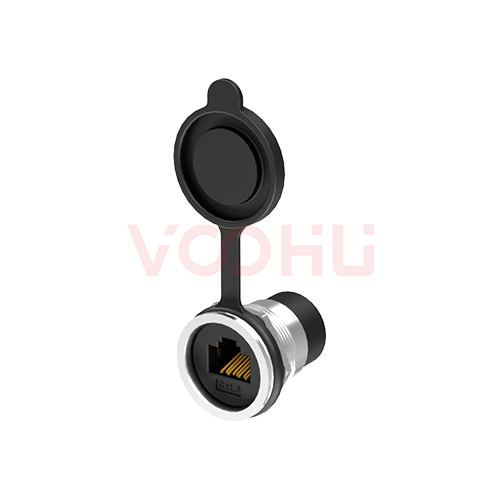
[Product] WHZJT020295
What are the options for mounting an RJ45 port on an equipment panel?
Whether you call it a panel mount RJ45 socket, a panel mount Ethernet connector or a chassis-mount port, the choice comes down to one of these four:
| Option | Choose it when | Plan for | VOOHU example |
|---|---|---|---|
| PCB jack behind a panel opening | The board edge sits at the panel and the port does not need sealing | Opening size and position tolerance between board and panel; the board takes the plug force | SYT111B002BA2A1D, 99TGWHQ618G830415 |
| Feed-through coupler | The board is away from the panel, or the port position may change between models | One more mated connection and an internal patch cord in the link | WHZJT020295 |
| Waterproof threaded receptacle | The port faces rain, wash-down water or dust | The IP rating applies with the plug mated; panel thickness must suit the seal | WHPMWRJ1085 |
| Locking panel housing | The cable can be pulled or the machine vibrates | A matching latched plug; mounting screws and their access from inside | WHKNZ63180 |
The options can be combined: the WHPMWRJ1085 is both a threaded waterproof part and a feed-through coupler. Decide on sealing first, because it is the hardest thing to change later.
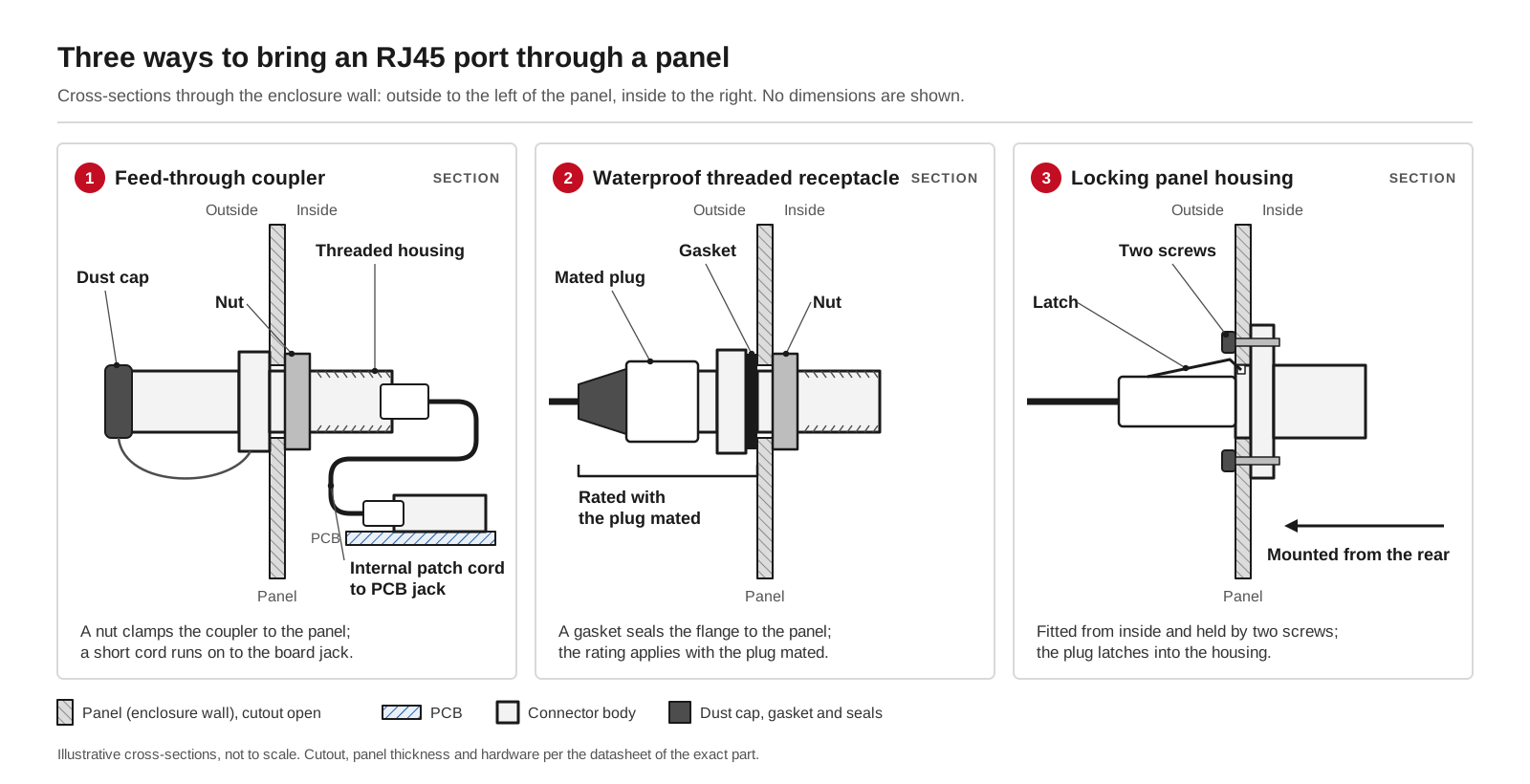
Three ways to bring an RJ45 port through a panel: a feed-through coupler with an internal patch cord, a waterproof threaded receptacle rated with the plug mated, and a locking housing mounted from the rear. Illustrative, not to scale; cutout and hardware per the datasheet of the exact part.
Panel mount RJ45 coupler: when the board is not at the panel
A feed-through (pass-through) coupler is an RJ45 jack on both faces, so the outside cable plugs into the front and a short patch cord inside runs to the jack on your board. It frees the board layout from the panel. The cost is one more mated connection and a second cord in the link, so keep the internal cord short and use the same cable grade as the outside run.
The WHZJT020295 shows what to look for on a metal coupler. Its zinc-alloy M22 housing is clamped by an M22 nut, and the drawing gives the cutout as Ø22.20 mm (+0.2/−0) with a flat dimensioned 21.00 ±0.15 mm, which keys the housing so it does not turn while you tighten the nut. It has a silicone dust cap and two grounding tabs, and its contact drawing carries the shield straight through from one face to the other. If you want the cable shield to reach the chassis at the panel, that is the path to check on any coupler you consider. For thin panels, the snap-in SYTUS030026SL is a plastic alternative: its drawing gives a 14.80 × 16.5 mm cutout without the latch, or 14.80 × 19.30 mm with the single panel latch on a 1.60 mm panel.
For the full coupler range, compare grades, shielding and mounting styles in the RJ45 inline coupler selector.
Panel mount RJ45 connector waterproof: what IP65 and IP67 cover
A waterproof panel connector, often listed as an IP67 RJ45 bulkhead connector, seals in two places: a gasket between the housing and the panel, and a seal between the receptacle and the mating plug. The IP code describes that mated assembly, so the plug is part of the specification, not an accessory you choose later.
The WHPMWRJ1085 is an M20 full-thread female-to-female coupler held by a PA66 94V-0 nut, with silicone gaskets and a snap-on dust cover. Its drawing recommends a Ø20.70 ±0.1 mm cutout with a flat dimensioned 9.00 mm (+0.1/−0.05), sets the maximum panel thickness at 3 mm, and rates the receptacle end IP65 with the plug and receptacle mated. The WHPMWRJ1101 is a 90° threaded receptacle rated IP67, with the same recommended cutout.
Plug selection, seal checks and chassis grounding for outdoor ports are covered step by step in our waterproof RJ45 selection guide and, for coupler versions, in Cat6A waterproof RJ45 coupler. To compare parts, open the waterproof RJ45 selector.
Locking RJ45 panel connectors for cables that get pulled
A standard RJ45 plug is held only by its small plastic latch. Locking panel connectors, often called XLR-style, add a housing that latches the plug, which suits machines that vibrate and ports where a cable is plugged and unplugged by hand all day. The WHKNZ63180 is installed from the rear of the panel and fixed with screws: its drawing gives the rear-side panel cutout as Ø22 mm plus two Ø3.2 mm mounting holes on a 24 × 19 mm pattern, a maximum panel thickness of 3 mm, a latch lock, a soft rubber dust cover, more than 1,000 mating cycles, and Class D transmission over 1–100 MHz.
If you would rather mount the locking jack on the PCB, the WHA80001051AB33 is a board-mount locking jack with its own zinc-alloy front plate, 23 mm wide with fixing holes 19.8 × 19.8 mm apart. It has a shield shell and spring tabs, is rated for 750 mating cycles minimum, and comes in standard (−20 to +70 °C) and industrial (−40 to +85 °C) temperature versions. Send your panel drawing with the sample request, and our FAE team will confirm the cutout for it. Plug pairing and the board-mount versus pass-through decision are covered in how to choose an RJ45 XLR locking connector; the parts are in the locking RJ45 selector.
Panel mount RJ45 jack: using the PCB jack as the panel port
When the board edge sits right at the panel, the simplest port is the PCB jack itself, with the panel opening cut around its face. The board then carries every plug insertion, so fix the board close to the jack, and the opening has to absorb the position tolerance between board and panel. Take the opening from the jack drawing. The SYT111B002BA2A1D drawing gives a reference panel cutout of 16.30 × 13.75 mm (±0.10), and the 99TGWHQ618G830415 drawing shows a panel opening of 18.34 × 11.68 mm (±0.25 each), with EMI spring fingers on both sides that bring the width to 20.83 mm. Fingers like these only bond the shield to the chassis if the panel is conductive where they touch, so keep paint off that area. Body sizes for plain, MagJack and multi-port jacks are compared in RJ45 jack dimensions, and MagJacks (RJ45 jacks with integrated magnetics) can be filtered in the MagJack selector.
Checklist: cutout, thickness, seal and shield
- Cutout. Copy the diameter, the flat and the tolerance from the drawing of the part you will buy; cutouts differ even between parts that look alike, as the table below shows.
- Panel thickness. Check it against the drawing: 3 mm maximum on the WHPMWRJ1085 and WHKNZ63180, and 1.60 mm for the single-latch cutout of the SYTUS030026SL. Include paint, powder coat or a label in the stack.
- Mounting side. A rear-mounted housing such as the WHKNZ63180 is screwed on from inside, so leave tool access before the board goes in.
- Sealing. Order the matching plug, keep the sealing face flat, and fit the dust cover whenever the port is unused.
- Shield path. Decide where the cable shield meets the chassis: through a coupler with grounding tabs, through EMI fingers on a PCB jack, or at the board. Do not assume a metal housing is bonded unless the drawing shows the ground path.
Which VOOHU panel mount RJ45 fits your enclosure?
| Part | Type | Panel cutout (drawing) | Panel thickness (drawing) | Fixing | Sealing |
|---|---|---|---|---|---|
| WHZJT020295 | Metal feed-through coupler, M22 | Ø22.20 mm (+0.2/−0), flat 21.00 ±0.15 mm | Send your panel thickness | M22 nut; two grounding tabs | Silicone dust cap |
| SYTUS030026SL | Plastic snap-in coupler | 14.80 × 16.5 mm (no latch); 14.80 × 19.30 mm (single latch) | 1.60 mm (single-latch cutout) | Snap latch | — |
| WHPMWRJ1085 | Waterproof coupler, M20 full thread | Ø20.70 ±0.1 mm, flat 9.00 mm (+0.1/−0.05) | 3 mm max | PA66 nut | IP65, plug mated; gaskets and dust cover |
| WHPMWRJ1101 | Waterproof 90° threaded receptacle | Ø20.70 ±0.1 mm, flat 9.00 mm (+0.1/−0.05) | Send your panel thickness | Thread and nut | IP67, plug mated |
| WHKNZ63180 | Locking panel housing, rear mounted | Ø22 mm + 2 × Ø3.2 mm holes, 24 × 19 mm | 3 mm max | Screws | Soft rubber dust cover |
| WHA80001051AB33 | Board-mount locking jack, metal front plate | Confirmed by our FAE team for your panel | Send your panel thickness | Plate holes 19.8 × 19.8 mm; PCB mount | — |
Where to start: the WHZJT020295 when the board sits away from the panel, the WHPMWRJ1085 when the port faces water or dust, and the WHKNZ63180 or the board-mount WHA80001051AB33 when the cable gets pulled. Each family has its own selector: couplers, waterproof RJ45 and locking RJ45.
[Product] WHPMWRJ1085
[Solution] /industrial-control/
FAQ
Q1: What size hole for an RJ45 plug?
There is no single RJ45 panel cutout; it depends on the part behind the hole. On VOOHU drawings, the WHZJT020295 coupler takes Ø22.20 mm with a 21.00 mm flat, the WHPMWRJ1085 and WHPMWRJ1101 waterproof parts take Ø20.70 mm with a 9.00 mm flat, and the WHKNZ63180 locking housing takes Ø22 mm plus two Ø3.2 mm screw holes. For a PCB jack behind the panel, use the opening on the jack drawing, as listed in RJ45 jack dimensions.
Q2: Is an RJ45 bulkhead connector the same as a panel mount coupler?
Usually, yes. "Bulkhead" describes a connector that passes through a wall or panel and is clamped to it, so a threaded feed-through coupler held by a nut, such as the WHZJT020295 or the WHPMWRJ1085, fits the description. The name does not tell you the cutout, the panel thickness range or whether the part is sealed, so check those three on the drawing before you compare prices.
Q3: Is a waterproof panel mount RJ45 still sealed with nothing plugged in?
Treat the IP rating as a rating of the mated connector. The VOOHU drawings state IP65 for the WHPMWRJ1085 with plug and receptacle mated, and IP67 for the WHPMWRJ1101. Fit the dust cover whenever the port is unused. If your enclosure must stay sealed with the port empty, tell our FAE team, and they will confirm the part and cover combination for it.
Get panel mount RJ45 samples checked against your panel
Send your panel drawing or cutout, the panel thickness and finish, whether the port must be sealed, and the cable or plug you will use through our sample request form. Our FAE team can suggest a VOOHU panel mount RJ45 that fits and check the cutout, panel thickness and shield path against the drawing. Samples are available for evaluation, and selected parts are free of charge. Our FAE team will be glad to confirm the options for your project. VOOHU supplies RJ45 and SFP connectors, LAN and PoE transformers and common mode chokes from Suzhou, China, to more than 1,500 customers.