
RJ45 Connector Buyer's Checklist: What to Ask Before You Approve a Jack
RJ45 101 · Part 3 · New to the series? Start with Part 1: What is an RJ45 connector? and Part 2: RJ45 connector types.
Before you approve an RJ45 connector for your product, get written answers to four groups of questions: which exact part and drawing revision you are buying; how it fits your board and enclosure (tab direction, entry angle, LED colors, shielding); what it does electrically (magnetics, data rate, PoE current); and how it is documented, sampled, packed and soldered. Most answers sit on the datasheet drawing, so the work is knowing which line to read and asking the supplier to confirm the rest. The checklist near the end puts every question on one page for your request for quotation (RFQ).
Picture the usual hand-off. Your engineer has picked a part number and you are placing the order. Then the samples arrive: the latch tab faces the wrong way, the green LED sits where the panel label says yellow, the parts come in trays when your line expected tape and reel, or the jack's magnetics do not suit the Ethernet chip. One question at the quoting stage would have caught each one.
Before the RFQ: what your engineer should hand you
Collect these from engineering before you contact a supplier; each one answers a question the supplier would otherwise send back to you.
- Part number and drawing revision (printed in the title block, the box in the drawing's corner), plus any accepted alternatives.
- A one-line description of the jack, in the format from Part 2.
- PHY part number and data rate. The PHY is the Ethernet chip behind the jack; integrated magnetics must suit it.
- PoE role (Power over Ethernet, DC power sent over the data cable): none, PSE (power sourcing equipment, such as a switch) or PD (powered device, such as a camera), plus the IEEE 802.3 PoE type.
- Enclosure and conditions: panel cutout, height above the board, temperature range, how often the port is plugged, water or vibration.
If any of this is still undecided, see our guide to choosing an industrial PCB RJ45 jack.
Questions about the part: orientation, LEDs, magnetics, PoE, plating and shielding
Tab direction and entry angle. Tab-up and tab-down jacks are mirror images, and 90° (side-entry) and 180° (top-entry) jacks have different footprints, so any swap means a new board layout. Confirm both on the drawing, and ask which side the recommended PCB layout is drawn from; read from the wrong side, a footprint comes out mirrored. On SYT561188AB1A1DB4 and SYT411Q199DB2A1DP, the layout heading says "viewed from component side". If a drawing does not say, get the viewing side confirmed in writing before layout; for VOOHU parts, our FAE team can confirm it. Pin order: RJ45 tab up vs tab down.
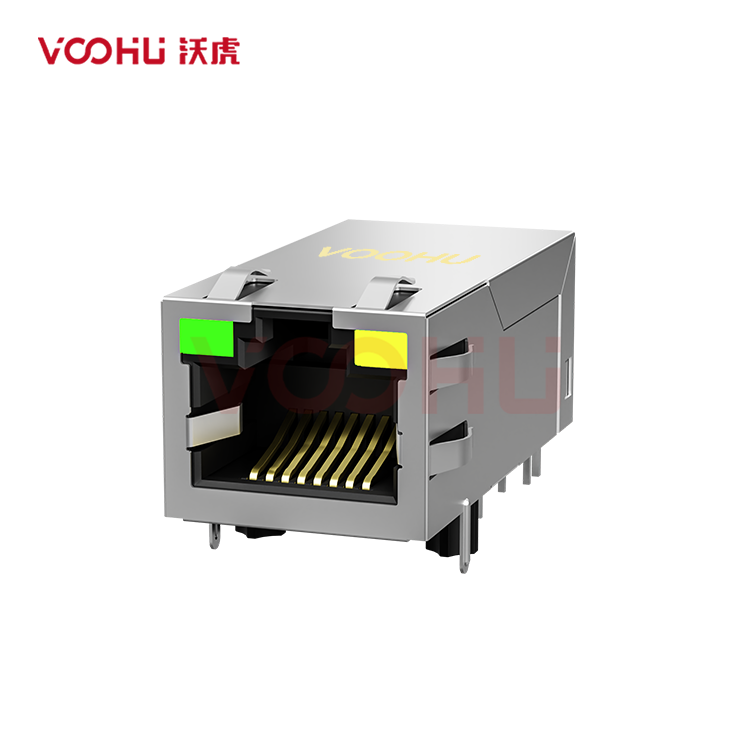
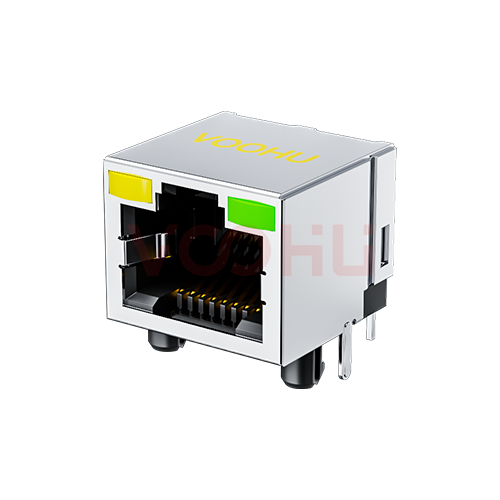
LED colors and positions. Similar jacks can put the same two colors on opposite sides: the front view of VOOHU's SYT561188AB1A1DB4 reads yellow left, green right, while SYT411Q199DB2A1DP reads green left, yellow right, and a swap means relabeling the panel or changing firmware. Catalog filters shorten this to "Y/G", so confirm left and right on the front view, which shows the jack as you face it. For pins and polarity, see how to check RJ45 LED position and polarity.
Magnetics and data rate. A MagJack (RJ45 jack with integrated magnetics) has the Ethernet transformers inside its shell; a plain jack needs a separate LAN transformer on the board, and the two footprints are not interchangeable. For a MagJack, ask for the schematic page and the rated data rate, for your engineer to check against the PHY. To shortlist parts, use our selector filtered to integrated magnetics or browse all RJ45 jacks.
PoE current. PoE power usually passes through the center taps (middle connections) of the magnetics, so a plain jack has no PoE rating of its own. Ask which IEEE 802.3 PoE type the part targets, the DC current with its test condition, and whether that current is per pair, per pair set or per port. For VOOHU MagJacks, our FAE team can confirm all three against your design; our PoE MagJack selection guide explains the numbers.
Plating and mating cycles. "Gold plated" says little. Ask for the gold thickness on the contact area and the rated mating cycles: 6 µin and 750 cycles minimum on both jacks above. For ports plugged often or facing harsh air, ask which thicknesses the series offers; if a drawing lists several plating options, ask how the option shows in the part number, so reorders match. See 3U, 6U and 50U gold plating.
Shielding. A metal shell helps EMC only when it reaches chassis ground, so ask how the shield tabs or EMI fingers (spring contacts that touch the panel) meet your panel and which panel cutout the supplier recommends. Our guide to shielded vs unshielded RJ45 connectors covers the grounding.
Approve the part against its drawing and revision, not a catalog summary or distributor listing. If the two disagree, ask the supplier which is current, in writing. Here is where each answer sits on VOOHU drawings, read from the datasheets of the parts named:
| Question | Where to look | On a VOOHU drawing |
|---|---|---|
| Which revision am I approving? | Title block | REV A0 on every drawing in this table |
| Tab, ports and speed | Title block | "TAB-DOWN 1X1 1000BASE" on SYT111Q066AA2A1D |
| Which LED is where? | Front view and LED table | SYT561188AB1A1DB4: yellow left, green right; green 568 nm and yellow 585 nm, both at 20 mA |
| Which side is the footprint drawn from? | Recommended PCB layout heading | "Viewed from component side" on SYT561188AB1A1DB4 and SYT411Q199DB2A1DP |
| What magnetics are inside? | Schematic page | SYT411Q199DB2A1DP: a 1CT:1 transformer (1:1 turns ratio, center-tapped) and a common mode choke on each of the four pairs |
| How much PoE current? | Notes | SYT411Q199DB2A1DP: balanced DC line current 720 mA max at 57 V DC continuous |
| What plating and life? | Material and mechanical notes | SYT561188AB1A1DB4 and SYT411Q199DB2A1DP: 6 µin gold on the contact area; 750 cycles minimum |
| What temperature range? | Notes | −40 to +85 °C operating on SYT561188AB1A1DB4, SYT411Q199DB2A1DP and 99TGWHQ618G830415 |
| Which housing plastic? | Material notes | PBT, UL94 V-0 (the plastic's flammability rating) on SYT561188AB1A1DB4 and SYT411Q199DB2A1DP; LCP, UL94 V-0 on the surface-mount SYTCB851188AB1W6SB1075 |
| Which soldering process? | Soldering profile | SYT411Q199DB2A1DP: wave solder, 260 ±5 °C, 5 s max; 99TGWHQ618G830415: wave soldering, 255 to 265 °C, 5 to 10 s |
| RoHS and REACH? | Compliance mark, then the test report | "REACH & RoHS COMPLIANT" on every page of SYT111Q066AA2A1D and SYT411Q199DB2A1DP; the third-party reports are on our quality documents page |
[Product] SYT561188AB1A1DB4
[Product] SYT411Q199DB2A1DP
Questions about documents: datasheet, drawing and test reports
Engineering needs the drawing; you need documents to release the part and to answer your customers' compliance questions later. Ask for:
- The datasheet at the approved revision, with the drawing, tolerances and recommended PCB layout, plus a 3D model; the VOOHU product pages for SYT561188AB1A1DB4 and SYT111Q066AA2A1D, for example, carry both.
- RoHS and REACH test reports. A mark on a drawing is a statement; the evidence is a third-party laboratory report whose scope covers your part. VOOHU's RoHS and REACH compliance is documented by third-party test reports, including RoHS reports for RJ45 connectors and RJ45 jacks with integrated magnetics, on our quality documents page; our FAE team will tell you which one covers your part.
- Certificates. VOOHU is ISO 9001 and ISO 14001 certified and holds a CE certificate for selected RJ45 connector models; our FAE team can send the model list.
Questions about samples and a second source
Ask for samples of the exact part number and revision you will buy, and try them in your own enclosure with your customers' cables. Does the plug latch and release cleanly through the panel? Are the LEDs where the label expects? Does the link reach full speed and, for PoE, carry its load? Record the sample's part number and revision in your approval.
A second source is a part you have checked against the first. Compare the two drawings line by line: pin positions and hole sizes, posts and shield tabs, tab direction, LED pins, height, panel cutout and, for a MagJack, the schematic and PoE current. Treat any match as a functional alternative — verify with samples in your design, and accept a claim of full interchangeability only when the supplier confirms it in writing for that exact pair of part numbers.
To replace another brand's part, send its part number to our FAE team; they can suggest VOOHU options and list the differences to check. A separate LAN transformer on the board also lets you second-source the jack and the transformer independently; see integrated vs discrete RJ45 designs.
Questions about packaging and your production line
Soldering process. SYT561188AB1A1DB4, SYT411Q199DB2A1DP and 99TGWHQ618G830415 are through-hole parts. Check the soldering profile against your line: SYT411Q199DB2A1DP gives 260 ±5 °C for 5 s max, 99TGWHQ618G830415 255 to 265 °C for 5 to 10 s, both for wave soldering. If your line runs reflow only, say so in the RFQ; a wave-solder profile does not approve a jack for pin-in-paste reflow, where through-hole pins are soldered in the reflow oven. The housing line is a clue: PBT on SYT561188AB1A1DB4 and SYT411Q199DB2A1DP, LCP (liquid crystal polymer, a heat-resistant plastic widely used in surface-mount connectors) on the surface-mount SYTCB851188AB1W6SB1075. For any VOOHU part, our FAE team can confirm soldering conditions for your line.
[Product] 99TGWHQ618G830415
Surface-mount jacks. An SMD jack is reflowed with the board, so also ask for the reflow profile and whether a moisture sensitivity level (MSL) applies; MSL, classified under IPC/JEDEC J-STD-020, tells your line how long parts may stay out of their sealed bag before reflow. For VOOHU SMD jacks, our FAE team can confirm both, or you can filter the selector to SMD jacks.
Packing and labels. Ask whether parts come in trays or on tape and reel (pocketed tape on a reel that feeds a placement machine), the quantity per pack, the label content (part number, quantity, lot or date code) and whether packing is set by the part number or on the order. Your feeders need the right format; incoming inspection needs the label to trace a lot.
A one-page checklist you can send with your RFQ
Copy this into your RFQ email. Fill in the first list and write "Not sure" where nothing is decided yet; a good supplier turns those lines into questions back to you. The second list is what the supplier should answer or send.
What we need
- Part number, drawing revision, accepted alternatives
- One-line description: ports, entry angle, tab, shielding, magnetics, PoE, LEDs, height, through-hole or SMD
- PHY part number and data rate
- PoE role (none, PSE or PD) and IEEE 802.3 PoE type
- LED colors, left and right, on the front view
- Operating temperature range, panel cutout, height above the board
- Our soldering process: wave, selective, pin-in-paste reflow or SMD reflow
- Sample quantity, annual volume, production start date
Please confirm or send
- Datasheet at this revision, recommended PCB layout and its viewing side, 3D model
- PoE DC current, test condition, and per pair, pair set or port
- Contact-area gold thickness, plating option in the part number, rated mating cycles
- Shield tabs or EMI fingers, recommended panel cutout
- RoHS and REACH test reports covering this part
- Soldering profile; MSL for SMD parts
- Packing format, quantity per pack, label content
- Samples of the production part number and revision
- Second source: differences from our current part, in writing
[Solution] /solution-ethernet/
Frequently asked questions
Q1: Does it matter what RJ45 connector I use?
For a cable plug, match the cable category and shielding. For the jack on your product, yes: its footprint, tab, LED pins, magnetics and PoE rating are designed into the board and enclosure, so a look-alike can still fail to fit or to work. Order by exact part number and drawing revision, not just "RJ45 jack".
Q2: What should an RJ45 connector datasheet include?
A dimensioned drawing with tolerances, the recommended PCB layout and its viewing side, materials and plating, mating cycles, electrical ratings, temperature range, soldering profile and revision. LED jacks add an LED table; MagJacks add a schematic, electrical tables, the hi-pot (isolation) rating and, for PoE parts, a DC current. If a line you need is missing, get it confirmed in writing; for VOOHU parts, our FAE team can do that.
Q3: Can I use an RJ45 connector alternative from another supplier?
Often, after checking: compare the two drawings line by line, including footprint, tab, LED pins, height and, for a MagJack, the schematic and PoE current, then test samples. Treat the result as a functional alternative — verify with samples in your design. Our FAE team can suggest VOOHU options for a part you want to replace.
Send your checklist to our FAE team
Send the part number, quantity and target date through our sample and quote form, and write "Not sure" for anything still open. Samples are available for evaluation, and selected parts are free of charge. Our FAE team will be glad to confirm the options for your project, from tab direction and LED colors to PoE and soldering. VOOHU supplies RJ45 and SFP connectors, LAN and PoE transformers and common mode chokes from Suzhou, China, to more than 1,500 customers. VOOHU has its own factories in Mianyang (magnetics) and Dongguan (connectors).
Earlier in the series: Part 1: What is an RJ45 connector? · Part 2: RJ45 connector types
Next in the series: Why RJ45 ports fail in the field