
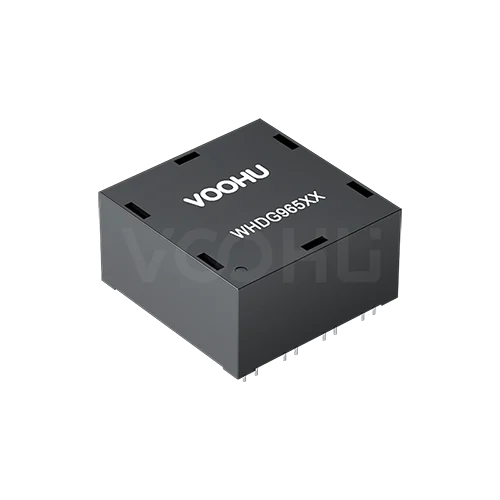
WHDG96503PTG Quad Ports DIP Gigabit Base-T PIN96 PoE+ LAN Transformer





Request a Quote
Leave your details and we will send a tailored volume quote.
Our sales team will contact you within 1 business day.
Contact Sales
Reach our sales team for pricing and lead time.

Submitted
We have received your request. Our sales team will contact you within 1 business day.




For technical assistance, pleaseclick the button below to add customer service or visit the sample request pageto fill out the form. We will serve you as soon as possible.
Technical Support Email: fae.thorne@voohu.cn Phone: +86 400-1048-018
For more details, please visit theDownload Centerto get documents or click the button below to add customer service. We will serve you as soon as possible.





For purchases and small-volume orders, please contact our sales team. We support VAT general/special invoices with a convenient and efficient process.
For technical assistance or sample requests, pleaseclick the button belowto add customer service orvisit the sample request pageto fill out the form. We will serve you as soon as possible.
Customer Service Email: song.lei@voohu.cn Phone: +86 180 2130 1120
Not in the same orientation. Package, pin numbering, electrical ratings and PoE rating all match, but the drawings label the sides oppositely: on the WHDG96503PTG pins 1–48 are the cable side and 49–96 the chip side, and on theWHDG96502PTGit is the reverse.
Swapping the part straight in puts the PHY side against the cable side. On a board already routed for one of them, the other needs its orientation re-checked — changing the part number alone is not enough.
A component figure. The WHDG96503PTG drawing annotates the operating temperature line as including the part's own temperature rise, so self-heating is already inside the range.
Thermal design can therefore compare against the measured component temperature directly, without setting aside a further margin on top. Other parts in the100/1000 BASE-T rangedo not carry that annotation, so the conclusion should not be carried across to them.
Solder wave at 255 °C to 265 °C with a dwell of 3.0 to 5.0 s.
Preheat runs at 100 °C to 110 °C for 60 to 90 s; after the wave the part comes down below 90 °C within 30 to 50 s, with the ramp rate held to 5 °C per second. The WHDG96503PTG is a through-hole part and needs no line change beyond running this profile. Surface-mount alternatives sit in the100/1000 BASE-T range.