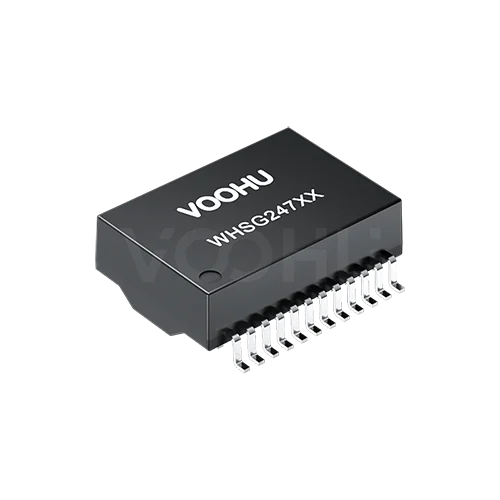
Bourns PT61020EL Alternative: VOOHU WHSG24706-1PTG Comparison
VOOHU WHSG24706-1PTG can be used as a functional alternative to the Bourns PT61020EL — verify with samples in your design. Both are 24-pin, 1.27 mm-pitch SMD LAN transformers for gigabit Ethernet with a PoE+ current rating and a −40 to +85 °C operating range, and both datasheets list pins 1–12 as the chip-side TCT/TD groups and pins 13–24 as the line-side MX/MCT groups in the same order. The internal structure is different. In the Bourns part, each channel has a chip-side transformer, a line-side common mode choke and a line-side autotransformer whose centre tap is brought out as MCT. In the VOOHU part, each channel has a three-wire common mode choke on the chip side and the transformer on the line side, with MCT taken from the transformer's centre tap. Check this against your PHY vendor's reference design before you commit the board.
PT61020EL vs. WHSG24706-1PTG: datasheet values
Bourns values are read from the PT61020EL datasheet (REV. 03/20); VOOHU values from the WHSG24706-1PTG datasheet (REV A0) and, where marked, its product page. Each value keeps the test condition its own datasheet attaches to it, because several conditions differ between the two. Dimensions are in mm.
| Item | Bourns PT61020EL (source) | VOOHU WHSG24706-1PTG (source) |
|---|---|---|
| Data rate | 10/100/1000 Base-T (DS p1) | 100/1000 BASE-T (DS p1 title); 10/100/1000BASE-T (product page) |
| Package | 24-pin SMD, 1.27 pitch (DS p1) | 24-pin SMD, 1.27 ± 0.20 pitch (DS p1) |
| Body length × width | 17.62 × 12.20 (DS p1, tolerance ± 0.25) | 17.55 ± 0.50 × 12.20 ± 0.50 (DS p1) |
| Width over leads | 16.00 (DS p1) | 16.00 ± 0.50 (DS p1) |
| Height | 6.00 (DS p1) | 6.00 ± 0.50 (DS p1) |
| Lead width; first-to-last lead | 0.46; 13.96 (DS p1) | 0.50 ± 0.10; 13.97 ± 0.20 (DS p1) |
| Recommended pads | 1.27 pitch; 0.76 × 1.91 pads; 13.97 first-to-last pad; 16.51 outer edge to outer edge (DS p1) | 1.27 pitch; 0.76 pad width; 13.97 first-to-last pad; 12.70 inner, 16.60 outer edge to edge, all typical (DS p1) |
| Chip-side pins | TCT1 1, TD1+ 2, TD1− 3 … TCT4 10, TD4+ 11, TD4− 12 (DS p1) | TCT1 1, TD1+ 2, TD1− 3 … TCT4 10, TD4+ 11, TD4− 12 (DS p1) |
| Line-side pins | MCT1 24, MX1+ 23, MX1− 22 … MCT4 15, MX4+ 14, MX4− 13 (DS p1) | MCT1 24, MX1+ 23, MX1− 22 … MCT4 15, MX4+ 14, MX4− 13 (DS p1) |
| Structure per channel | Chip-side 1CT:1 transformer; line-side two-wire common mode choke; line-side autotransformer with its centre tap to MCT (DS p1 schematic) | Chip-side three-wire common mode choke (TD+, TCT, TD−); line-side 1CT:1CT transformer with MCT from its line-side centre tap (DS p1 schematic) |
| Turns ratio | 1 CT:1 ± 5% (DS p1) | 1CT:1CT ± 5% (DS p2) |
| OCL | 350 µH min; 100 kHz, 0.2 V, 8 mA DC bias (DS p1) | 350 µH min; 100 kHz, 0.1 V, 14 mA DC bias (DS p2) |
| Leakage inductance | 0.50 µH max; 100 kHz, 0.2 V (DS p1) | 0.5 µH max; 100 kHz, 0.1 V (DS p2) |
| Interwinding capacitance | 25 pF typ (DS p1) | Not stated |
| DCR | 0.90 Ω max (DS p1) | 1.4 Ω max (DS p2) |
| Insertion loss | −1.1 dB max, 0.3–100 MHz (DS p1) | −1.2 dB max, 0.5–1 MHz; −0.2 − 0.002·f^1.4 dB max, 1–125 MHz (DS p2) |
| Return loss | −18 dB (0.3–30 MHz), −14.4 dB (40 MHz), −13.1 dB (50 MHz), −12 dB (60–80 MHz), min (DS p1) | −16 dB min, 1–40 MHz; −10 + 20·log(f/80) dB min, 40.1–100 MHz (DS p2) |
| Crosstalk | −35 dB (0.3–30 MHz), −28 dB (60–100 MHz), min (DS p1) | −30 dB min, 1–100 MHz (DS p2) |
| Common-mode rejection | −40 dB (0.3–30 MHz), −35 dB (60 MHz), −30 dB (80–100 MHz), min (DS p1) | −30 dB min, 1–100 MHz (DS p2) |
| Isolation hi-pot | 1500 VAC, 1 mA, 1 s (DS p1) | 1500 VAC, 1 mA, 60 s (DS p2) |
| PoE | PoE+ current up to 650 mA for 1000 Base-T (DS p1) | IEEE 802.3at compliant performance, 720 mA current capability (DS p2); PoE+ (up to 720 mA) (product page) |
| Operating temperature | −40 to +85 °C (DS p1) | −40 to +85 °C (DS p2) |
| Storage temperature | Not stated | −40 to +85 °C (DS p2) |
| Moisture sensitivity level | MSL 1 (DS p1) | Not stated |
| Reflow | 245 °C peak (DS p1 features); profile Tp 250 °C ± 3 °C (DS p2) | Not stated |
Ethernet common mode choke: which side is it on, and what else differs?
Choke placement. PT61020EL places a two-wire common mode choke on the line side of each channel, between the transformer and an autotransformer. WHSG24706-1PTG places a three-wire common mode choke on the chip side, ahead of the transformer, and has no line-side choke or autotransformer. Neither datasheet presents the two arrangements as interchangeable. Take the magnetics requirements from your PHY vendor's reference design or layout guide, compare them with the WHSG24706-1PTG schematic, and include the emissions and immunity checks you normally run when you test a sample board.
Where the centre taps come from. The chip-side centre taps are TCT1–TCT4 on pins 1, 4, 7 and 10 in both parts; on WHSG24706-1PTG the TCT line is one of the three wires wound through the chip-side choke. The line-side centre taps are MCT1–MCT4 on pins 24, 21, 18 and 15: Bourns brings them out from the autotransformer, VOOHU from the line-side winding of the transformer. These are the pins your Bob Smith termination and, in a PoE design, the PSE or PD power path connect to, so review that part of the schematic together with the PoE controller's reference circuit.
PoE current. Bourns rates PT61020EL for PoE+ current up to 650 mA for 1000 Base-T. VOOHU states IEEE 802.3at compliant performance with a 720 mA current capability for WHSG24706-1PTG. The two figures come from different datasheets without a shared test definition, so size the port from your own PSE or PD current budget and check it against each part's own figure.
OCL test condition and DCR. Both datasheets give 350 µH minimum OCL, measured at 100 kHz in both cases but with 0.2 V and 8 mA DC bias for Bourns and 0.1 V and 14 mA DC bias for VOOHU. Leakage inductance is 0.5 µH maximum on both, again at 0.2 V and 0.1 V respectively. DCR is 0.90 Ω max for PT61020EL and 1.4 Ω max for WHSG24706-1PTG; neither sheet says which winding the value applies to, so use each figure as printed when you estimate PoE conduction loss and temperature rise, and confirm on a sample.
Hi-pot duration. Both parts are specified at 1500 VAC with a 1 mA limit. The test lasts 1 s on the Bourns datasheet and 60 s on the VOOHU datasheet, so quote the condition that matches the method in your safety documentation.
Loss and rejection figures. Insertion loss, return loss, crosstalk and common-mode rejection are given over different frequency bands, and VOOHU writes insertion and return loss as formulas in frequency. Read them band by band from the table above, or measure both parts on your own board, instead of setting one column directly against the other.
Pads, outline and soldering. The recommended land patterns share a 1.27 mm pitch, a 0.76 mm pad width and 13.97 mm from the first to the last pad in a row. Measured from outer edge to outer edge across the two rows, they span 16.51 mm on the Bourns layout and 16.60 mm on the VOOHU layout, a 0.09 mm difference; Bourns also gives a 1.91 mm pad length, while VOOHU gives a 12.70 mm inner edge distance. Nominal body width, width over leads and height are 12.20, 16.00 and 6.00 mm on both, and body length is 17.62 mm for Bourns and 17.55 ± 0.50 mm for VOOHU. The VOOHU datasheet does not list an MSL or reflow profile, so ask our FAE team for the process data your assembly line needs before the first sample build.
Which designs is WHSG24706-1PTG suited to?
WHSG24706-1PTG is aimed at gigabit ports that also carry PoE+ in an SMD layout — PoE switches, wireless access points, IP cameras and industrial switches that operate within −40 to +85 °C. For a gigabit port in the same 24-pin, 1.27 mm format that does not carry PoE, the product range also includes WHSG24701TG, which is listed as not PoE rated.
FAQ
Q1: What is a PT61020EL equivalent?
VOOHU WHSG24706-1PTG is a functional alternative to the Bourns PT61020EL — verify with samples in your design. It is a 24-pin, 1.27 mm-pitch SMD gigabit LAN transformer for −40 to +85 °C with a PoE+ current figure in its datasheet. Its common mode choke is on the chip side, whereas PT61020EL has its choke on the line side, so check the magnetics against your PHY reference design.
Q2: Which side is the common mode choke on in PT61020EL and WHSG24706-1PTG?
In PT61020EL it is on the line side: chip-side transformer, then a two-wire choke, then an autotransformer that provides the MCT centre tap. In WHSG24706-1PTG it is on the chip side: a three-wire choke carrying TD+, TCT and TD−, then the transformer, whose line-side centre tap provides MCT. Your PHY vendor's reference design states which magnetics arrangement it was laid out with.
Q3: Why are common mode chokes used in Ethernet magnetics?
A common mode choke presents a high impedance to noise that appears equally on both wires of a pair while letting the differential data signal through, which helps keep common-mode noise from coupling between the PHY and the cable. Datasheets express this as common-mode rejection: −40 / −35 / −30 dB minimum across bands from 0.3 to 100 MHz for PT61020EL, and −30 dB minimum over 1–100 MHz for WHSG24706-1PTG.
Q4: What PoE current do the PT61020EL and WHSG24706-1PTG Ethernet transformers support?
The Bourns datasheet gives PT61020EL a PoE+ current of up to 650 mA for 1000 Base-T. The VOOHU datasheet gives WHSG24706-1PTG IEEE 802.3at compliant performance with a 720 mA current capability. Use each value as printed against your own PSE or PD current budget, and take the DCR (0.90 Ω and 1.4 Ω max) into your thermal estimate.
Request WHSG24706-1PTG samples and a magnetics review
If you are moving a PT61020EL design, attach the schematic page around the magnetics (PHY, centre-tap network and PoE path) and your land pattern to the sample request form. Samples are available for evaluation, and selected parts are free of charge. Our FAE team will be glad to confirm the options for your project. Our FAE team can suggest suitable parts and help check the design — in this case, the chip-side choke arrangement of WHSG24706-1PTG against your PHY reference design, the PoE+ current path through the centre taps and the 16.51 / 16.60 mm pad outline.
VOOHU supplies RJ45 and SFP connectors, LAN and PoE transformers and common mode chokes from Suzhou, China, to more than 1,500 customers.
Other 24-pin parts with a PoE+ rating are listed in the LAN transformer selector, which opens with the PoE+ (up to 720 mA) and 24-pin filters applied.
Related products: WHSG24706-1PTG — 24-pin SMD 1000BASE-T LAN transformer, 1.27 mm pitch, PoE+ (720 mA current capability), −40 to +85 °C. WHSG24701TG — 24-pin SMD 1000BASE-T LAN transformer, 1.27 mm pitch, not PoE rated, −40 to +85 °C.
产品WHSG24706-1PTG
方案/solution-poe/