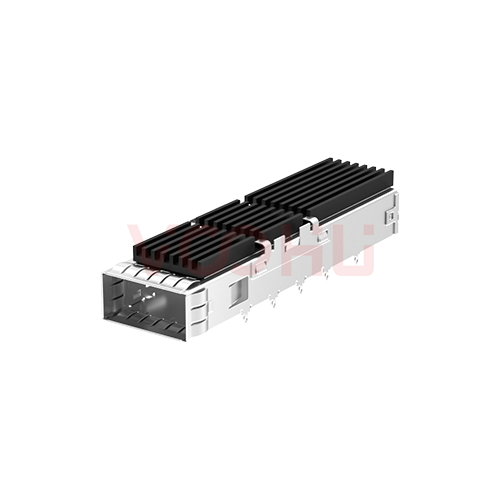
OSFP vs QSFP-DD vs QSFP28 vs QSFP112: Host-Board Cage and Connector Differences
OSFP vs QSFP-DD vs QSFP28 vs QSFP112: Host-Board Cage and Connector Differences
On the host board, QSFP28, QSFP56 and QSFP112 keep the four-lane QSFP format: one 38-contact, 0.8 mm pitch connector inside a cage. QSFP-DD adds a second row of contacts, for 76 contacts and eight lanes in a port of the same height and width, and its MSA keeps QSFP-DD cages backward compatible with QSFP modules. OSFP vs QSFP-DD is the bigger step: OSFP is a separate eight-lane form factor with a 60-pin connector and a heat sink built into the module, so it needs its own footprint. Within the QSFP family, QSFP112 ports use SFF-TA-1027 connectors and cages, while QSFP28 and QSFP56 ports can also use the earlier SFF-8662 or SFF-8672 connectors. VOOHU supplies QSFP28, QSFP56 and QSFP-DD cages and cage-and-connector assemblies as 1×1 ports, 2×1 and 2×2 stacks and 1×4 ganged rows, and 1×1 connectors for QSFP28, QSFP56, QSFP-DD and QSFP112.
What is the main difference between QSFP28 and QSFP-DD?
The table compares the five form factors from the board side. Lane rates are what each standard's connector and cage system is designed for; they are not ratings of any particular part.
| Item | QSFP28 | QSFP56 | QSFP112 | QSFP-DD | OSFP |
|---|---|---|---|---|---|
| Electrical lanes | 4 | 4 | 4 | 8 | 8 |
| Per-lane rate the system is designed for | Up to 28 Gb/s | Up to 56 Gb/s | Up to 112 Gb/s | 50 Gb/s PAM4 (QSFP-DD), 100 Gb/s (QSFP-DD800), 200 Gb/s (QSFP-DD1600) | 50, 100 or 200 Gb/s (400G, 800G or 1.6T per port) |
| Connector contacts | 38 | 38 | 38 | 76 | 60 |
| Connector and cage documents | SFF-8662 or SFF-8672 connector, SFF-8663 or SFF-8683 cage, or SFF-TA-1027 | Same choices as QSFP28 | SFF-TA-1027 only | QSFP-DD MSA hardware specification | OSFP MSA specification |
| Accepts QSFP+ modules | Yes | Yes | Yes | Yes | Not defined in the OSFP specification |
| Board configurations in the standard | 1×n ganged, 2×n stacked | 1×n ganged, 2×n stacked | 1×1 and 2×1 stacked | 1×1 SMT, 2×1 stacked press-fit; QSFP-DD800 adds 2×1 SMT | Single-row SMT, stacked SMT, stacked press-fit |
| Where the heat sink sits | Optional with SFF-8683 cages | Optional with SFF-8683 cages | Cage with or without a riding heat sink | Riding heat sink on the cage; some module types add one outside the cage | Built into the module (a riding-heat-sink variant, OSFP-RHS, is a separate, incompatible type) |
QSFP-DD keeps the QSFP opening and adds depth. Its module edge carries 38 pads on the top and 38 on the bottom, 76 in total, and the QSFP-DD MSA describes the port as slightly deeper on the host board than QSFP28 but with identical height and width, so port density per panel stays the same while each port doubles from four lanes to eight. A classic QSFP module still fits: its pads sit deeper on the paddle card, so they mate only with the longer row of connector contacts, the short row stays unconnected and host lanes 5 to 8 are unused. For the PCB this means a new footprint: the VOOHU QSFP28 connectorWHSFP35111D010has 38 solder leads, while the QSFP-DD connectorWH690M019D0S01has 76. The same applies to QSFP112 vs QSFP-DD: QSFP112 reaches higher lane rates on the 38-contact layout, QSFP-DD doubles the lane count.
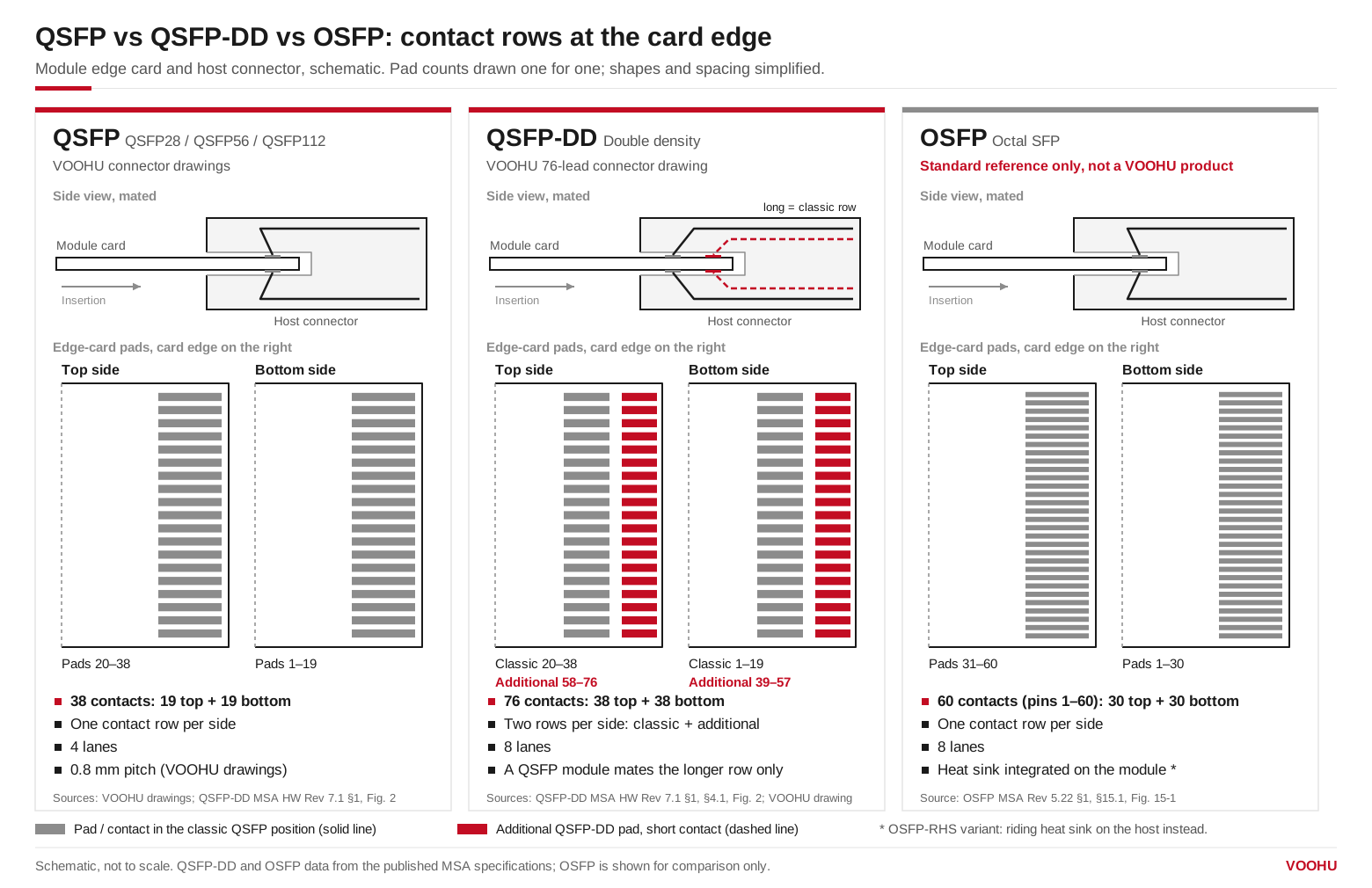
QSFP-DD adds a second, shorter row of contacts behind the QSFP row, so a QSFP module mates only the longer row. OSFP uses its own 60-pin connector. Schematic, not to scale.
The connector change also sets the assembly. The QSFP-DD MSA defines a 1×1 surface-mount connector under a press-fit cage, and a 2×1 stacked press-fit cage with an integrated connector; QSFP-DD800 adds 2×1 surface-mount versions. Plan the port count and stacking before layout, because a 1×1 SMT footprint and a 2×1 press-fit footprint are not interchangeable.
OSFP vs QSFP-DD: which one changes the board more?
An OSFP transceiver is an eight-lane pluggable module, like QSFP-DD, and the OSFP MSA lists 400G, 800G and 1.6T versions on 50, 100 and 200 Gb/s lanes. The two differ in how they reach that point:
- Connector.OSFP uses its own 60-pin connector; QSFP-DD stays on a 76-contact connector in the QSFP opening.
- Backward fit.The QSFP-DD MSA keeps its cages backward compatible with QSFP modules. The OSFP specification defines no QSFP compatibility, so an OSFP port is a separate footprint, not an upgrade of a QSFP one.
- Heat sink.A standard OSFP module carries an integrated heat sink, with a closed or open top. QSFP-DD normally uses a riding heat sink on the cage, as QSFP does, and some QSFP-DD module types add a heat sink on the part that sits outside the cage. OSFP-RHS moves the heat sink to the host and is not compatible with standard OSFP.
- Board options.The OSFP specification covers single-row SMT, stacked SMT and stacked press-fit cages, including belly-to-belly layouts on both sides of the board.
So QSFP-DD changes the board less: the panel cut-out, port pitch and QSFP module support carry over, and only the connector footprint and cage depth change. VOOHU's current range covers the QSFP family; OSFP is compared here at the standard level.
QSFP28 vs QSFP56 vs QSFP112: is the cage the same?
All three are four-lane QSFP solutions in SFF-8665, and all keep a 38-contact connector; the VOOHU QSFP28, QSFP56 and QSFP112 connector drawings all show 38 contacts at 0.8 mm. The difference on the board is which connector and cage documents apply:
- QSFP28 and QSFP56can use the 28 GBd, 0.8 mm SFF-8662 (Style A) or SFF-8672 (Style B) connector with an SFF-8663 or SFF-8683 cage, or the newer SFF-TA-1027 parts.
- QSFP112is listed only with SFF-TA-1027 connectors and cages. SFF-TA-1027 defines a 1×1 connector with footprint styles A and B and a 2×1 stacked connector with styles A to D, and its cages come with or without a riding heat sink.
SFF-8665 also notes that using a QSFP112 connector or cage refers to the mechanics and does not require the port to run at 112 Gb/s, and SFF-TA-1027 cages and connectors accept legacy QSFP+ modules. A board that may later move to QSFP112 can therefore start with QSFP112-generation parts. Choose the connector by the module generation you plan to support; our FAE team can confirm which VOOHU connector and cage match it.
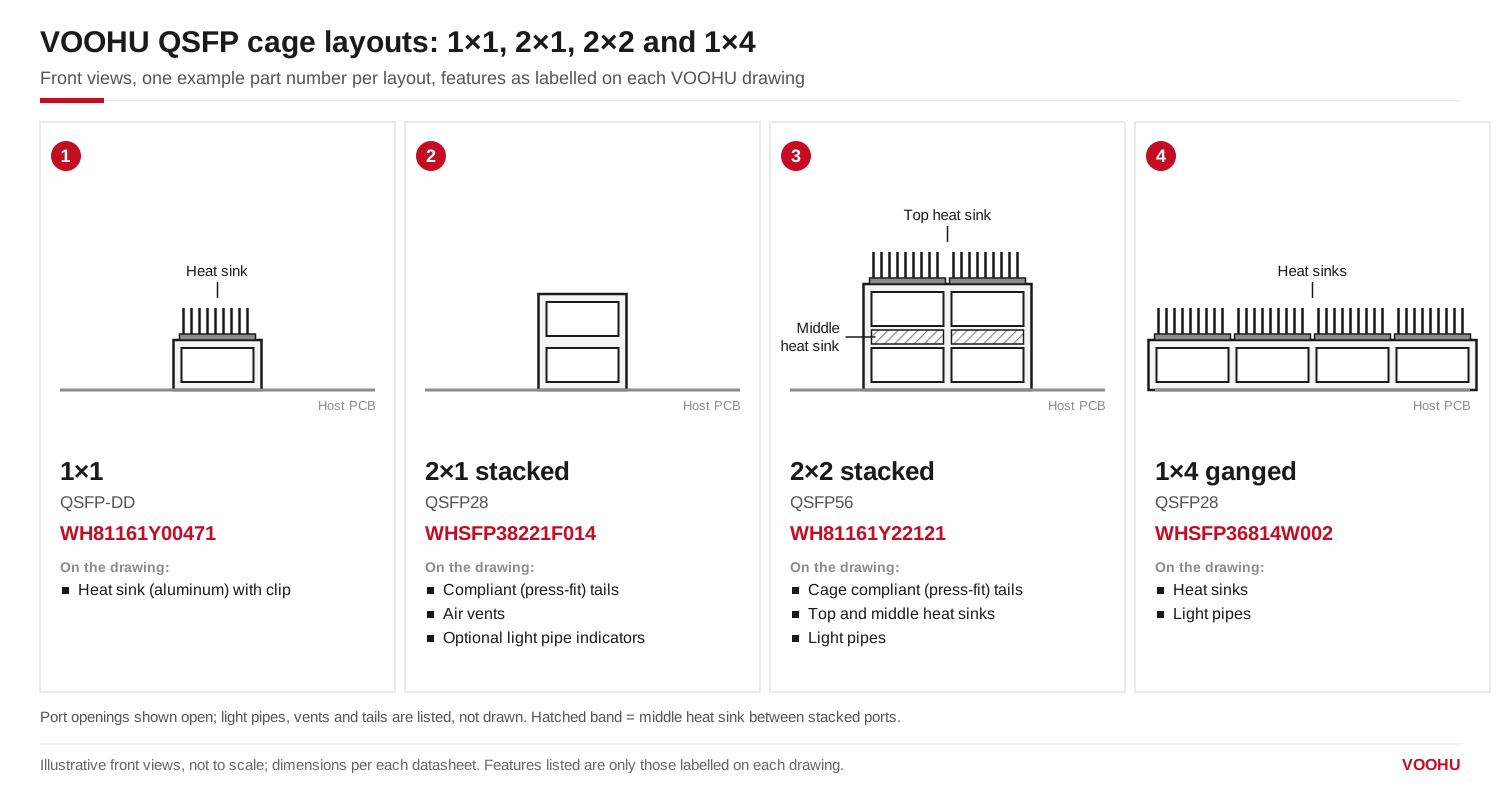
Four port layouts from VOOHU drawings: 1×1 (WH81161Y00471), stacked 2×1 (WHSFP38221F014), stacked 2×2 (WH81161Y22121) and ganged 1×4 (WHSFP36814W002). Illustrative; dimensions per each datasheet.
Press-fit or surface mount: how does a QSFP cage connector go on the board?
VOOHU drawings show both mounting methods:
- Press-fit (compliant tails).The QSFP28 2×1WHSFP38221F014and 2×2WHSFP38422F020and the QSFP56 2×2WH81161Y22121are cage-and-connector assemblies whose drawings call out compliant tails.
- Surface mount.The QSFP28 connector WHSFP35111D010 has 38 solder leads, and the QSFP-DD connector WH690M019D0S01 has 76 solder leads with a pick-and-place zone for automatic placement.
- Both sides of the board.The drawing of the QSFP28 1×1 cageWH81161Y00171includes a PCB layout for belly-to-belly applications, with ports mirrored on the top and bottom of the board.
Take hole sizes, pad sizes and keep-out areas from the drawing of the exact part number, and send us your board stack-up if you want the footprint checked.
Does a QSFP cage need a heatsink?
For QSFP and QSFP-DD ports the main heat sink usually rides on the cage, so it is chosen with the cage rather than with the module. SFF-8665 describes the SFF-8683 cage, one of the cage documents for QSFP28 and QSFP56, as supporting optional heat sink attachment, and SFF-TA-1027 defines QSFP112 cages with or without a riding heat sink. VOOHU offers both styles:
- The QSFP28 1×1 cageWHSFP36111W040comes with an aluminum heat sink and a stainless steel clip.
- The QSFP56 2×2 assemblyWH81161Y22121has a top and a middle heat sink, so both rows of ports are covered, plus light pipes.
- The QSFP-DD 1×1 cageWH81161Y00471carries an aluminum heat sink with a clip.
- The QSFP28 1×4 ganged cageWHSFP36814W002combines heat sinks with clear polycarbonate light pipes.
- Where a stacked port runs without a heat sink, the QSFP28 2×1 WHSFP38221F014 uses air vents in the cage.
The heat sink size follows the module power you plan for each port, which is set by your system, so tell us the module type when you ask for a cage version.
Which VOOHU QSFP cages and connectors fit each port type?
| Port you are designing | VOOHU part | What the drawing shows |
|---|---|---|
| QSFP28, two ports stacked, press-fit | WHSFP38221F014 | 2×1 cage-and-connector assembly, compliant tails, air vents, light pipes |
| QSFP56, four ports in a 2×2 block | WH81161Y22121 | 2×2 assembly, compliant tails on the cage, top and middle heat sinks, light pipes |
| QSFP-DD, single port with heat sink | WH81161Y00471 | 1×1 cage with aluminum heat sink and clip |
| QSFP-DD connector | WH690M019D0S01 | 76-contact connector with solder leads; for the connector that pairs with your cage, ask our FAE team to confirm |
| QSFP112, single port | WHSFP51311D002 | 1×1 connector, 38 contacts at 0.8 mm, contact current rating 1.5 A, voltage rating 30 V DC |
To see every option, browse theQSFP28, QSFP56, QSFP-DD, QSFP112andQSFP/QSFP+families, or open the I/O connector selector filtered tocage-and-connector assemblies. For single-lane SFP+ and SFP28 ports, see our guide toSFP+ and SFP28 cage selection; for the 20-pin SFP host connector, see ourSFP connector pinoutguide. The standards cited here are published by theSNIA SFF TA TWG, theQSFP-DD MSAand theOSFP MSA.
FAQ
Q1: Is QSFP-DD backwards compatible with QSFP28?
Yes. The QSFP-DD MSA keeps its cages and connectors backward compatible with QSFP modules, so a QSFP28 module plugs into a QSFP-DD port. Its pads mate only the longer row of contacts, and the port runs on host lanes 1 to 4 while lanes 5 to 8 stay unconnected.
Q2: Is QSFP compatible with OSFP?
Not by the standards. OSFP has its own 60-pin connector and module outline, and the OSFP specification does not define QSFP compatibility. Plan an OSFP port as a separate footprint rather than as a variant of a QSFP or QSFP-DD footprint.
Q3: Can I plug QSFP28 into QSFP56 or QSFP112 ports?
Mechanically, yes. SFF-8665 lets QSFP28 and QSFP56 use the same connector and cage documents, and SFF-TA-1027 cages and connectors for QSFP112 accept legacy QSFP+ modules. Whether the port then runs at the QSFP28 rate depends on the host and the module, not on the cage.
Q4: What does QSFP-DD stand for?
QSFP-DD is Quad Small Form-factor Pluggable Double Density. "Double density" refers to doubling the number of high-speed electrical lanes per port compared with QSFP28, from four to eight, in a port of the same height and width.
Need help matching a QSFP cage and connector to your board?
Send us your port plan through thesample and support request form: the form factor (QSFP28, QSFP56, QSFP112 or QSFP-DD), 1×1 or stacked, press-fit or SMT, and whether you need heat sinks or light pipes. We can suggest matching VOOHU cages and connectors and check the footprint against the drawing. Samples are available for evaluation, and selected parts are free of charge. Our FAE team will be glad to confirm the options for your project.
VOOHU supplies RJ45 and SFP connectors, LAN and PoE transformers and common mode chokes from Suzhou, China, to more than 1,500 customers. Our connectors are made in our own factory in Dongguan.