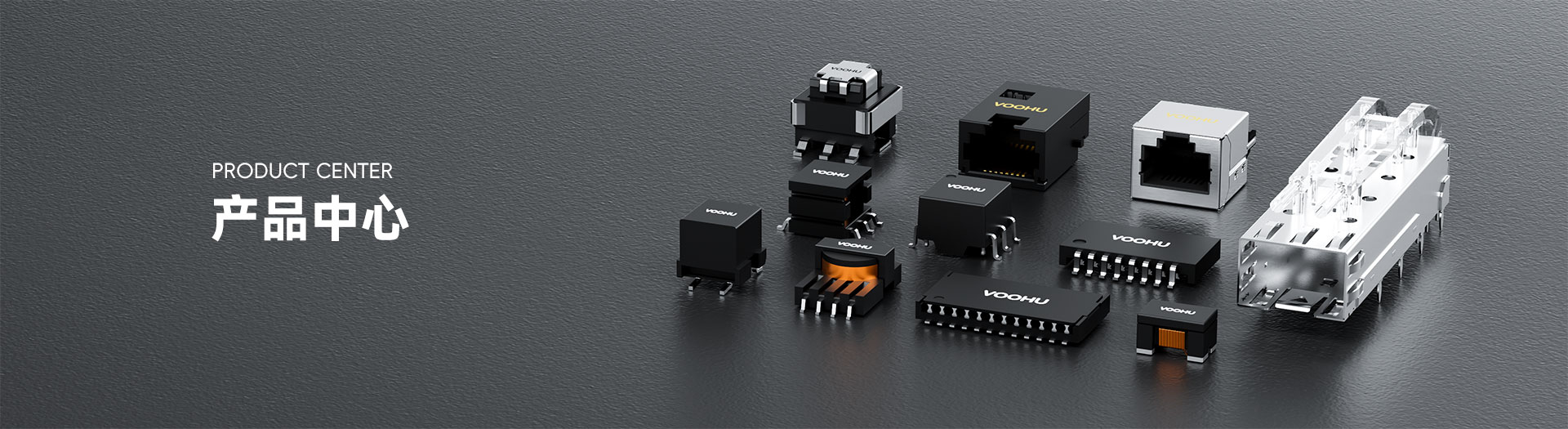
WHD20601G Dual Ports DIP 10/100Base-TX PIN20 non-PoE LAN Transformer


Request a Quote
Leave your details and we will send a tailored volume quote.
Our sales team will contact you within 1 business day.
Contact Sales
Reach our sales team for pricing and lead time.

Submitted
We have received your request. Our sales team will contact you within 1 business day.


For technical assistance, pleaseclick the button below to add customer service or visit the sample request pageto fill out the form. We will serve you as soon as possible.
Technical Support Email: fae.thorne@voohu.cn Phone: +86 400-1048-018
For more details, please visit theDownload Centerto get documents or click the button below to add customer service. We will serve you as soon as possible.


For purchases and small-volume orders, please contact our sales team. We support VAT general/special invoices with a convenient and efficient process.
For technical assistance or sample requests, pleaseclick the button belowto add customer service orvisit the sample request pageto fill out the form. We will serve you as soon as possible.
Customer Service Email: song.lei@voohu.cn Phone: +86 180 2130 1120
Four channels, split between two ports at two channels — one pairset — each.
The WHD20601G holds four 1CT:1CT units, grouped on the drawing as TD1/TX1, RD1/RX1, TD2/TX2 and RD2/RX2, each pair forming one complete 100M port. This is easily confused with Gigabit: adual-port Gigabit partholds eight channels and four pairsets, twice the unit count. Read the data rate first, then divide by port count.
On board area one part wins: the WHD20601G is 25.40 × 10.00 mm against two16-pin single-port partsat 20.30 × 9.80 mm each, close to half the width.
But a dual-port device ties both ports together — a fault on either means replacing the whole part — and two single-port parts leave the layout freer, letting the two RJ45s sit in different places on the board. Cross talk between the ports of the WHD20601G is held to -30 dB Min across 1–100 MHz, so isolation itself is not the deciding factor.
No. That 8 mA is the DC bias applied to the winding while measuring open-circuit inductance, used to verify magnetising behaviour — it is not current available for powering anything.
The WHD20601G is a non-PoE part with no DC supply rating on its centre taps at all. Whether a device can deliver power is settled by a separate datasheet line giving a current capability and the applicable IEEE class, not by the test condition on the inductance line. Parts with such a line are grouped in theGigabit range.