



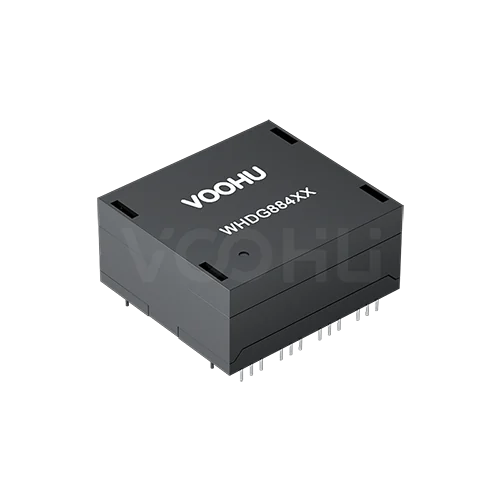
WHDG88409PG Quad Ports DIP Gigabit Base-T PIN88 PoE+ LAN Transformer





Request a Quote
Leave your details and we will send a tailored volume quote.
Leave a phone number or an email. Either one is enough.
Our sales team will contact you within 1 business day.
Contact Sales
Reach our sales team for pricing and lead time.

Submitted
We have received your request. Our sales team will contact you within 1 business day.




For technical assistance, please message us on WhatsApp or visit the sample request page to fill out the form. We will serve you as soon as possible.
Technical Support Email: voohu@voohuele.com WhatsApp: +86 133 5804 1040
For certificates and test reports, please visit the Download Center, or contact us and we will send you the documents you need.





For samples, pricing or technical assistance, please visit the sample request page to fill out the form, or message us on WhatsApp. We will serve you as soon as possible.
Email: voohu@voohuele.com WhatsApp: +86 133 5804 1040
A component figure. The WHDG88409PG drawing annotates the operating temperature line as including the part's own temperature rise, so self-heating is already inside the range.
Thermal design can compare against the measured component temperature directly, without setting aside a further margin. Only a few parts in the 100/1000 BASE-T range carry that annotation, so the conclusion does not transfer to others in the family.
In two places: the WHDG88409PG datasheet states IEEE 802.3at compliant performance with 720 mA current capability, which the non-PoE parts do not carry at all; and the two state insertion and return loss differently — the WHDG88409PG gives them as functions of frequency up to 125 MHz, the non-PoE parts as fixed values per band up to 100 MHz.
The two drawing styles also group the pins differently, so check placement against each drawing rather than assuming similar part numbers share a pinout. Both types are listed in the 100/1000 BASE-T range.
Indoor four-port Gigabit PoE+ equipment where the component temperature stays between 0 °C and +70 °C.
The WHDG88409PG is a through-hole part assembled by wave soldering and supplied 17 pieces to a tube. All four ports share the same structure with four channels each, and cross talk between them is held to -30 dB Min across 1–100 MHz. Equipment that powers up below 0 °C needs the wide-temperature grade in the same family.