
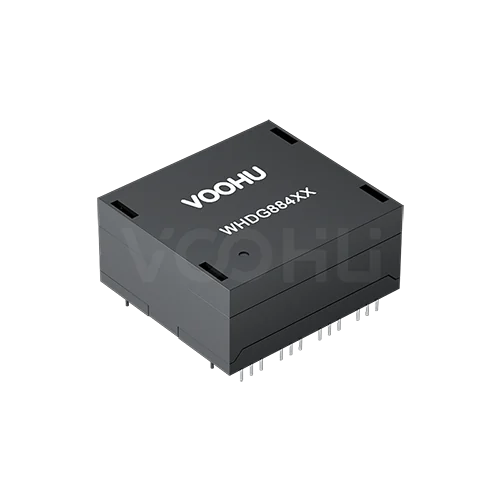
WHDG88409PG Quad Ports DIP Gigabit Base-T PIN88 PoE+ LAN Transformer





Request a Quote
Leave your details and we will send a tailored volume quote.
Our sales team will contact you within 1 business day.
Contact Sales
Reach our sales team for pricing and lead time.

Submitted
We have received your request. Our sales team will contact you within 1 business day.



For technical assistance, pleaseclick the button below to add customer service or visit the sample request pageto fill out the form. We will serve you as soon as possible.
Technical Support Email: fae.thorne@voohu.cn Phone: +86 400-1048-018
For more details, please visit theDownload Centerto get documents or click the button below to add customer service. We will serve you as soon as possible.





For purchases and small-volume orders, please contact our sales team. We support VAT general/special invoices with a convenient and efficient process.
For technical assistance or sample requests, pleaseclick the button belowto add customer service orvisit the sample request pageto fill out the form. We will serve you as soon as possible.
Customer Service Email: song.lei@voohu.cn Phone: +86 180 2130 1120
A component figure. The WHDG88409PG drawing annotates the operating temperature line as including the part's own temperature rise, so self-heating is already inside the range.
Thermal design can compare against the measured component temperature directly, without setting aside a further margin. Only a few parts in the100/1000 BASE-T rangecarry that annotation, so the conclusion does not transfer to others in the family.
In two places: the WHDG88409PG datasheet states IEEE 802.3at compliant performance with 720 mA current capability, which the non-PoE parts do not carry at all; and the two state insertion and return loss differently — the WHDG88409PG gives them as functions of frequency up to 125 MHz, the non-PoE parts as fixed values per band up to 100 MHz.
The two drawing styles also group the pins differently, so check placement against each drawing rather than assuming similar part numbers share a pinout. Both types are listed in the100/1000 BASE-T range.
Indoor four-port Gigabit PoE+ equipment where the component temperature stays between 0 °C and +70 °C.
The WHDG88409PG is a through-hole part assembled by wave soldering and supplied 17 pieces to a tube. All four ports share the same structure with four channels each, and cross talk between them is held to -30 dB Min across 1–100 MHz. Equipment that powers up below 0 °C needs thewide-temperature gradein the same family.