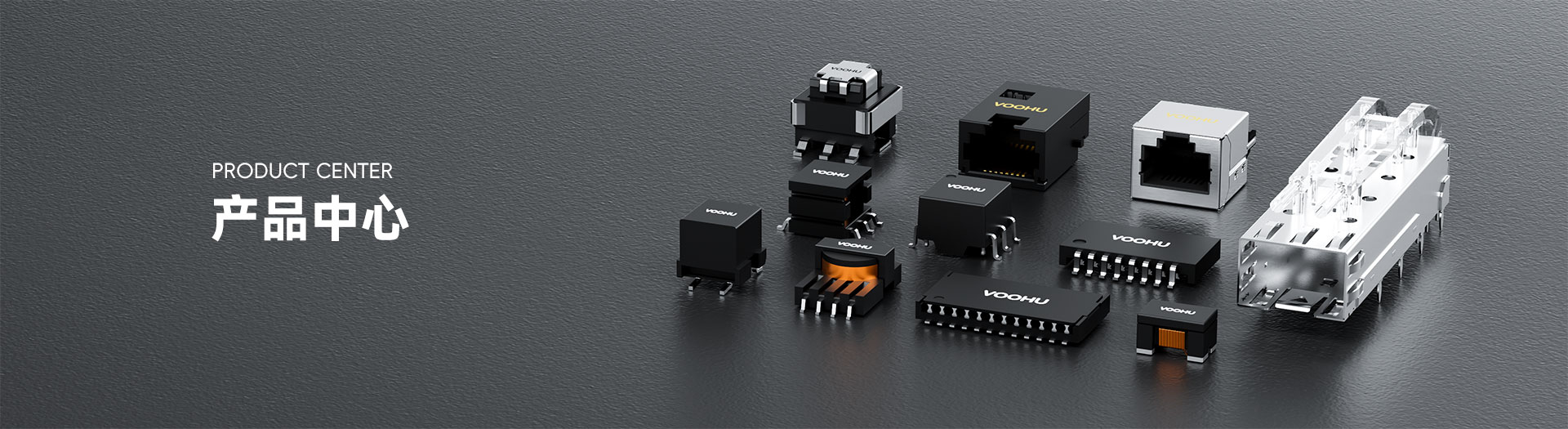
WHDG72301-1G Quad Ports DIP Gigabit Base-T PIN72 non-PoE LAN Transformer


Request a Quote
Leave your details and we will send a tailored volume quote.
Our sales team will contact you within 1 business day.
Contact Sales
Reach our sales team for pricing and lead time.

Submitted
We have received your request. Our sales team will contact you within 1 business day.



For technical assistance, pleaseclick the button below to add customer service or visit the sample request pageto fill out the form. We will serve you as soon as possible.
Technical Support Email: fae.thorne@voohu.cn Phone: +86 400-1048-018
For more details, please visit theDownload Centerto get documents or click the button below to add customer service. We will serve you as soon as possible.


For purchases and small-volume orders, please contact our sales team. We support VAT general/special invoices with a convenient and efficient process.
For technical assistance or sample requests, pleaseclick the button belowto add customer service orvisit the sample request pageto fill out the form. We will serve you as soon as possible.
Customer Service Email: song.lei@voohu.cn Phone: +86 180 2130 1120
Go by body outline, not by pin count: the WHDG72301-1G is a 65.70 × 6.50 mm bar-shaped package, while the K-coded parts are a 34.50 × 19.00 mm block, and the two land patterns are not interchangeable.
The bar needs roughly 66 mm of straight space on the board; the block occupies a near-square area. The hole sizes differ as well — ø0.90 mm on the WHDG72301-1G against ø0.70 mm on the block parts. Selection starts with the shape of the area the PCB can give. Both outlines are listed in the100/1000 BASE-T range.
Package, pinout and electrical ratings are identical; the only difference is which side carries the common-mode choke — the WHDG72301-1G puts it on the pin 37–54 and 55–72 side, theWHDG72303Gon the pin 1–18 and 19–36 side.
The footprint is the same, so changing between them needs no PCB work. Decide from the relative position of the PHY and the RJ45 on the board and from the element order drawn in the PHY reference design.
Yes. The WHDG72301-1G holds sixteen separate 1CT:1CT units, four channels to each Gigabit port.
One channel is one differential pair; two channels, one out and one back, make a pairset, so each Gigabit port is two pairsets. Cross talk between ports is held to -30 dB Min across 1–100 MHz, and every port keeps its own termination and grounding as the PHY reference design specifies. Other port counts are listed in the100/1000 BASE-T range.