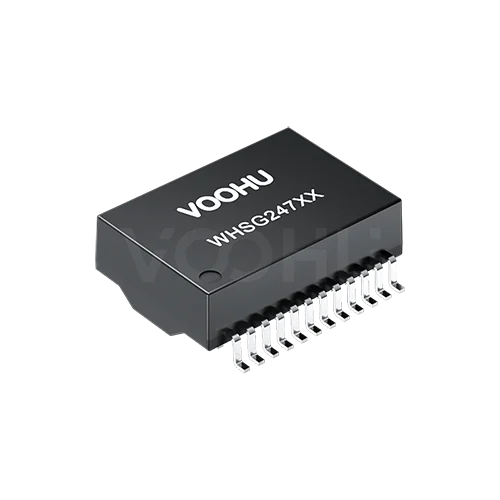




Würth 749020011A Alternative: VOOHU WHSG24701TG Comparison
The short answer is yes. The VOOHU WHSG24701TG is a functional alternative to the Würth Elektronik WE-LAN 749020011A — verify with samples in your design. Both are 24-pin, 1.27 mm-pitch SMD gigabit LAN transformers rated −40 to +85 °C. Every pin carries the same signal name on both, from TCT1 on pin 1 to MCT1 on pin 24, and both list 350 µH minimum OCL with 8 mA of DC bias and a 1500 V, 60 s hipot. The difference sits behind the line-side pins. Würth's schematic shows an additional center-tapped choke on the line side of each channel, and MCT is taken from that choke; on the WHSG24701TG, MCT comes from the transformer's own line-side center tap. The two datasheets also state their return loss at 40 and 50 MHz, their common mode rejection and their crosstalk in different ways. Those two points are what to check on your own board.
Which 749020011A datasheet are you reading?
Check the revision box before you compare anything. The Würth figures in this article come from the 749020011A specification for release, Rev 03, dated 2014-01-08, read from a copy hosted by a distributor; the page numbers below are the file's own "page 1 / 2 / 3 of 3". The same file also carries Rev 02 from 2013-08-02, and the two are not interchangeable: Rev 02 gives an operating range of 0 to 70 °C and a 6.00 ± 0.25 mm height, while Rev 03 gives −40 to +85 °C and 6.50 mm max. The electrical limits and the hipot line read the same in both. If your approved vendor list still quotes Rev 02, its temperature line is wrong for this comparison. We could not confirm whether Würth has issued anything later than Rev 03, so ask Würth for the current revision before you freeze the AVL. VOOHU figures come from the WHSG24701TG datasheet, Rev A0: outline, pads and schematic on page 1, the electrical table on page 2.
749020011A vs. WHSG24701TG: datasheet values side by side
| Parameter | Würth 749020011A, Rev 03 (source) | VOOHU WHSG24701TG, Rev A0 (source) |
|---|---|---|
| Data rate / ports | 1000 BaseT, single port, four channels (page 1) | 100/1000 BASE-T, single port, four channels (DS p1) |
| Pins / pitch | 24; 11 × 1.27 = 13.97 mm first to last pad (page 1, pad layout) | 24; 1.27 ± 0.20, 13.97 ± 0.20 mm (DS p1) |
| Pin functions | TCT1 1, TD1+ 2, TD1− 3 … TCT4 10, TD4+ 11, TD4− 12; MX4− 13, MX4+ 14, MCT4 15, MX3− 16, MX3+ 17, MCT3 18, MX2− 19, MX2+ 20, MCT2 21, MX1− 22, MX1+ 23, MCT1 24 (page 2) | Same signal name on each pin number (DS p1) |
| Line side, per channel | Transformer, then common mode choke, then a center-tapped choke; MX± from its ends, MCT from its center tap (page 2) | 1CT:1CT transformer; MCT from the transformer's line-side center tap; common mode choke between the transformer and MX± (DS p1) |
| Turns ratio | 1 : 1 Tx / Rx, ± 3% (page 1) | 1CT:1CT ± 5% (DS p2) |
| OCL | 350 µH min, 100 kHz, 100 mV, 8 mA DC bias (page 1) | 350 µH min, 100 kHz, 0.1 V, 8 mA DC bias (DS p2) |
| Insertion loss | −1.0 dB max, 1–100 MHz (page 1) | −1.1 dB max, 1–100 MHz (DS p2) |
| Return loss (min) | −18 dB at 1–40 MHz, −16 dB at 50 MHz, −12 dB at 60–80 MHz, −10 dB at 100 MHz; 100 Ω (page 1) | −18 dB at 1–30 MHz, −14.4 dB at 40 MHz, −13.1 dB at 50 MHz, −12 dB at 60–80 MHz, −10 dB at 100 MHz (DS p2) |
| Common mode rejection (min) | "DCMR": −43 dB at 30 MHz, −37 dB at 60 MHz, −33 dB at 100 MHz (page 1) | "CMR": −30 dB, 1–100 MHz (DS p2) |
| Crosstalk (min) | −40 dB at 60 MHz, −35 dB at 100 MHz (page 1) | −30 dB, 1–100 MHz (DS p2) |
| Leakage inductance / DCR | Not stated | 0.5 µH max / 1400 mΩ max (DS p2) |
| Hipot | 1500 Vrms, 1 min (page 1) | 1500 VAC, 1 mA, 60 s (DS p2) |
| Test conditions printed | +25 °C, 33% RH (page 1, test conditions) | Electrical table headed "@25 °C" (DS p2) |
| Operating / storage temperature | −40 to +85 °C / not stated (page 1) | −40 to +85 °C / −40 to +125 °C (DS p2) |
| Length | 17.50 ± 0.25 mm (page 1, dim. A) | 17.55 ± 0.50 mm (DS p1) |
| Width across leads | 16.00 ± 0.25 mm (page 1, dim. C) | 16.00 ± 0.50 mm (DS p1) |
| Height | 6.50 mm max (page 1, dim. B) | 6.00 ± 0.50 mm, i.e. 5.50 to 6.50 mm (calculated) (DS p1) |
| Suggested pads: width / inner span / outer span | 0.76 / 12.70 / 16.51 mm (page 1) | 0.76 / 12.70 / 16.60 mm typ (DS p1) |
| Moisture sensitivity | MSL 3 (page 1) | Not stated |
| Terminal plating | Sn 5 µm min over Ni 1 µm min (page 1) | Not stated |
| Packing | 350 per reel (page 3) | 350 per reel (DS p2) |
Ethernet transformer center tap connection: where MCT comes from on each part
Follow one channel from the chip side outward. On both parts the chip side starts the same way: TD+ and TD− at the ends of a winding, with its center tap brought out as TCT. From there the two schematics part company. On the Würth drawing, the signal passes through the transformer, then a common mode choke, and then a second, center-tapped winding on the line side. MX+ and MX− are the two ends of that last winding, and MCT is its center tap; the transformer's own line-side winding has no tap brought out. On the WHSG24701TG drawing, the line-side winding of the 1CT:1CT transformer has its center tap brought out as MCT, and the common mode choke sits between the transformer and the MX pins. Same pin numbers, same nets on your board, but whatever you connect to pins 15, 18, 21 and 24 meets a different piece of magnetics on each part.
Bob Smith termination on a 749020011A layout: what to check after the swap
If your board ties the four MCT pins into a line-side termination network, the resistor-and-capacitor arrangement often called Bob Smith termination, keep in mind that neither datasheet recommends values for it, and neither says how its own line-side arrangement affects common mode emissions. Since neither sheet answers the question, the checks below are what you can do on your own board:
- Build two boards, or rework one, so the only change is the transformer. Keep the termination values, the cable, the firmware and the test setup.
- Run the same radiated and conducted pre-scan on both and record each part's margin to your limit line on one report.
- If the margin moves, send us both scans together with your termination values so we can review them with you.
- If your EMC analysis used Würth's common mode rejection points at 30, 60 and 100 MHz, note that the WHSG24701TG datasheet gives one figure, −30 dB from 1 to 100 MHz, instead. Measure the parts on your board, or ask us for data at the frequencies you need.
Two limit tables, two styles: reading return loss, CMR and crosstalk
Return loss is easy to line up. The two tables agree at 1–30 MHz (−18 dB), 60–80 MHz (−12 dB) and 100 MHz (−10 dB). They differ at two points: Würth keeps −18 dB out to 40 MHz and lists −16 dB at 50 MHz, while VOOHU lists −14.4 dB at 40 MHz and −13.1 dB at 50 MHz. Common mode rejection and crosstalk are written to different templates altogether. Würth gives spot minimums: −43, −37 and −33 dB at 30, 60 and 100 MHz for what it calls DCMR, and −40 and −35 dB at 60 and 100 MHz for crosstalk. VOOHU gives one flat minimum for each, −30 dB across 1–100 MHz. Two smaller lines also change: turns ratio tolerance is ±3% on the Würth sheet and ±5% on the VOOHU sheet, and insertion loss is −1.0 versus −1.1 dB max over 1–100 MHz.
What this means in practice is paperwork as much as engineering. A design verification report or incoming inspection sheet that copies Würth's spot frequencies has no matching line on the VOOHU datasheet. Write each part's limits from its own datasheet, on separate lines, and decide from your PHY and product requirements which frequencies you actually need to verify.
Pads and height on an existing 749020011A footprint
The land patterns share pad width (0.76 mm), pitch (1.27 mm), first-to-last span (13.97 mm) and inner span (12.70 mm). The outer span is 16.51 mm on the Würth sheet and 16.60 mm typical on the VOOHU sheet, which puts the outer pad edge about 0.045 mm further out on each side (calculated). Check your library pad against both numbers rather than assuming one. Height reads differently but ends at the same place: Würth gives 6.50 mm max, VOOHU gives 6.00 ± 0.50 mm, so both top out at 6.50 mm (calculated for VOOHU). Keep your keep-out at 6.50 mm. For reflow, Würth states MSL 3 and its terminal plating; the VOOHU datasheet states neither, so ask us for both before you set floor life and the reflow profile.
Swap checklist: 749020011A to WHSG24701TG
| # | Check | Who | Done when |
|---|---|---|---|
| 1 | Get Würth's current 749020011A revision; record "Würth Rev 03 or later" and "VOOHU Rev A0" in the AVL entry | Purchasing / Quality | Temperature and height lines in the AVL match the revisions you hold |
| 2 | Confirm the library symbol maps TCT/TD on pins 1–12 and MX/MCT on pins 13–24 by name | Hardware | Netlist compare shows no changed connections |
| 3 | Run an A/B radiated and conducted pre-scan with unchanged termination values | Hardware / EMC | Margins for both parts recorded on one report |
| 4 | Measure return loss at 40 and 50 MHz on your board | Component / SI engineer | Result judged against your PHY or product requirement |
| 5 | Rewrite inspection limits from the VOOHU table: RL including −14.4 / −13.1 dB, CMR and crosstalk −30 dB, turns ratio ±5% | Quality / incoming inspection | Separate lines per part number |
| 6 | Check library pad outer edge against 16.51 and 16.60 mm; keep the 6.50 mm height keep-out | Layout | First samples show full toe fillets |
| 7 | Request MSL and terminal plating for the WHSG24701TG | EMS / Quality | Floor life and profile set from the VOOHU answer |
Where the WHSG24701TG fits
The WHSG24701TG is for one gigabit copper port on a board that places the magnetics as a discrete SMD part next to a plain RJ45 jack, in equipment specified for −40 to +85 °C. That is the same slot the 749020011A fills once you are working from its Rev 03 sheet.
If your design needs a different pin count, port count or isolation rating, our Ethernet transformers range lists the other options side by side.
FAQ
Q1: What is the Würth 749020011A, and what is an equivalent part?
The 749020011A is a Würth Elektronik WE-LAN 24-pin, 1.27 mm-pitch SMD single-port gigabit LAN transformer. In Rev 03 of its specification it is rated −40 to +85 °C. The VOOHU WHSG24701TG is a functional alternative — verify with samples in your design. It has the same signal name on each pin, 350 µH minimum OCL at 8 mA bias and a 1500 V, 60 s hipot. Check the line-side MCT arrangement, the 40/50 MHz return loss and CMR lines, and the outer pad span (16.51 vs. 16.60 mm).
Q2: Ethernet transformer center tap connection: is MCT wired the same way on both parts?
On the board, yes: MCT1 to MCT4 are pins 24, 21, 18 and 15 on both. Inside, no. On the 749020011A, MCT is the center tap of an extra center-tapped choke on the line side. On the WHSG24701TG, MCT is the center tap of the transformer's line-side winding, with the common mode choke between the transformer and the MX pins.
Q3: Is the 749020011A rated for −40 to +85 °C or 0 to 70 °C?
That depends on the revision you hold. Rev 02 (2013-08-02) lists 0 to 70 °C; Rev 03 (2014-01-08) lists −40 to +85 °C. Ask Würth for the current revision. The WHSG24701TG datasheet, Rev A0, lists −40 to +85 °C operating and −40 to +125 °C storage.
Q4: Ethernet transformer common mode choke: how many does each datasheet show per channel?
The Würth schematic shows a common mode choke followed by a center-tapped choke on the line side of each channel. The WHSG24701TG schematic shows one common mode choke on the line side, between the transformer and the MX pins. Neither datasheet describes how its arrangement affects emissions, so compare the two on your own board with the same termination.
Request WHSG24701TG samples for an A/B check
When you request WHSG24701TG samples, tell us the termination values on your MCT pins and, if you have one, the pre-scan from the Würth build. Samples are available for evaluation, and selected parts are free of charge. Our FAE team will be glad to confirm the options for your project. Our FAE team can suggest suitable parts and help check the design — for this pair, reviewing your line-side termination against the WHSG24701TG schematic, the return loss and common mode rejection data you need for your verification report, and the MSL and plating entries for your reflow setup. VOOHU supplies RJ45 and SFP connectors, LAN and PoE transformers and common mode chokes from Suzhou, China, to more than 1,500 customers.
Related product: WHSG24701TG, the single-port gigabit LAN transformer compared above: 24 pins on a 1.27 mm pitch, 6.00 ± 0.50 mm high, a 1CT:1CT transformer with MCT from its line-side center tap in each channel, 350 µH minimum OCL at 8 mA DC bias, 1500 VAC, 1 mA, 60 s hipot and a −40 to +85 °C operating range.
Sources
- Würth Elektronik 749020011A specification for release, Rev 03 (2014-01-08), pages 1–3; Rev 02 (2013-08-02) for the temperature and height notes.
- VOOHU WHSG24701TG datasheet, Rev A0.