EtherCAT PHY Requirements: What an EtherCAT Slave Needs from Its PHY
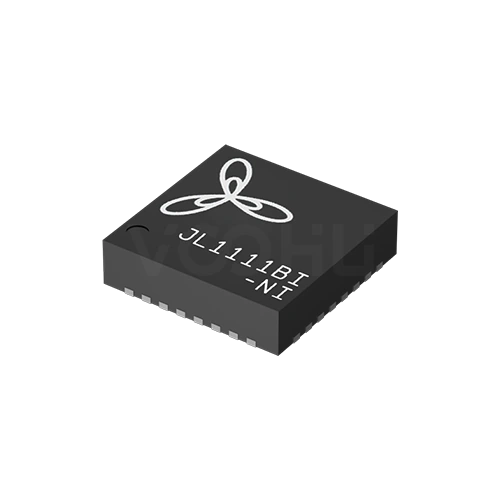
An EtherCAT slave needs a PHY that runs IEEE 802.3 100BASE-TX (or 100BASE-FX) at 100 Mbit/s full duplex and connects to the EtherCAT slave controller (ESC), preferably over MII. Beckhoff's PHY selection guide lists the must-haves: auto-negotiation, MDI/MDI-X auto-crossover, an RX_ER signal, an unchanged preamble, no Energy Efficient Ethernet, a 100 Mbit/s link signal, and a configuration that works from power-on without software. It also recommends a link loss reaction time faster than 15 µs, a 25 MHz clock and an industrial temperature range. VOOHU is a distributor of JLSemi Ethernet PHYs, including the EtherCAT-marked JL1111BI-NI(EtherCAT), and supplies the 10/100 LAN transformers that sit between the PHY and the RJ45.
What is the EtherCAT physical layer?
EtherCAT uses 100 Mbit/s full-duplex Ethernet, so on the cable side an EtherCAT port looks like a Fast Ethernet port: aPHY, a LAN transformer and a connector, or a 100BASE-FX fiber transceiver. The difference is behind the PHY. Instead of a normal Ethernet MAC, the PHY connects to an EtherCAT slave controller, which, in the words of Beckhoff's guide, handles EtherCAT communication as the interface between the fieldbus and the slave application and processes frames on the fly. That is why EtherCAT does need special hardware: the ESC. A slave usually has two ports, one towards the master and one onward to the next slave, so it carries two PHYs.
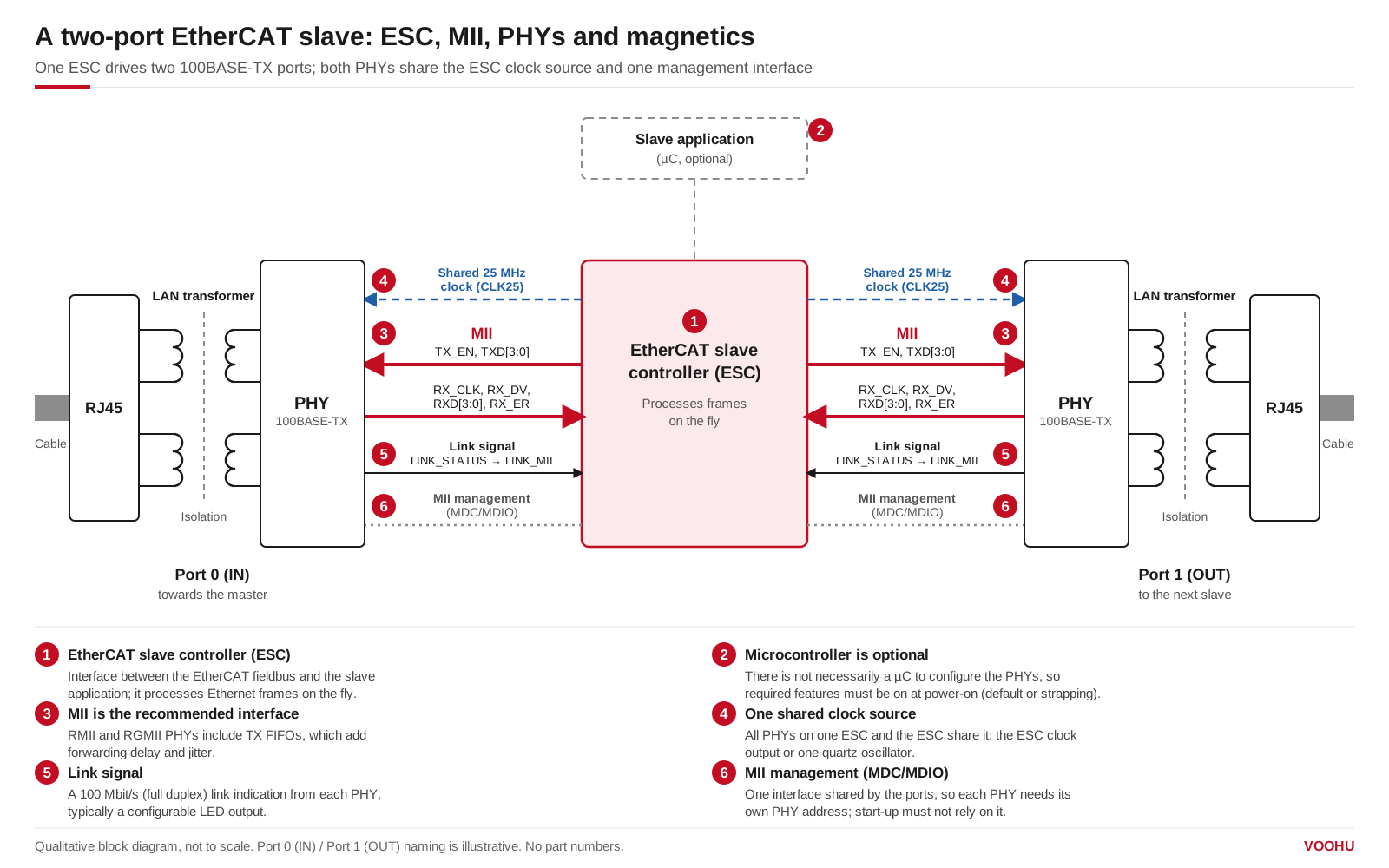
A two-port EtherCAT slave: the ESC connects to each PHY over MII and shares one clock source with both PHYs; each PHY drives its port through a LAN transformer. Simplified diagram.
EtherCAT PHY requirements: what a PHY has to do
Beckhoff, a maker of EtherCAT slave controllers, keeps the reference list in itsapplication note "PHY selection guide"(version 3.2, October 2025). Its general requirements for EtherCAT at 100 Mbit/s are that the PHY complies with IEEE 802.3 100BASE-TX or 100BASE-FX, including:
- support for 100 Mbit/s full-duplex links;
- an MII interface (RMII or RGMII is also listed);
- auto-negotiation in 100BASE-TX mode;
- the MII management interface;
- MDI/MDI-X auto-crossover in 100BASE-TX mode;
- no change to the Ethernet frame preamble length;
- no use of IEEE 802.3az Energy Efficient Ethernet;
- a minimum cable length of 0 m;
- an RX_ER signal that indicates invalid symbols both during frames and in the inter-frame gap;
- keeping an additional nibble at the end of a frame without marking it with RX_ER;
- a signal that indicates a 100 Mbit/s (full-duplex) link, typically a configurable LED output.
The guide notes that state-of-the-art Ethernet PHYs typically fulfil these.
Two more requirements catch designers out because an EtherCAT device does not necessarily have a microcontroller to set up the PHY. First, configuration must not rely on the MII management interface: required features have to be active after power-on, by default or by strapping options. Second, the ESCs share one MII management interface across the ports, so each PHY needs its own address, and addresses 0–3 are recommended, with none of them used as a broadcast or isolate address.
EtherCAT MII or RMII: why MII is recommended
Beckhoff recommends MII for EtherCAT because RMII and RGMII PHYs include TX FIFOs, which increase the forwarding delay of a slave and the forwarding jitter. Its MII-based ESCs leave out the transmit FIFO to keep forwarding delay low, and that brings two conditions: all PHYs on one ESC and the ESC itself must share the same clock source, and the phase between TX_CLK and the PHY's clock input must be fixed every time the PHYs power up or link, unless the ESC can compensate it automatically. For how MII, RMII and RGMII differ in general, seeMII vs RMII vs RGMII vs SGMII.
Link loss reaction time and the other recommendations
The best-known number in the guide is a recommendation, not a requirement: the PHY's link loss reaction time, from link loss to a change of the link signal or LED output, should be faster than 15 µs to enable redundancy operation, also when only one of the RX+ and RX− lines is disconnected. If a PHY is slower, enhanced link detection must be enabled in the ESC; it uses the RX_ER signal. The guide adds that enhanced link detection is usually disabled in robust applications without redundancy and has to be enabled in redundant networks. Its other recommendations include a 25 MHz clock source (a quartz oscillator or the ESC's clock output), 3.3 V I/O, an industrial temperature range, ESD tolerance of 4 kV or better, support for cables up to 120 m, baseline wander compensation, and restricting auto-negotiation advertisement to 100 Mbit/s full duplex by strapping.
EtherCAT PHY selection guide: how to check a candidate PHY
The Beckhoff guide also has tables of example PHYs, but it is clear about what they mean. The lists collect information from datasheets, vendors and some basic hardware tests; they "do not imply any kind of certification for EtherCAT", and Beckhoff writes that "it is likely that other devices and devices from many vendors meet the requirements as well". So the practical method is the same for any PHY: take the requirement list above, check each item against the PHY's full datasheet, decide which features must be set by strapping, and test the PHY with the ESC you use.
EtherCAT PHY chip: checking the JL1111 against the list
The JL1111 is a single-port Fast Ethernet PHY from JLSemi, distributed by VOOHU. In the JL1111 series, VOOHU's PHY selector marks one part for EtherCAT,JL1111BI-NI(EtherCAT), and lists it with an MII interface and a −40 to 85 °C temperature range. The table below sets the main Beckhoff items against the JL11x1 product brief, a one-page summary that covers the whole series.
| Beckhoff item | JL11x1 product brief / VOOHU selector | How to confirm |
|---|---|---|
| IEEE 802.3 100BASE-TX | "100Base-TX IEEE 802.3u Compliant" | Stated in the brief |
| 100 Mbit/s full duplex | "Full/half duplex operation" | Stated in the brief |
| MII interface (recommended) | "Supports MII mode" (the brief also lists RMII); the selector lists JL1111BI-NI(EtherCAT) as MII | Stated |
| Auto-negotiation | "Supports Auto-Negotiation" | Stated in the brief |
| MDI/MDI-X auto-crossover | "Supports auto MDIX" | Stated in the brief |
| 25 MHz clock source | "Supports 25MHz external crystal or OSC" | Stated in the brief; ask our FAE team about TX_CLK phase |
| 3.3 V supply | "Single power supply 3.3V" | Stated in the brief |
| Industrial temperature range | −40 to 85 °C for JL1111BI-NI(EtherCAT) in the VOOHU selector | Listed |
| MII management interface, PHY address, strapping | Not stated in the product brief | Ask our FAE team (full datasheet) |
| RX_ER behaviour, preamble and end-of-frame nibble | Not stated in the product brief | Ask our FAE team (full datasheet) |
| EEE disabled | Not stated in the product brief | Ask our FAE team (full datasheet) |
| 100 Mbit/s link signal | Not stated in the product brief | Ask our FAE team (full datasheet) |
| Link loss reaction time (recommended <15 µs) | Not stated in the product brief | Ask our FAE team (full datasheet) |
A "not stated" row means only that the one-page brief does not cover that detail; it says nothing either way about the PHY. RX_ER behaviour, preamble handling, EEE, the link signal, strapping options and link loss timing belong in the full datasheet and register description, and our FAE team can check each of them against the full JL1111 datasheet for the ESC you use. One note on wording: the brief's "Link Down Power Saving" is a power-saving feature, not a link loss reaction time, so do not read it as one. For the series overview and theJL1111 datasheet, see the series page, or compare variants in thePHY selector.
Which LAN transformer does an EtherCAT port use?
A 100BASE-TX EtherCAT port uses a 10/100 LAN transformer between the PHY and the connector, as any Fast Ethernet port does. The Beckhoff guide sets requirements for the PHY and does not specify the magnetics, so choose the transformer to suit the PHY's MDI interface and your temperature range. Two VOOHU 10/100 parts in surface-mount packages:
- WHS40005TG: operating temperature −40 to +85 °C, the same range the selector lists for JL1111BI-NI(EtherCAT); isolation 1500 VAC, 1 mA, 60 s.
- WHS16002GA: −40 to +125 °C for boards that run hotter; isolation 1500 VAC, 1 mA, 60 s.
Neither transformer datasheet names a specific PHY, so ask our FAE team to confirm the center-tap connection for the JL1111 in your design. More options are in the10/100BASE-TX LAN transformer selectorand the10/100 LAN transformer family.
产品WHS40005TG
方案/solution-ethernet/
FAQ
Q1: Is EtherCAT full duplex?
Yes. EtherCAT uses 100 Mbit/s full-duplex Ethernet, and the Beckhoff PHY selection guide requires the PHY to support 100 Mbit/s full-duplex links. Its MII signal table notes that EtherCAT uses full duplex only, which is why the collision and carrier-sense signals are not used.
Q2: Can I build an EtherCAT slave with an STM32 and a standard Ethernet PHY?
Not with the microcontroller's Ethernet MAC alone. An EtherCAT slave needs an EtherCAT slave controller between the fieldbus and the application, and the PHYs connect to the ESC. The microcontroller then runs the slave application and talks to the ESC. Unless your MCU has an ESC built in, add one, and choose PHYs that meet the requirements above.
Q3: Does EtherCAT use RJ45?
A 100BASE-TX EtherCAT port uses the same twisted-pair physical layer as Fast Ethernet, so an RJ45 jack with a 10/100 LAN transformer, or a jack with integrated magnetics, is a common choice. The Beckhoff guide also covers 100BASE-FX, where the port is a fiber transceiver instead.
Q4: Is there an EtherCAT certification for PHYs?
The Beckhoff PHY selection guide does not certify PHYs. It states that its example lists do not imply any kind of certification for EtherCAT and that devices from many vendors are likely to meet the requirements. What matters is whether a PHY meets the requirement list and works with your ESC, which you confirm from the full datasheet and by testing.
Request JL1111 EtherCAT PHY samples and a requirement check
Designing an EtherCAT slave? Tell us the ESC you use, the number of ports, MII or fiber, and your temperature range through oursample and support form. Our FAE team can check the JL1111BI-NI(EtherCAT) against the requirement items above using the full datasheet, suggest a matching 10/100 LAN transformer, and help check the design. Samples are available for evaluation, and selected parts are free of charge. Our FAE team will be glad to confirm the options for your project. VOOHU is a distributor of JLSemi Ethernet PHYs. VOOHU supplies RJ45 and SFP connectors, LAN and PoE transformers and common mode chokes from Suzhou, China, to more than 1,500 customers.