
VOOHU Field Guide: Troubleshooting Gigabit Ethernet Ports — Link-Up Failure, Packet Loss and Overheating, with Magnetics Selection
VOOHU Field Guide: Troubleshooting Gigabit Ethernet Ports — Link-Up Failure, Packet Loss and Overheating, with Magnetics Selection
A gigabit Ethernet port (1000BASE-T) is a near-mandatory feature on almost every switch, router, IP camera (IPC) and industrial gateway board — and it is also one of the interfaces most likely to bite back during bring-up. In the field, engineers keep running into the same three high-frequency failures: the link will not come up (or silently drops to 100 Mbps), random packet loss with a rising bit-error rate, and a network-port area that runs noticeably hot once the device is fully loaded. All three share one trait: a software-only investigation usually finds nothing, and the real culprit turns out to hide in the invisible physical-layer details — the LAN transformer, the common-mode choke, the protection devices, and the PCB layout.
Gigabit signaling upgrades the 100 Mbps-era two-pairs-one-direction scheme to four pairs, full duplex, 125 MHz PAM-5 in both directions on every pair. That places far tighter demands on the insertion loss, return loss, common-mode rejection ratio (CMRR) and intra-pair skew of the magnetics. Even a small selection or layout error quietly eats into the link margin and later surfaces as a negotiation, error-rate or thermal problem. Below we take the three failures apart from a physical-layer standpoint and map each to a concrete VOOHU in-stock selection answer.
Failure 1: No link, or link drops to 100 Mbps — the hidden traps in the transformer and termination
Gigabit auto-negotiation exchanges capability information over the differential pairs using a burst of Fast Link Pulses (FLP). If negotiation keeps failing, or the link cycles negotiate-drop-renegotiate, do not rush to swap the PHY — the problem is very likely in the port magnetics. The three classic traps: first, a part-number mismatch — using a two-pair 10/100M transformer or integrated RJ45 in a four-pair gigabit slot physically removes two channels, so the link falls back to 100 Mbps or fails entirely; second, excessive leakage inductance and stray capacitance degrade the FLP pulse edges and amplitude, so the negotiation threshold is misjudged; third, a wrong or missing center-tap / Bob-Smith termination network breaks the common-mode balance of the pairs, and the PHY DSP cannot lock and converge.
The parameters that matter: insertion loss, return loss and CMRR
A qualified gigabit LAN transformer must hold insertion loss no worse than 1.0 dB across 1–100 MHz, sufficient return loss (typically better than about -14 dB at 100 MHz), and CMRR better than about -30 dB at 30 MHz. When a part falls short it rarely dies outright — instead the link only misbehaves under long cable runs, high temperature or strong interference, giving the classic works-on-the-bench, drops-in-the-field symptom. Choosing a genuinely compliant 1000BASE-T transformer, and handling the center tap and termination strictly to the datasheet, is the fundamental fix here.
Failure 2: Random packet loss, errors and EMC test failures — common-mode noise and impedance discontinuity
At the physical layer, packet loss is simply the bit-error rate (BER) exceeding what the PHY can correct. Gigabit 1000BASE-T uses PAM-5, where the level spacing between symbols is only a few millivolts, so any common-mode noise, crosstalk or reflection riding on the pairs can flip a symbol — which shows up as ping loss, iperf throughput that will not climb, and a steadily rising CRC error count. There are usually three root causes: common-mode noise coupling, where switching-supply ripple and clock harmonics couple into the pairs through the PCB ground plane or the cable; excessive intra-pair skew from inadequate length matching, which erodes the convergence margin; and ESD/TVS devices with high parasitic capacitance that create an impedance step at gigabit frequencies and wreck the return loss.
What the common-mode choke does, and EMC remediation
The LAN transformer already provides some common-mode rejection, but when the EMC radiated-emission (RE) or immunity (EFT/surge) margin is thin, a signal-line common-mode choke in series on the transformer network side gives the common-mode current a second interception while barely touching the differential signal. Pick a part whose common-mode impedance is high across the noise band (commonly 30–300 MHz) yet whose rated current still covers the PoE bias. This is exactly why many gigabit ports that fail radiated emissions by 3–6 dB pass simply by adding one well-chosen common-mode choke.
Failure 3: Overheating under load and PoE bias saturation — DCR and bias current
When a device runs fully loaded and the connector-plus-transformer area is clearly hotter than the surrounding parts, two causes are usually at work. First, the transformer winding DC resistance (DCR) is too high, producing I²R heating under the PoE bias current (whether as a powered device, PD, or power sourcing equipment, PSE). Second, the core drifts toward saturation under DC bias: the open-circuit inductance (OCL) falls and losses rise, creating a vicious hotter-more-saturated-hotter cycle. Gigabit-plus-PoE deserves special attention: the center tap may carry hundreds of milliamps up to 1.5 A or more of DC, so you must choose a transformer that explicitly specifies a rated PoE current and an inductance-retention figure under DC bias (OCL vs. bias current) — not one judged on small-signal AC parameters alone.
An often-overlooked detail is the thermal behavior of the integrated magnetic RJ45 (magnetic jack). Packing the transformer inside the connector shell leaves little room and a poor heat path, making it more temperature-sensitive under high PoE current. Either pick a part that explicitly supports the target PoE class, or — for high-power PoE such as PoE++ / 90 W — switch to a discrete transformer plus a standalone RJ45 to buy back thermal headroom.
VOOHU gigabit-port selection strategy: from it links to it is reliable
For all three failure classes, VOOHU offers a one-stop lineup spanning magnetics, connectors, protection devices and PHY/switch silicon, letting engineers choose along either a discrete or an integrated path.
Magnetics: discrete LAN transformer vs. integrated magnetic RJ45
For the best signal integrity, thermal design and multi-PoE-class flexibility, choose a discrete gigabit LAN transformer — 100/1000 BASE-T LAN transformers, single-port parts such as WHSG24301JM and WHSG24701D1, or dual-port parts such as WHDG48201P1, with isolation from 1500 to 4000 Vrms and 4PPoE bias support. When space, cost and layout simplicity dominate, choose an integrated magnetic RJ45 — the SYT-series integrated RJ45 (for example SYT811B198FA2A10DQB), which packs the transformer, common-mode choke, RJ45 body and LEDs into one housing — ideal for space-constrained IP cameras and consumer routers.
Common-mode suppression and port protection: EMC and surge remediation
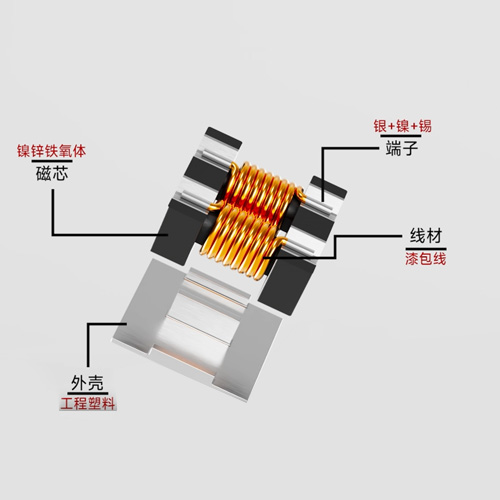
When EMC or surge margin runs short, add a signal-line common-mode choke on the transformer network side — a compact WHLC2012A series part, or a high-impedance WHAC3225B series — to suppress common-mode radiation. For port protection, use a tiered low-capacitance ESD + bidirectional TVS + GDT scheme: put a low-capacitance ESD diode (parasitic capacitance as low as 0.3 pF) on the signal lines so gigabit integrity is untouched, and let a bidirectional TVS and a gas discharge tube (GDT) bleed off the high surge energy in stages. On the PHY side, an Ethernet PHY (such as the gigabit JL2101 series) completes end-to-end impedance and parameter matching.
Quick selection table
|
Observed symptom |
Physical-layer root cause |
VOOHU selection answer (P/N or category) |
|
No link / drops to 100 Mbps |
Part mismatch, high leakage, wrong center-tap termination |
Gigabit WHSG24301JM / WHDG48201P1 (100/1000 BASE-T) |
|
Random loss, rising CRC errors |
Common-mode coupling, impedance step, intra-pair skew |
Signal-line choke WHLC2012A + low-cap ESD |
|
Radiated emissions over by 3–6 dB |
Port common-mode current radiating |
Add WHAC-3225B signal-line common-mode choke |
|
Surge damages the port |
Insufficient protection tiering |
Low-cap ESD + bidirectional TVS + GDT |
|
Overheating under load / PoE |
High winding DCR, DC bias saturation |
PoE-rated WHSG/WHDG gigabit transformers |
|
Tight space, cost pressure |
Discrete parts use too much board area |
Integrated magnetic RJ45 (transformer + magnetics + LED) |
Conclusion: get selection right, and get the gigabit port right the first time
The three gigabit-port failures — negotiation, packet loss and thermal — look wildly different on the surface, yet almost all trace back to the same roots: the electrical parameters, common-mode rejection and DC-carrying capability of the magnetics. Get selection right — a truly compliant gigabit transformer to protect negotiation and signal integrity, a signal-line common-mode choke plus tiered protection to protect EMC and surge margin, and PoE-rated parts to protect against thermal rise — and the vast majority of field failures are killed in the design phase rather than fought over and over in mass production and on site.
VOOHU is built on a simple promise — to make connections more reliable — offering complete selection and sampling support from LAN transformers, integrated magnetic RJ45, common-mode chokes and ESD/TVS/GDT protection to PHY and switch silicon. Rather than firefighting in the field, choose the right components once at design time: it is the shortest path to a simpler design, a higher first-pass yield and long-term reliability.