

Performance category
Confirm Cat5e/Cat6 in the part specification rather than inferring an absent category from its name.

I/O Connector products
A Cat5e coupler joins two cable runs on a gigabit link without re-terminating either end. Keep the coupler category at or above the cable category, and remember that every inline join adds a discontinuity the channel has to absorb.
Part number search & selector
The table uses the current English-site product records, published selection fields and part-specific technical-file links.
* Frozen Image and Part Number columns · drag horizontally to review all specifications
| Image | Datasheet | Compare | Downloads |
Network Level
|
Transmission Bandwidth
|
Shield
|
Gold plating of contacts
|
Panel
|
Sample |
|---|
| Image | Part number | Datasheet | Compare | Downloads | Network Level | Transmission Bandwidth | Shield | Gold plating of contacts | Panel | Sample |
|---|---|---|---|---|---|---|---|---|---|---|
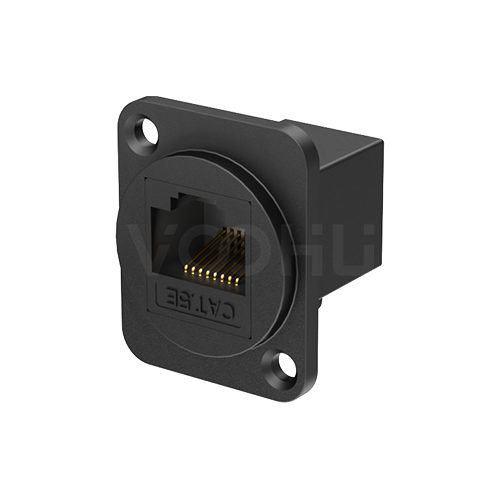 |
SYTZT1188IWA17DY3S2T5E387A | SPEC | Cat5e | 100MHz | NO | 3U | YES |
|
||
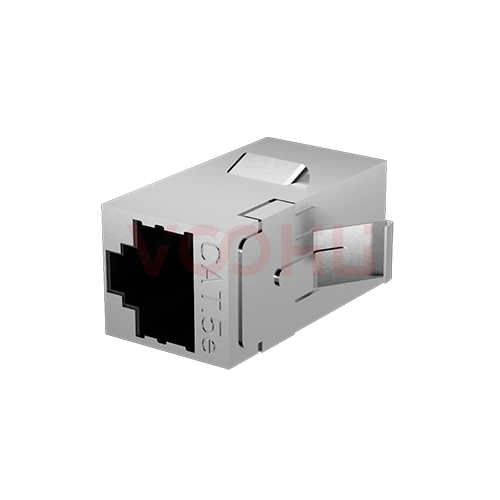 |
SYTZT1188GWC8D3T5E387 | SPEC | Cat5e | 100MHz | YES | 6U | NO |
|
Broaden the selected filters or clear the current search.
Product family quick links
Counts reflect the current published product data.
How to select
Narrow the published fields in sequence, compare the remaining candidates and verify the part-specific files before design-in.
Specify both interfaces, gender and contact mapping; assess any one-to-two adapter separately.
Choose documented Cat5e or Cat6 candidates for the channel; missing fields are not a pass.
Review shield grounding, panel retention, cutout and cable clearance.
Test at the intended length, data rate and power conditions, then send the part number, quantity and timing for a quote.
Key selection parameters
Confirm Cat5e/Cat6 in the part specification rather than inferring an absent category from its name.
MHz describes frequency, not achieved data rate in Mb/s.
Review shield continuity and grounding across the coupler, cables and equipment.
Check clips/fasteners, cutout, panel thickness and access on both sides.
Verify plating location and units and contact mapping; a one-to-two adapter is not an ordinary inline coupler.
Product family comparison
Use this summary as a routing step, then verify every required value in the exact part-number row and linked technical files.
Return to the selector ↑Technical performance & application fit
Application suitability is part-number specific. Treat the catalog fields as a shortlist, then confirm the design against the linked technical files.
Downloads & technical resources
Search a full or partial SKU, then open its datasheet, 3D model or PCB footprint without returning to the product table.
Showing representative available file sets. Search to find a specific SKU.
VOOHU’s published product content is reviewed by its engineering team. Specifications, downloads and technical support information are tied to specific part numbers, so you can verify them before requesting samples or a quotation.
Category overview
Couplers are simple parts, but two questions come up constantly: whether they slow the link, and which category to use.
Discuss a new design
Contact FAE for a replacement assessment.
Already have a part number? Request samples or a quote.
A coupler mates two RJ45 plugs back to back, so two existing cable runs become one channel without cutting and re-terminating either end. That is its whole purpose: extending or repairing a run with existing patch leads rather than making up a new cable.
Not in the sense people usually mean. A coupler does not reduce the negotiated link speed. It adds a connection point, which introduces an impedance discontinuity and a small insertion loss. On a short gigabit run that sits inside the margin. Near the length limit, or at 10G, it consumes margin already thin.
The channel performs to its weakest element, so a Cat5e coupler caps a Cat6A channel at Cat5e. Use a coupler at or above the category of the cable and the link. On screened installations, use a shielded coupler so the screen stays continuous through the join, or the shielding is defeated at that point.
FAQ & related guides
These answers guide the page workflow. Part-specific engineering limits still come from the linked technical files.
Yes. Cat5e is rated for gigabit Ethernet, so a coupler at this grade suits a gigabit link provided the cable on both sides is also Cat5e or better. The coupler should never be the lowest rated element in the channel.
Not in normal use. An inline join adds a small impedance discontinuity and some loss, but on a gigabit link within the standard length limit that margin is usually ample. Problems appear when the run is already near the length limit or the installation is poor.
Category rating. Cat6 is specified for higher bandwidth and tighter performance limits, which matters if the link runs 10G over a short distance or if the installed cable is Cat6. On a plain gigabit link with Cat5e cable, the Cat5e coupler is the matched choice.
Yes. The 100 metre channel limit covers the whole path, so two joined runs must total within it. Inserting a coupler does not extend the permitted distance; it simply avoids re-terminating when joining two existing runs.
With a complete part number, send the part number, quantity, delivery region and the date you need it. If you are still selecting, send the cable category, the total run length and whether the coupler needs shielding.
Engineer support
Send the candidate part number and the condition you need reviewed. Sample support can be added after the selection is clear; commercial questions may be discussed in the same engineering conversation.
Include the document revision
Temperature, isolation voltage and PoE current basis
Pin count, pitch and spacing between pin rows
To help prioritize samples and evaluation
When you need candidates and a comparison of differences
Engineering review identifies candidate parts and explains the differences.
From the selector or engineering review
Prototyping / pilot build / production
Specify sample and production timing separately
Compliance documents, material declarations or third-party reports
Samples are free of charge. Sample quantity and lead time depend on the part number and project stage. Sales will respond on business days.