8+2 port layout
Eight external ports run 100M over copper; each MII port connects to a MAC, such as the host or a cascade link, as the datasheet allows.

Ethernet Interface Chip products
JL5110 provides eight external 100M ports plus two MII uplinks in a QFN88 package at 10 by 10 millimetres. Two uplinks allow one link to the host and one to cascade a second switch, extending the port count.
Part number search & selector
Filter the JL5110 by port layout, interface mode, MAC and supply voltage, temperature, package and size.
* Frozen Image and Part Number columns · drag horizontally to review all specifications
| Image | Datasheet | Compare | Downloads |
Series
|
Data Rate
|
Ports
|
Interface Mode
|
MAC interface voltage
|
External supply voltage
|
Copper Port
|
Optical Port
|
Temperature
|
Package
|
Size
|
Sample |
|---|
| Image | Part number | Datasheet | Compare | Downloads | Series | Data Rate | Ports | Interface Mode | MAC interface voltage | External supply voltage | Copper Port | Optical Port | Temperature | Package | Size | Sample |
|---|---|---|---|---|---|---|---|---|---|---|---|---|---|---|---|---|
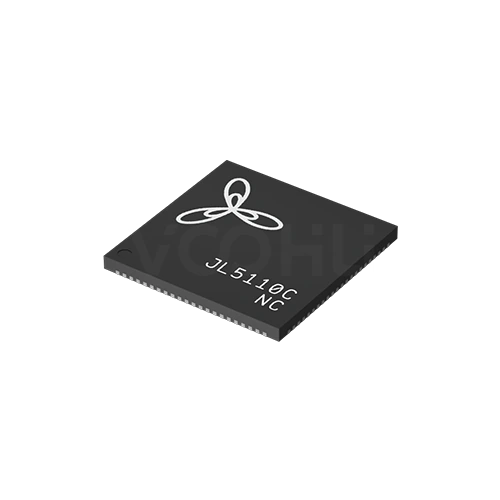 |
JL5110C-NC | SPEC | JL5110 series | 100M | 8+2 | MII | 3.3V | 3.3V(1.1V)¹ | 10 Base-T | NA | 0~70℃ | QFN88 | 10*10 mm |
|
Broaden the selected filters or clear the current search.
By port topology
Port notation such as 5+1 means five external ports plus one host uplink.
Series overview
The JL5110 Ethernet switch IC serves two MACs from one 100M switch: eight external copper ports plus two MII ports, listed as 8+2. Counting both MII ports, it is a 10 port Ethernet switch IC in QFN88 at 10 × 10 mm and a commercial grade. For one host port, compare the JL5109; for gigabit with fiber, the JL6110 series.
Eight external ports run 100M over copper; each MII port connects to a MAC, such as the host or a cascade link, as the datasheet allows.
Both MII ports list a 3.3 V MAC interface voltage, so each connected MAC needs MII at 3.3 V I/O.
JL5110C-NC uses QFN88 at 10 × 10 mm with a 3.3 V (1.1 V) supply listing; leave room for both MII groups.
Plan magnetics and an RJ45 jack for every copper port; see our 10/100 Ethernet transformers. Keep the port pairs clear of the MII groups.
Applications
A second MII port lets one board chain switches or serve two MACs.
A product needing more than eight 100M ports can cascade a second switch chip over the spare MII port, where the datasheet allows.
Data concentrators can give the processor an MII link and serve field devices on the copper ports.
A machine controller can join the plant network through MII and connect drives, I/O or HMIs in panels within 0 to 70 °C.
Documents
Open the JL5110 Ethernet switch IC datasheet, then confirm the MII pin groups, supply sequence and QFN88 outline.
Showing representative available file sets. Search to find a specific SKU.
VOOHU’s published product content is reviewed by its engineering team. Specifications, downloads and technical support information are tied to specific part numbers, so you can verify them before requesting samples or a quotation.
Sourcing
The JL5110 is supplied by VOOHU as an authorized JLSemi distributor; its datasheet (PDF) is the reference for MII timing, supply rails and package.
Discuss a new design
Contact FAE for a replacement assessment.
Already have a part number? Request samples or a quote.
Samples are available for evaluation, and selected parts are free of charge. Our FAE team will be glad to confirm the options for your project. Share the quantity and project stage for a quote, and we will confirm availability.
To replace a 100M switch IC with two MAC ports, send its part number and datasheet. Our FAE team compares MII, register and layout differences and suggests JL5110 candidates for sample validation before production.
VOOHU is ISO 9001 and ISO 14001 certified. Since 2018 VOOHU has supplied more than 1,500 customers, including 150+ listed companies. Our FAE team answers JLSemi switch IC design questions.
FAQ
Sourcing, temperature range and the gigabit alternative.
The common arrangement is one link to the host controller so it can join the network, and one cascading to a second switch device to extend the port count. Whether specific combinations are supported is defined in the datasheet, so confirm the intended topology rather than inferring it from the port count.
It can be. All traffic crossing between the two devices passes through that single link at its interface speed. If your traffic pattern sends a lot across the boundary, the cascade becomes the limit for the whole design. Estimate the cross-device traffic before choosing this topology.
They share the port count, uplink type, package and temperature grade. The only difference is the number of uplinks: JL5109 has one, JL5110 has two. If you need both a host connection and a cascade, JL5110 is required; if one link is enough, JL5109 is simpler.
Often that is the better answer. A single device with enough ports avoids the cascade bottleneck and simplifies the design. Cascading makes sense when port count exceeds what one device offers, or when the physical arrangement of the product requires two separate boards.
With a complete part number, send the part number, quantity, delivery region and the date you need it. If you are still selecting, describe the port topology including any cascade, and the expected traffic pattern across the devices.
As an authorized JLSemi distributor, VOOHU quotes JL5110C-NC, arranges samples and offers FAE review of the MII connections and port circuits.
Not in the selector: JL5110C-NC is listed at 0 to 70 °C. For −40 to +85 °C with a host link, look at the JL5106 at 100M or the gigabit JL6110 series.
The JL5110 is a 100M Ethernet switch IC with MII at 3.3 V, in QFN88 at 10 × 10 mm. The JL6110 runs gigabit, adds 1000BASE-X fiber and uses TQFP176 at 20 × 20 mm, with an industrial option.
Engineer support
Send the candidate part number and the condition you need reviewed. Sample support can be added after the selection is clear; commercial questions may be discussed in the same engineering conversation.
Include the document revision
Temperature, isolation voltage and PoE current basis
Pin count, pitch and spacing between pin rows
To help prioritize samples and evaluation
When you need candidates and a comparison of differences
Engineering review identifies candidate parts and explains the differences.
From the selector or engineering review
Prototyping / pilot build / production
Specify sample and production timing separately
Compliance documents, material declarations or third-party reports
Samples are free of charge. Sample quantity and lead time depend on the part number and project stage. Sales will respond on business days.