
VOOHU Selection Guide: LAN-Transformer Selection, Cost-Down and EMC Pitfall-Avoidance for Home & Consumer Router/Switch Ports
VOOHU Selection Guide: LAN-Transformer Selection, Cost-Down and EMC Pitfall-Avoidance for Home & Consumer Router/Switch Ports
Consumer-grade products such as home routers, desktop switches, set-top boxes (STB), optical modems (ONU) and smart-speaker ports share two labels: high volume and cost sensitivity. On a home router shipping in the millions, saving a few cents of port BOM adds up to real annual profit; and making the board a little larger, or placing a few extra parts, magnifies production cost too. Yet the port's LAN transformer (or integrated magnetic RJ45) is exactly the part that "drives cost, drives space and decides whether you pass certification smoothly." The daily headache for engineers is the constant trade-off between "cost-down" and "passing EMC while keeping link quality": pick the magnetics too rich and cost blows out; pick them too cheap and you fail radiated-emissions testing or long-cable compatibility.
This article skips the exotic frontier tech and focuses on the three most practical things about a consumer port: how to find the lowest-total-cost choice between discrete magnetics and integrated magnetic RJ45; how to pick the right 10/100-vs-gigabit speed and part for the product's positioning; and how to cut cost without spending away your EMC margin. It closes with a VOOHU in-stock selection strategy and a quick-reference table, so engineers can make "cheap" and "reliable"—two goals that look contradictory—happen in one pass.
Challenge 1: The Dual Pressure of Cost and Space — Discrete Magnetics vs Integrated Magnetic RJ45
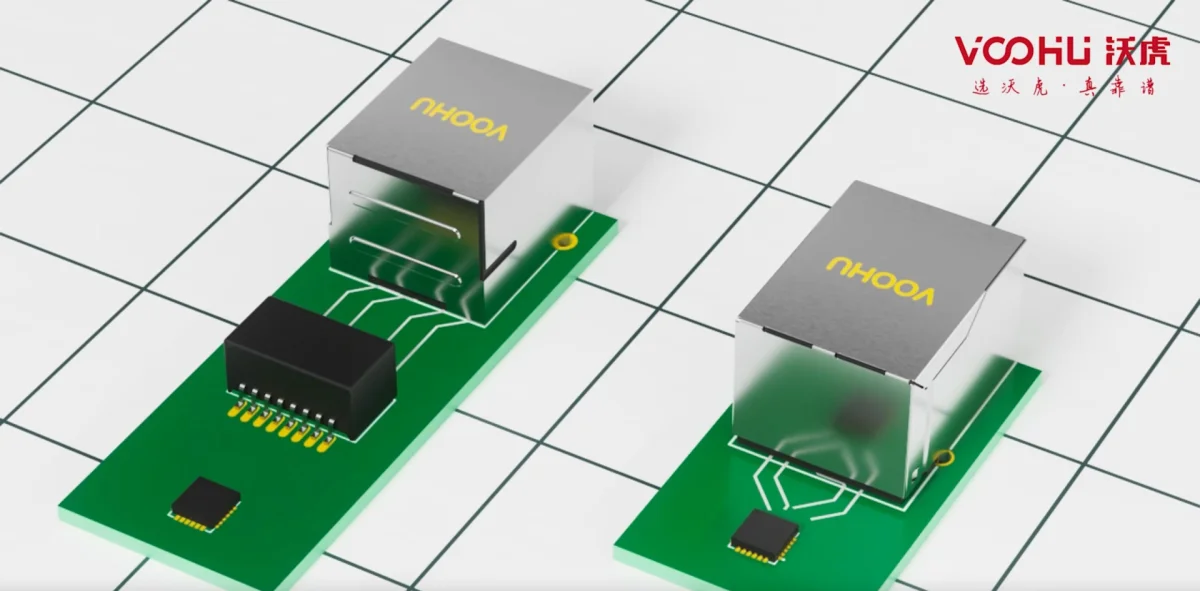
A consumer BOM stretches every cent, and the space inside the box is usually crowded by the power stage, antennas and shield cans—so the port scheme has to balance "part unit price" against "board area + placement cost." The two mainstream paths each trade something off. The discrete path uses a standalone LAN transformer plus an ordinary RJ45: the transformer is cheap and multi-sourced, suiting models that are not board-area constrained and chase the lowest material cost. The integrated magnetic RJ45 (magnetic jack) packs transformer, common-mode choke, RJ45 body and even LEDs into one part: the unit price is a bit higher, but it removes the transformer's board footprint and one placement step, shortens the differential traces and lowers the chance of routing errors—ideal for space-tight home routers and set-top boxes that want a simpler line. Which is really cheaper must be settled on the total of "part price + board-area cost + placement cost + defect rate," not on unit price alone.
Single/Multi-Port Schemes and Part-Number Consolidation
Desktop switches and multi-port routers often have four to eight ports, where a multi-port LAN transformer or multi-port integrated RJ45 sharply cuts part count and placement points—a powerful cost-down lever. Beyond that, when building a product family, consolidate port part numbers as much as possible—several models sharing one transformer or integrated RJ45—to grow purchasing volume and spread development and certification cost. In selection, favor a versatile part whose parameters cover the common speeds, so one part serves several models: cheaper and easier to manage than choosing a different part for every model.
Challenge 2: 100M or Gigabit? — Match Speed and Part to Product Positioning
The most common waste on a consumer port is picking the wrong speed tier. Entry-level set-top boxes, older ONUs and low-end APs are perfectly fine with a 100M (10/100BASE-TX) port, yet fitting a gigabit LAN transformer wastes money; conversely, a high-end gaming or NAS router with only a 100M port becomes an experience bottleneck. The right move is to match the product's positioning: a 100M port uses a dedicated 10/100 transformer—simplest structure, lowest cost; a gigabit port (10/100/1000BASE-T) must use a dedicated gigabit transformer with four winding pairs, open-circuit inductance (OCL) ≥ 350μH and 100m cable support. The winding count and parameters of the two are not interchangeable—never mix them, or you get downshifts at best and no link at worst.
OCL, Insertion Loss and Cable Compatibility
Even among gigabit transformers, whether the parameters are up to spec decides whether the link "runs a full 100m over a cheap cable." Low open-circuit inductance (OCL) raises low-frequency insertion loss and leaves too little link margin over long cables; sub-par insertion loss and return loss make downshifts more likely on no-name or aged cables. Consumer products must especially account for the wildly varied cabling on the user side, so choose a transformer with margin on OCL, insertion loss and return loss to cut down the nasty "it won't connect with one particular cable at the customer's home" support tickets. Cost-down is fine, but these core AC parameters cannot be skimped.
Challenge 3: Cost-Down Must Not Mean EMC-Down — Cheaper Ways to Pass CE/FCC
Consumer electronics must pass EMC certification such as CE (EU) or FCC (US) to reach market, and the port is precisely the hot spot for radiated (RE) and conducted (CE) emissions. Choosing cheap magnetics with poor common-mode rejection to save cost often means over-limit radiation at the certification stage, forcing shield cans, board respins and retests—so the "material money saved" is paid back several times over in rework and delay, making it more expensive overall. Truly smart cost-down leaves enough EMC margin at design time: hold the first line with a LAN transformer whose CMRR is up to spec, add a small signal-line common-mode choke on the network side for a second interception when needed, and treat the center tap and Bob-Smith termination strictly per spec. These cost very little yet greatly raise the odds of passing certification the first time.
Common-Mode Suppression and Low-Cost Protection
Protection is the same story: a home device does not face the heavy surge an industrial one does, but it still has to handle ESD and the induced surge common on household cabling. A low-capacitance ESD diode of 0.3pF class on the pairs barely touches gigabit signal integrity, costs little, and markedly improves the port's ESD immunity and reliability. This "small input, big return" protection is the sweet spot between cost and reliability for a consumer product, and it also lowers the field-return rate after volume shipment.
VOOHU Consumer-Port Selection Strategy: Get Cost and Reliability Right Together
Around the consumer-port demand to be "cheap, certifiable and easy to manage," VOOHU offers a complete lineup from 100M to gigabit and from discrete to integrated, backed by common-mode chokes, low-capacitance protection, PHY and switch ICs—helping engineers get the port right in one pass at the best total cost.
LAN Transformer and Integrated Magnetic RJ45 Selection
For 100M models, choose a 10/100 BASE-T LAN transformer—simplest structure, lowest material cost; for gigabit models, choose a 100/1000 BASE-T LAN transformer, single-port such as WHSG24301JM and WHSG24701D1, and for multi-port switches/routers a dual-port to cut part count. When space is tight or you want a simpler line, the first choice is an integrated magnetic RJ45, the (e.g. SYT811B198FA2A10DQB), packing transformer, common-mode choke, RJ45 and LEDs into one part to save area, save placement and shorten traces—a real cost-down lever for home routers and set-top boxes.
Common-Mode Suppression, Protection and PHY/Switch IC Pairing
When you need EMC margin, add a small signal-line common-mode choke on the network side, such as the WHLC2012A series, to buy radiated-test pass rate at very little cost; for pair protection choose a low-capacitance ESD protection diode (0.3pF class) that balances ESD immunity with signal integrity. On the silicon side, pair an Ethernet PHY (JL1101 = 10/100, JL2101 = gigabit) with a switch IC to match parameters across the whole port link and consolidate part numbers; see the consumer-electronics application solutions for a system view.
Selection Quick-Reference Table
|
Consumer-Port Cost-Down Need |
Selection Key |
VOOHU Selection Answer (P/N · Category) |
|
Entry STB/ONU, 100M is enough |
Do not over-spec to gigabit |
10/100 BASE-T LAN transformer |
|
Gigabit home router, single port |
OCL ≥ 350μH, 100m support |
WHSG24301JM / WHSG24701D1 |
|
4–8 port desktop switch |
Cut part count / placement points |
Dual-port WHDG48201P1 (100/1000 BASE-T) |
|
Tight space, simpler line |
Save area + placement step |
Integrated magnetic RJ45 SYT series |
|
CE/FCC radiated over limit |
Low-cost common-mode fix |
Compact WHLC-2012A signal-line CMC |
|
Better ESD, low-cost protection |
Low-cap, no SI harm |
0.3pF low-cap ESD |
|
Consolidate P/N across models |
Spread purchasing & certification cost |
Conclusion: Get "Cheap" and "Reliable" Right in One Pass
Cost-down on a consumer port is never "pick whatever part is cheapest," but adding up part price, board area, placement cost, certification risk and field returns together, and choosing the right speed, the right discrete/integrated path and enough EMC and cable-compatibility margin at design time. Match the product positioning, save space with integrated magnetic RJ45, spread cost with multi-port schemes and part-number consolidation, and hold certification and reliability with one small common-mode choke and a low-capacitance ESD—that is the answer that saves money without blowing up.
With "make the connection more reliable" as its founding purpose, VOOHU provides complete selection support and samples for consumer ports—spanning 100M/gigabit LAN transformers, integrated magnetic RJ45, common-mode chokes, low-capacitance protection, PHY and switch ICs. For cost-sensitive volume products, helping customers get the port right in one pass at the best total cost is exactly what we do best.