

Voohu Electronics Push-Pull Converter Solutions
In industrial electronic design, achieving power supply isolation and stable output is a key aspect of ensuring reliable system operation.
VOOHU Electronics offers a complete isolated voltage switching regulation solution based on a push-pull topology. Through a carefully selected combination of components, it meets the isolated power supply requirements of applications such as industrial servos and communication interfaces.
Solution Structure and Technical Principles
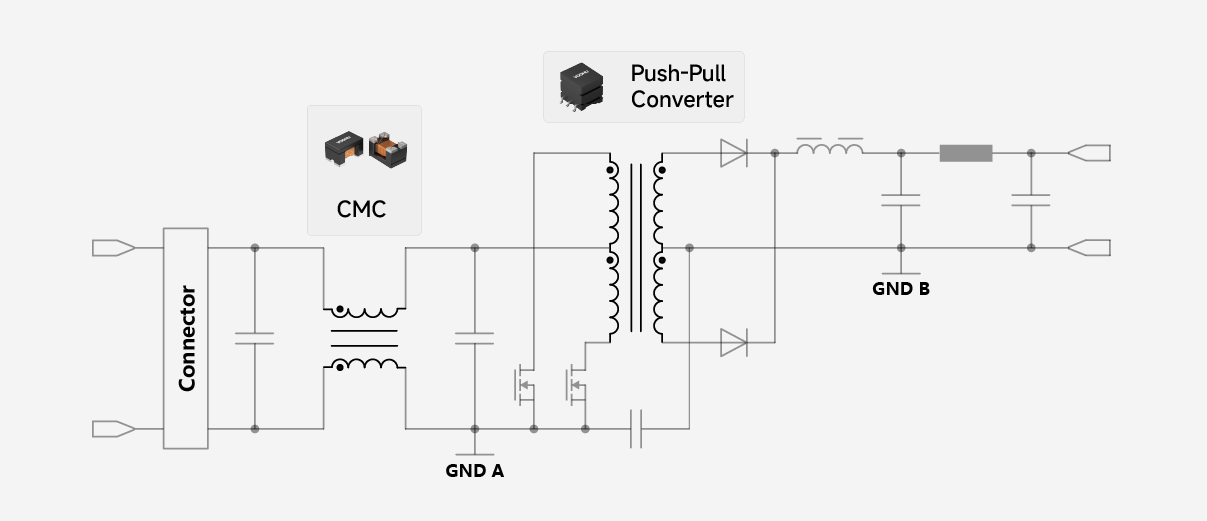
This solution (push-pull transformer solution) adopts a push-pull topology. Through the coordinated operation of the following core functional modules, it achieves input-to-output voltage conversion and electrical isolation:
Input Filtering
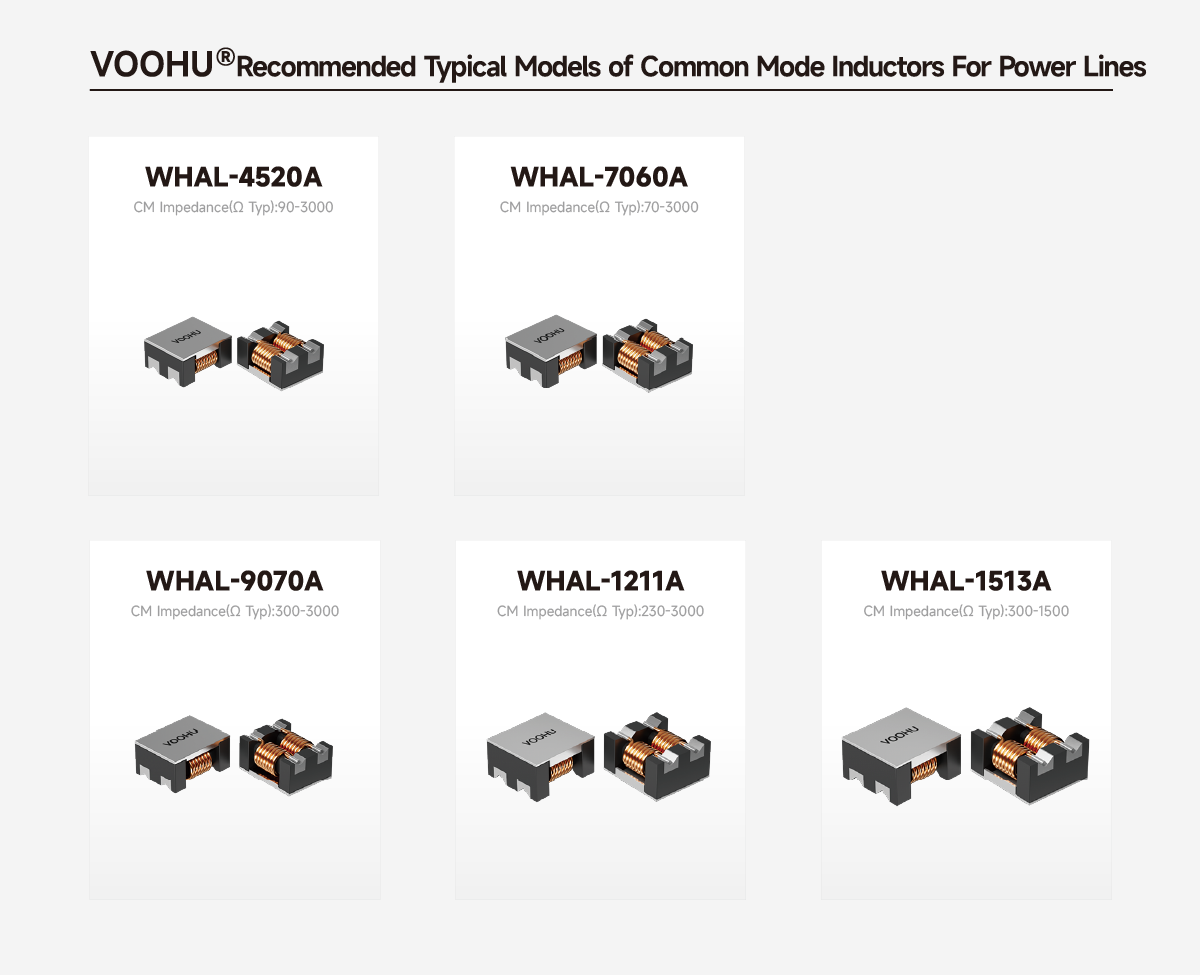
The solution uses a common-mode inductor (CMC) at the power input as an input filter to suppress common-mode interference signals from the mains or upstream power supply. Currently available power common-mode inductors include the 7060, 9070, and 1211 series. Different sizes and inductance values correspond to different rated currents and filtering characteristics, allowing designers to select the appropriate type based on the actual power rating. The purpose of input filtering is to ensure the quality of the current entering the switching devices, providing relatively clean input energy for subsequent circuits.
Switching Oscillation
The filtered DC current needs to be converted into a high-frequency AC square wave. This process is accomplished by electronic switches. The solution can use transistors or MOSFETs as switching devices, which receive PWM (Pulse Width Modulation) signals from the controller and alternately turn on and off at a set frequency. Through this high-frequency switching action, the DC current is inverted into a high-frequency pulse current, which is fed to the primary winding of the push-pull transformer.
Transformation and Isolation
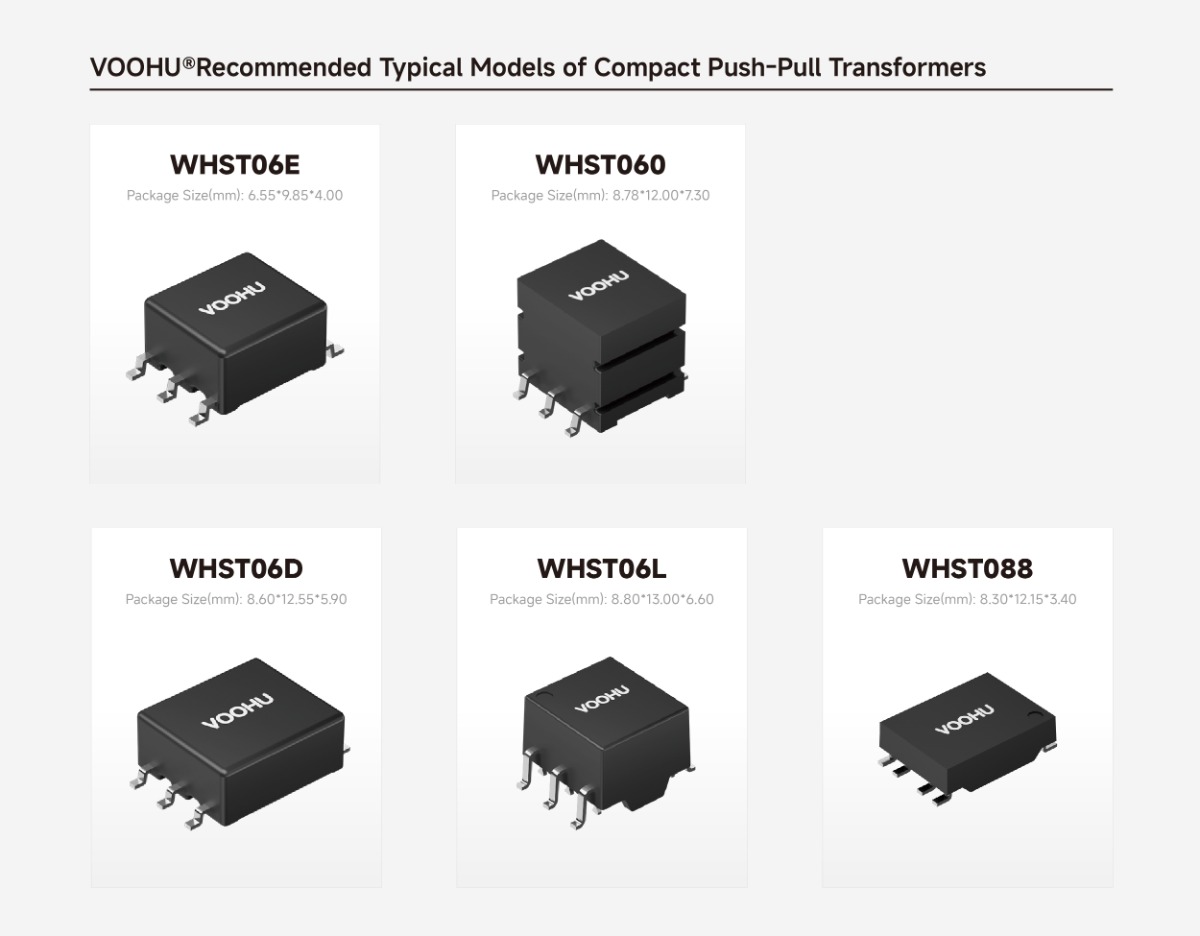
The push-pull transformer is the core component for achieving voltage conversion and electrical isolation. Currently available transformer series include 060, 06K, 06E, 06Q, and 088, each differing in package size, pin definitions, and electrical parameters to accommodate various PCB layout requirements.
The transformer operates based on electromagnetic induction: when a high-frequency pulse current is applied to the primary winding, an alternating magnetic field is generated in the core, inducing a corresponding voltage in the secondary winding. The output voltage is determined by the turns ratio of the primary and secondary windings; during design, a suitable turns ratio can be selected to convert the input voltage to the desired output voltage value. Simultaneously, there is no direct electrical connection between the primary and secondary windings, achieving electrical isolation between the input and output sides. This is crucial for preventing high-voltage side faults from entering the low-voltage control circuit.
Rectification and Filtering
The high-frequency AC square wave output from the transformer secondary winding needs to be converted into a stable DC current to supply the load.
Rectification: A diode-based rectifier circuit is used to convert the AC square wave into a unidirectional pulsating DC waveform.
Filtering: The rectified waveform contains high-frequency ripple components, which need to be smoothed by an LC filter network composed of a filter capacitor and a filter inductor. The charging and discharging characteristics of the capacitor combined with the inductor's opposition to current changes can effectively prevent sudden changes in current and voltage, ultimately outputting a stable DC voltage with low ripple.
Typical Application Scenarios
This solution has a broad application base in the industrial control field, mainly reflected in the following two aspects:
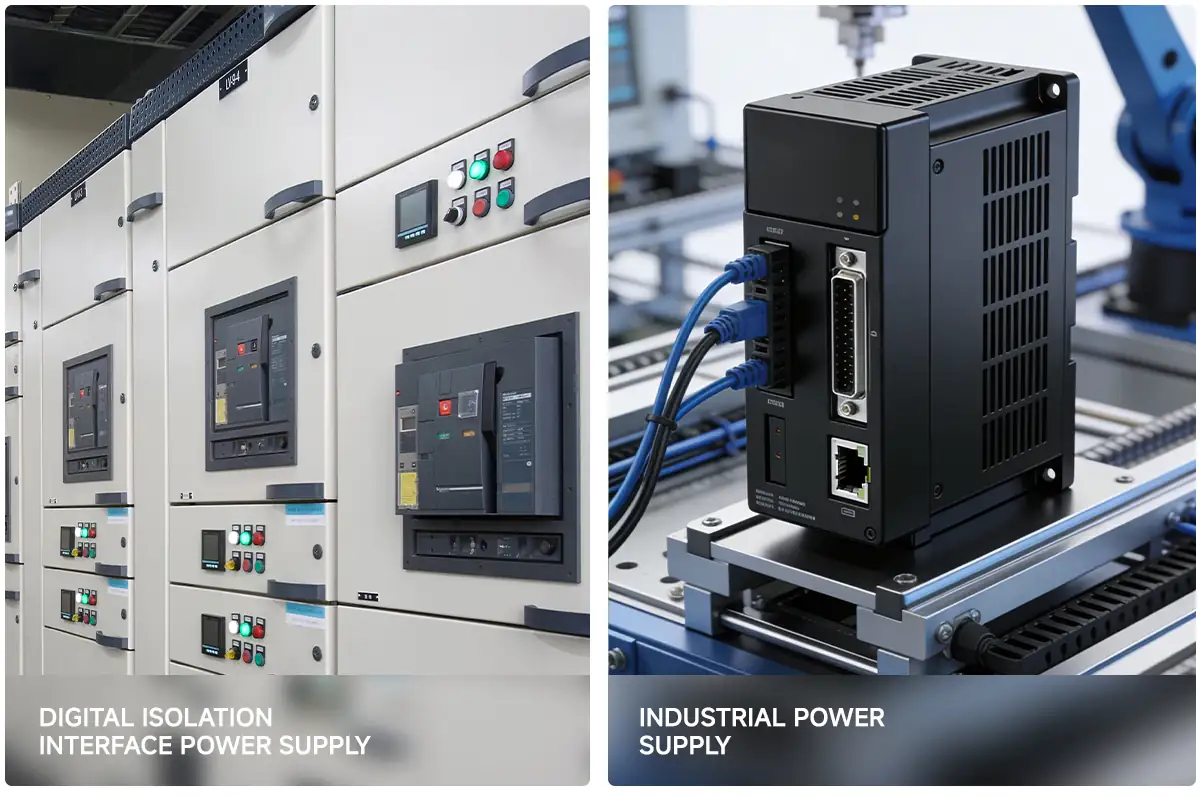
Application 1: Powering Digital Isolation Interfaces
In industrial environments, bus communications such as RS485 and CAN often face the problem of ground potential difference interference. If the power supply end of the communication interface is not isolated, the isolation device may fail due to excessive common-mode voltage.
This solution can serve as an isolated power supply for digital isolation ICs, providing the communication interface side with an operating voltage that is electrically isolated from the system's main power supply. When the power supply end is isolated, the communication bus can truly possess the ability to resist common-mode interference, preventing the isolation device from losing its isolation function due to potential fluctuations at the construction site, and ensuring the reliability of data transmission.
Application 2: Industrial Power Supply
In addition to powering communication interfaces, this solution is also suitable for a wider range of industrial power supply scenarios. In industrial drive systems, multiple isolated auxiliary power supplies are often required for powering control circuits, drive circuits, etc.
The push-pull topology-based power supply solution can achieve high-power output while maintaining output voltage stability. By selecting appropriate power inductors, transformers, and switching devices, this solution can provide stable and reliable power supply support for industrial equipment under a wide input voltage range and different load conditions.
Founded in 2018 and with its overseas expansion planned for 2025, VOOHU Electronics has become a reliable partner for over 1000 companies thanks to its "superior quality, reasonable prices, attentive service, and reliable delivery."
If you're also looking for a "worry-free, cost-effective, and convenient" supplier of communication electronic components, consider VOOHU. After all, the choice of over 100 listed companies is a sure bet.
Choose VOOHU – truly reliable. This isn't just a slogan; it's the answer written with the trust of over 1000 customers over 8 years.
VOOHU Electronics offers a complete isolated voltage switching regulation solution based on a push-pull topology. Through a carefully selected combination of components, it meets the isolated power supply requirements of applications such as industrial servos and communication interfaces.
Solution Structure and Technical Principles
This solution (push-pull transformer solution) adopts a push-pull topology. Through the coordinated operation of the following core functional modules, it achieves input-to-output voltage conversion and electrical isolation:
Input Filtering
The solution uses a common-mode inductor (CMC) at the power input as an input filter to suppress common-mode interference signals from the mains or upstream power supply. Currently available power common-mode inductors include the 7060, 9070, and 1211 series. Different sizes and inductance values correspond to different rated currents and filtering characteristics, allowing designers to select the appropriate type based on the actual power rating. The purpose of input filtering is to ensure the quality of the current entering the switching devices, providing relatively clean input energy for subsequent circuits.
Switching Oscillation
The filtered DC current needs to be converted into a high-frequency AC square wave. This process is accomplished by electronic switches. The solution can use transistors or MOSFETs as switching devices, which receive PWM (Pulse Width Modulation) signals from the controller and alternately turn on and off at a set frequency. Through this high-frequency switching action, the DC current is inverted into a high-frequency pulse current, which is fed to the primary winding of the push-pull transformer.
Transformation and Isolation
The push-pull transformer is the core component for achieving voltage conversion and electrical isolation. Currently available transformer series include 060, 06K, 06E, 06Q, and 088, each differing in package size, pin definitions, and electrical parameters to accommodate various PCB layout requirements.
The transformer operates based on electromagnetic induction: when a high-frequency pulse current is applied to the primary winding, an alternating magnetic field is generated in the core, inducing a corresponding voltage in the secondary winding. The output voltage is determined by the turns ratio of the primary and secondary windings; during design, a suitable turns ratio can be selected to convert the input voltage to the desired output voltage value. Simultaneously, there is no direct electrical connection between the primary and secondary windings, achieving electrical isolation between the input and output sides. This is crucial for preventing high-voltage side faults from entering the low-voltage control circuit.
Rectification and Filtering
The high-frequency AC square wave output from the transformer secondary winding needs to be converted into a stable DC current to supply the load.
Rectification: A diode-based rectifier circuit is used to convert the AC square wave into a unidirectional pulsating DC waveform.
Filtering: The rectified waveform contains high-frequency ripple components, which need to be smoothed by an LC filter network composed of a filter capacitor and a filter inductor. The charging and discharging characteristics of the capacitor combined with the inductor's opposition to current changes can effectively prevent sudden changes in current and voltage, ultimately outputting a stable DC voltage with low ripple.
Typical Application Scenarios
This solution has a broad application base in the industrial control field, mainly reflected in the following two aspects:
Application 1: Powering Digital Isolation Interfaces
In industrial environments, bus communications such as RS485 and CAN often face the problem of ground potential difference interference. If the power supply end of the communication interface is not isolated, the isolation device may fail due to excessive common-mode voltage.
This solution can serve as an isolated power supply for digital isolation ICs, providing the communication interface side with an operating voltage that is electrically isolated from the system's main power supply. When the power supply end is isolated, the communication bus can truly possess the ability to resist common-mode interference, preventing the isolation device from losing its isolation function due to potential fluctuations at the construction site, and ensuring the reliability of data transmission.
Application 2: Industrial Power Supply
In addition to powering communication interfaces, this solution is also suitable for a wider range of industrial power supply scenarios. In industrial drive systems, multiple isolated auxiliary power supplies are often required for powering control circuits, drive circuits, etc.
The push-pull topology-based power supply solution can achieve high-power output while maintaining output voltage stability. By selecting appropriate power inductors, transformers, and switching devices, this solution can provide stable and reliable power supply support for industrial equipment under a wide input voltage range and different load conditions.
Founded in 2018 and with its overseas expansion planned for 2025, VOOHU Electronics has become a reliable partner for over 1000 companies thanks to its "superior quality, reasonable prices, attentive service, and reliable delivery."
If you're also looking for a "worry-free, cost-effective, and convenient" supplier of communication electronic components, consider VOOHU. After all, the choice of over 100 listed companies is a sure bet.
Choose VOOHU – truly reliable. This isn't just a slogan; it's the answer written with the trust of over 1000 customers over 8 years.
share to
Newsletter subscription
Subscribe to our newsletter and stay updated on the latest information of our company and product.
Name
|
Subscribe
I agree that the information that I provide will be used in accordance with the terms of Voohu International Inc. Privacy & Cookies Policy