WHALD03G4UESD

Protective Component products
ESD Protection Diodes
ESD devices clamp fast static discharge while adding as little capacitance as possible, which is what a USB, Ethernet or HDMI port needs. Place them close to the connector with a short path to ground, then verify the eye diagram on the real link.
Part number search & selector
Find ESD Protection Diodes part numbers
The table uses the current English-site product records, published selection fields and part-specific technical-file links.
* Frozen Image and Part Number columns · drag horizontally to review all specifications
| Image | Datasheet | Compare | Downloads |
Polarity
|
Vrwm/V
|
Vesd Air/Vesd Contact
|
Cj/pf
|
Package
|
Operating Temperature
|
Sample |
|---|
| Image | Part number | Datasheet | Compare | Downloads | Polarity | Vrwm/V | Vesd Air/Vesd Contact | Cj/pf | Package | Operating Temperature | Sample |
|---|---|---|---|---|---|---|---|---|---|---|---|
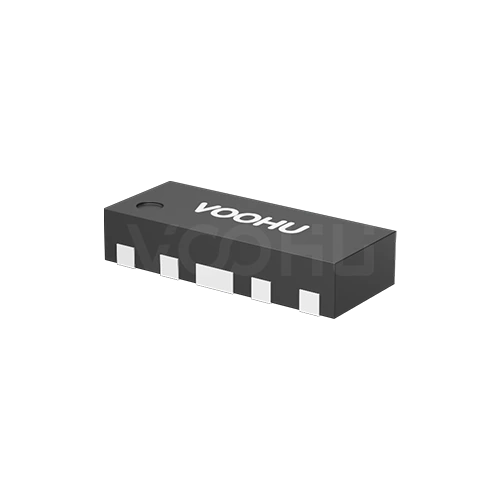 |
WHALD03G4U | SPEC | ESD | 3.3 | ±15KV/±12KV | 0.3 | DFN2510-10L | -40 °C to 125 °C |
|
||
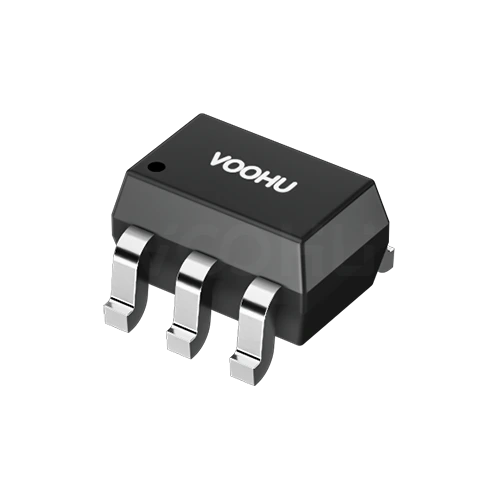 |
WHTA5V01P2C | SPEC | ESD | 5 | ±20KV/±20KV | 1.2 | SOT-363 | -40 °C to 125 °C |
|
||
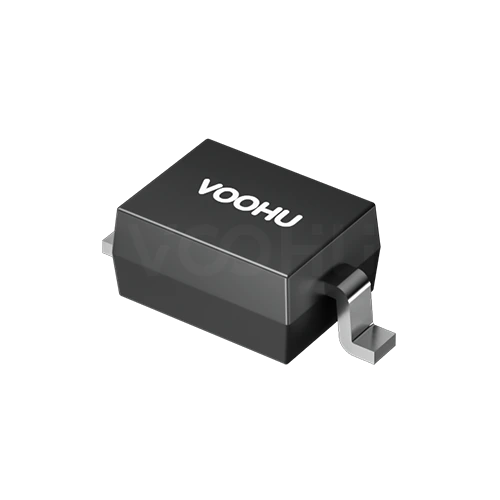 |
WHTA3V30P8B | SPEC | ESD | 3.3 | ±30KV/±30KV | 0.8 | SOD323 | -40 °C to 125 °C |
|
No matching part numbers
Broaden the selected filters or clear the current search.
By polarity
Unidirectional and bidirectional devices
Polarity follows the signal: unidirectional for DC rails, bidirectional for AC and differential lines.
How to select
Selection guide for TVS Diodes and ESD Protection Devices
Selection steps, parameter explanations and the series comparison for TVS Diodes and ESD Protection Devices are on one page. Confirm the series there, then use this list for part numbers, files and samples.
Open the TVS Diodes and ESD Protection Devices selection guide →
Documents
TVS and ESD datasheets
Datasheets carry the clamping curve, pulse waveform conditions and capacitance.
Showing representative available file sets. Search to find a specific SKU.
- 3
- PDF datasheets listed
- 0
- 3D file sets listed
- 0
- PCB footprints listed
VOOHU’s published product content is reviewed by its engineering team. Specifications, downloads and technical support information are tied to specific part numbers, so you can verify them before requesting samples or a quotation.
FAQ
TVS and ESD questions engineers ask
Answers cover TVS against ESD, polarity choice, capacitance and placement.
How does an ESD protection diode work?
It sits in parallel between the signal line and ground. In normal operation it is high impedance and draws almost nothing. When a static discharge arrives it conducts rapidly, diverting the energy to ground and holding the voltage within what the downstream chip survives. Response speed and residual voltage decide how well it protects.
Why does low capacitance matter?
The device is a parallel load on the signal line. High speed interfaces are sensitive to capacitive loading: it attenuates high frequency content, degrades the eye and raises return loss. Low capacitance parts exist specifically so protection can be fitted without costing link margin.
Where should it be placed?
As close to the connector or the point of entry as possible, with the path to ground as short and wide as the layout allows. Stray inductance in that path adds voltage overshoot during a fast discharge. The signal must not reach the protected chip before it reaches the device.
How do I choose the standoff voltage?
Above the highest voltage the signal line reaches in normal operation, including any common mode offset. Too low and the device leaks or triggers during normal communication. Too high and the clamping voltage rises, which reduces how well the downstream chip is protected.
How do I request samples or a quote?
With a complete part number, send the part number, quantity, delivery region and the date you need it. If you are still selecting, send the interface type, the data rate, the working voltage and the discharge level you must withstand.
Engineer support
Continue after product selection
Send the candidate part number and the condition you need reviewed. Sample support can be added after the selection is clear; commercial questions may be discussed in the same engineering conversation.
- 1Selected part numbers
- 2Engineering review
- 3Sample request
- 4Commercial discussion
For a replacement review
- Original part and datasheet
Include the document revision
- Operating conditions
Temperature, isolation voltage and PoE current basis
- Package constraints
Pin count, pitch and spacing between pin rows
- Project stage and annual volume
To help prioritize samples and evaluation
- Target review date
When you need candidates and a comparison of differences
Engineering review identifies candidate parts and explains the differences.
For samples and a quotation
- Candidate part numbers
From the selector or engineering review
- Quantity and project stage
Prototyping / pilot build / production
- Required delivery date
Specify sample and production timing separately
- Required documentation
Compliance documents, material declarations or third-party reports
Samples are free of charge. Sample quantity and lead time depend on the part number and project stage. Sales will respond on business days.
Published replacement reviews
Push-Pull Transformer Selection Comparison: VOOHU WHST06Q02E0 vs. Würth Elektronik 750316819
View all alternatives