

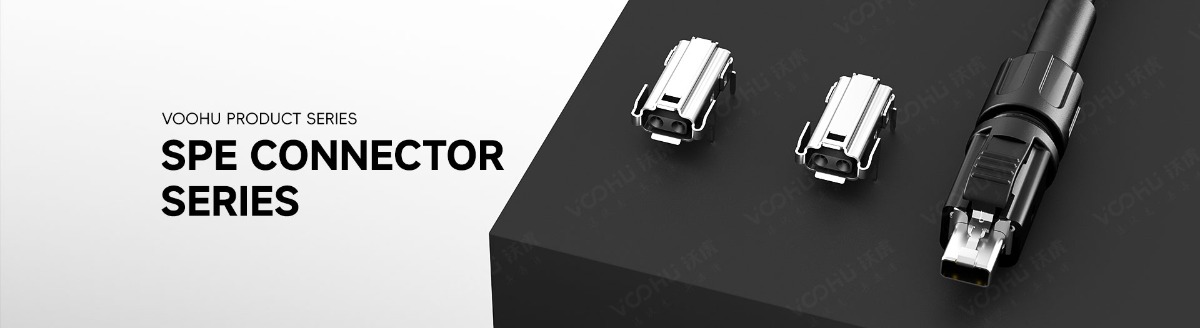
【PRODUCT BASIC INTRODUCTION】SINGLE-PAIR ETHERNET(SPE) CONNECTOR
In the traditional industrial automation pyramid, the field layer (sensors, actuators) and the control layer (PLC) have long been separated by various closed, low-speed fieldbuses (such as Profibus, CAN, IO-Link, etc.).
This architecture leads to complex cabling, high protocol conversion costs, and numerous data silos, severely hindering the data transparency and cloud collaboration advocated by the Industrial Internet of Things (IIoT) and Industry 4.0.
Single Pair Ethernet (SPE) was developed to end this situation. It aims to extend the power, openness, and high speed of Ethernet to every tiny field device in an unprecedentedly streamlined way—using only a single twisted pair of cables. As the core of this technology's physical infrastructure, the SPE connector, with its standardized, high-performance, and industrial-grade design, is becoming the cornerstone for building next-generation all-IP factory networks.
More SPE related information on this site: SPE Connector、 SPE: Single-Pair Ethernet Solution、SPE Single-Pair Ethernet Solution (Phase 2)、SPE Standard Circuit Design Reference
I. Structural Introduction (From Outside to Inside)
1. Metal Shielding Shell (Outermost Layer)
Material:
· Stainless steel / nickel-plated zinc alloy, matte finish
Function:
· Provides 360° continuous electromagnetic shielding, suppressing EMI
· Serves as mechanical support, enhancing vibration/shock resistance
· Forms metal-to-metal contact with the plug's metal shielding shell, ensuring shielding continuity
· Has 4 metal solder feet at the bottom for soldering to the PCB ground plane, achieving reliable grounding
2. Insulator Body
Material: High-temperature engineering plastic (such as PA66, PPS), UL94V-0 flame retardant rating, standard mating surface on the front with two socket openings corresponding to the plug pins one-to-one
3. Contacts
· 2 (differential pair, A/B lines)
Material:
· Copper alloy (such as brass), gold-plated contact area, tin-plated tail
Function:
· Transmits high-speed differential signals, carries... PoDL Current
4. PCB Mounting
4 Metal Shielding Shell Solder Pins: Soldered to the PCB ground plane for shielding grounding.
2 Contact Solder Pins: Soldered to the PCB signal layer for transmitting differential signals.
Function:
· Cooperates with the locking arm of the plug to form a mechanical lock, preventing accidental dislodgement.
· The shielding plate usually has an enhanced locking device to ensure that the shielding contact does not fail.
II. Classification
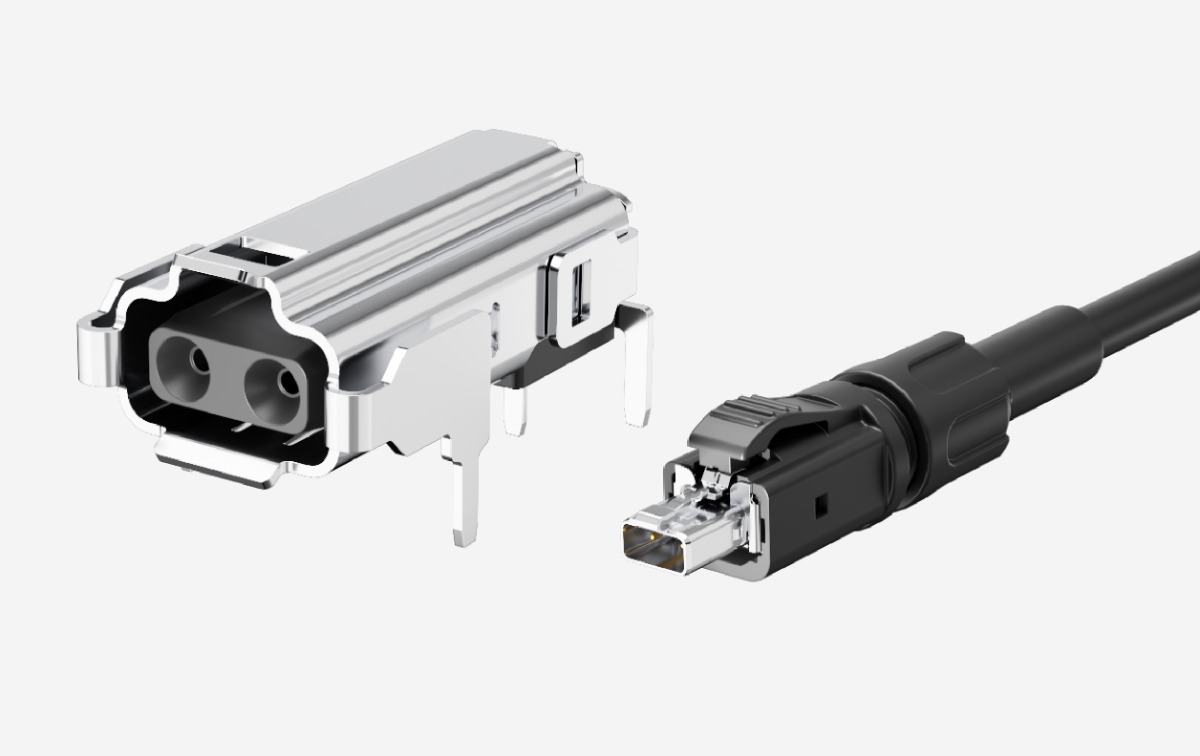
1. Horizontal SPE IP20 PCB Socket
This is currently the most mainstream form in industrial SPE applications.
Structural Features: The connector body is attached to the PCB surface, and the pins are parallel to the PCB, suitable for board edge routing where space is limited.
2. Vertical SPE IP20 PCB Socket
Structural features: The connector body stands upright on the PCB, and the pins are perpendicular to the PCB. It is suitable for scenarios that need to withstand frequent plugging and unplugging or vertical cable routing.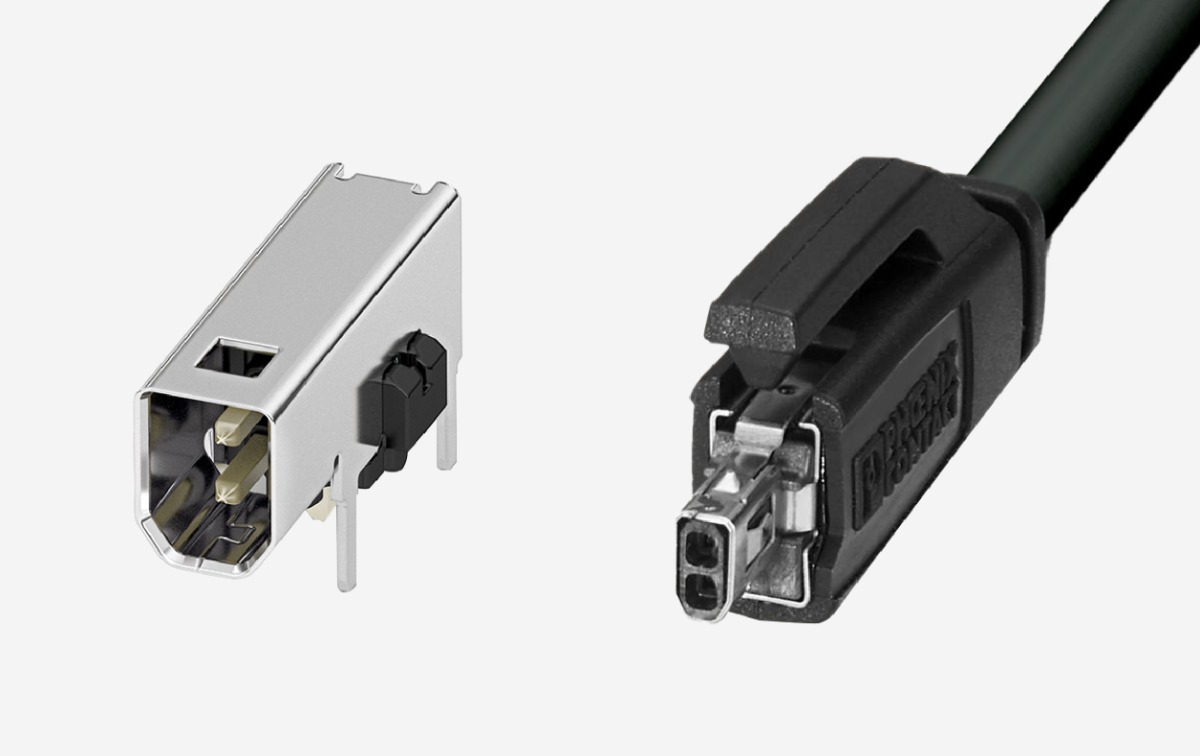
Advantages:
1. Compared to 2-pair and 4-pair cabling, single-pair cables reduce cost, weight, and space requirements.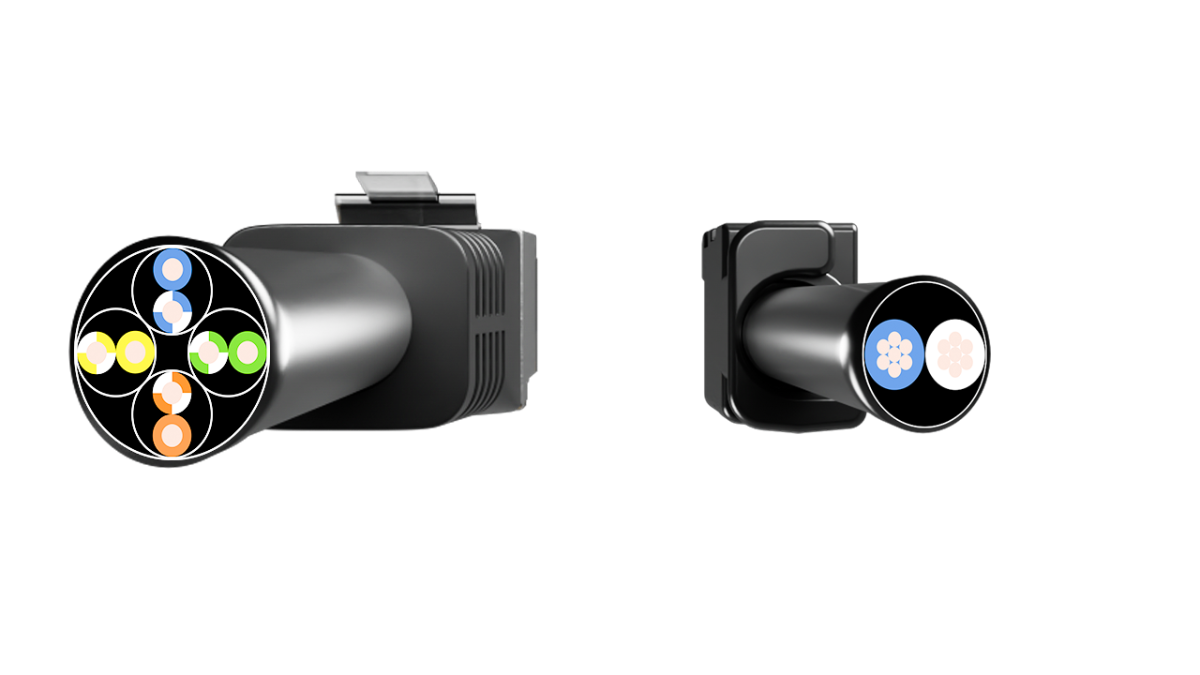
3. Supports Ethernet protocols with a network segment length of 40 meters and a data rate of 1Gb/s, and a network length of 1 kilometer and a data rate of 10Mb/s.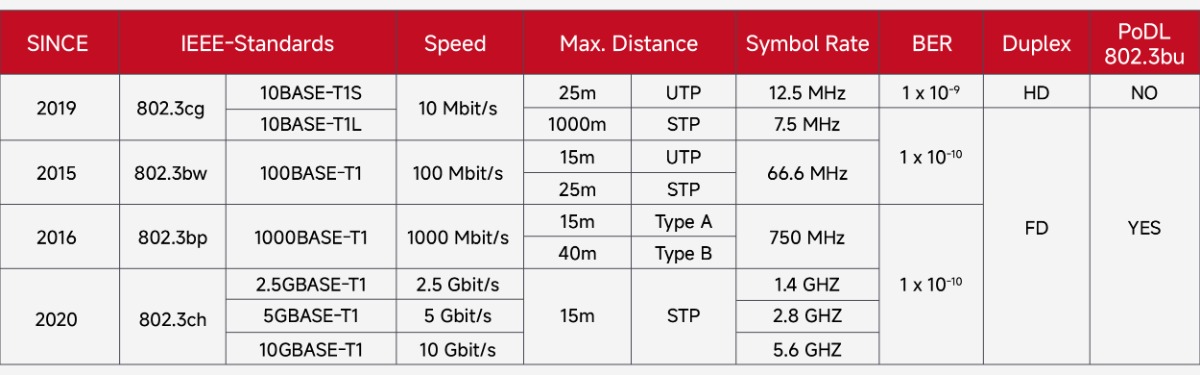
4. Supports PoDL, with a maximum cable length of 1 km and no signal attenuation. PoDL is a very compact connection method that integrates power and data using only two signal lines. This technology has been standardized in IEEE 802.3bu.
It can support a large number of new applications required in the future, enabling smaller and lighter connection solutions.
Currently, the definition of PoDL applies to point-to-point connections, where one side is the power supply end, called the "Power Supply Equipment" (PSE), and the other side is the "Power Receiver Equipment" (PD).
Data transmission should not be affected when power is injected into or disconnected from the data line.
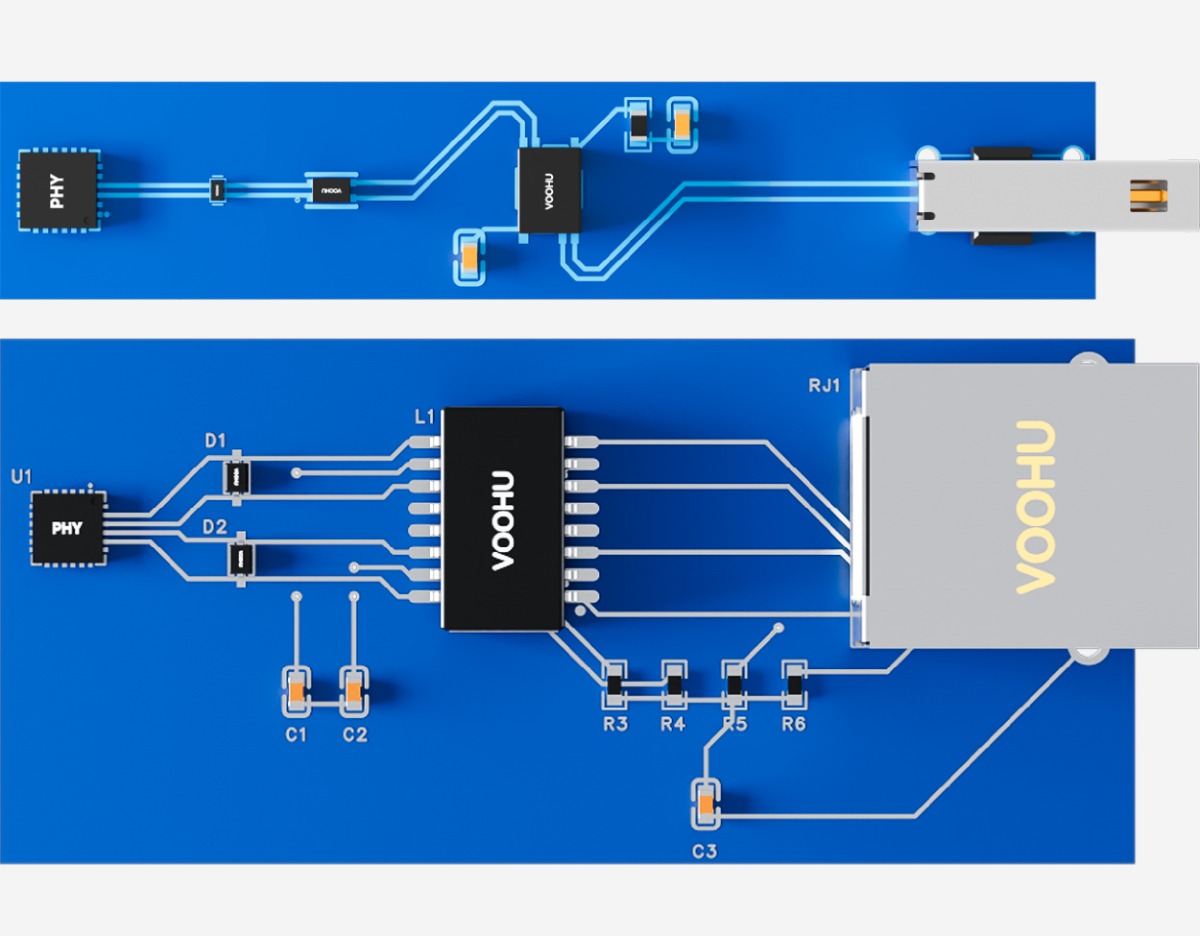
A typical circuit structure for connecting the PHY chip and power to the data line is shown in the figure.
The basic circuit design of the SPE requires a common-mode current transformer (CMC) and common-mode node termination to suppress common-mode noise, and a DC blocking capacitor.
The power line can be connected to the SPE line by adding a low-pass filter or simply connecting an inductor in series between the PSE or PD and the data line to avoid interfering with the data signal.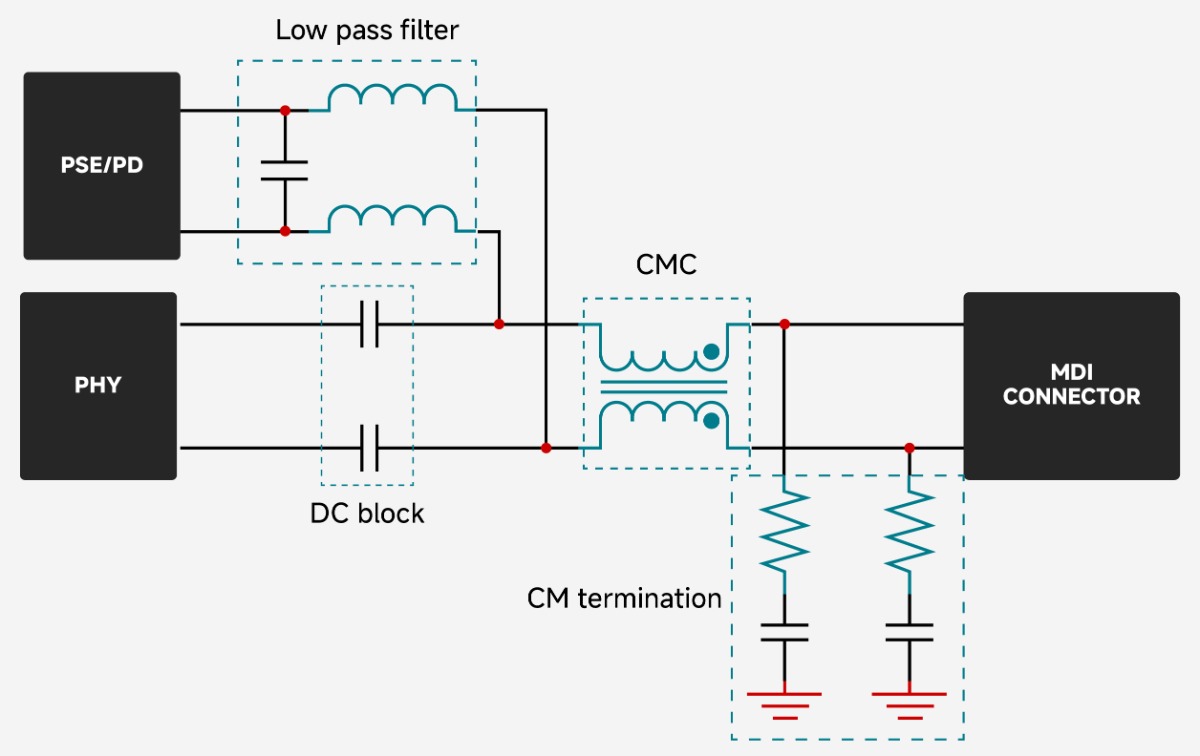
Application Scenarios:
1. Industrial Internet of Things (IIoT) Applications
Intelligent Sensor Networks: Direct Ethernet connection for temperature, pressure, and flow sensors.
Distributed I/O Systems: Remote I/O modules connected to the main controller via SPE.
Machine Vision Integration: Direct Ethernet video stream output from industrial cameras.
Predictive Maintenance: Real-time data transmission and analysis from vibration sensors.
2. Factory Automation Applications
Robot Workstations: Connection between robot controllers and end effectors.
Conveyor Line Systems: Network connection for distributed motor drives.
Quality Inspection Stations: Centralized data acquisition from various inspection devices.
AGV Communication: Real-time control and monitoring of automated guided vehicles.
3. Medical Equipment:
Internal connectivity of medical imaging equipment.
Network integration of patient monitors.
Communication of laboratory automation equipment.
4. Transportation and Construction:
Intelligent traffic monitoring systems.
Building automation control networks.
Elevator control system communication.
1: What is a Single Pair Ethernet (SPE) connector? What solutions does VOOHU Electronics offer in this area?
A Single Pair Ethernet (SPE) connector is an industrial connector that enables high-speed Ethernet communication using only one pair of twisted wires, extending the openness and high bandwidth of Ethernet to field devices such as sensors and actuators.
VOOHU Electronics provides complete SPE solutions designed to fully comply with IEEE 802.3 signal requirements and meet the 1.5 kV isolated Ethernet safety standard (IEC 62368-1).
VOOHU's SPE solutions support 10BASE-T1 and 100BASE-T1 standards, offering signal stability up to 1000 meters. With a simple and compact layout, they are core components for Industrial IoT and all-IP factory networks.
2: What are the main structural features of VOOHU's SPE connectors?
VOOHU's SPE connectors feature an industrial-grade design and consist of the following core components:
Metal Shielded Housing: Made of stainless steel/nickel-plated zinc alloy, providing 360° continuous electromagnetic shielding, suppressing EMI, and enhancing vibration and shock resistance.
Insulation Body: High-temperature engineering plastics (PA66, PPS), UL94V-0 flame retardant rating.
Contacts: Two differential signal contacts, copper alloy substrate, gold-plated contact areas, supporting high-speed differential signal transmission and PoDL (Power over Data Line).
Circuit Protection: VOOHU solutions integrate a TVS array (ESD protection up to 15 kV), common-mode inductor (noise attenuation), and autotransformer (isolation voltage 1.5 kV) to ensure interface reliability.
3: What are the application scenarios for VOOHU's SPE connectors?
VOOHU's SPE connectors are widely used in the following fields:
Industrial IoT: Smart sensor networks (direct Ethernet connection for temperature, pressure, and flow sensors), distributed I/O systems, machine vision integration, predictive maintenance.
Factory Automation: Robot workstations, conveyor systems, quality inspection stations, AGV real-time control and monitoring.
Medical Equipment: Internal connections for medical imaging equipment, patient monitor network integration, communication for laboratory automation equipment.
Transportation and Building: Intelligent traffic monitoring systems, building automation control networks, elevator control system communication.
Process Automation: Chemical explosion-proof areas achieve Ex ia certification through SPE + isolation barriers, replacing the traditional 4-20mA solution.
Energy Internet of Things: Oilfield well site sensors transmit pressure data via 10BASE-T1L, reducing repeater deployment for kilometer-level transmission.
4: What are the installation methods for VOOHU's SPE connectors? What are their advantages compared to traditional RJ45?
VOOHU's SPE connectors are mainly available in two PCB mounting forms: horizontal and vertical, adapting to different space layout requirements.
Compared to traditional RJ45, VOOHU's SPE connectors have the following significant advantages:
Smaller Size: Saves up to 75% of PCB space.
Simpler Wiring: Requires only one pair of wires, reducing cable count by 75%, weight by 50%, and installation efficiency by 60%.
Longer Transmission Range: Supports 40-meter transmission at 1Gb/s or 1000-meter transmission at 10Mb/s (10BASE-T1L standard).
Integrated Power Supply: Supports PoDL (Power over Data Line), with a maximum power supply of 50W, enabling simultaneous data and power transmission.
Superior Shielding: 360° all-metal shielding design, passing IEC 61000-4-5 4kV surge and EN 61373 vibration tests.
5. What support and services does VOOHU Electronics provide in SPE technology?
VOOHU Electronics not only provides high-performance SPE connector products but also builds a complete solution ecosystem:
One-Stop Procurement: Customers can purchase all necessary hardware products from VOOHU, including SPE connectors, network transformers, ESD protection devices, and Ethernet PHY chips.
Technical Support: VOOHU's technical support team consists of experienced engineers, providing professional support throughout the entire process, from hardware selection to circuit design, from testing and verification to manufacturing.
Digital Platform: VOOHU's proprietary internet platform provides one-stop online services such as material selection, document downloads, sample requests, small-batch purchases, and solutions, saving customers selection, time, and communication costs.
Customized Services: We provide personalized hardware design and manufacturing services based on specific customer needs.
The VOOHU website (www.voohuele.com) features a dedicated SPE solutions section, where users can access complete solution documents (including topology diagrams, component selection lists, and performance parameter tables) for various scenarios, download technical manuals, and obtain real-world test data and optimization suggestions from solution implementation cases.
-
Founded in 2018 and with its overseas expansion planned for 2025, VOOHU Electronics has become a reliable partner for over 1000 companies thanks to its "superior quality, reasonable prices, attentive service, and reliable delivery."
If you're also looking for a "worry-free, cost-effective, and convenient" supplier of communication electronic components, consider VOOHU. After all, the choice of over 100 listed companies is a sure bet.
Choose VOOHU – truly reliable. This isn't just a slogan; it's the answer written with the trust of over 1000 customers over 8 years.
Newsletter subscription
Subscribe to our newsletter and stay updated on the latest information of our company and product.
Name
|
I agree that the information that I provide will be used in accordance with the terms of Voohu International Inc. Privacy & Cookies Policy