
Industrial TSN Physical-Layer Design: How VOOHU Helps You Choose the Right Ethernet Transformers, Common-Mode Chokes and Port Protection for Deterministic Networking
Industrial TSN Physical-Layer Design: How VOOHU Helps You Choose the Right Ethernet Transformers, Common-Mode Chokes and Port Protection for Deterministic Networking
Introduction: TSN Writes “Determinism” Into Industrial Networks—the Physical Layer Can No Longer Be an Afterthought
Over the past few years, industrial automation, machine vision, motion control and new-energy production lines have all been living through the same shift: upgrading legacy fieldbuses and ordinary Ethernet to Time-Sensitive Networking (TSN). The IEEE 802.1 family—time-aware shaping (802.1Qbv), frame preemption (802.1Qbu/802.3br), precise time synchronization (802.1AS/gPTP) and seamless redundancy (802.1CB)—gives standard Ethernet microsecond-level deterministic scheduling for the first time, so PLCs, servo drives and AI inspection cameras can share a single network.
Yet many engineers fall into a trap during component selection, assuming TSN is purely a matter of the MAC layer and switch scheduling, while the physical-layer PHY, LAN transformer and RJ45 connector only need to “link up.” The prototype behaves perfectly on the bench, then starts dropping packets, jittering and losing gPTP lock the moment it enters a workshop full of VFDs, servos and contactors. The root cause is rarely the protocol stack—it is the neglected physical layer. Deterministic scheduling is built on a foundation of zero packet loss, low jitter and strong immunity; if that foundation is shaky, even the cleverest scheduling above it comes to nothing.
As a component supplier deeply focused on signal integrity (SI) and electromagnetic compatibility (EMC), VOOHU wants this article to make the design logic of the TSN physical layer clear: why it is designed this way, what problems you will hit, and how to suppress the risks with the right components.
Technical Analysis: The “Hidden” Requirements TSN Places on the Physical Layer
Determinism = Extremely Low BER + Stable, Low Jitter
The core promise of TSN is bounded latency with extremely low jitter. But the moment the physical layer produces bit errors, the story changes. For retransmitted traffic, a single CRC error forces a resend and injects an unpredictable chunk of latency; for 802.1CB-protected traffic, errors steadily eat into the precious redundancy margin. In other words, every order-of-magnitude degradation in bit error rate (BER) erodes determinism. Industrial TSN links typically demand a BER better than 1E-10—or stricter—placing hard limits on return loss, insertion loss and near-end crosstalk at the port.
Jitter matters just as much. 802.1AS relies on the PHY timestamping frames on the transmit and receive paths to achieve nanosecond synchronization. If the PHY’s TX/RX latency is asymmetric or drifts with temperature, a fixed offset appears between master and slave clocks; meanwhile reflections from poor transformer return loss and deterministic jitter (DJ) injected by common-mode noise both degrade timestamp accuracy. Every picosecond of physical-layer jitter ultimately adds up in the synchronization error budget.
The Industrial EMI Environment: The Port Is a “Highway” for Common-Mode Noise
VFDs and servos in the workshop produce steep di/dt and dv/dt at every switching edge, coupling large amounts of common-mode noise—from tens of kHz to hundreds of MHz—through cables, racks and ground loops. The twisted-pair port is exactly the main gateway for that noise to enter and leave the equipment. With insufficient common-mode rejection, the noise converts into differential-mode interference riding on the wanted signal, driving the BER up; the classic symptom is “the closer to high-power equipment, the easier it drops.” That is why industrial TSN ports demand far higher common-mode rejection ratio (CMRR) than consumer ports, and the PHY alone is nowhere near enough.
From Gigabit to Multi-Rate: 2.5G/10G Make the Specs Even Tougher
As machine-vision resolution and AI inference throughput grow, industrial TSN is migrating from 1000BASE-T to 2.5GBASE-T, 5G and even 10GBASE-T. Doubling the data rate doubles the Nyquist frequency, so the LAN transformer must hold flat insertion loss and adequate return loss over a much wider band, while the parasitics of the center tap and windings and inter-layer crosstalk are all amplified. Reusing an old 10/100 or gigabit transformer to “make do” at 2.5G usually collapses the return-loss curve at high frequency, leaving the link flickering in and out—the most insidious killer of TSN scheduling.
Every Link in the Chain: How the Physical Layer Decides Determinism
PHY and Clock: The Origin of Jitter and Latency Symmetry
The PHY is the heart of A/D conversion and clock recovery, and directly sets the link’s jitter floor and latency symmetry. Industrial TSN calls for a wide-temperature PHY that is friendly to gPTP timestamping. The JLSemi Ethernet PHYs offered by VOOHU cover 100M/1G/2.5G with MII/RMII/RGMII/SGMII interfaces and come in industrial (-40 to 85℃) and automotive (-40 to 105℃) grades; the JL1111BI-NI for EtherCAT slaves fits hard-real-time motion control especially well, and pairs with VOOHU switch ICs to build TSN switches and gateways.
LAN Transformer: Isolation, Common-Mode Rejection—and the Easily Overlooked PoE Bias
The LAN transformer performs three key jobs: galvanic isolation (typically 1500 Vrms or higher), impedance matching and common-mode rejection. Its return loss, insertion loss and common-mode rejection curves are written straight into the link’s error budget. The trap engineers fall into most often is DC bias under PoE: when PoE current flows through the transformer center-tap winding, it superimposes a DC bias on the core, and if the open-circuit inductance (OCL) has too little margin under that bias, the core approaches saturation and both common-mode rejection and return loss degrade—problems that surface only at full-load powering and are extremely hard to reproduce. So a TSN+PoE port must use a PoE power transformer and LAN transformer that explicitly state their PoE current rating and guarantee OCL under bias.
Common-Mode Chokes: A Second EMI Insurance for the Transformer
The LAN transformer has some common-mode rejection of its own, but in a noisy industrial setting you often need to add a signal-line common-mode choke in series on the signal pairs for a second stage of suppression. It is nearly transparent to the wanted differential signal yet blocks high-frequency common-mode noise from leaving the equipment, buying valuable margin for EMC certification and field reliability. Three selection rules: the common-mode impedance must cover the noise band, the leakage inductance must be small enough not to harm the high-speed differential signal, and the rated current must match. For common-mode noise on PoE or DC supply lines, choose a power-line common-mode choke on the power side instead.
Port Protection: The Last Link in Reliability
Industrial and outdoor ports must face ESD, EFT bursts and lightning surges. The sensible approach is staged protection: a GDT bleeds off high-energy lightning, a bidirectional TVS clamps the residual voltage, and an ESD array handles static—shedding the energy stage by stage. The key is that the junction capacitance of the protection devices must not be too large, or it will introduce reflections into the high-speed differential signal and do more harm than good—precisely where SI and protection must be traded off together.
Solution: VOOHU’s Industrial TSN Physical-Layer Selection Guide
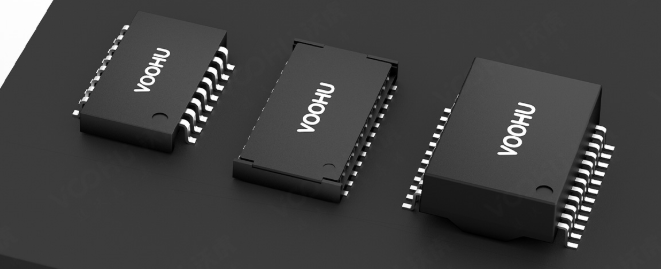
Bringing the analysis together, VOOHU offers an integrated “from chip to connector” selection approach. The core principle: choose the transformer/integrated RJ45 by data rate and powering scheme, hold jitter and synchronization with a wide-temperature PHY, and guard EMC and reliability with common-mode chokes and staged protection. The table below gives recommended combinations for four typical TSN ports; every part number can be found on the VOOHU website with specs and free samples.
| Typical TSN Port | Recommended PHY | LAN Transformer / Integrated RJ45 | Common-Mode Choke | Port Protection | Temp. Grade |
|---|---|---|---|---|---|
| 1G TSN industrial switch / gateway port | JL2101 / JL1101 (RGMII) | WHSG24301JM (single) / WHDG48201P1 (dual) or SYT integrated RJ45 | WHAC3225B / WHLC2012A | ESD array + bidir. TVS | -40~85℃ |
| 2.5G TSN machine vision / AI inspection | JL2101 (2.5G) | WHSQ48002P1 (single) / WHDQ96504P2 (quad) | WHAC3225B signal-line CMC | ESD + bidir. TVS | -40~85℃ |
| EtherCAT slave / motion control | JL1111BI-NI (EtherCAT) | Gigabit transformer or Integrated RJ45 | WHLC2012A signal-line CMC | ESD array | -40~85℃ |
| Outdoor / PoE-powered TSN device | JL2101 / JL1101 | WHDG dual-port (PoE-rated) + PoE power transformer | WHAL power-line CMC | GDT + TVS + ESD (3-stage) | -40~85℃ |
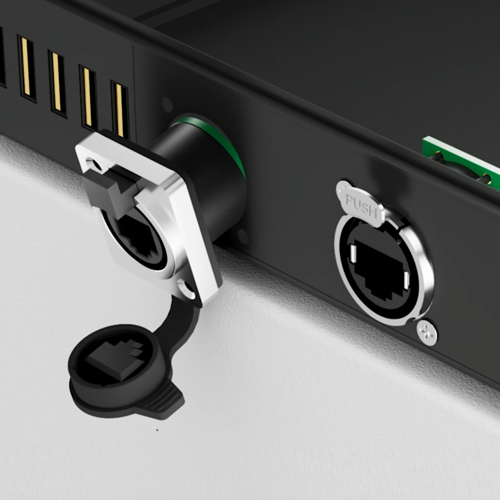
A few practical tips for implementation: place the Bob-Smith termination and common-mode capacitor for the center tap close to the transformer; keep differential pairs length-matched over a continuous reference plane, away from power and switching nodes; reserve bias margin on PoE ports and verify OCL; ground protection devices nearby and prefer low-junction-capacitance parts. To simplify the design further, VOOHU’s integrated magnetic RJ45 merges the LAN transformer and connector into one part, saving board space while ensuring consistent SI performance—ideal for high-density industrial switches and compact industrial control equipment.
Conclusion: Build Determinism on a Reliable Physical-Layer Foundation
TSN determinism is an end-to-end chain, and a weak physical layer anywhere can become the source of jitter and packet loss for the whole network. Rather than chasing intermittent faults during system integration, it pays to get the PHY, LAN transformer, common-mode chokes and protection devices right at the selection stage. VOOHU provides a one-stop lineup of LAN transformers, integrated magnetic RJ45, signal-line and power-line common-mode chokes, Ethernet PHYs and switch ICs, plus ESD / TVS / GDT protection—spanning 1G to 10G multi-rate and industrial/automotive temperatures—helping engineers build a solid, reliable TSN physical layer with fewer suppliers and a shorter schedule. Choose the right parts and make determinism truly deterministic—that is what “reliable” means at VOOHU. Contact VOOHU technical support for selection advice and samples tailored to your specific application.