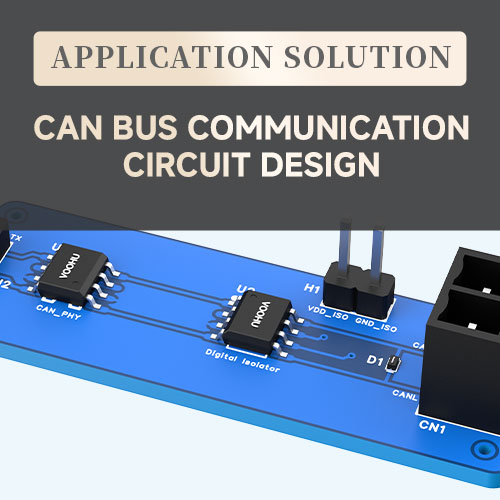

【Standard Circuit Design】VOOHU Electronics — Standard Circuit Design Reference for CAN Communication
【Standard Circuit Design】VOOHU Electronics — Standard Circuit Design Reference for CAN Communication
This solution is VOOHU Electronics (VOOHU)'s standard CAN communication solution. The company has focused on the field of communication electronic components for over 9 years, adhering to the business philosophy and service concept of "Choose VOOHU – Truly Reliable", and providing comprehensive technical solution support.
Technical Background & Core Concepts
CAN Communication
The CAN bus adopts a multi-master architecture: any node on the bus has no master-slave distinction and can initiate communication actively at any time. Based on CSMA/CA (Carrier Sense Multiple Access / Collision Avoidance) and non-destructive bitwise arbitration, when multiple nodes transmit simultaneously, the system arbitrates bit by bit according to the frame identifier: high-priority messages continue unaffected, while lower-priority nodes automatically back off. No data is lost during the entire process, ensuring deterministic delivery of critical information.
Why does Ethernet need this technology?
In harsh scenarios such as industrial control, automotive electronics, energy storage, and automation, real-time communication demands deterministic latency, strong immunity, error self-healing, and fault isolation.
Although the CAN bus protocol embeds reliability mechanisms like lossless arbitration, message broadcasting, and fault confinement at the physical layer, without a matching physical-layer circuit, common-mode noise, surge shocks, ESD, and impedance mismatches will erode signal integrity, making it difficult to realize these protocol advantages.
A proven CAN communication standard circuit design reference helps developers implement proper isolation and filtering on the signal chain, provide comprehensive overvoltage and ESD protection for ports, and ensure physical layer consistency through standardized connection solutions. This fully unleashes the potential of the CAN protocol, significantly shortens development cycles, reduces trial-and-error costs, and makes real-time communication systems truly stable and reliable.
Leveraging its deep expertise in communication electronic components, VOOHU Electronics now launches the CAN Communication Standard Circuit Design Reference, with its own brand product matrix at the core, providing full design and selection support ranging from signal links, immunity isolation, to physical interfaces.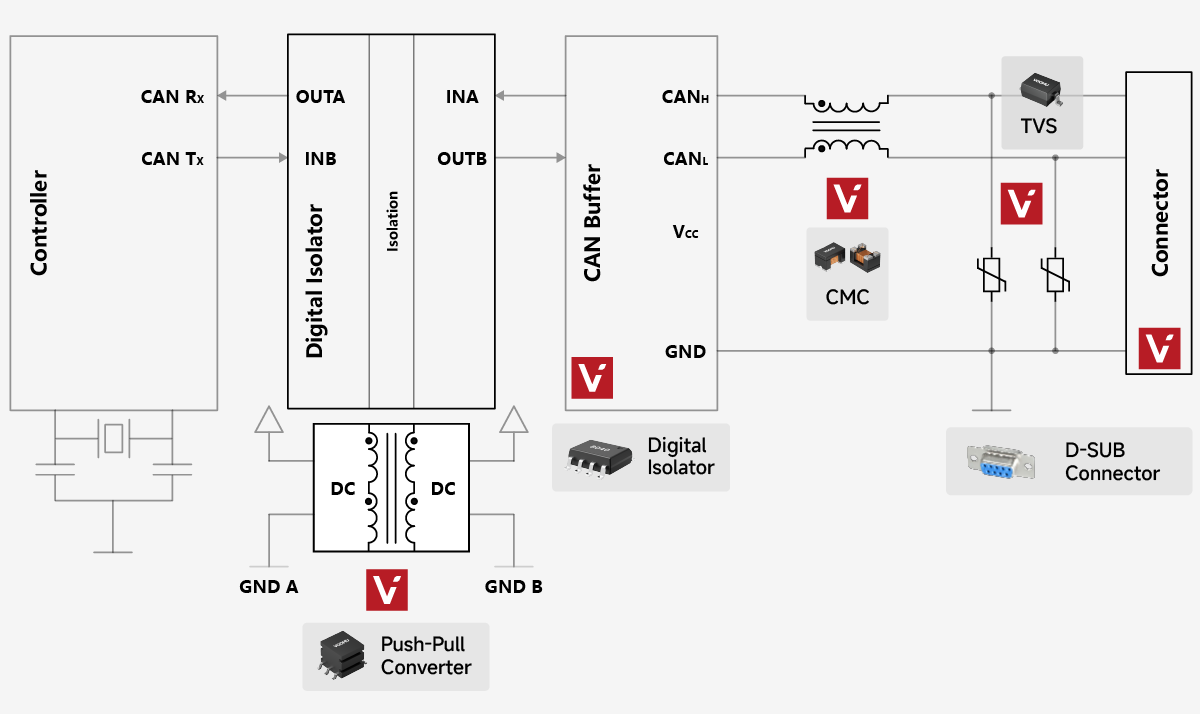
Technical Solution Details
CAN Communication Circuit Protection Design
PHY:
The 1042 high-speed CAN transceiver provides the interface between the CAN protocol controller and the physical dual-wire CAN bus. It delivers differential transmit and receive capability for microcontrollers equipped with a CAN protocol controller.
-
STB pin:
Must not be left floating. The STB pin has an internal pull-up; leaving it floating will keep the chip in standby mode. -
VIO pin:
Must be powered; otherwise communication will fail in practice, and the pin level will continuously toggle. -
120Ω resistors:
Both the source end and the terminal end must have 120Ω resistors. With both installed, the resistance measured between CAN_H and CAN_L with a multimeter should be 60Ω. -
TXD and RXD:
Do not place large resistors in series on TXD and RXD; communication is possible even without series resistors.
CMC:
At the common-mode noise frequency of the CAN bus, the CMC should have as high an inductance as possible, exhibiting high impedance to suppress common-mode noise propagation. Too low an inductance will result in poor common-mode noise suppression, while too high an inductance introduces size and cost constraints. Recommendation: For 500kbps CAN communication, use a CMC with 51μH inductance; for 2Mbps CAN FD communication, use a CMC with 100μH inductance.
Protection Device (TVS):
When selecting a TVS diode, besides considering its transient response characteristics (fast energy dissipation), the following parameters should be noted: reverse stand-off voltage (VRWM), breakdown voltage (VBR), clamping voltage (VCL), maximum absolute rating (AMR), peak pulse power (PPP), and capacitance (Cd).
This solution adopts multi-channel integrated device protection: capacitance <50pF, ensuring signal integrity while filtering parasitic noise and passing ESD tests. Compliant with IEC61000-4-2, Level 4, air discharge 30kV, model SMC24, AEC-Q101 certified.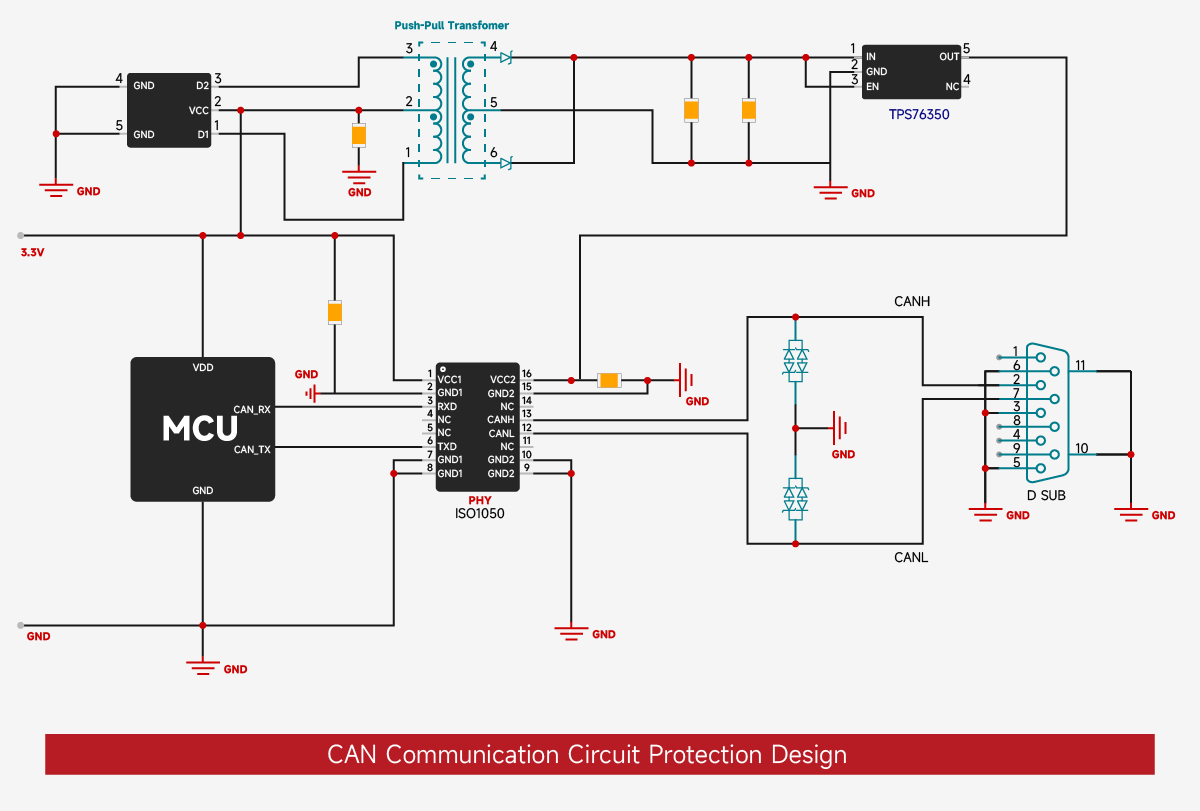
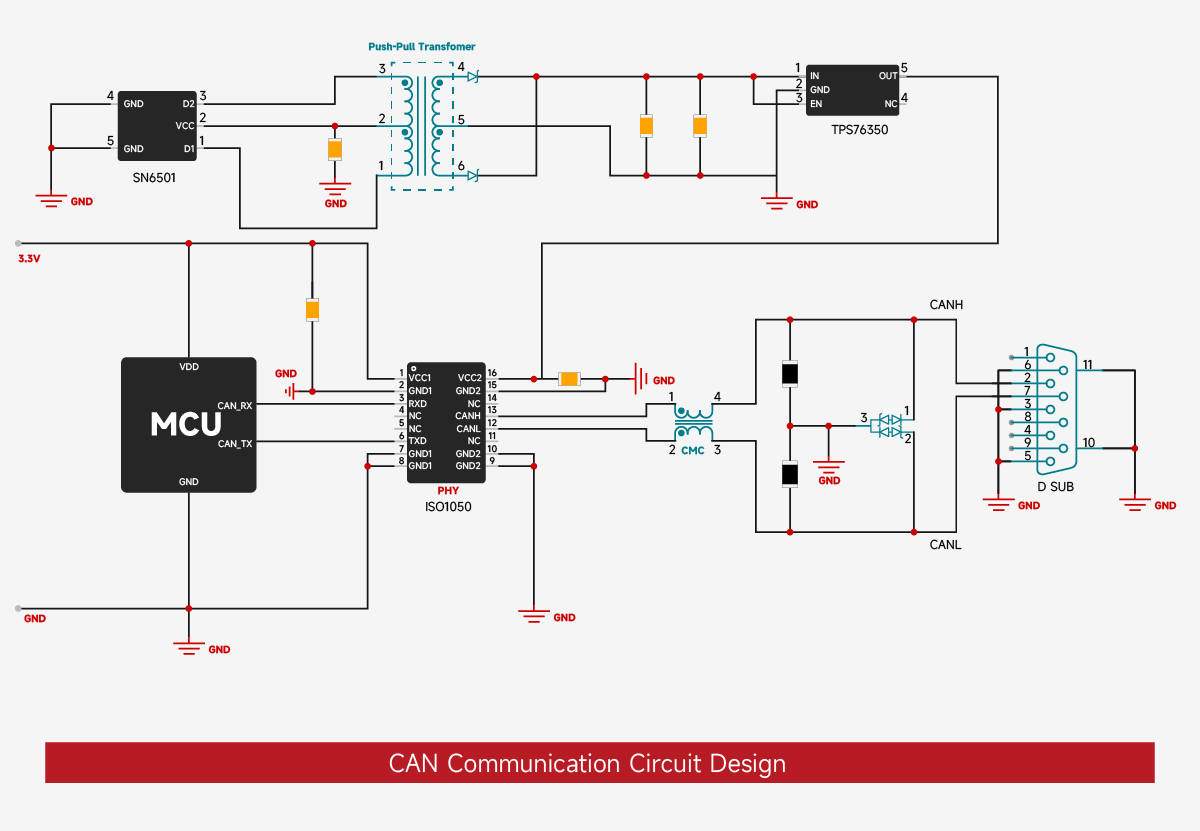
Typical Application Scenarios
-
Intelligent Transportation Systems (ITS): intersection cameras, electronic police
-
Industrial Internet of Things (IIoT): factory automation, robotics
-
Renewable Energy Generation: PV inverters, wind power converter cabinets
-
Automotive Domain Controllers: T-BOX, ECU, VCU domain controllers
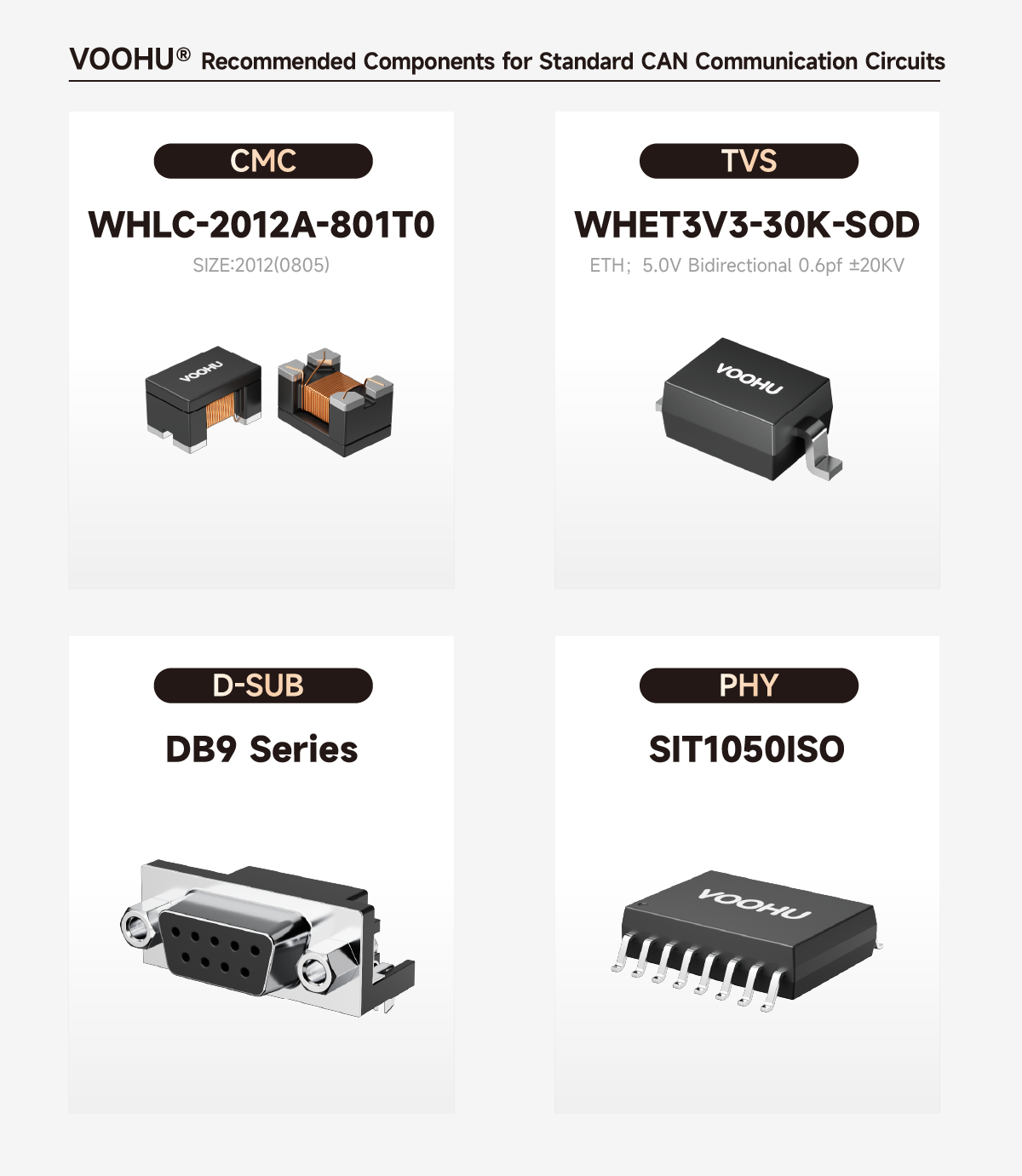
Note: The above solutions are standard designs for reference only. The final circuit design shall be based on on-site requirements. For in-depth support, please contact us free of charge.
Tel: 400-1048-018; E-mail: wohu@wohu-tek.com
From its founding in 2018 to its overseas expansion in 2026, VOOHU Electronics has become a reliable partner for more than 1,000 enterprises by virtue of "excellent quality, fair pricing, attentive service, and reliable delivery."
If you are also looking for a telecommunications electronic component supplier that saves you worry, money, and effort, why not try VOOHU? After all, the choice of more than 100 listed companies can't be wrong.
Choose VOOHU – Truly Reliable. That is not just a slogan; it is an answer written by the trust of 1,000+ customers over nine years.