
【Solution Application Areas】RS485 in Industrial Communication Applications – Part 1
【Solution Application Areas】RS485 in Industrial Communication Applications – Part 1
In industrial communication systems, the selection of physical layer interfaces directly affects the signal integrity, reliability, and system cost of bus nodes. From multi‑node interconnection in PLC control cabinets, to lightning protection in outdoor sensor networks, and to strong electromagnetic interference suppression in motor drive scenarios, each application imposes specific and stringent requirements on transceivers, isolation devices, and protection components.
VOOHU Electronics (VOOHU) focuses on RS485 industrial communication scenarios and provides full‑duplex isolated interface solutions, covering a complete link of products including digital isolators, push‑pull transformers, common‑mode chokes, TVS/ESD/GDT protection devices, and D‑SUB connectors, helping engineers quickly build highly reliable, low‑EMI industrial communication nodes.
Focusing on industrial RS485 communication scenarios, this article starts from a complete full‑duplex isolated RS485 interface solution and outlines key component selection points and design considerations for hardware engineers.
To help customers intuitively understand solution details and quickly match their own needs, the VOOHU official website (www.voohu.cn) has set up a solution zone: click on “Industry Solutions” – “Solutions”. Here you can find complete solution documents for various scenarios (including topology diagrams, component selection lists, performance parameter tables), download technical manuals for each sub‑field, and obtain measured data and optimisation suggestions from real‑world case implementations. Whether for early‑stage solution planning, mid‑stage technical selection, or later‑stage problem troubleshooting, the online reference resources provide precise support to help shorten design cycles and reduce development risks.
RS485 Overview
RS485 (TIA/EIA-485) has become one of the de facto standards for industrial fieldbuses. From the initial half‑duplex two‑wire multi‑node polling to today’s full‑duplex four‑wire simultaneous bidirectional communication, RS485 technology continues to evolve around three core objectives: longer transmission distance, stronger anti‑interference capability, and higher node capacity.
Current RS485 interface design faces two key challenges: first, common‑mode interference suppression in complex electromagnetic environments – industrial motors, variable frequency drives, contactors and other equipment generate substantial high‑frequency noise, which is easily coupled onto the communication bus via cables, causing data errors or even chip damage; second, ground potential differences in multi‑node systems – different devices have different grounding conditions, and ground loop currents introduce power‑frequency interference and accelerate interface ageing.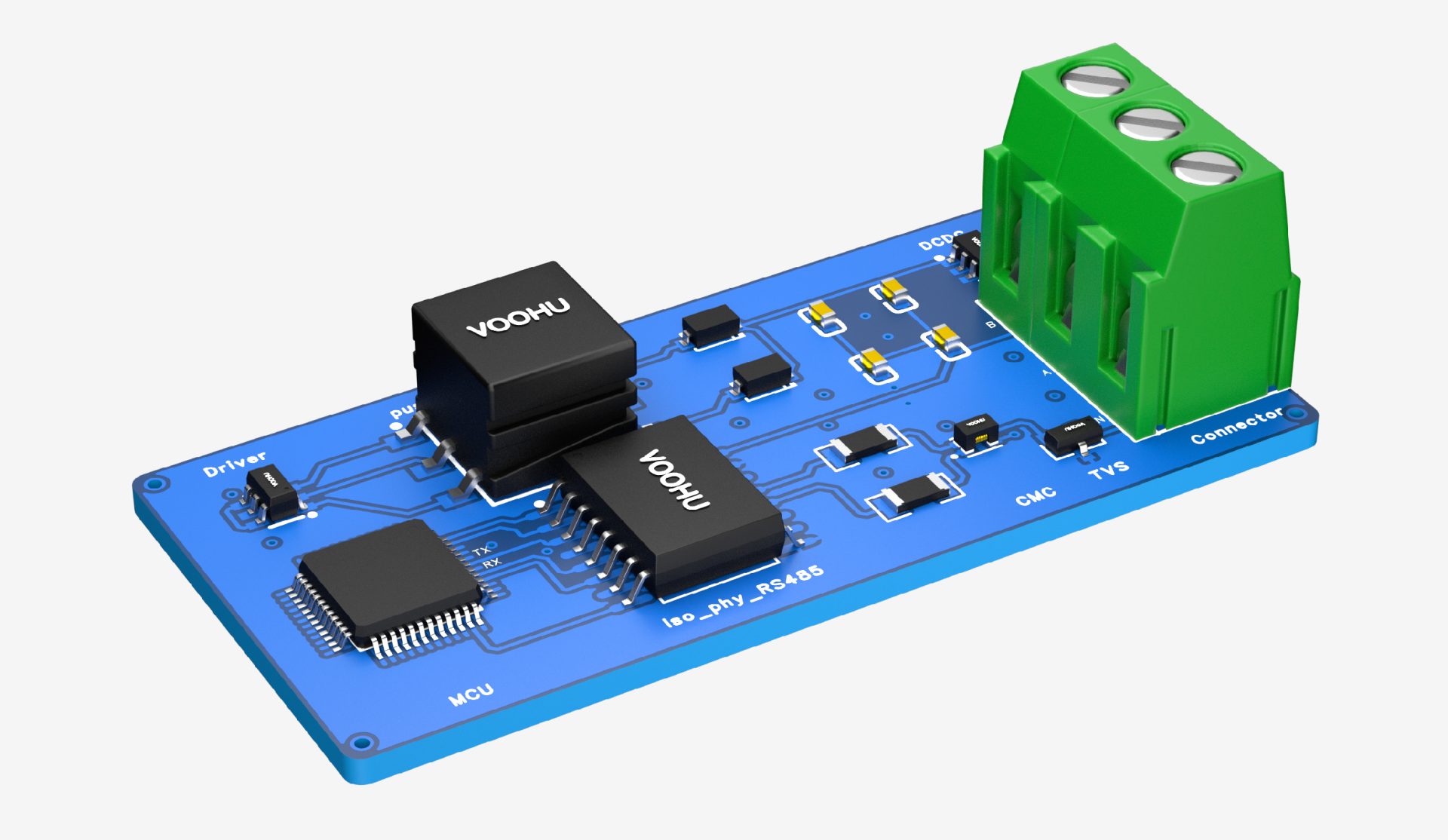
Industrial Communication Application
Core Subsystem: Full‑Duplex Isolation Architecture and Signal Chain
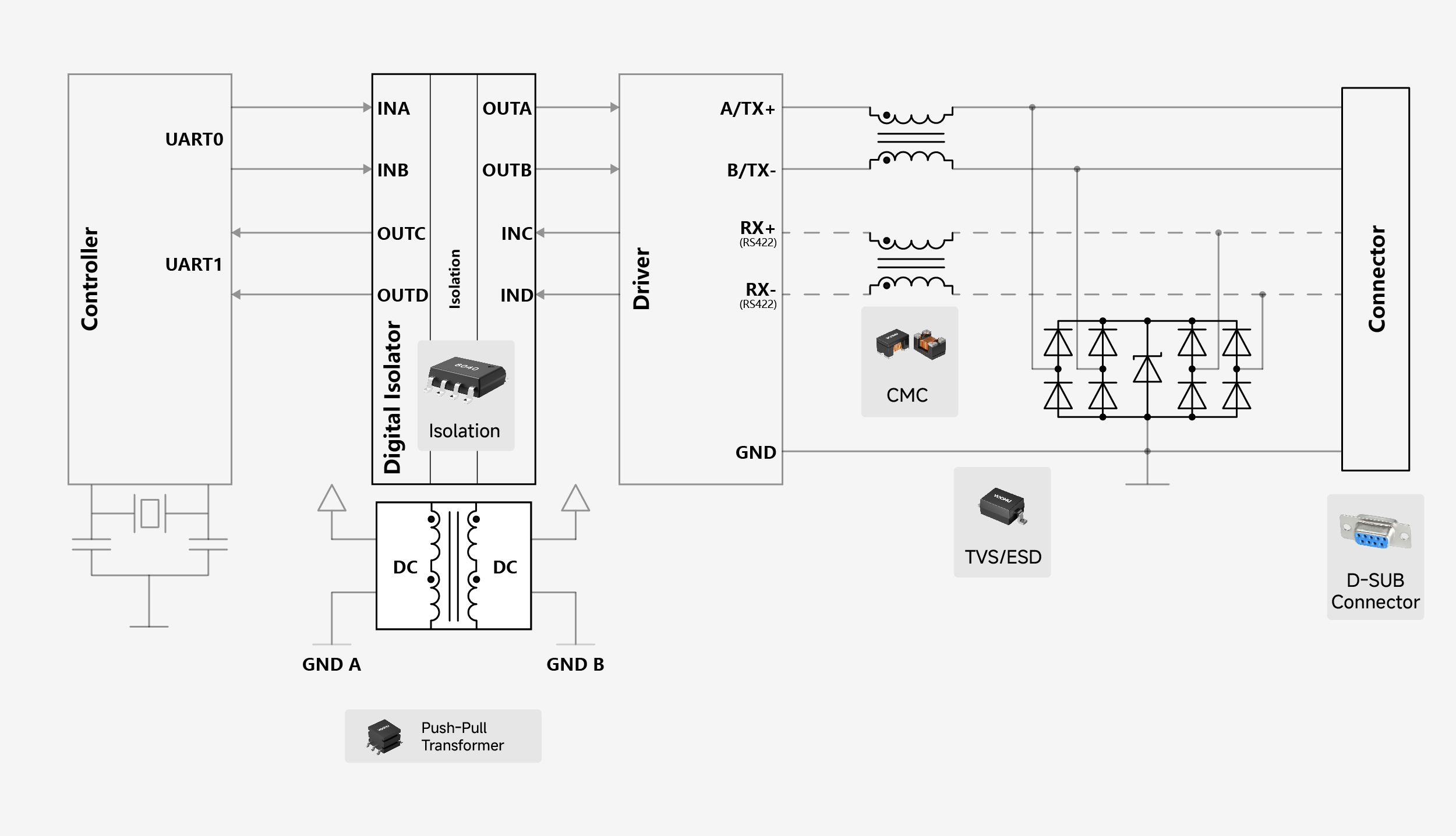
In a full‑duplex RS485 interface, the overall signal chain is: controller (UART TX/RX) → digital isolator → RS485 transceiver (differential conversion) → common‑mode choke (EMC filtering) → TVS protection array → bus connector; the power chain is: system power → DC‑DC isolated power supply → independent RS485 side power supply. This solution adopts a dual isolation architecture (signal isolation and power isolation), completely cutting the DC path between the controller and the bus.
Controller Selection Points
The controller provides UART serial TX/RX signals, acting as the main control unit responsible for data processing and transmit/receive control. In full‑duplex RS485 mode, no direction control pin is needed (half‑duplex requires DE/RE direction switching); only TX and RX are needed to achieve simultaneous bidirectional communication, making communication efficiency significantly higher than half‑duplex solutions. An MCU with a hardware UART peripheral is recommended, supporting baud rates above 115200bps to meet industrial real‑time requirements.
Digital Isolator
The digital isolator isolates the logic signals between the controller and the RS485 side, cuts the DC path between the two sides, prevents ground loop currents and common‑mode interference from entering the controller, and protects the main control chip. Full‑duplex communication actually requires only 2 channels (TX + RX). A dual‑channel or quad‑channel digital isolator can be selected. Isolation withstand voltage is recommended to be no less than 2500Vrms, data rate no less than 10Mbps, supporting 3.3V/5V dual voltage domains to accommodate different MCU logic levels.
DC‑DC Isolated Power Supply
The DC‑DC isolated power supply provides an independent isolated power supply for the RS485 side circuit. Together with the digital isolator, it achieves complete electrical isolation (signal + power), completely cutting the ground loop. This is a core design element of the isolated RS485 solution, solving interference and chip damage caused by ground potential differences between different nodes. An isolated DC‑DC module with output power of 1‑3W is recommended, input voltage 3.3V or 5V, output voltage 5V or 3.3V (matching the transceiver supply), isolation withstand voltage no less than 1500VDC.
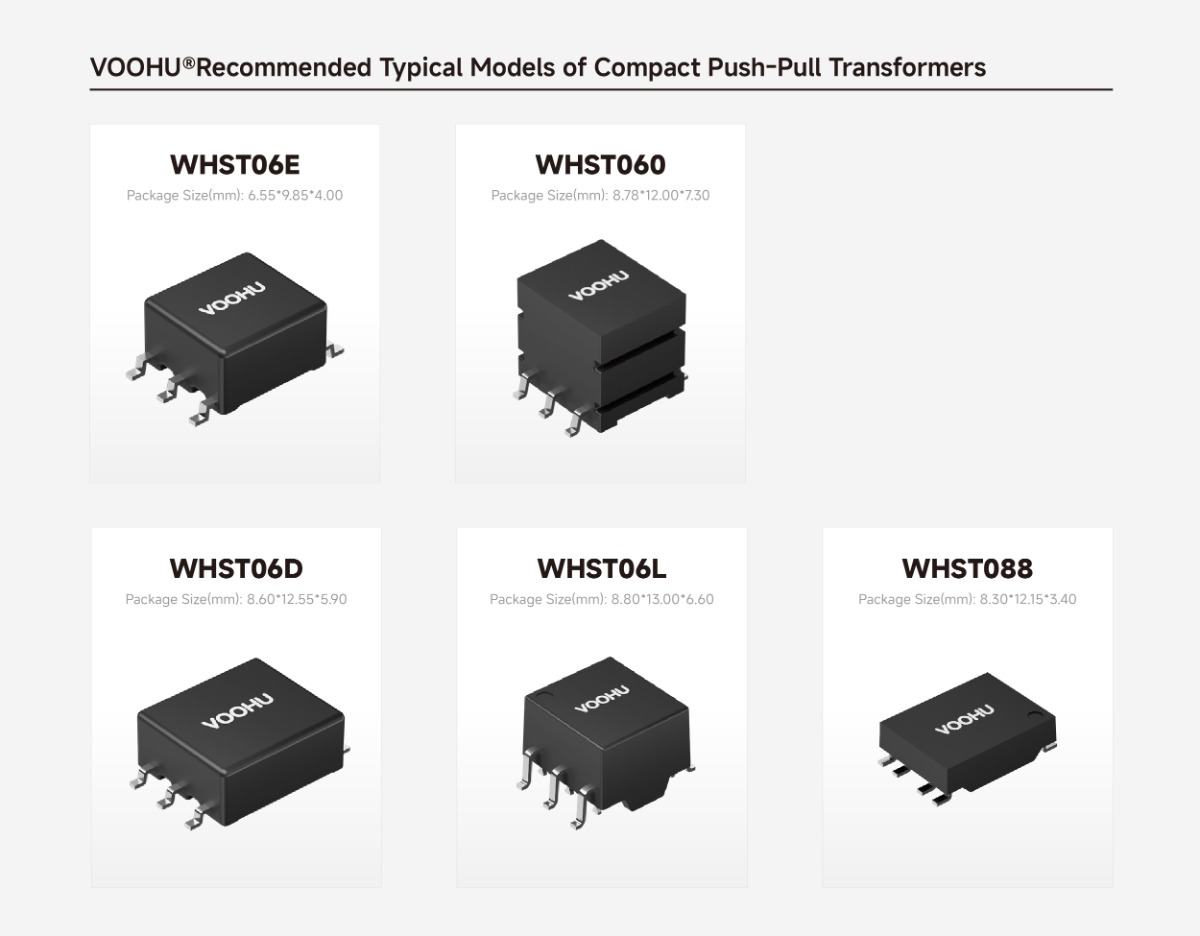
VOOHU Electronics provides the WHST06 series push‑pull transformers, which can be used with a PWM controller to build an isolated power supply. A typical model is WHST06D02A0 (inductance 100μH, turns ratio 1.2:1, isolation withstand voltage 2500VAC), supporting -40~125°C wide temperature, suitable for industrial RS485 isolated power supply design. Compared with off‑the‑shelf DC‑DC modules, the push‑pull transformer solution offers better cost flexibility and size adaptability.
RS485 Transceiver
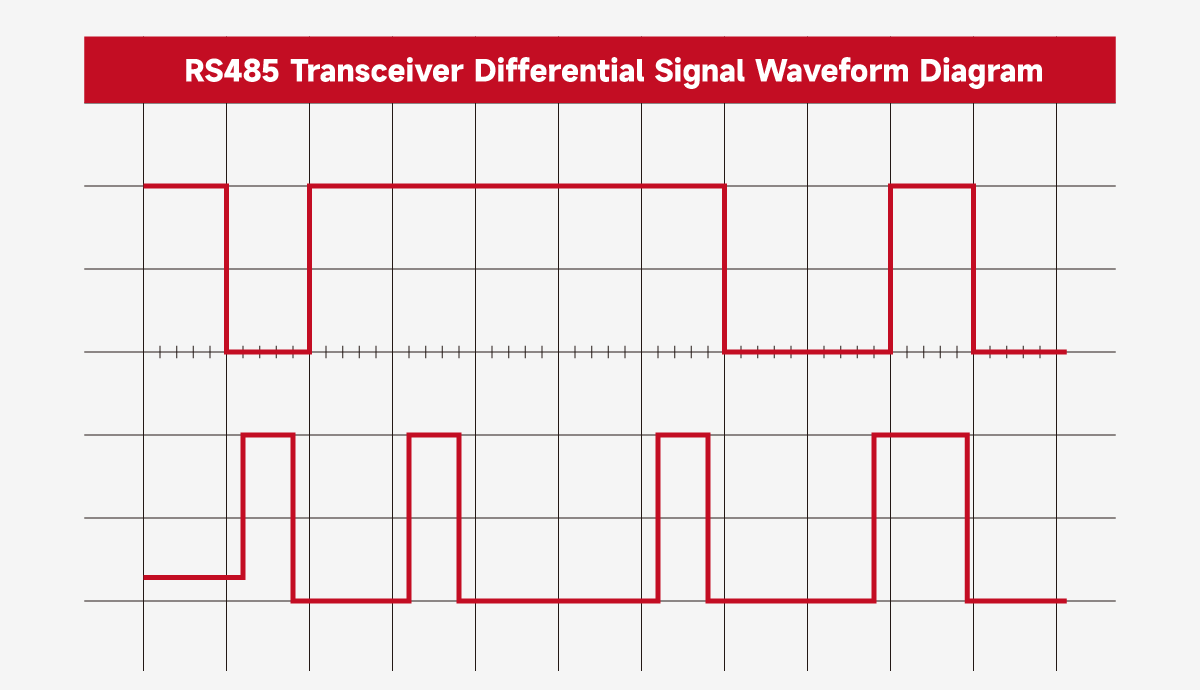
The RS485 transceiver converts UART single‑ended signals into two independent differential signal pairs: the transmit differential pair (TX+/TX-) and the receive differential pair (RX+/RX-), achieving full‑duplex differential transmission. Differential transmission naturally suppresses common‑mode interference – common‑mode noise on the two wires has equal amplitude and the same phase, and cancels out after differential operation at the receiver. When selecting, pay attention to: data rate (≥10Mbps recommended), bus node count (≥32 nodes recommended), ESD protection level (≥±15kV HBM), and common‑mode voltage range (-7V to +12V is the industry baseline). VOOHU distributes mainstream RS485 transceivers and provides supporting technical support.
Common‑Mode Chokes for Signal Lines
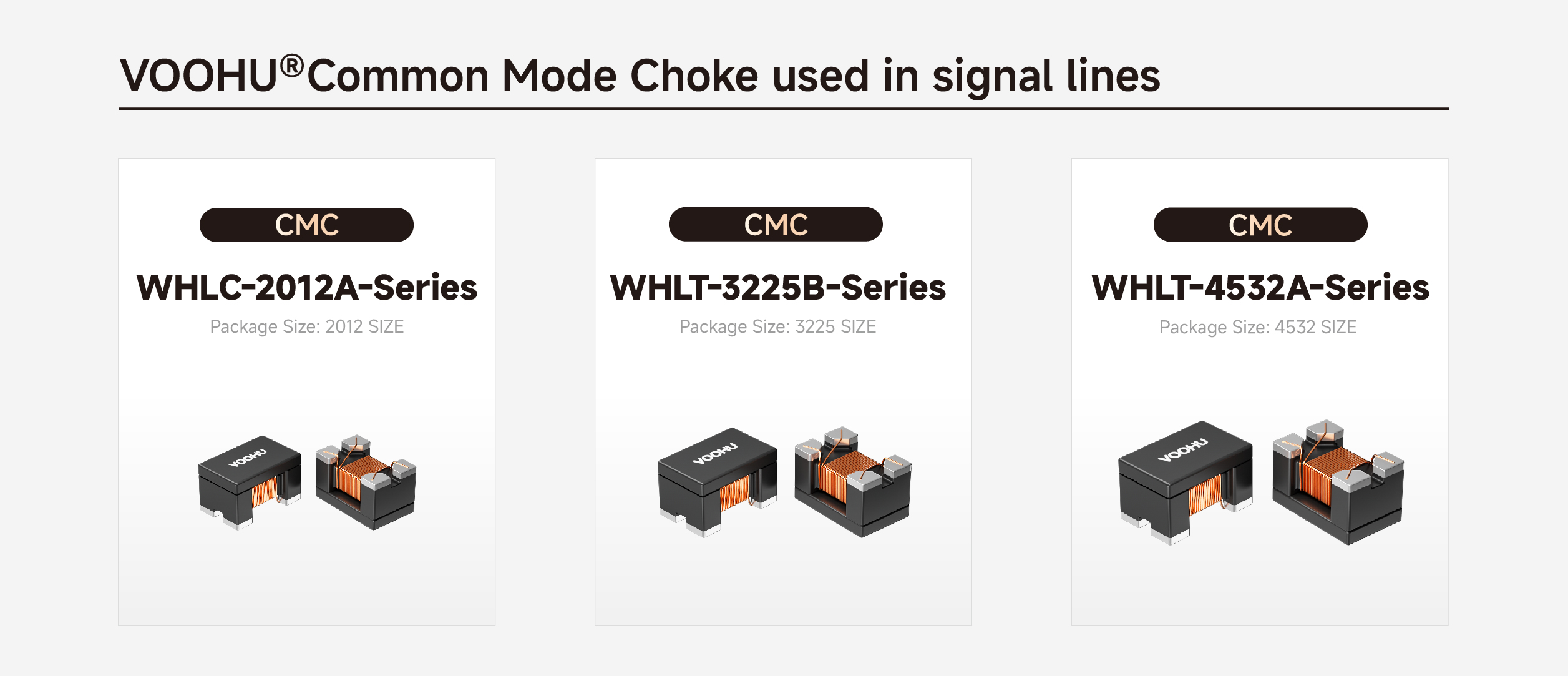
Add common‑mode chokes on the differential lines of the transmit and receive channels respectively to filter high‑frequency common‑mode noise on the bus and improve system EMC performance. Common‑mode chokes do not affect differential communication signals – the magnetic fluxes generated by differential current in the core cancel each other, so the choke presents almost no impedance; common‑mode noise flows in the same direction, causing magnetic flux to add, creating high impedance that blocks the noise. Recommended common‑mode impedance: 600‑2000Ω @ 100MHz, rated current ≥200mA, to meet RS485 drive capability while maintaining filtering effectiveness.
-
2012 Series (e.g., WHLC-2012A-900T0): 90Ω @ 100MHz, 0.35Ω, 300mA – suitable for compact nodes
-
3532 Series (e.g., WHAC-3225B-110U0): 550Ω @ 100MHz, 0.8Ω, 300mA – general industrial nodes
-
4532 Series (e.g., WHAC-4532A-220U0): 1200Ω @ 100MHz, 1.4Ω, 200mA – for high‑interference scenarios
TVS Protection Array
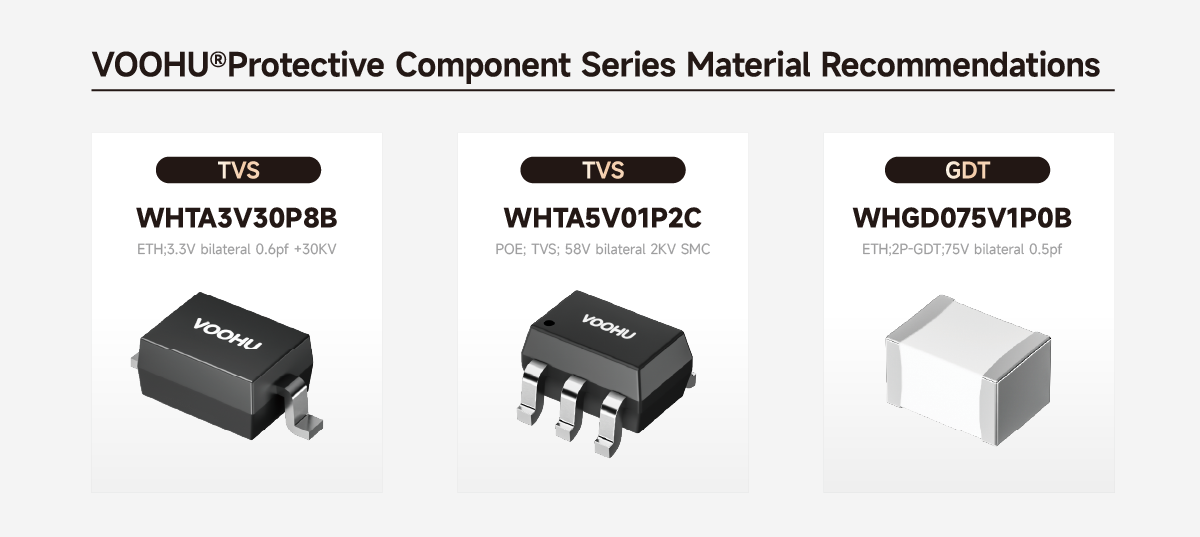
TVS transient voltage suppressor arrays discharge transient over‑voltages on the bus such as ESD and lightning‑induced surges. They must cover both common‑mode over‑voltage (signal line to ground) and differential‑mode over‑voltage (between differential lines). Bidirectional TVS diodes are recommended, with breakdown voltage 6‑9V (leaving margin for signal swing), peak pulse power ≥350W (8/20μs waveform), response time ≤1ps, to meet IEC 61000-4-2 (ESD) and IEC 61000-4-5 (surge) standards.
VOOHU offers a variety of RS485‑specific TVS devices, such as WHTA6V5B (6.5V bidirectional, SOD123) and WHTA12V05B (12V bidirectional, SOD323), with junction capacitance as low as 15pF, not affecting high‑speed signal integrity. In layout, TVS should be placed first between the A and B lines (differential‑mode protection), then from each line to ground (common‑mode protection), and as close as possible to the bus connector.
Enhanced Lightning Protection (Outdoor Scenarios)
For deployment outdoors or in lightning‑prone environments, add a ceramic gas discharge tube (GDT) before the TVS to further improve surge protection capability. GDTs can withstand kA‑level surge currents but have a slower response time than TVS, so a TVS is needed for secondary clamping – forming a two‑stage protection architecture (GDT + TVS). A GDT is recommended with DC breakdown voltage 90V, impulse sparkover voltage ≤700V, nominal discharge current ≥5kA (8/20μs).
VOOHU provides GDT gas discharge tube series, such as WHGT090V1P0A (3‑pin, 90V breakdown voltage, 1pF capacitance) and WHGD090V1P0B (2‑pin, 90V), which together with VOOHU TVS form a complete lightning protection solution.
Bus Connector and Termination
The bus connector provides the external physical interface and also brings out the isolated signal ground, providing a common‑mode reference level for the bus. The isolated ground is common only on the bus side and does not form a ground loop. When this node is an endpoint node of the RS485 bus, 120Ω termination resistors must be added to the transmit and receive differential pairs respectively to match the characteristic impedance of the RS485 standard cable, eliminate signal reflections, and ensure signal integrity over long‑distance communication.
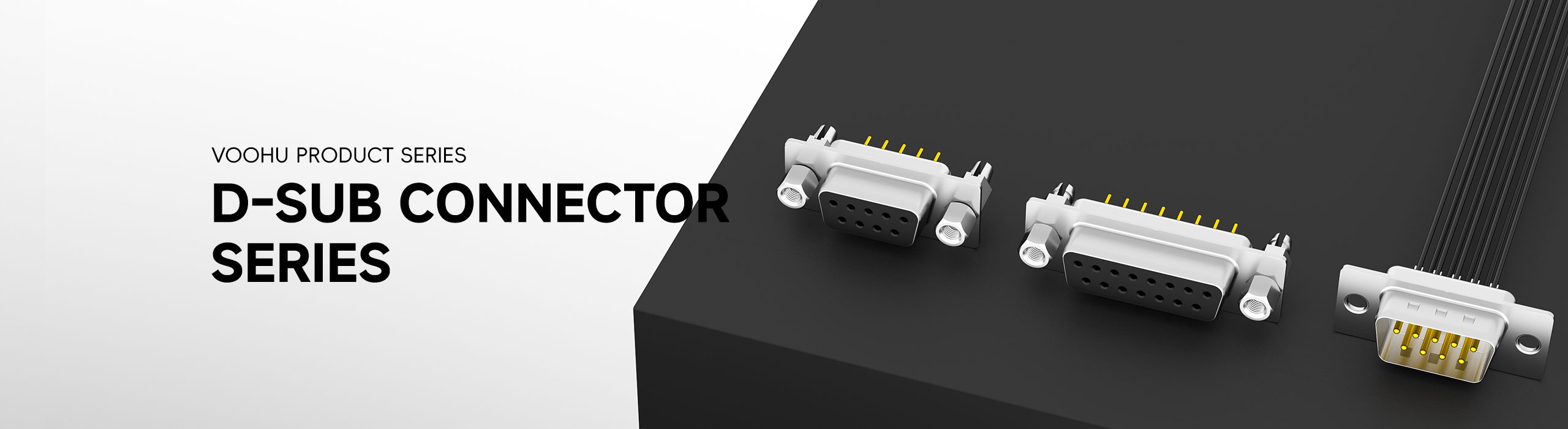
VOOHU offers a full range of D‑SUB connectors (9‑pin, 15‑pin, 25‑pin, etc.) and standard interfaces, supporting high‑density mating, with optional gold plating thickness, meeting industrial‑grade durability requirements.
The above outlines the component selection and design considerations for a full‑duplex isolated RS485 interface solution. From the signal chain to power isolation, from EMC filtering to over‑voltage and over‑current protection, each stage carries clear engineering value. In actual design, adjustments must also be made based on the specific MCU selection, PCB layout, bus topology, EMC certification requirements, etc.
VOOHU Electronics (VOOHU) provides a complete set of physical layer supporting components for RS485 applications: digital isolator selection support, WHST06 series push‑pull isolation transformers, 2012/3225/4532 series common‑mode chokes, WHTA series bidirectional TVS, D‑SUB connectors, and GDT lightning protection devices, covering -40~125°C wide temperature, suitable for industrial applications. Reference circuit designs, free samples, and FAE technical support are also available to help engineers quickly build stable, highly immune RS485 bus nodes.
RS485 has been industrially proven for over forty years, evolving from early half‑duplex multi‑point communication to today’s full‑duplex isolated architecture. Its vitality stems from the core advantages of simplicity, reliability, and low cost. In the era of accelerating Industry 4.0 and edge computing, RS485 remains one of the most mature and economical physical layer solutions for interconnecting various sensors, actuators, and PLCs.