Contacts
Both parts list 2 PIN, the one twisted pair an SPE link needs. On an SPE connector, retention or shield terminations may still add pins to the footprint.

I/O Connector products
Select a cable-side plug or board-side socket for a Single Pair Ethernet interface. The current catalog includes a 2-contact crimp plug and a PCB socket. Compare termination and layout, then verify specified mating parts, dimensions and electrical conditions. Request samples, pricing or an existing-part assessment.
Part number search & selector
The table uses the current English-site product records, published selection fields and part-specific technical-file links.
* Frozen Image and Part Number columns · drag horizontally to review all specifications
| Image | Datasheet | Compare | Downloads |
Contacts
|
Connector form factor
|
Rated current
|
Rated voltage
|
Termination method
|
Sample |
|---|
| Image | Part number | Datasheet | Compare | Downloads | Contacts | Connector form factor | Rated current | Rated voltage | Termination method | Sample |
|---|---|---|---|---|---|---|---|---|---|---|
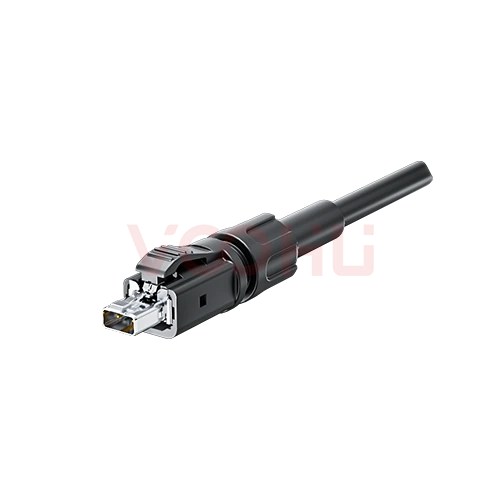 |
WHSPE00468 | SPEC | 2 PIN | Plug | 4A | 60V | Crimp |
|
||
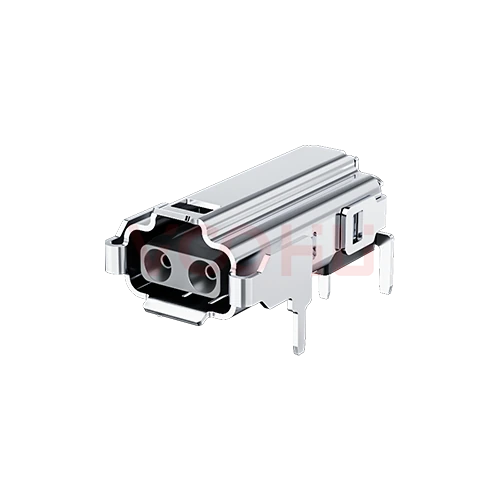 |
WHSPE00467 | SPEC | 2 PIN | Socket | 4A | 60V | THT |
|
Broaden the selected filters or clear the current search.
Is this another brand's part number? Find the VOOHU replacement →
Product family quick links
Counts by contact number come from the current single pair Ethernet records.
How to select
A single pair Ethernet connector is chosen from the network specification outward: the PHY and mating standard first, then cable or board termination, the ratings and finally samples.
Name the PHY (10BASE-T1L, 100BASE-T1 or 1000BASE-T1), the mating standard, the cable and any power-over-data requirement before comparing parts.
The SPE plug is crimped onto the cable; the socket solders into the PCB as a through-hole (THT) part. Review crimp tooling and the board process separately.
Use controlled drawings to confirm that plug and socket mate, then check clearances, temperature rise, the 4 A and 60 V ratings and the mating cycles your service plan needs.
Download the datasheet and 3D model, then validate samples. Send your requirements even if the final single pair Ethernet connector or some parameters are still open.
Key selection parameters
The SPE selector shows five fields. They describe the parts, not the link: the PHY, cable, PoDL class and enclosure still decide the result.
Both parts list 2 PIN, the one twisted pair an SPE link needs. On an SPE connector, retention or shield terminations may still add pins to the footprint.
Plug for the cable end, socket (often called an SPE jack) for the board end. Confirm from drawings that the listed plug and SPE socket are designed as a mating pair.
Crimp on the plug: check wire size, strip length and tooling. THT on the socket: check holes, pitch and the solder process.
4 A and 60 V are listed. Read them with temperature-rise conditions; their product does not establish a PoDL power class.
Confirm the mating standard, the PHY, the cable and any PoDL requirement as separate checks, for both ends of the link.
Product family comparison
Both listed SPE connector parts are 2-contact. The difference is the end of the link they serve: a crimp plug on the cable and a through-hole socket on the board. Check each part row for form factor and termination.
Return to the selector ↑| Contacts | Parts | Connector form factor | Rated current | Rated voltage | Termination method | Action |
|---|---|---|---|---|---|---|
| 2 PIN | 2 | Socket, Plug | 4A | 60V | THT, Crimp | Filter → |
Technical performance & application fit
SPE suits sensors, actuators and field devices where cable size and reach matter. Send the PHY, cable, environment and power needs, and the review covers the SPE connector in that context.
Downloads & technical resources
Search by part number to open each SPE datasheet in PDF or its 3D model. If your layout needs a PCB footprint that is not listed, request the design data.
Showing representative available file sets. Search to find a specific SKU.
VOOHU’s published product content is reviewed by its engineering team. Specifications, downloads and technical support information are tied to specific part numbers, so you can verify them before requesting samples or a quotation.
Category overview
SPE trades bandwidth for cable mass, and the interface is defined by a published standard rather than by contact count.
A conventional copper Ethernet link uses two or four twisted pairs. Single Pair Ethernet carries the link on one, which cuts cable weight, diameter and connector size. That is the whole reason it exists, and it is why it suits sensors, field devices and vehicle harnesses where cable mass is a real cost.
The PHY standards set the reach. 10BASE-T1L (IEEE 802.3cg) runs 10 Mbit/s up to about 1,000 m and underpins Ethernet-APL in process plants, while 100BASE-T1 and 1000BASE-T1 come from automotive networks and cover much shorter runs. Because the PHY names all end in T1, some engineers simply call the part a T1 connector.
Two contacts is the minimum an SPE link needs, but several mating faces are published for different environments. Two connectors with two contacts each will not necessarily mate. Confirm which interface standard your network specifies, and confirm it for both ends of the link.
The IEC 63171 series defines those mating faces. Part 1 is aimed at office and building cabling, while an IEC 63171-6 connector is the industrial style, with IP20 versions and sealed versions in M8 and M12 style housings. The listed parts do not state which part of the series they follow, so ask for the conformity document before design-in.
The current listing is a cable-side crimp plug and a board-side socket. If your design needs a different mating face, a screened version or a sealed body, send the standard and the environment rather than working around the parts listed here, and our engineers will confirm what can be supplied.
The same applies to a hybrid connector that carries the data pair alongside separate power contacts, or to a ready-made cable assembly. Describe the system rather than the part, and FAE can tell you whether one of the listed SPE parts fits.
FAQ & related guides
Answers on standards, ingress, power and footprints. Limits for each SPE connector part number come from its own datasheet.
It is the mating interface for an SPE link, used with a suitable PHY, cable and circuit. The connector itself performs no protocol conversion or packet forwarding; it carries one twisted pair and, on some designs, PoDL power on the same pair.
WHSPE00468 is a 2-contact crimp plug for the cable end, and WHSPE00467 is a 2-contact through-hole socket, an SPE PCB connector for the board end. Both list 4 A and 60 V. Confirm the designated mating pair and assembly conditions from the drawings.
Confirm the specific IEC 63171 part from controlled product documentation or conformity evidence; the SPE name alone does not establish mating compatibility. Send the part and edition your network requires and we will check it against the drawings.
No ingress rating is published for the two listed parts. A board socket inside an enclosure normally sits in an IP20 environment, while field connections often need a sealed M8 or M12 style body. Send the environment and we will confirm what can be offered.
The 4 A and 60 V ratings describe the contacts, not a powered channel. Review the PoDL class, the rating conditions, temperature rise, cable and termination, then validate the complete powered link.
Take conductor size, strip length, tooling and pull-force requirements from the contact and assembly specifications of the plug. Ask for missing process documents rather than copying values from a similar connector.
No. The PCB pattern may include retention or shield connections. Verify hole sizes, spacing, orientation and board-edge distance from the drawing, and request design data if no footprint file is listed.
For a known part, send the part number, quantity, cable or PCB requirement, destination and timing. For a new design, describe the PHY, wire size, environment and power needs for sales and FAE review.
Engineer support
Send the candidate part number and the condition you need reviewed. Sample support can be added after the selection is clear; commercial questions may be discussed in the same engineering conversation.
Include the document revision
Temperature, isolation voltage and PoE current basis
Pin count, pitch and spacing between pin rows
To help prioritize samples and evaluation
When you need candidates and a comparison of differences
Engineering review identifies candidate parts and explains the differences.
From the selector or engineering review
Prototyping / pilot build / production
Specify sample and production timing separately
Compliance documents, material declarations or third-party reports
Samples are available for evaluation, and selected parts are free of charge. Our FAE team will be glad to confirm the options for your project. Sales will respond on business days.