
VOOHU actual combat: How to implement the unmanaged switch solution - switching chip (100M/Gigabit) selection and integrated magnetic RJ45 network port design to avoid pitfalls
VOOHU actual combat: How to implement the unmanaged switch solution - switching chip (100M/Gigabit) selection and integrated magnetic RJ45 network port design to avoid pitfalls
5-port and 8-port unmanaged switches (Unmanaged Switches), small desktop switches, "fool switches" for monitoring weak current boxes, and the need to "expand a few more network ports" on the motherboard are among the most shipped Ethernet products. Security branch lines, building intercoms, industrial gateways, set-top boxes/optical modem undermounts, office desktops - they are used almost everywhere. When many hardware engineers make this type of board for the first time, they will be stuck on the same questions: Should I choose 100M or 100M switching chips, and how many ports should I choose? Since the PHY has been integrated into the chip, do you need a network transformer at the network port and how to configure it? Why is it that the first version of the proof cannot be negotiated as soon as it is powered on, or that the EMC radiation test exceeds the standard, or that the ESD test fails?
These problems may seem scattered, but their roots actually lie in the selection and coordination of the link "switching chip + network port magnetic parts + port protection". This article starts from the physical layer structure of the non-network management switching chip, explains the selection logic, network port design points and the most common pitfalls at once, and gives practical selection suggestions based on VOOHU's on-shelf switching chip, integrated magnetic RJ45 and network transformer.
1. What exactly is integrated inside the non-network management switching chip?
To choose the right material, first look at the chip boundaries. A non-network management deviceSwitch chip, essentially equal to "Switch Core (including MAC address table and message cache) + Ethernet of each portPHY+Internal SerDes/MII interconnection". In other words, both MAC and PHY have been built into the chip. What engineers see on the schematic diagram are only several sets of MDI differential ports, power supply, clock crystal oscillator and LED driver. This is why it is more trouble-free and cost-effective than the "PHY + independent MAC" solution.
But here is a key conclusion that must be kept in mind: the switching chip integrates the PHY, but does not and cannot integrate the network transformer. The MDI differential pair of each copper cable port (10Base-T/100Base-TX/1000Base-T) still must pass through a network transformer (or a magnetic module inside the integrated magnetic RJ45) before it can be connected to the RJ45 and connected out of the chassis. The network transformer is responsible for electrical isolation of 1500-3000V, common-mode noise suppression, and impedance matching of the transceiver channel—these three things cannot be replaced by a silicon-based PHY. If the magnetic isolation of the network port is omitted, the EMC/ESD will not be able to pass, or the ground circulation caused by the ground potential difference will directly kill the port.
1.1 What is the difference between network ports between 100M chips and Gigabit chips?
100M (100Base-TX) only uses two pairs of lines, one pair for transmission and one pair for reception, and the corresponding network transformer is a 2+2 structure; Gigabit (1000Base-T) has four pairs of lines all participating in full-duplex transmission and reception, and the network transformer is a four-pair structure. The center tap, common mode choke and termination are doubled, and the requirements for return loss, near-end crosstalk (NEXT) and common mode suppression ratio are also stricter. A high-frequency mistake in the project is to equip the Gigabit port with a network changer that can only run at 100M. As a result, either Gigabit cannot be negotiated and the speed can only be reduced to 100M, or the bit error rate soars and packets are lost as soon as long cables are plugged in. Therefore, the speed level is the first red line for selecting magnetic components for network ports.
1.2 How to choose between integrated magnetic RJ45 and discrete network transformer + ordinary RJ45?
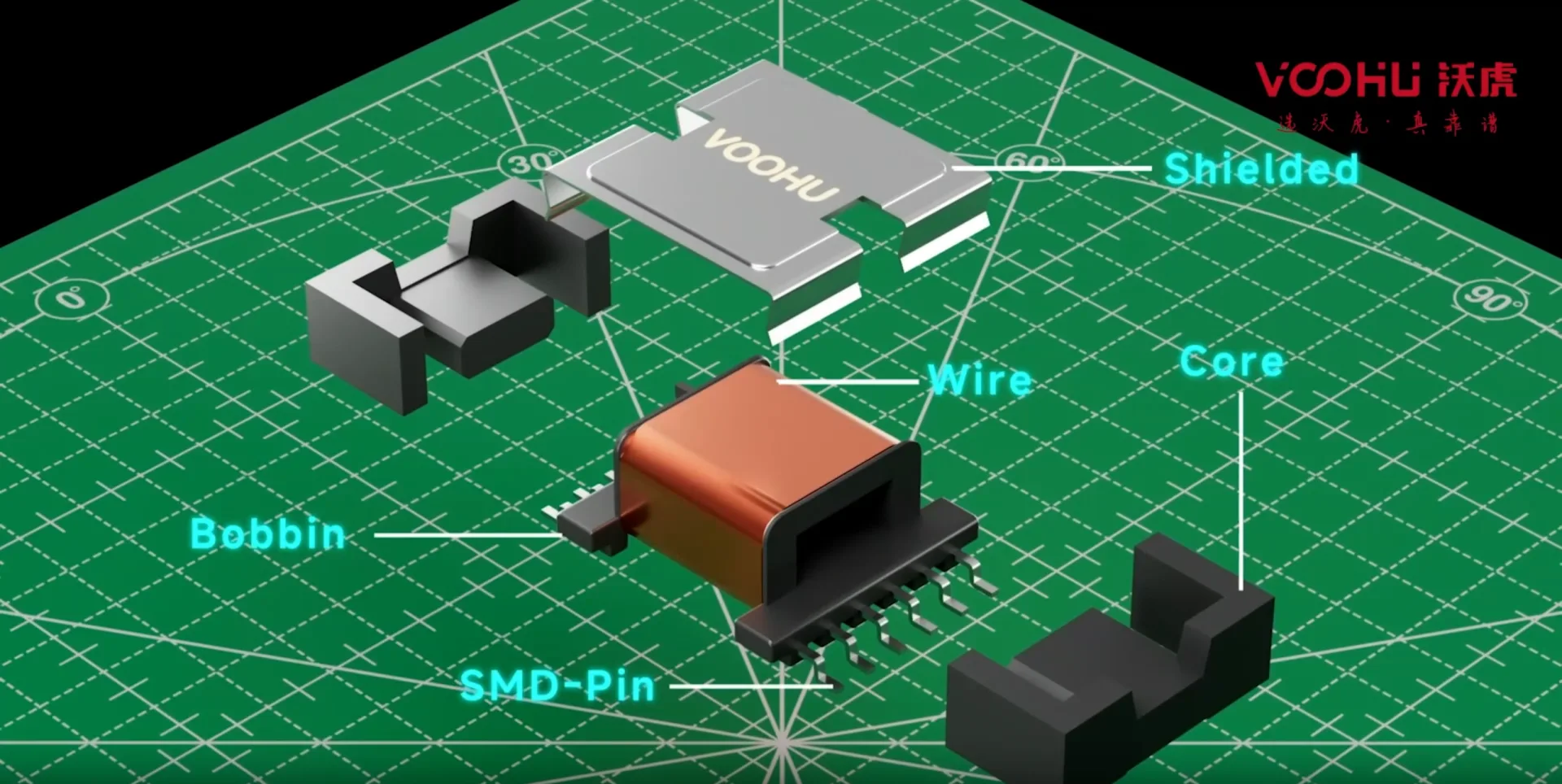
Integrated magnetic RJ45 (Mag-Jack, like VOOHUIntegrated magnetic RJ45SYT series) stuffs the network transformer, common mode inductor and RJ45 connector into the same connector shell, saving board space and wiring, and naturally shortening the wiring length from PHY to magnetic parts. It has good mass production consistency and is especially suitable for switch motherboards with a large number of ports and tight space; the price is a slightly higher unit price and less flexibility. Discrete plan (Network transformer+ ordinary RJ45), the single board cost is lower, the magnetic parts can be selected and replaced individually, and the withstand voltage and PoE current can be higher, but it takes up a large board area, has long wiring, and has higher layout requirements.
One-sentence decision: with a large number of ports, tight space, and pursuit of batch consistency, priority is given to integrating magnetic RJ45; for extremely cost-sensitive needs, higher isolation withstand voltage or greater PoE overcurrent capability, and the ability to flexibly replace magnetic parts, choose a discrete solution. The electrical principles of the two are exactly the same, and the only difference is the trade-off between integration, cost and flexibility.
1.3 Why can't the negotiation work as soon as the power is turned on, or why does the EMC/ESD test fail?
Failure to negotiate or inexplicable slowdown: Most likely the traces between the MDI differential pair and the network transformer are not equal in length to 100Ω, the center tap decoupling capacitor (typically 0.1µF/1kV) is missing or the withstand voltage is insufficient, the Bob-Smith termination (75Ω+1000pF/2kV) is not properly matched, or simply the network transformer rate level is insufficient. EMC radiation (RE) exceeds the standard: it is common when differential pairs are of unequal length and common mode noise is not added by the network transformer.Signal line common mode inductorImproper handling of effective suppression, chassis ground and signal ground. ESD/surge kill port: RJ45 is a directly exposed port and must be added on the cable side of the transformer.ESD/TVS array, in outdoor or lightning protection scenarios, then superimpose the GDT gas discharge tube to the center tap/chassis ground. Most of these pitfalls can be avoided in advance during the selection and layout stages.
2. VOOHU unmanaged switch solution selection suggestions
In practical terms, it is recommended to follow the three-step process of "How many ports → What speed → Indoor or industrial" and assemble the chip, network port magnetic components and port protection at once.
The first step is to order the switching chip. For desktop/office 5-port 100M, choose JL5104/JL5105; for monitoring and weak current boxes with 8-port 100M, choose JL5108; for home/SOHO 5-port Gigabit, choose JL6105; for industrial switches that require 8-port Gigabit or even optical uplinks, choose JL6108/JL6110 (supports SGMII/1000Base-X-optical port). In terms of operating temperature, the commercial suffix -NC (0~70℃) is used for indoor consumer products, and the industrial suffix -NI (-40~85℃) is used for outdoor chassis, industrial weak current wells, workshops and other wide-temperature scenarios to leave sufficient margin for temperature.
The second step is to determine the magnetic parts of the network port. If there are many ports and tight space, use integrated magnetic RJ45 (SYT series, for example, SYT811B198FA2A10DQB for 8 ports, SYT111B372EA2A1DFL for single port); cost sensitive Or if you need higher withstand voltage and larger PoE current, use a discrete network transformer (Gigabit single-port WHSG24701D1, dual-port WHDG48201P1, 10/100 network transformer for 100M port) + ordinary RJ45. The third step is to determine protection and EMC. Reserve ESD/TVS on the MDI cable side for each port, reserve signal line common mode inductors (such as WHAC3225B, WHLC2012A) for radiation rectification, and stack GDT for outdoor/lightning protection.
| Application scenarios | Recommended switching chip | Rate/port | Network port magnetic parts (material number on shelf) | Port Protection/EMC |
|---|---|---|---|---|
| 5-port desktop small switch | JL5104/JL5105 | 100M / 4~5 ports | Integrated magnetic RJ45 SYT111B372EA2A1DFL (single port) | ESD array |
| 8-port monitoring/weak current box | JL5108 | 100M/8 ports | Integrated magnetic RJ45 SYT811B198FA2A10DQB (8 ports) | ESD + signal line common mode inductance |
| 5-port Gigabit home / SOHO | JL6105 | 1G/5 ports | Integrated RJ45 or WHSG24701D1 (discrete single port) | ESD/TVS |
| 8-port Gigabit industrial (optional optical port) | JL6108/JL6110 | 1G/8(+2)port | WHSG / WHDG discrete network transformer or multi-port integrated RJ45 | ESD/TVS + GDT + common mode inductor |
| Extremely cost-sensitive consumer products | JL5105/JL6105 | 100M/1G | Discrete network transformer (10/100 or WHSG) + ordinary RJ45 | ESD array |
Description: Choose -NC for commercial specifications, choose -NI for industrial specifications; the integrated magnetic RJ45 has the same electrical principle as the discrete network transformer, and you can choose one according to space, cost, withstand voltage/PoE requirements; the optical port is uplinked to SGMII/1000Base-X of the scene switch chip, equipped with SFP connector.
3. Conclusion: Move selection risk forward to the design stage
The unmanaged switch seems to be the "simplest Ethernet product", but what really determines whether it can be tested once and mass-produced without repair is the matching between the switching chip speed and port number selection, network port magnetics (integrated or discrete), and port protection. Please always remember the red line: the chip integrates the PHY, but it will never integrate the network transformer, and not even a single piece of magnetic isolation for the network port can be omitted. Using VOOHU's switching chip, integrated magnetic RJ45 and full-rate network transformer, common mode inductor, ESD/TVS/GDT to build a homologous BOM can move the selection and layout risks from the production line to the design stage, making the solution simpler and more reliable, and making subsequent certification and batch delivery more worry-free.
Frequently Asked Questions (FAQ)
Q1. The switching chip has integrated PHY, do I need a network transformer?
Must. The chip integrates MAC and PHY. The network transformer is responsible for electrical isolation (1500~3000V), common mode suppression and impedance matching, which cannot be replaced by the chip. If you omit the network change, at least the EMC/ESD will not pass, or at worst, the ground circulation caused by the ground potential difference will directly kill the ports. Be sure to keep them one by one.
Q2. For a 5-port/8-port unmanaged switch, should I choose 100M or 1000M chip?
Look at the link requirements. For pure surveillance, access control, and old equipment branching, 100M is enough. It is more cost-effective to choose JL51xx (such as JL5105/JL5108); for home/office, NVR backhaul, and industrial backbone, choose Gigabit JL61xx (such as JL6105/JL6108). Don’t blindly go to Gigabit because of “good-looking parameters.” Gigabit network transformation and layout costs are higher.
Q3. How to choose between integrated magnetic RJ45 and "discrete network transformer + ordinary RJ45"?
If you have a large number of ports, tight space, and pursue batch consistency, choose the integrated magnetic RJ45 (SYT series) to save boards and wiring; if you are extremely cost-sensitive, and if you need higher voltage resistance or larger PoE current, and flexible replacement of magnetic parts, choose a discrete solution. The electrical principles of the two are the same, but the differences lie in integration, cost and flexibility.
Q4. Should I choose commercial or industrial switching chips? What is the difference between -NC and -NI?
Look at the ambient temperature. -NC is commercial specification (0~70℃), used for indoor desktop/office; -NI is industrial specification (-40~85℃), used for outdoor chassis, industrial weak current wells, and workshops. Insufficient temperature margin will cause high-temperature crashes and random packet loss. Be sure to choose -NI in wide-temperature scenarios.
Q5. The sample Gigabit port cannot be negotiated or can only run 100 Mbit/s, what should I check first?
First check the network variable rate level (must be 100/1000 or higher), whether the four pairs of MDI differentials are equal to 100Ω, whether the center tap capacitor and Bob-Smith termination are complete, and then check the chip strap and clock. About 80% of the problems are caused by magnetic component selection or termination issues rather than software configuration.
Q6. The EMC radiation (RE) of a multi-port switch exceeds the standard. How to rectify it?
First ensure that the common mode suppression of each port network transformer is in place and the differential pairs are of equal length, then reserve the signal line common mode inductor (such as WHAC3225B, WHLC2012A) between the PHY and the network transformer and install it port by port. Cooperate with the chassis ground and Bob-Smith termination. Most REs that exceed the standard can be suppressed.
Q7. Do switch network ports need ESD and surge protection? Where to add it?
RJ45 is an exposed port and must be protected. The ESD/TVS array is added to the cable side of the transformer (MDI to ground); when outdoors or when lightning protection is required, the GDT gas discharge tube is stacked to the center tap/chassis ground. For indoor consumer products, at least use an ESD array. Do not run naked.
Q8. Is it feasible to have switching chips, network ports and magnetic components all in one place?
feasible. VOOHU's switching chips, integrated magnetic RJ45 and full-rate network transformers, common mode inductors, and ESD/TVS/GDT are supplied from the same source. It can configure the BOM in one stop and provide pin-to-pin and layout suggestions, shortening the selection and verification cycle.