

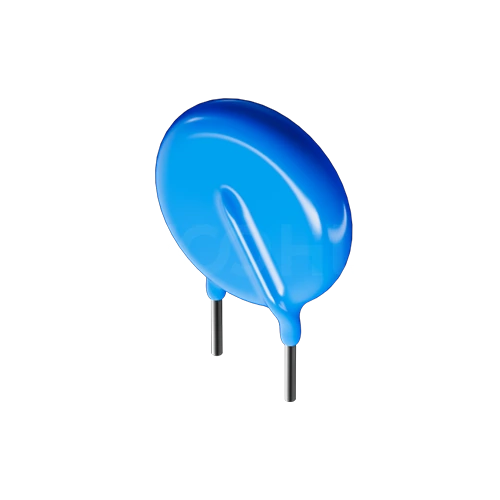
Varistor voltage
The voltage across the part at a small stated measuring current, usually one milliamp. It is a threshold marker, not the clamping level under surge.

Protective Component products
A metal oxide varistor absorbs surge energy by dropping its resistance sharply above a threshold voltage. Select the varistor voltage above the line working voltage, confirm the clamping voltage stays below what the downstream circuit survives, then plan for how the part fails.
Part number search & selector
The table uses the current English-site product records, published selection fields and part-specific technical-file links.
* Frozen Image and Part Number columns · drag horizontally to review all specifications
| Image | Datasheet | Compare | Downloads |
Tolerance Voltage (DC.V)
|
Clamping Voltage/V
|
Rated Power/W
|
Package
|
Operating Temperature
|
Sample |
|---|
Broaden the selected filters or clear the current search.
By disc size
Disc diameter broadly tracks energy handling, but the datasheet figures decide.
How to select
Work from line voltage to surge class to clamping, then plan the failure mode.
Pick a varistor voltage above the highest steady voltage the line sees, including tolerance and expected swell, so the part is not conducting in normal service.
Identify the waveform and level the installation must survive, then choose a surge current and energy rating that covers it at that stated waveform.
Clamping is measured at a stated surge current. Confirm the figure at your surge level stays below the withstand voltage of everything downstream.
Varistors age and can fail short and hot. Pair with a fuse, thermal cut-out or thermally protected part so a failed varistor cannot become a fire risk.
Parameters
Varistor voltage and clamping voltage are different numbers measured different ways.
The voltage across the part at a small stated measuring current, usually one milliamp. It is a threshold marker, not the clamping level under surge.
The highest steady AC or DC voltage the part tolerates without conducting. Select against the worst-case line voltage, not the nominal value.
The voltage across the part while it diverts a stated surge current. This is what downstream components actually see, so compare at the same current.
Peak current the part withstands at a stated waveform, and how many times. Ratings fall as the number of events rises, which the datasheet curve shows.
Joules the part absorbs under a stated pulse. Useful for comparing candidates, but only meaningful alongside the waveform it was measured with.
Larger discs generally absorb more energy and clamp at a similar voltage. Treat diameter as a first filter and confirm against the rated figures.
Compare
Energy, clamping tightness and capacitance separate the three technologies.
Return to the selector ↑| Tolerance Voltage (DC.V) | Parts | Clamping Voltage/V | Rated Power/W | Package | Operating Temperature | Action |
|---|---|---|---|---|---|---|
| 65 | 1 | 135 | 0.1 | D14 | -40 °C to 125 °C | Filter → |
Application review
Confirm the installation class, the line voltage and the required failure behaviour.
Documents
Datasheets carry the voltage window, clamping figures and surge waveform conditions.
Showing representative available file sets. Search to find a specific SKU.
VOOHU’s published product content is reviewed by its engineering team. Specifications, downloads and technical support information are tied to specific part numbers, so you can verify them before requesting samples or a quotation.
Category overview
A metal oxide varistor is simple to fit and easy to get wrong, because the number you select on is not the number the circuit sees.
Discuss a new design
Contact FAE for a replacement assessment.
Already have a part number? Request samples or a quote.
The body is a sintered ceramic of zinc oxide grains. Below the threshold it behaves as a high resistance and draws almost nothing. Above it, conduction across the grain boundaries rises steeply, so the part carries current and holds the voltage roughly constant. Surge energy is absorbed as heat rather than passed downstream.
Varistor voltage is measured at about one milliamp and marks the threshold. Clamping voltage is measured while the part diverts a real surge and is substantially higher. Selecting on varistor voltage alone is the common mistake: compare what the circuit survives against the clamping figure at your surge level.
Every surge degrades the ceramic slightly. Over many events the threshold drifts down, leakage rises and the part warms in normal service. The end state is often a short circuit that keeps heating. That is why a mains varistor belongs behind a fuse or beside a thermal cut-out, so the failure stays contained.
FAQ
Answers cover how a varistor works, ageing, failure modes and coordination.
The ceramic body is made of zinc oxide grains. Below the threshold voltage the grain boundaries block conduction and the part draws almost no current. Above it, conduction rises steeply, so the varistor carries current while holding the voltage across it roughly constant. Surge energy is absorbed as heat in the ceramic instead of reaching the circuit behind it.
Varistor voltage is measured at a small current, usually one milliamp, and marks where conduction begins. Clamping voltage is measured while the part diverts a real surge and is considerably higher. Downstream components see the clamping figure, so select against that at your actual surge current.
Set it above the highest steady voltage the line reaches, including tolerance and any expected swell, so the part is not conducting in normal service. Then confirm the clamping voltage at your surge level still sits below the withstand voltage of everything downstream. Both checks have to pass.
Yes. Each surge degrades the ceramic a little. Over many events the threshold drifts downward, leakage current rises and the part runs warmer in ordinary service. The datasheet derating curve shows how the surge rating falls with the number of events, and that curve is what you should design against.
Because the usual end-of-life failure is a short circuit that keeps dissipating power. A degraded varistor on a mains line can draw enough current to overheat while still conducting. Pairing it with a fuse, a thermal cut-out or using a thermally protected part keeps that failure contained.
A varistor absorbs large energy at moderate cost and clamps loosely. A TVS diode clamps tightly and responds fast but handles less energy. A gas discharge tube takes the most energy with very low capacitance but fires slowly. Many designs use more than one, coordinated with series impedance between the stages.
Generally no. Varistor capacitance is high enough to load a high-speed line noticeably and distort the signal. For data lines, compare low-capacitance TVS or ESD parts, or a gas discharge tube where energy handling matters more than clamping tightness.
With a complete part number, send the part number, quantity, delivery region and the date you need it. If you are still selecting, send the line voltage and type, the surge standard and level, and whether thermal protection is required, and a sales engineer will shortlist candidates.
Engineer support
Send the candidate part number and the condition you need reviewed. Sample support can be added after the selection is clear; commercial questions may be discussed in the same engineering conversation.
Include the document revision
Temperature, isolation voltage and PoE current basis
Pin count, pitch and spacing between pin rows
To help prioritize samples and evaluation
When you need candidates and a comparison of differences
Engineering review identifies candidate parts and explains the differences.
From the selector or engineering review
Prototyping / pilot build / production
Specify sample and production timing separately
Compliance documents, material declarations or third-party reports
Samples are free of charge. Sample quantity and lead time depend on the part number and project stage. Sales will respond on business days.