

Series / package family
EP and EFD labels route you to candidate groups. Use drawings for actual length, width, height, land pattern and pins; a series name is not a dimensional value.
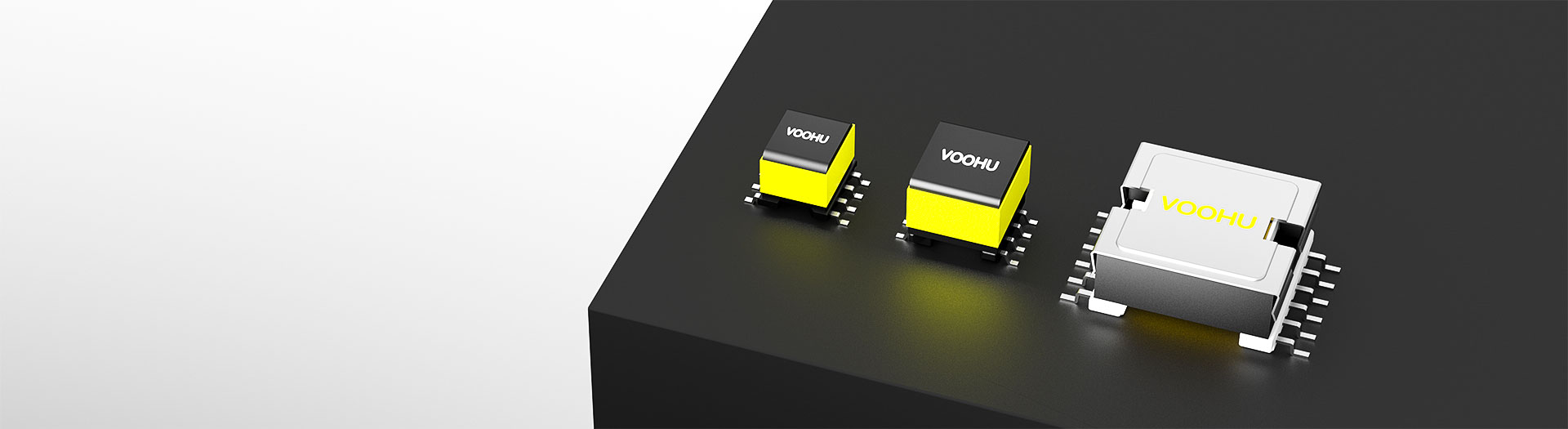
Transformer products
Explore VOOHU EP and EFD series for isolated DC-DC power designs in PoE powered devices. Shortlist by target output, load and package, then check the exact part's input conditions, converter topology and winding documentation. For a new design or an existing-part review, your sales engineer can coordinate FAE support.
Part number search & selector
The table uses the current English-site product records, published selection fields and part-specific technical-file links.
* Frozen Image and Part Number columns · drag horizontally to review all specifications
| Image | Datasheet | Compare | Downloads |
Package Size
|
Power (W)
|
Output Voltage (V)
|
Output Current (A)
|
Sample |
|---|
| Image | Part number | Datasheet | Compare | Downloads | Package Size | Power (W) | Output Voltage (V) | Output Current (A) | Sample |
|---|---|---|---|---|---|---|---|---|---|
 |
ST1333WH | SPEC | EP13 Series | 12W | 12V | 0.41A~1.0A |
|
||
|
|
ST1313WH | SPEC | EP13 Series | 13W | 13V | 0.41A~1.0A |
|
||
|
|
ST1312WH | SPEC | EP13 Series | 12W | 12V | 0.41A~1.0A |
|
||
|
|
ST1311WH | SPEC | EP13 Series | 10W | 13.5V | 0.41A~1.0A |
|
||
|
|
ST1306WH | SPEC | EP13 Series | 10W | 12V | 0.41A~1.0A |
|
Broaden the selected filters or clear the current search.
Product family quick links
Counts reflect the current published product data.
How to select
Narrow the published fields in sequence, compare the remaining candidates and verify the part-specific files before design-in.
Identify whether this is the isolated DC-DC stage of a PoE powered device or another supply location. Provide actual input range, PoE power budget and any alternative supply such as an adapter.
List output voltage, continuous and peak loads, startup requirements and auxiliary supplies. Confirm the controller, topology, operating mode and switching frequency.
Shortlist with the existing output and package filters, then check windings, inductance, leakage inductance, DCR, isolation and drawings against the exact datasheet. Ask the FAE to review conditions not listed.
Validate candidates in the actual circuit before production design-in. If your part number is already established, request samples or pricing directly without an additional engineering review first.
Key selection parameters
EP and EFD labels route you to candidate groups. Use drawings for actual length, width, height, land pattern and pins; a series name is not a dimensional value.
Use this for initial comparison and confirm the associated output conditions. A transformer's catalog power label is not a PoE class or an all-condition guarantee.
This identifies the referenced output option. The transformer is not a stand-alone regulator; final output depends on the complete DC-DC circuit.
Distinguish current bands from exact ratings. Calculate power only with defined output conditions. “≥2A” is not a 2A upper limit and does not identify one exact power value.
Product family comparison
Use this summary as a routing step, then verify every required value in the exact part-number row and linked technical files.
Return to the selector ↑| Package Size | Parts | Power (W) | Output Voltage (V) | Output Current (A) | Action |
|---|---|---|---|---|---|
| EP7 Series | 5 | 10W, 12W, 15W | 5V, 12V, 13V | 0.41A~1.0A, 1.08A~1.99A, ≥ 2A | Filter → |
| EP10 Series | 11 | 5W, 6W, 7W, 10W, 12W | 5V, 12V, 13.5V | 0.41A~1.0A, ≥ 2A | Filter → |
| EP13 Series | 25 | 10W, 12W, 13W, 14W, 18W, 20W, 24W, 25W, 25.2W, 30W | 5V, 12V, 13.4V, 13.5V, 13V, 14V, 24V | 0.41A~1.0A, 1.08A~1.99A, ≥ 2A, 5A | Filter → |
| EFD15 Series | 4 | 10W, 13W | 3.3V, 5V, 12V, 24V | 0.41A~1.0A, 1.08A~1.99A, ≥ 2A, 3A | Filter → |
| EFD20 Series | 5 | 30W, 60W, 100W | 5V, 12V, 24V | 1.08A~1.99A, ≥ 2A, 8.35A | Filter → |
| EFD25 Series | 4 | 45W, 60W, 72W, 90W | 12V, 15V, 24V | ≥ 2A, 3A, 3.75A | Filter → |
Technical performance & application fit
Application suitability is part-number specific. Treat the catalog fields as a shortlist, then confirm the design against the linked technical files.
Downloads & technical resources
Search a full or partial SKU, then open its datasheet, 3D model or PCB footprint without returning to the product table.
Showing representative available file sets. Search to find a specific SKU.
VOOHU’s published product content is reviewed by its engineering team. Specifications, downloads and technical support information are tied to specific part numbers, so you can verify them before requesting samples or a quotation.
Category overview
A PoE power transformer is not the same thing as a PoE-capable LAN transformer, and confusing the two is the most common error in this category.
Discuss a new design
Contact FAE for a replacement assessment.
Already have a part number? Request samples or a quote.
A PoE-capable LAN transformer carries the data signal and tolerates the DC bias PoE puts on the line. A PoE power transformer sits in the isolated DC-DC converter that turns the delivered voltage into the rails the device uses. One handles signal, the other power conversion. Not interchangeable.
Because it belongs to the power stage, the selection is driven by the converter design: input voltage range, output voltage and current, switching frequency and the isolation the safety case requires. The PoE class tells you the power budget, but the transformer is chosen against the converter topology.
EP and EFD cores of increasing size cover increasing output power. Larger cores give more winding window, which allows lower losses at higher current, at the cost of board area and height. Work from the output power and the available space, then verify temperature rise on the real board.
FAQ & related guides
These answers guide the page workflow. Part-specific engineering limits still come from the linked technical files.
Not simply because both support PoE. A power transformer belongs to the applicable DC-DC conversion stage, while LAN magnetics serve the Ethernet data interface. Their windings, electrical parameters and design objectives differ. Identify the circuit location and exact parts first. If unsure, share the original part and circuit details so your sales engineer can coordinate FAE review.
No. Distinguish PSE output, PD input and final DC-DC output. Cable, rectification and conversion losses, along with load peaks, affect the budget. Provide actual input, target output and load, controller and cooling conditions before comparing catalog power fields. Matching power figures do not establish circuit suitability.
No. Interpret the ratio using the main output, auxiliary windings and pin definitions, then assess it with the topology, operating mode, switching control and rectification. Shortlist by target voltage and review the full part-specific documentation. A turns ratio is not a guaranteed regulated input-to-output voltage ratio.
No. PoE supplies can use different converter topologies. Flyback operation and its mode must be confirmed from the controller, circuit and specific transformer documentation. If you are searching for a PoE flyback transformer, state that topology and its operating conditions rather than treating the entire EP/EFD catalog as a validated flyback solution.
Start with output requirements, load and available space, then compare exact parts within the candidate series. A family name alone does not establish power class, fixed dimensions or compatibility. Use the selector to shortlist, then check pins, land pattern, height, windings and test conditions before replacing a part based on core family.
Not directly. Review AC/DC type, test duration, tested pins and acceptance conditions together. Working insulation requirements also depend on additional design conditions. If a project needs specific safety or compliance documentation, state the requirements and part number so your sales engineer can supply or coordinate confirmation of the applicable information.
Provide the original full part number, datasheet revision, input/output and load, controller/topology and fixed package constraints where possible. You can inquire with incomplete information and add documents after the initial reply. Your sales engineer coordinates FAE review of candidates, differences and validation items. There is no automatic replacement result; final design-in requires circuit validation.
Request samples from the product table, or state “samples/quotation” in your inquiry with the full part number, quantity, destination and required date. No additional engineering review is required first. Your sales engineer will confirm stock, cost and dispatch arrangements. Production or custom-part timing is confirmed separately, and dispatch is not the overseas delivery date.
Engineer support
Send the candidate part number and the condition you need reviewed. Sample support can be added after the selection is clear; commercial questions may be discussed in the same engineering conversation.
Include the document revision
Temperature, isolation voltage and PoE current basis
Pin count, pitch and spacing between pin rows
To help prioritize samples and evaluation
When you need candidates and a comparison of differences
Engineering review identifies candidate parts and explains the differences.
From the selector or engineering review
Prototyping / pilot build / production
Specify sample and production timing separately
Compliance documents, material declarations or third-party reports
Sample quantity, lead time and cost depend on the project stage and part number. Sales will respond on business days.