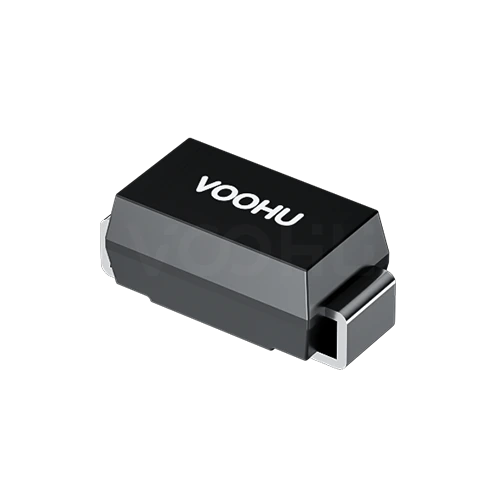
58 V working voltage
WHTB058VA holds off 58 V (Vrwm) in either direction. That clears nominal 24 V and 48 V DC inputs.

Protective Component products
A bidirectional TVS behaves symmetrically in both directions, which is what AC lines, differential pairs and buses swinging either side of ground require. There is no polarity to observe, but the standoff voltage still has to clear the full signal swing.
Part number search & selector
Filter bidirectional TVS diodes by polarity, working voltage, ESD rating, capacitance, package and temperature.
* Frozen Image and Part Number columns · drag horizontally to review all specifications
| Image | Datasheet | Compare | Downloads |
Polarity
|
Vrwm/V
|
Vesd Air/Vesd Contact
|
Cj/pf
|
Package
|
Operating Temperature
|
Sample |
|---|
Broaden the selected filters or clear the current search.
By polarity
Polarity follows the signal: unidirectional for DC rails, bidirectional for AC and differential lines.
Series overview
A bidirectional TVS diode sits in parallel with the circuit it protects, across a two-wire input or from a line to ground, and clamps transients of either polarity. It is also called a bipolar TVS diode or bidirectional transient voltage suppressor. WHTB058VA pairs a 58 V working voltage with a DO-214AB body for supply lines; for data lines, see the bidirectional ESD diodes.
WHTB058VA holds off 58 V (Vrwm) in either direction. That clears nominal 24 V and 48 V DC inputs.
Breakdown starts above Vrwm and the clamp sits higher still, so the circuit behind the bidirectional TVS diode must withstand the datasheet clamp level.
DO-214AB, also called SMC, is a large surface-mount outline. Short, wide copper to line and return keeps loop inductance from adding to the clamp.
The selector lists WHTB058VA for −60 °C to +150 °C; pulse capability falls as it heats, so check the derating curve.
Open the TVS Diodes and ESD Protection Devices selection guide →
Applications
Use one wherever line voltage can reverse, by design or by mistake.
Reversed field wiring makes a unidirectional TVS conduct and blow the fuse. WHTB058VA stays off up to 58 V either way; a fuse ahead covers a shorted failure.
Ahead of its input bridge, a PoE powered device can receive the supply in either polarity. Compare the highest PoE voltage with the 58 V working voltage of WHTB058VA.
Solenoids and small motors on an H-bridge kick back in whichever polarity the current had. A bidirectional TVS diode across the coil clamps both cases.
Documents
Search by part number for the datasheet and check breakdown, clamping voltage and package outline before layout.
Showing representative available file sets. Search to find a specific SKU.
VOOHU’s published product content is reviewed by its engineering team. Specifications, downloads and technical support information are tied to specific part numbers, so you can verify them before requesting samples or a quotation.
Sourcing
VOOHU supplies bidirectional TVS diodes alongside ESD diodes, gas discharge tubes and varistors. The WHTB058VA datasheet is published; check its clamping and pulse ratings first.
Discuss a new design
Contact FAE for a replacement assessment.
Already have a part number? Request samples or a quote.
Samples are available for evaluation, and selected parts are free of charge. Our FAE team will be glad to confirm the options for your project. Send the part number and quantity for a quotation, and we will confirm availability.
Send the part number and datasheet of your current TVS diode. Our FAE team compares voltages, pulse rating and package, then suggests VOOHU candidates to validate with samples.
VOOHU is ISO 9001 and ISO 14001 certified. Since 2018 VOOHU has supplied more than 1,500 customers, including 150+ listed companies.
FAQ
Answers on other voltages, AC lines and design files.
Whenever the protected line carries voltage of both polarities: AC lines, AC coupled signals, differential pairs and most industrial or automotive buses. A unidirectional part would conduct on the negative half and corrupt the signal, so bidirectional is a requirement rather than a preference on those lines.
Electrically it is symmetric, so there is no polarity in the usual sense. Even so, confirm the pin assignment from the datasheet package drawing, because multi-channel parts have defined channel-to-pin mapping and the marking may still indicate orientation for assembly purposes.
Above the highest voltage the line reaches in either direction during normal operation, including any common mode offset the bus specifies. If the standoff is set only against the nominal signal amplitude, the device may conduct on legitimate signal excursions and corrupt communication.
It depends on the capacitance. A device sized for surge energy usually has capacitance high enough to degrade a fast link noticeably. For high speed differential interfaces, compare low capacitance ESD parts first, and measure the eye diagram and return loss with the part fitted.
With a complete part number, send the part number, quantity, delivery region and the date you need it. If you are still selecting, send the line type, the full signal swing including common mode, the surge standard and the data rate.
Send the line voltage range, surge level and preferred package. Our FAE team will check whether VOOHU can supply a suitable part from its TVS and ESD range and confirm availability.
Usually. Size it on the peak: 24 V AC peaks near 34 V, more at high line. A 58 V part stays off there; check its clamp figure against the equipment behind it.
Only the datasheet is published at present. Use its DO-214AB outline drawing or a standard DO-214AB land pattern, and check pads against the drawing.
Engineer support
Send the candidate part number and the condition you need reviewed. Sample support can be added after the selection is clear; commercial questions may be discussed in the same engineering conversation.
Include the document revision
Temperature, isolation voltage and PoE current basis
Pin count, pitch and spacing between pin rows
To help prioritize samples and evaluation
When you need candidates and a comparison of differences
Engineering review identifies candidate parts and explains the differences.
From the selector or engineering review
Prototyping / pilot build / production
Specify sample and production timing separately
Compliance documents, material declarations or third-party reports
Samples are free of charge. Sample quantity and lead time depend on the part number and project stage. Sales will respond on business days.