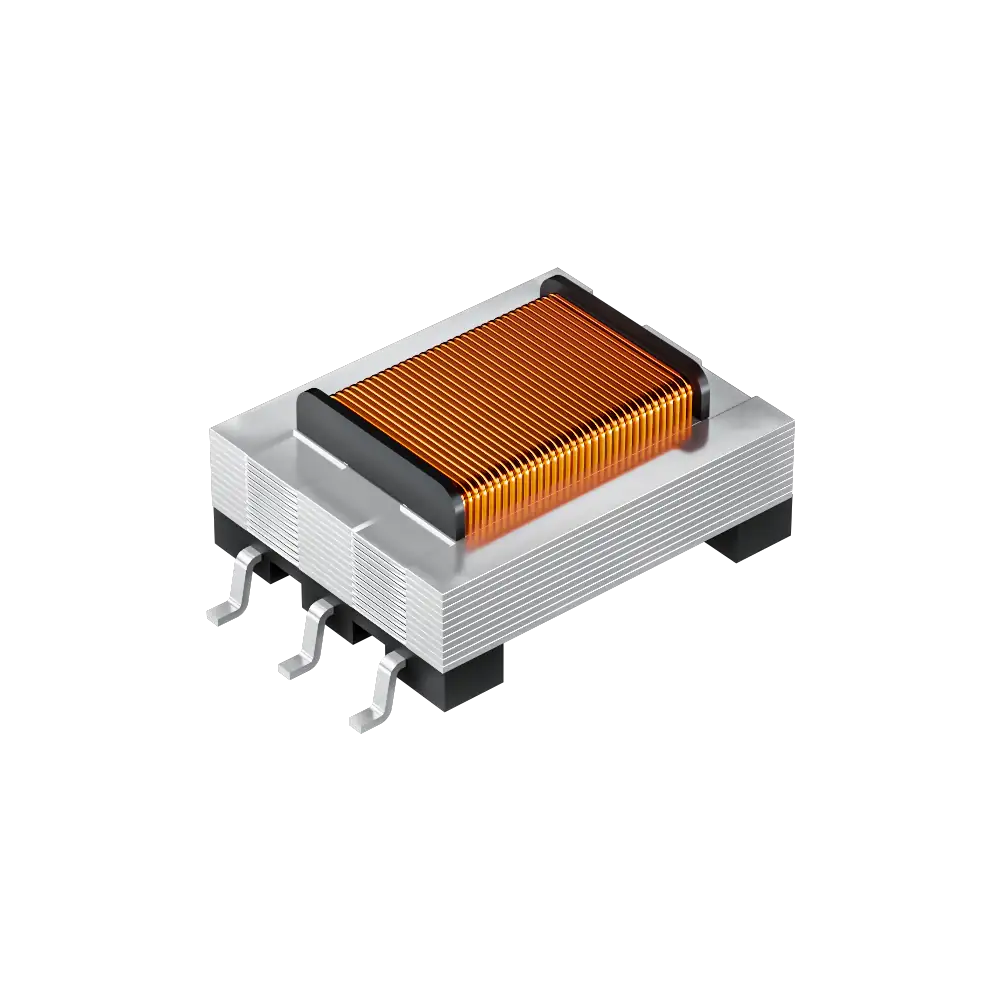
VOOHU Audio Transformers products

Transformer products

Audio Transformers

Audio transformers match impedance and provide galvanic isolation on audio lines, breaking the ground loops that cause hum. Filter by pin count, AC impedance, turns ratio and withstand voltage, then check insertion loss, frequency response and the mounting footprint before you commit to a part.

For OEM and volume orders. MOQ is one full reel, tray or tube per part.

  • Own factories: connectors in Dongguan, magnetics in Mianyang
  • 1,500+ customers, including 150+ listed companies
  • ISO 9001 and ISO 14001 certified
  • Certificates and test reports →

Part number search & selector

Find Audio Transformers part numbers

The table uses the current English-site product records, published selection fields and part-specific technical-file links.

* Frozen Image and Part Number columns · drag horizontally to review all specifications

Audio Transformers product selection results
Image Part number Datasheet Compare Downloads PinsL/W/H(mm*mm*mm)AC impedance PRI:SEC(Ω)DC resistance PRI:SEC(Ω)Turn Ratio(PRI:SEC)Mounting MethodHi-Pot(AC)Insertion Loss(dB)Insertion Loss (dB) Sample
VOOHU WHTT5005 Audio Transformers WHTT5005 SPEC 5 PIN14.5*8.2*5600:60065:751±2%SMD1000V1.31.3
VOOHU WHTT5003 Audio Transformers WHTT5003 SPEC 5 PIN14.5*8.5*5.08None45:551±1%SMD500V-—
VOOHU WHTT5002 Audio Transformers WHTT5002 SPEC 5 PIN14.5*8.5*5.08600:46090.5:112:1021±1%SMD500V-—
VOOHU WHTT5001 Audio Transformers WHTT5001 SPEC 5 PIN14.5*8.2*4.8600:365138:1301±1%SMD1000V2.8—
VOOHU WHTT5000 Audio Transformers WHTT5000 SPEC 5 PIN14.5*8.2*4.8300:600120:2502±1%SMD1000V-—

By pin count

Choose an audio transformer by pin count

Pin count sets the winding taps and the board footprint of an audio transformer, so start from the circuit you have.

How to select

Selecting an audio transformer in four steps

Work from source and load impedance outward to level, isolation and footprint, the same order an impedance matching transformer is specified in.

  1. 01

    Fix the impedance on both sides

    State source and load impedance, signal level and frequency range, and whether the stage converts balanced to unbalanced. On a 600 ohm line, a 600 ohm audio transformer is the usual starting point.

  2. 02

    Derive the turns ratio

    The impedance ratio is the square of the turns ratio. A 600:600 part is a 1:1 audio transformer; stepping 600 down to 150 ohm needs a 2:1 turns ratio.

  3. 03

    Check level and isolation

    Confirm the maximum level the core carries without saturating, then the dielectric strength the safety case demands. For a line level audio transformer, check that level at the lowest frequency, where the core works hardest.

  4. 04

    Confirm the footprint

    Match pin count, pin pitch and height against the board, then verify insertion loss and frequency response on your own hardware. Every part listed is a PCB audio transformer in SMD or DIP form.

Parameters

What the audio transformer datasheet values mean

Each figure in an audio transformer datasheet is measured under stated conditions; read the conditions with the number.

01

Pin count

Sets the winding taps and the footprint. A 4 pin audio transformer brings out two plain windings, while a 5 pin audio transformer or 6 pin audio transformer can add taps such as a center tap. Parts with different pin counts are not drop-in replacements for each other.

02

AC impedance

Quoted for a stated frequency, commonly 1 kHz. Read the test frequency with the value; the same part reads differently elsewhere in the band.

03

Turns ratio

Fixes the impedance transformation and the voltage relationship between windings. Impedance ratio equals turns ratio squared, so a 2:1 part transforms impedance by four.

04

DC resistance

Winding copper loss. It adds to insertion loss and matters most when the winding also carries a bias current.

05

Dielectric strength

The Hi-Pot (AC) column, from 500 V to 4600 V in the table, is the isolation the barrier withstands under the stated test. Choose against the safety requirement, not against the working voltage alone.

06

Insertion loss

Signal lost through the audio transformer at the stated frequency. Compare candidates at the same frequency or the numbers do not mean the same thing.

Compare

Audio transformer families side by side

Pin count and impedance separate the families more than package size does. Use the rows to see which impedance pairs and hi-pot levels exist at each pin count.

Return to the selector ↑
PinsPartsL/W/H(mm*mm*mm)AC impedance PRI:SEC(Ω)DC resistance PRI:SEC(Ω)Turn Ratio(PRI:SEC)Mounting MethodHi-Pot(AC)Insertion Loss(dB)Insertion Loss (dB)Action
4 PIN1711*8.2*5, 14*8*4.4, 14.5*8.2*5, 14*8.15*5.08, 15.2*8.2*5, 15.2*8*5.08, 15.2*8.2*4.9, 15.6*8.5*5, 18.5*5.08*4.6, 18.2*8.5*4.6, 20.9*8.5*4.5, 20.5*8.5*4.5600:287, 600:290, 600:301, 600:346, 600:400, 600:600, 20000:20000140:170, 105:105, 48:42, 160:135, 157:146, 73:73, 150:150, 160:133, 118:140, 62:3.2, 155:144, 180:160, 141:171, 2370:28201±1%, 1±2%, 1±3%, 6±1%SMD1000V, 1250V, 1500V, 1650V1, 1.3±0.5, 1.5, 2.9±0.1, 3.3±0.2, 3.3±0.25, 3.5, 3.85, -, 2.3Not specifiedFilter →
5 PIN514.5*8.2*5, 14.5*8.2*4.8, 14.5*8.5*5.08600:600, 600:365, 600:460, 300:600, None120:250, 138:130, 90.5:112:102, 45:55, 65:751±1%, 1±2%, 2±1%SMD500V, 1000V1.3, 2.8, -1.3, Not specifiedFilter →
6 PIN613.2*8.2*5, 13.5*9.5*7.5, 13.5*10.0*7.50, 14*8*4.4, 15.2*9.0*7.5600:316, 600:412, 600:430, 10000:10000, None155:150, 115:115, 30:38, 50:50, 170: 170, 1620:16201±1%, 1±2%, -SMD, DIP1200V, 1250V, 1500V, 3750V, 3880V, 4600V2, 3.0±0.25, 4.5, -Not specifiedFilter →

Application review

Where audio transformers are used

The same audio coupling transformer behaves differently on a broadcast line, an intercom run or an instrument input. Check these points first for each use.

Application review

Professional audio and broadcast

  • Confirm line level, balanced wiring and the impedance ratio, then check insertion loss and frequency response across the audio band.
  • On balanced studio and broadcast lines, a 600 ohm part is the classic line transformer.
Application review

Intercom and paging systems

  • Long runs pick up ground noise, and an audio transformer for ground loop problems breaks the current path.
  • Verify the isolation rating and that the core handles the maximum drive level without saturating.
  • Telephone-style circuits use the same impedances as a telecom transformer.
Application review

Industrial and instrumentation audio

  • Check the dielectric strength against the safety case.
  • Confirm the operating temperature range covers the enclosure.
  • High-impedance inputs may call for the 10000:10000 or 20000:20000 ohm parts rather than a 600 ohm one.
Application review

Consumer audio interfaces

  • Height and footprint usually decide, so a small audio transformer in SMD form is the common choice.
  • Confirm the pin pitch and that frequency response holds at the levels the interface actually uses.
Get technical support →

Documents

Audio transformer datasheets and drawings

Each audio transformer datasheet carries the tested impedance, frequency response, pinout and recommended footprint. Search by full or partial part number.

28
PDF datasheets listed
25
3D file sets listed
26
PCB footprints listed

VOOHU’s published product content is reviewed by its engineering team. Specifications, downloads and technical support information are tied to specific part numbers, so you can verify them before requesting samples or a quotation.

Category overview

What an audio transformer does, and why 600 ohm

Two questions come up on almost every audio transformer enquiry: what the part is actually for, and why so many datasheets quote 600 ohm.

01

What it does

An audio transformer couples a signal magnetically between two windings. Nothing conducts across the barrier, so a ground loop between two pieces of equipment cannot push current through the signal path, which is what removes hum. Used this way it is an audio isolation transformer, the core of most ground loop isolator designs.

The second job is impedance matching, so a source drives a load it can actually deliver power into. Catalogs then call the same signal transformer an impedance matching transformer or audio matching transformer.

02

Why 600 ohm keeps appearing

600 ohm is a telephone and broadcast line convention rather than a law of physics. It became the reference impedance for balanced lines, so the 600 ohm transformer turned into the standard line transformer and telecom transformer. A 600:600 part is a 1:1 isolation part; a 600:150 part steps impedance down by four, which is a 2:1 turns ratio.

Most parts in this table have a 600 ohm primary with secondaries from about 287 to 600 ohm, alongside a 300:600 step-up part and 10000:10000 and 20000:20000 ohm parts for high-impedance circuits.

03

How to wire and verify it

Identify the primary, secondary and any center tap from the datasheet pinout, not from the physical symmetry of the package; a center tap transformer needs the extra pin wired as the schematic shows. Keep the balanced pair symmetric on the board.

Then measure insertion loss and frequency response on your own hardware, because the published curve is taken under the datasheet's stated source and load. In an audio isolation transformer PCB layout, also keep the copper of the two sides apart under the part.

FAQ

Audio transformer questions engineers ask

Answers cover what an audio transformer does, the 600 ohm convention, wiring and the limits on swapping one part for another.

Can an audio transformer cure a ground loop?

Usually, yes. It couples the signal magnetically between two windings, so the two sides share no electrical connection and the loop current that causes hum has no path through the signal. That is why an audio isolation transformer sits inside most ground loop isolators. It also transforms impedance and can convert between balanced and unbalanced wiring.

Why do so many audio transformers say 600 ohm?

600 ohm is a convention inherited from telephone and broadcast line practice, not a physical constant. Balanced lines were built around it, so a 600 ohm audio transformer became the default part for them. A 600:600 part is a 1:1 isolation transformer. If the datasheet quotes a different pair, read the test frequency alongside it.

How do I work out the turns ratio I need?

Impedance ratio is the square of the turns ratio. To go from 600 ohm to 150 ohm the impedance ratio is four, so the turns ratio is two to one. Fix the source and load impedance first, then derive the ratio, then confirm the part carries your maximum signal level without the core saturating.

Does pin count tell me anything useful?

Yes. Pin count sets how many winding taps are brought out and therefore how the part can be wired: whether a center tap is available, whether both windings are fully accessible, and how the audio transformer sits on the board. Parts with different pin counts are not interchangeable even when the electrical ratings look similar.

Can I swap in an audio transformer with the same impedance?

Not automatically. Matching impedance is necessary but not sufficient. Compare turns ratio, DC resistance, dielectric strength, maximum level and insertion loss, and check the pinout and footprint. After any change, re-measure frequency response and distortion on your own board rather than relying on the datasheet curve.

Will an audio transformer affect sound quality?

It will have some effect. Every audio transformer has insertion loss, a finite bandwidth and a level above which the core saturates and distortion rises. How audible that is depends on the part and on how hard you drive it. Compare candidates at the same test frequency and level, and verify on your own hardware.

What isolation rating should I ask for?

Choose against the safety requirement that applies to the equipment, not against the normal working voltage. The dielectric strength in an audio transformer datasheet is measured under a stated test condition, so read the condition with the number. If the design has to meet a specific standard, tell us which one and our engineers will confirm which parts qualify.

How do I request audio transformer samples or a quote?

VOOHU is the audio transformer manufacturer behind these parts, with magnetics production in its own Mianyang plant. If you already have a complete part number, send it with the quantity, delivery region and the date you need it. If you are still selecting, send the source and load impedance, signal level, frequency range and any isolation requirement, and a sales engineer will shortlist candidates before you commit to samples.

Engineer support

Continue after product selection

Send the candidate part number and the condition you need reviewed. Sample support can be added after the selection is clear; commercial questions may be discussed in the same engineering conversation.

  1. 1Selected part numbers
  2. 2Engineering review
  3. 3Sample request
  4. 4Commercial discussion

For a replacement review

  • Original part and datasheet

    Include the document revision

  • Operating conditions

    Temperature, isolation voltage and PoE current basis

  • Package constraints

    Pin count, pitch and spacing between pin rows

  • Project stage and annual volume

    To help prioritize samples and evaluation

  • Target review date

    When you need candidates and a comparison of differences

Engineering review identifies candidate parts and explains the differences.

For samples and a quotation

  • Candidate part numbers

    From the selector or engineering review

  • Quantity and project stage

    Prototyping / pilot build / production

  • Required delivery date

    Specify sample and production timing separately

  • Required documentation

    Compliance documents, material declarations or third-party reports

Samples are available for evaluation, and selected parts are free of charge. Our FAE team will be glad to confirm the options for your project. Sales will respond on business days.

For OEM and volume orders. MOQ is one full reel, tray or tube per part.

Your information will be used only to respond to this support request.

Published replacement reviews View all alternatives

Parameter comparison

Compare selected part numbers

Differences are presented for review; confirm final values and file revisions in each part-specific datasheet.