

Channel
Use this field to align the part family with the required interface or connection.

Transformer products
Select communication isolation magnetics for battery management systems. VOOHU offers single- and dual-channel BMS transformer options, with or without common mode chokes. Start with the BMS IC and communication link, then review working voltage, isolation test conditions and board space. If your part number is known, request samples or pricing directly.
Part number search & selector
The table uses the current English-site product records, published selection fields and part-specific technical-file links.
* Frozen Image and Part Number columns · drag horizontally to review all specifications
| Image | Datasheet | Compare | Downloads |
Channel
|
Working Voltage (VDC)
|
Isolation
|
CMC
|
Sample |
|---|
| Image | Part number | Datasheet | Compare | Downloads | Channel | Working Voltage (VDC) | Isolation | CMC | Sample |
|---|---|---|---|---|---|---|---|---|---|
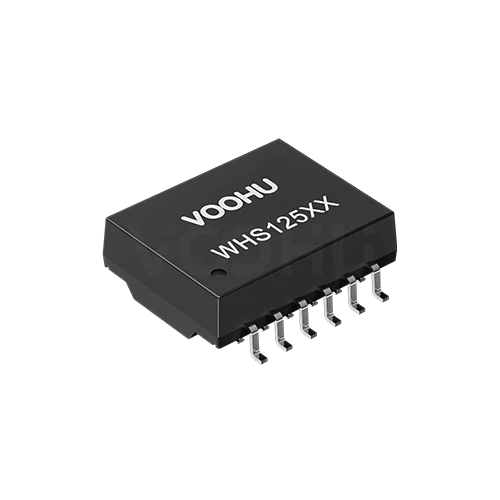 |
WHS12503A0 | SPEC | Dual | 1500 | 4300VDC | Yes |
|
||
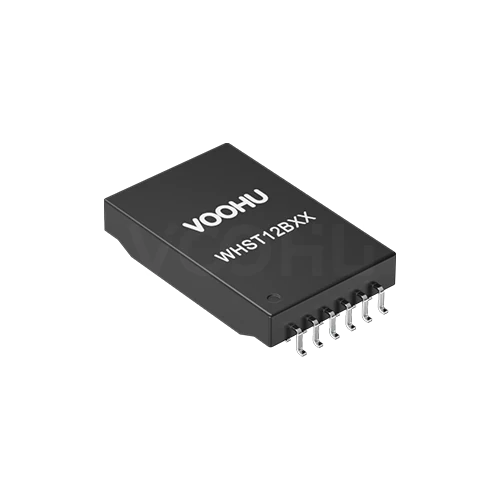 |
WHST12B03A0 | SPEC | Dual | 1500 | 6300VDC | Yes |
|
||
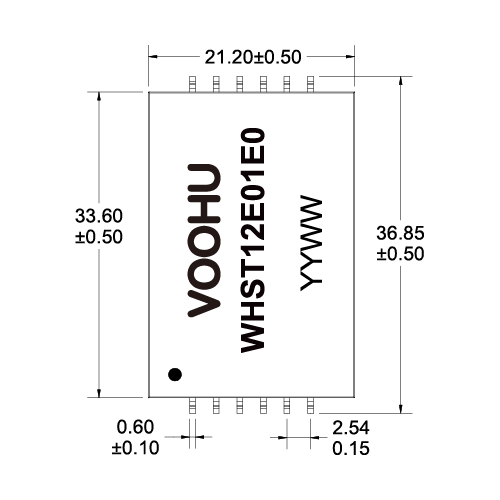 |
WHST12E01E0 | SPEC | Dual | 1600 | 4300VDC | Yes |
|
||
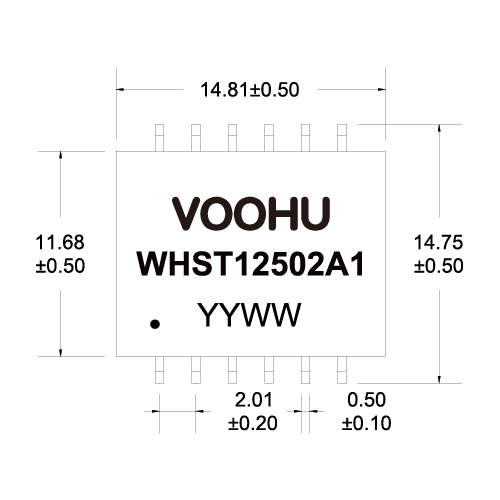 |
WHST12502A1 | SPEC | Dual | 1500 | 4300VDC | Yes |
|
Broaden the selected filters or clear the current search.
Product family quick links
Counts reflect the current published product data.
How to select
Narrow the published fields in sequence, compare the remaining candidates and verify the part-specific files before design-in.
Share the BMS IC, reference circuit, cabling and node architecture, including the potential relationship across the isolation boundary.
Compare single/dual channel and CMC options, then review turns ratio, taps and primary-inductance test conditions.
Record working voltage, AC/DC test voltage, duration, leakage-current limit and creepage separately. Do not combine maximum ratings from different parts.
Check pins, pads and isolation routing, then validate communication and EMC performance in the target link before production release.
Key selection parameters
Use this field to align the part family with the required interface or connection.
Compare the published values with the electrical limits required by the design.
Compare the published values with the electrical limits required by the design.
Use this published parameter to narrow the candidate part numbers before datasheet review.
Product family comparison
Use this summary as a routing step, then verify every required value in the exact part-number row and linked technical files.
Return to the selector ↑Technical performance & application fit
Application suitability is part-number specific. Treat the catalog fields as a shortlist, then confirm the design against the linked technical files.
Downloads & technical resources
Search a full or partial SKU, then open its datasheet, 3D model or PCB footprint without returning to the product table.
Showing representative available file sets. Search to find a specific SKU.
VOOHU’s published product content is reviewed by its engineering team. Specifications, downloads and technical support information are tied to specific part numbers, so you can verify them before requesting samples or a quotation.
Category overview
In a battery management system the transformer carries communication across a potential difference that would otherwise be dangerous.
Discuss a new design
Contact FAE for a replacement assessment.
Already have a part number? Request samples or a quote.
Battery stacks put cell groups at very different potentials, so a monitoring board on one group cannot share a ground with one on another. The isolation transformer carries the signal magnetically across that gap, so data passes while both sides stay separate. The isolation rating is a safety parameter.
These parts carry signal, not power. The winding is designed for the data waveform and the isolation requirement, not for delivering current to a load. Substituting a power transformer of similar size will not work, because the two are specified against entirely different criteria.
A single channel part isolates one communication link. A dual channel part isolates two in one body, which saves board area on stacks with multiple links. A dual channel part does not by itself provide redundancy: whether the two channels are independent depends on the circuit they sit in, not on the transformer.
FAQ & related guides
These answers guide the page workflow. Part-specific engineering limits still come from the linked technical files.
These products are selected for communication signal coupling and isolation, not power output. For an isolated supply or active battery balancing, first establish the topology, power and controller requirements, then select the appropriate power or balancing magnetics. The BMS transformer name alone does not establish suitability.
Count the transformer channels required by the communication schematic and review their connections, footprint, pinout and insulation requirements. A single-channel part is a starting point for one-channel matching; a dual-channel part can be evaluated for a two-channel design. Dual channel does not automatically establish redundancy or protocol qualification.
They describe different conditions. Working voltage concerns the specified operating insulation conditions; isolation test voltage applies between defined terminals for a stated duration. Do not infer one from the other or combine ratings from different parts. Use the same part-specific datasheet and the system insulation requirements.
Matching turns ratio or pin count does not establish interchangeability. The presence, location and characteristics of the common mode choke affect the link; external filtering, termination and protection also need review. Share the BMS IC, current part and schematic for FAE assessment. An integrated CMC is not automatically the better choice.
Compatibility cannot be assumed for the entire catalog. For isoSPI or another interface, check turns ratio, primary inductance, center taps, leakage inductance, cabling and isolation against the specific IC reference design, then validate communication and EMC performance. Share the IC model and link architecture for candidate matching.
Start with the BMS IC, interface, potential relationship across the isolation boundary, required working voltage and temperature range. Add cable length, PCB constraints and qualification requirements. The nominal pack voltage does not replace a review of each isolation boundary. Request part-specific qualification documentation for automotive projects.
If the part is known, send the number, quantity, project stage, destination and requested dispatch date for a quote or sample request; a replacement review is not required first. If no part is selected, begin with the application conditions. Sales confirms availability, costs and lead time for the specific item.
Send the current part number, datasheet, schematic and fixed mechanical constraints. A sales engineer will coordinate an FAE review and a comparison of candidates. Electrical, insulation, layout and sample validation are required; universal drop-in compatibility is not promised. Custom feasibility, tooling and timing are confirmed per project.
Engineer support
Send the candidate part number and the condition you need reviewed. Sample support can be added after the selection is clear; commercial questions may be discussed in the same engineering conversation.
Include the document revision
Temperature, isolation voltage and PoE current basis
Pin count, pitch and spacing between pin rows
To help prioritize samples and evaluation
When you need candidates and a comparison of differences
Engineering review identifies candidate parts and explains the differences.
From the selector or engineering review
Prototyping / pilot build / production
Specify sample and production timing separately
Compliance documents, material declarations or third-party reports
Samples are free of charge. Sample quantity and lead time depend on the part number and project stage. Sales will respond on business days.