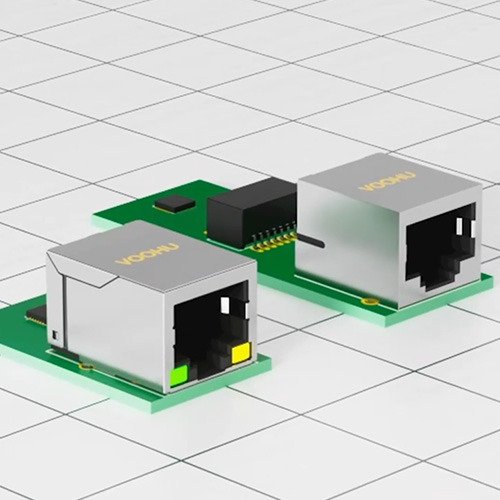
RJ11 and RJ45 jacks belong to the same modular-connector family, but they are not interchangeable. An RJ11-style jack has 6 positions and is usually fitted with 4 or 6 contacts (6P4C or 6P6C) for telephone, modem and some serial lines. The jack sold as RJ45 for Ethernet has 8 positions and 8 contacts, which is why it is also called 8P8C. On a PCB the difference is physical: in the VOOHU 5521 jack series, the 6P6C jack is 12.15 mm wide and the 8P8C jack is 15.00 mm wide, with the same 13.00 mm depth and 14.50 mm height, so their footprints cannot be swapped. An RJ11 plug can enter an RJ45 jack, but that is a misuse case, not a compatible connection. For boards that need both ports, VOOHU supplies matching RJ11 and RJ45 jacks, and our FAE team can check the footprint and pin 1 orientation.
#What is the difference between RJ11 and RJ45?
"RJ" stands for registered jack, a set of telephone wiring designations from the US Bell System. Strictly, RJ11 describes a single-line telephone interface on a 6-position jack, but component catalogs also use the name for 6P4C and 6P6C jacks. RJ45 has become the everyday name for the 8-position, 8-contact jack used by Ethernet. For PCB work, the "xPyC" code tells you more than either name: the number before P is the number of positions (slots) in the housing, and the number before C is how many of those positions carry a contact.
#What does 8P8C mean, and is it the same as RJ45?
8P8C means 8 positions, 8 contacts. It is the generic name of the modular connector that Ethernet cabling uses; the IEC 60603-7 series covers this 8-way connector. The original RJ45S registered jack was a keyed 8-position jack with only two contacts, intended for a telephone data line, and it is not the connector found on Ethernet equipment. In everyday use, "RJ45 jack", "8P8C jack" and "Ethernet jack" all mean the same part on a PCB. VOOHU datasheets use 8P8C in the part title, and the parts are listed under RJ45 connectors.
#RJ11 vs RJ45 size: how do the PCB footprints differ?
The clearest way to compare the two is within one jack series, where only the number of positions changes. The figure and table below use VOOHU right-angle, through-hole, unshielded jacks. In the 5521 series, all four variants share a 13.00 mm depth, a 14.50 mm height, 0.90 mm signal-hole callouts on two staggered rows (1.02 mm horizontal offset between consecutive pins, 2.54 mm between rows) and two 2.30 mm locating-peg holes. What changes is the body width and the peg spacing, and that is enough to make each footprint unique.
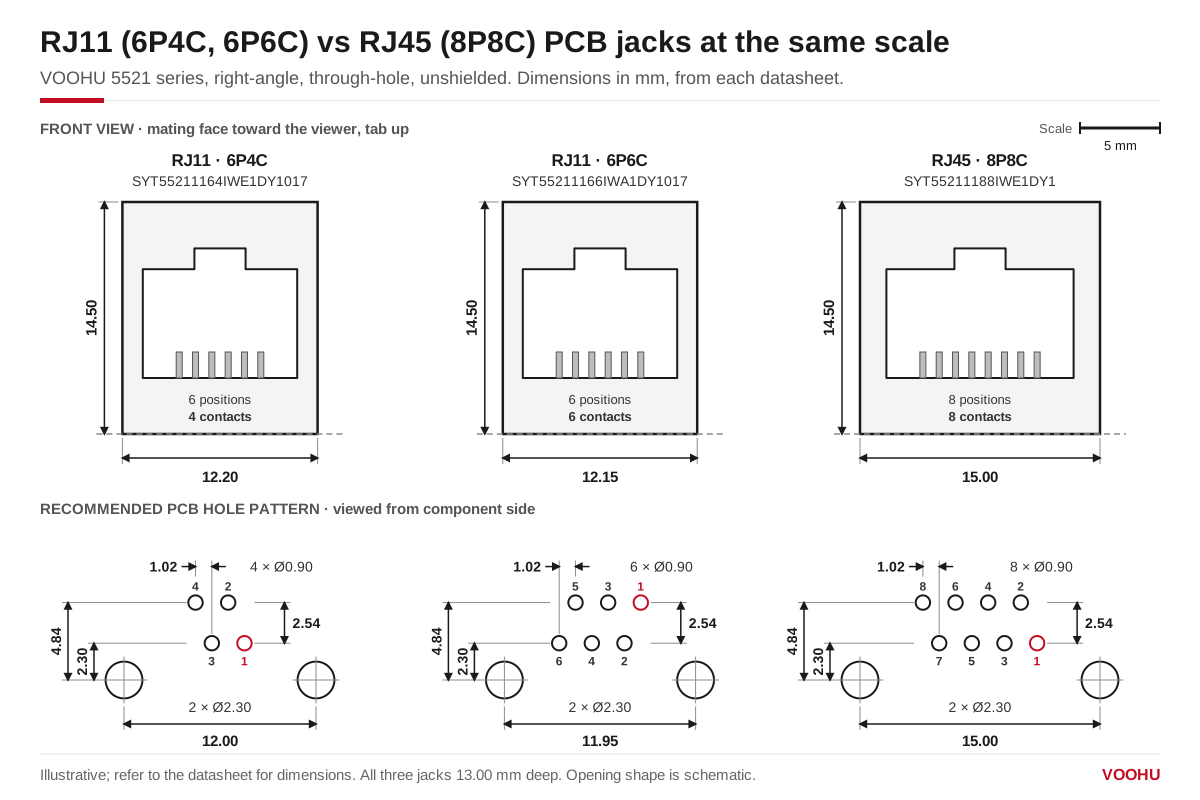
Front view and recommended PCB hole pattern (component side) of SYT55211164IWE1DY1017 (6P4C), SYT55211166IWA1DY1017 (6P6C) and SYT55211188IWE1DY1 (8P8C), drawn to the same scale. All three are 13.00 mm deep. Illustration only; dimensions per each datasheet.
Dimensions are taken from each part's datasheet. Hole sizes are the callouts printed in each datasheet's recommended PCB layout, viewed from the component side. The datasheets do not say whether these are drilled or finished sizes, so confirm with our FAE team before you release the footprint.
Two points follow from the table. First, even within one series the RJ11 and RJ45 footprints do not overlap: the peg spacing is 11.95 mm against 15.00 mm in the 5521 series and 10.16 mm against 11.43 mm in the 5722 series, so a "universal" pad pattern is not an option. Second, a 6P4C jack is not a 6P6C jack with two pins removed from the layout. The datasheet of SYT55211164IWE1DY1017 numbers its four contacts J1 to J4 without showing which four of the six slots they occupy, so map the pinout from the datasheet drawing or ask our FAE team first. For the 6P4C vs 6P6C choice itself, see RJ11 6P4C vs 6P6C.
#Can I plug an RJ11 into an RJ45 jack?
Physically, a 6-position plug is narrow enough to enter an 8-position jack, where it sits over the middle positions. It is not a supported connection. Many cabling guides warn that the plastic shoulders on either side of a 6-position plug can press on the outer contacts of an 8-position jack (positions 1 and 8) and bend them, after which a normal RJ45 plug may no longer make reliable contact. VOOHU jack datasheets do not rate the jacks for mating with a 6-position plug, so treat it as misuse. The other direction does not work at all: an 8-position plug is wider than the opening of a 6-position jack.
There is an electrical reason to keep them apart as well. An analog telephone line carries a DC loop voltage and a high-voltage ringing signal, while an Ethernet port expects low-voltage differential signals through its LAN transformer. Neither port is designed to be connected to the other's line.
#How do I prevent mix-ups on a board with both jacks?
- Use separate footprints and keep the ports apart. Do not try to share one pad pattern; leave enough space and a panel label between the RJ11 and RJ45 openings.
- Use color as a cue. Housing color is listed in each datasheet: in the 5521 examples, SYT55211164IWE1DY1017 (6P4C) and SYT55211188IWE1DY1 (8P8C) are gray and SYT55211166IWA1DY1017 (6P6C) is black. Choosing different colors for adjacent RJ11 and RJ45 ports is a simple visual cue. For example, place a black 6P6C jack such as SYT55211166IWA1DY1017 next to a gray 8P8C jack such as SYT55211188IWE1DY1; for other housing colors, ask our FAE team.
- Keep one latch orientation per panel. The 5521 jacks are tab up and the 5722 jacks are tab down; mixing them on one edge makes the panel harder to use. See RJ45 tab up vs tab down for how orientation affects the pinout view.
- Fit the contacts you actually need. If only four conductors are used, 6P4C is enough; choose 6P6C when all six positions are wired.
#Which VOOHU RJ11 and RJ45 jacks should I start with?
For a board that needs a telephone-style port next to an Ethernet port, the three 5521-series jacks below share the same depth and height, so their fronts line up on one board edge:
- SYT55211164IWE1DY1017: 6P4C, right-angle, through-hole, tab up, 12.20 mm wide. For telephone, modem or line ports that use four conductors.
- SYT55211166IWA1DY1017: 6P6C, same body style, 12.15 mm wide. For ports that wire all six positions.
- SYT55211188IWE1DY1: 8P8C, same series, 15.00 mm wide. A plain RJ45 jack without magnetics, so it pairs with a discrete LAN transformer on the board.
To compare other contact counts, port counts and orientations, filter the RJ11 jack selector, or browse RJ11 connectors and RJ45 connectors.
#FAQ: RJ11, RJ45 and 8P8C
Can I use RJ11 for Ethernet?
Not for standard Ethernet. 10BASE-T and 100BASE-TX use pins 1-2 and 3-6 of an 8-position jack, and 1000BASE-T uses all four pairs, so a 6-position jack cannot carry the Ethernet pin assignment. Internet service over a telephone line, such as DSL, reaches a modem through an RJ11 port, and the modem then provides an RJ45 Ethernet port.
What does 8P8C stand for?
Eight positions, eight contacts. It describes the modular connector itself, while RJ45 is the common name for that connector on Ethernet equipment. VOOHU's SYT55211188IWE1DY1, for example, is an 8P8C jack listed under RJ45 connectors.
Is RJ11 the same size as RJ45?
No. Both the plugs and the jacks differ in width. In the VOOHU 5521 series, the 6P6C jack is 12.15 mm wide and the 8P8C jack is 15.00 mm wide, while depth (13.00 mm) and height (14.50 mm) are the same.
Can one PCB footprint accept either an RJ11 or an RJ45 jack?
No. The locating pegs land in different places: 11.95 mm apart on the 5521-series 6P6C jack against 15.00 mm on the 8P8C jack, and 10.16 mm against 11.43 mm in the 5722 series. Give each jack its own footprint from its datasheet.
Get RJ11 and RJ45 samples for your layout
Need RJ11 and RJ45 jacks that line up on the same board edge? Send your panel drawing or footprint, the contact count you need (6P4C, 6P6C or 8P8C) and the latch orientation through our sample request form. Samples are available for evaluation, and selected parts are free of charge. Our FAE team will be glad to confirm the options for your project, including checking the footprint, pin 1 position and front alignment against your layout. VOOHU supplies RJ45 and SFP connectors, LAN and PoE transformers and common mode chokes from Suzhou, China, to more than 1,500 customers.
Need a quote, samples or selection support?
Part number SYT55211164IWE1DY1017 is filled in for you. Add the quantity and lead time and submit. Our FAE team will be glad to confirm the options for your project.
Before you order: samples, MOQ, lead time and import duties in our ordering guide →