A gas discharge tube (GDT) is a surge arrester made of two or three electrodes sealed in a small ceramic tube filled with gas. At normal line voltage it is practically an open circuit, with insulation resistance in the gigaohms and capacitance of 1 pF or less on these parts. When a surge drives the voltage past its spark-over voltage, the gas ionizes and the tube switches into a low-voltage arc that carries the surge current to ground. When the surge ends, the arc goes out and the line returns to normal. GDTs are used as the first stage of surge protection on telecom, data and antenna lines, usually with a TVS diode behind them to clamp what gets through. VOOHU supplies 2-electrode SMD GDTs with 90 V, 200 V and 400 V DC spark-over voltages, and a 3-electrode 90 V GDT rated 5 kA at 8/20 µs.
#How does a gas discharge tube work?
"Gas discharge" means current flowing through a gas once the gas has been ionized. A GDT uses this in four stages during a surge:
- 1.Off. Below its spark-over voltage the gas insulates, so the GDT draws almost no current.
- 2.Spark-over. As the surge voltage rises, the field between the electrodes ionizes the gas. This is the spark-over (breakdown) voltage.
- 3.Glow and arc. A short glow discharge turns into an arc. The arc voltage is low, so the GDT dissipates little energy while carrying a large current.
- 4.Extinguishing. When the surge current falls, the arc dies, the gas de-ionizes and the GDT returns to high impedance.
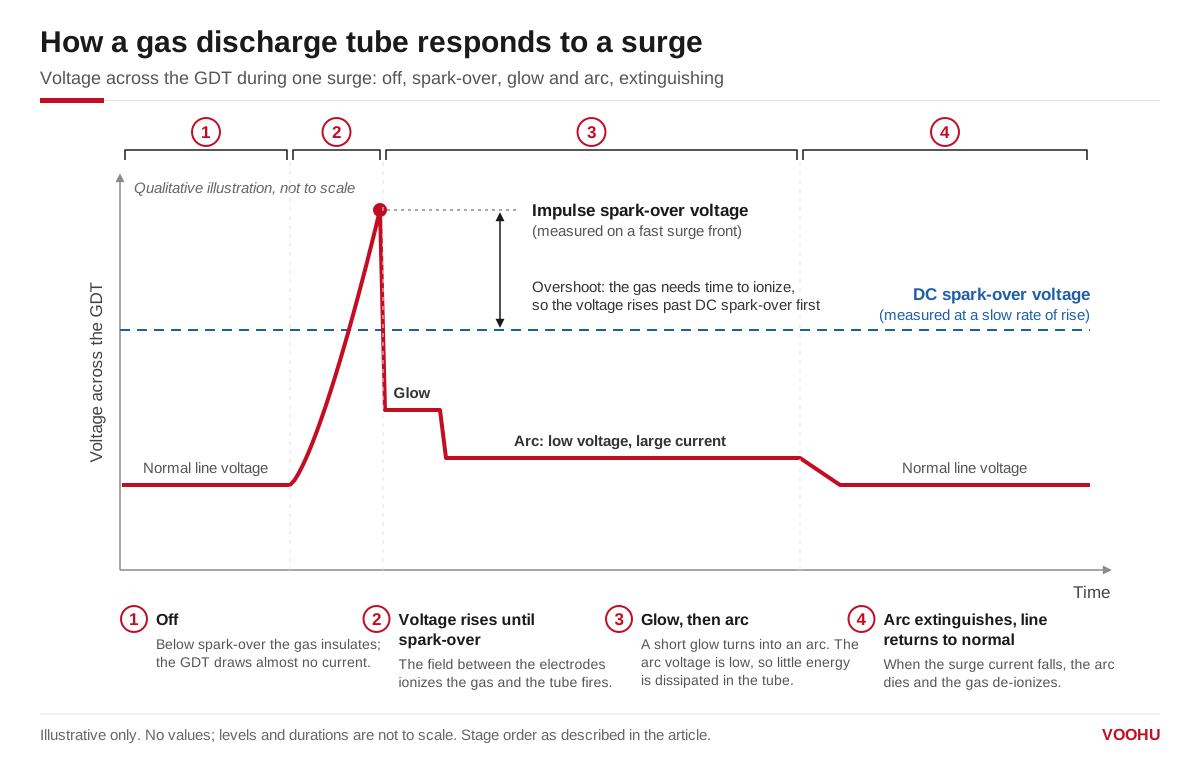
During a surge, the voltage across a GDT rises to its impulse spark-over voltage, collapses through glow to a low arc voltage, and returns to normal when the arc goes out. Illustration only, not to scale.
One condition matters for the last stage: if the circuit can keep supplying current after the surge, for example a DC supply across the tube, the arc may not go out. That continued current is called follow current, and the highest DC voltage at which the tube is still expected to reset is its holdover voltage.
#What is a gas discharge tube used for?
A GDT protects equipment from lightning-induced surges and power-cross events on lines that leave the building or run a long way: telephone and xDSL lines, line cards and modems, data ports and antenna feeds. It is the usual first stage on such ports because it carries far more surge current than a TVS diode of similar size, with capacitance too low to load fast signals. In an Ethernet port, a GDT typically sits on the cable side of the LAN transformer, with ESD or TVS diodes on the PHY side.
What is the gas discharge tube symbol?
The most common schematic symbol is a circle, for the sealed envelope, with two electrodes facing each other across a gap and a dot inside to show that the tube is gas-filled. A 3-electrode GDT adds a third electrode, drawn as the ground terminal, between the two line electrodes. Some libraries draw the envelope as a rounded rectangle; the electrodes and the gap are what identify it.
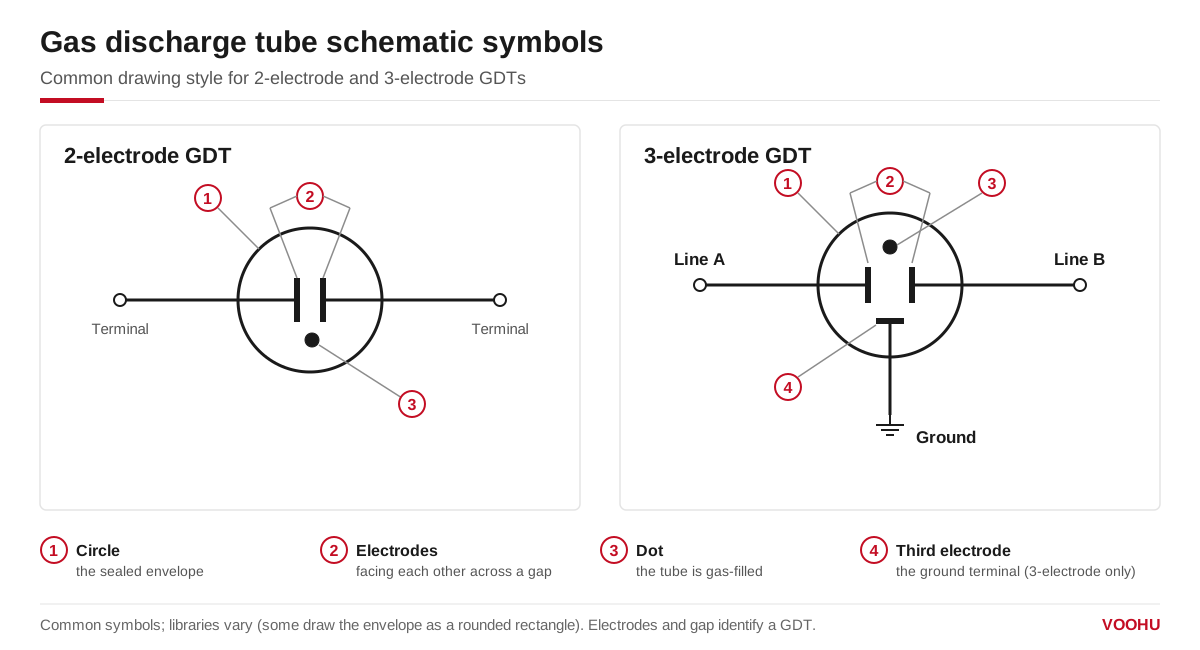
Common symbols for a 2-electrode GDT (left) and a 3-electrode GDT with its ground terminal (right).
#How do you read a gas discharge tube datasheet?
A GDT datasheet gives two breakdown voltages measured at different rates of rise, the surge current it survives and how many times, and its off-state properties. The table uses the values on VOOHU datasheets.
Other surge ratings appear outside the main table. The WHGD series datasheet lists a maximum surge current of 3000 A (8/20 µs, rated per IEC 61000-4-5); 6 kV at 10/700 µs, five times in each polarity (per ITU-T K.21, as stated in the datasheet); and 1000 A at 8/20 µs, ten times. The WHGT090V1P0A also lists an impulse life of 300 operations at 100 A (10/1000 µs) and an AC discharge current of 5 A (50 Hz, 1 s).
Three points help when you read these numbers:
- Impulse spark-over is always higher than DC spark-over. The gas needs time to ionize, so on a fast surge the voltage overshoots before the tube fires. For the WHGD090V1P0B, a 90 V DC spark-over becomes up to 600 V on a 1 kV/µs edge. That overshoot is what the next protection stage, or the protected circuit, has to withstand.
- Use the minimum of the DC spark-over range. The tolerance is wide: the 200 V part fires anywhere from 160 V to 240 V. The minimum, not the nominal, has to stay above the highest voltage that appears on the line in normal operation.
- Check the waveform and the count on every surge rating. "2000 A, 10 times at 8/20 µs" and "3000 A maximum" describe different tests. Compare parts only on the same waveform and the same number of operations.
#How do you choose the GDT voltage and type?
- 1.List the highest normal voltage on the line, including supply tolerance and any fault condition the port must ride through. Pick a GDT whose minimum DC spark-over is above it with margin.
- 2.Check the impulse spark-over against the stage behind it. A lower-voltage GDT fires earlier and lets less overshoot through.
- 3.Size the surge current to your test level, on the same waveform the datasheet uses.
- 4.Watch for follow current on powered lines. Across a DC supply, the arc must go out at your line voltage; a common approach is a MOV in series with the GDT. Our FAE team can check this for your supply.
- 5.Choose 2 or 3 electrodes. A 3-electrode GDT protects both wires of a pair in one part, and its two gaps share one gas volume, so they fire together. Two 2-electrode GDTs give more layout freedom.
#Gas discharge tube vs TVS diode: how do they work together?
A GDT and a TVS diode are complements, not alternatives. The GDT is the heavy-current stage: it diverts the bulk of a surge while adding very little capacitance, but it only conducts once the gas has ionized, at a voltage well above the line voltage. A TVS diode clamps quickly and close to the working voltage, but carries far less current. Used together, the TVS diode limits the fast front of the surge and the GDT takes over the bulk of the current.
The catch is coordination. A TVS diode connected directly across a GDT clamps below the GDT spark-over voltage, so the GDT never fires and the TVS diode takes the whole surge. Put a decoupling element, a resistor or an inductor, in series between the two stages. The surge current through it raises the voltage at the GDT until the GDT fires, and from then on the GDT carries the current.
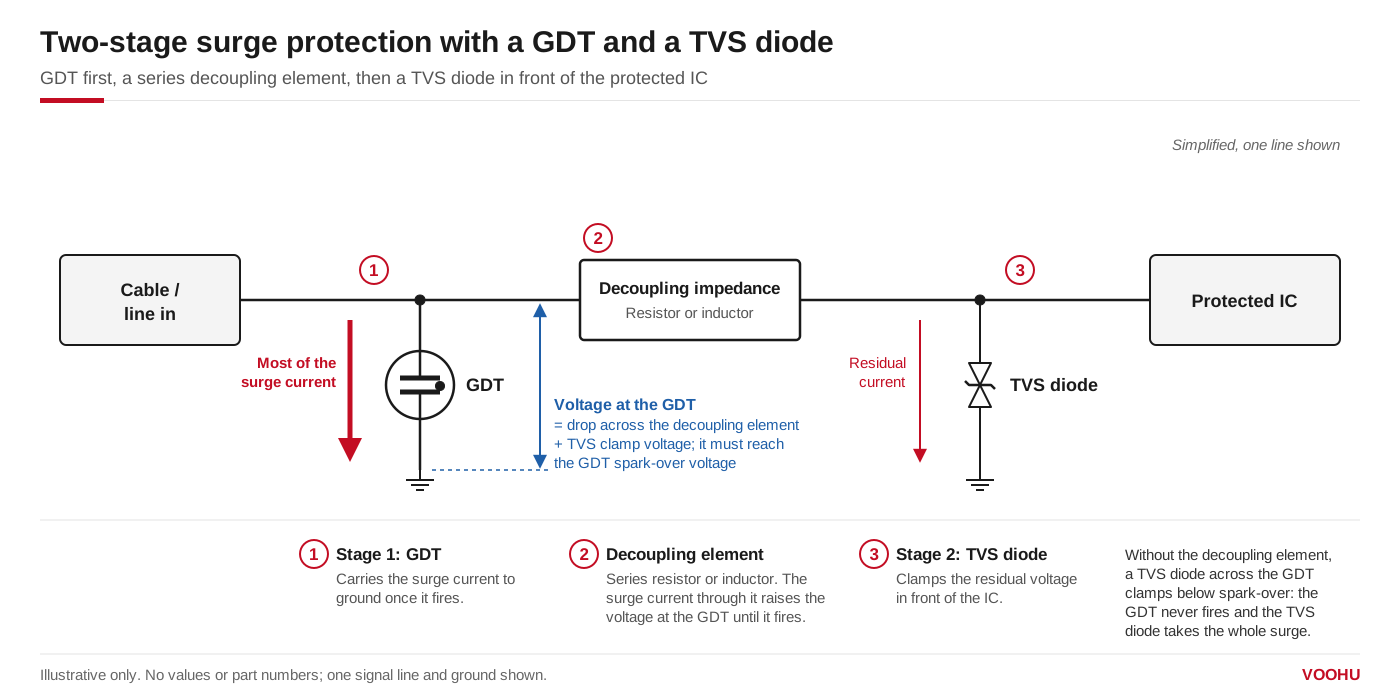
Two-stage protection: the GDT carries the surge current, the series element lets its voltage rise to spark-over, and the TVS diode clamps the residual voltage at the IC. Simplified, one line shown.
When to use MOV, TVS or GDT? A GDT for high surge current where capacitance must stay low, a MOV for surge energy on power inputs, and a TVS diode for fast clamping in front of the IC. See also VOOHU varistors.
#Which VOOHU GDT should you start with?
All four have capacitance of 1 pF or less. Compare the 2-electrode parts in the GDT selector, or see the full gas discharge tubes range. For the stage behind the GDT, see how to choose an ESD protection diode for Ethernet.
#FAQ
Do gas discharge tubes have polarity?
No. A GDT has symmetrical electrodes and fires the same way for positive and negative surges, so a 2-electrode GDT can be fitted either way round. On a 3-electrode GDT the center electrode is the ground terminal, so that one has to be placed correctly.
How long does a gas discharge tube last?
In the off state a GDT carries almost no current, so datasheets state its life as a number of surges at a given current and waveform rather than in hours. The WHGD series is rated for 2000 A at 8/20 µs ten times, and the WHGT090V1P0A for 5 kA at 8/20 µs ten times and 300 operations at 100 A (10/1000 µs). How long that lasts in the field depends on how often the line sees surges.
Is a GDT faster or slower than a TVS diode?
Slower. A TVS diode is a silicon junction that conducts as soon as it reaches breakdown, while the gas in a GDT has to ionize first, so on a fast surge the voltage overshoots to the impulse spark-over before the GDT fires. That is why a TVS diode is placed behind the GDT, with a decoupling element between them, to clamp the fast front while the GDT handles the current.
Get help choosing surge protection for your port
Tell us the line you are protecting, its highest normal voltage, the surge level you must pass and what sits behind the GDT in the sample and support request form. Our FAE team can suggest a GDT voltage and a matching TVS diode, and check the coordination and follow current for your line. Samples are available for evaluation, and selected parts are free of charge. Our FAE team will be glad to confirm the options for your project.
VOOHU supplies RJ45 and SFP connectors, LAN and PoE transformers, common mode chokes and TVS, ESD, GDT and MOV protection devices from Suzhou, China, to more than 1,500 customers.
Need a quote, samples or selection support?
Part number WHGD090V1P0B is filled in for you. Add the quantity and lead time and submit. Our FAE team will be glad to confirm the options for your project.
Before you order: samples, MOQ, lead time and import duties in our ordering guide →