Single Pair Ethernet (SPE) carries Ethernet over one twisted pair instead of the two or four pairs used on RJ45 links, and the same pair can also carry power through Power over Data Lines (PoDL). SPE is a family of IEEE 802.3 PHYs rather than a single standard: 10BASE-T1L reaches at least 1,000 m at 10 Mb/s, 10BASE-T1S puts several nodes on one short bus, and 100BASE-T1 and 1000BASE-T1 target in-vehicle links of at least 15 m. Two standards approved in 2026 fill the gaps: IEEE 802.3da extends multidrop to at least 16 nodes over 50 m, and IEEE 802.3dg defines 100BASE-T1L for at least 500 m. Both ends of a link must run the same PHY. VOOHU supplies SPE connectors, including the WHSPE00467 board socket and WHSPE00468 cable plug, together with the interface parts around them.
#How does Single Pair Ethernet work?
Standard 100BASE-TX Ethernet uses two pairs, one for each direction. SPE puts both directions on one pair. 10BASE-T1L and 1000BASE-T1 transmit in both directions at the same time (full duplex), and each end uses echo cancellation to subtract its own transmitted signal from what it receives; 100BASE-T1 is also full duplex.
10BASE-T1S takes a different approach. In multidrop mode, several nodes share one pair and take turns to transmit (half duplex). IEEE 802.3cg also defines PLCA (Physical Layer Collision Avoidance) as an option, which gives each node its transmit opportunity in turn.
The same pair can carry DC power. With PoDL, the power source couples DC onto the pair through inductors and the powered device takes it off the same way; part 2 of this guide covers that circuit.
#Single Pair Ethernet vs standard Ethernet: what changes at the port?
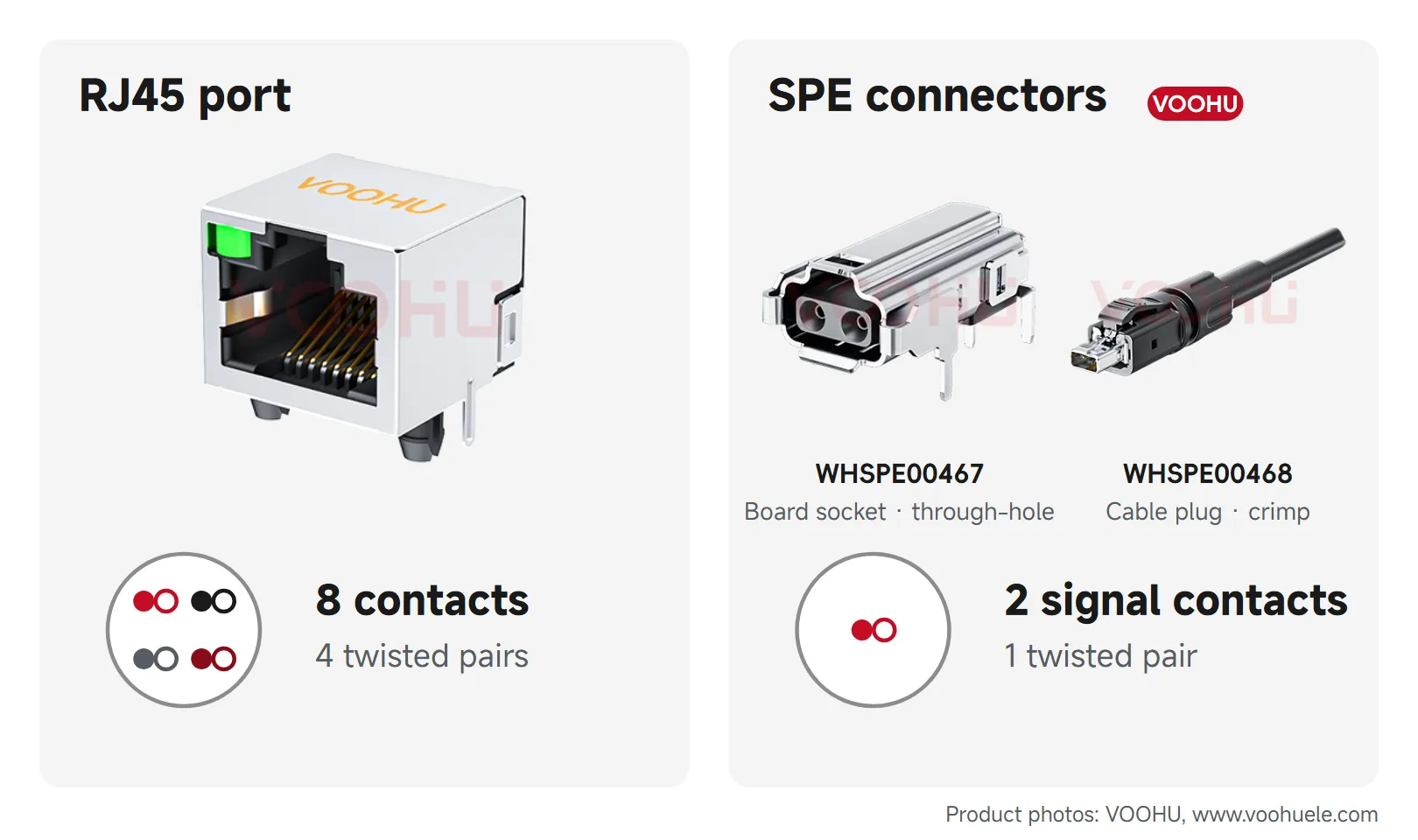
Put an RJ45 port next to an SPE interface and the difference is obvious. RJ45 has 8 contacts and carries 4 twisted pairs; an SPE connector has 2 signal contacts and carries 1 pair. The cable gets thinner, the connector gets smaller and the interface circuit between the PHY and the connector gets simpler.
VOOHU lists one SPE part for the board end and one for the cable end: the WHSPE00467 board socket is a through-hole part soldered to the PCB, and the WHSPE00468 cable plug is crimped onto the twisted pair; both are 2-pin parts rated 4 A and 60 V. Confirm the mating counterpart of each from the drawings before you design them in. Industrial SPE mating faces are standardized in the IEC 63171 series, from compact interfaces used inside equipment and cabinets to M8 and M12 circular interfaces rated IP65/IP67 for the field.
#How long can a Single Pair Ethernet cable be?
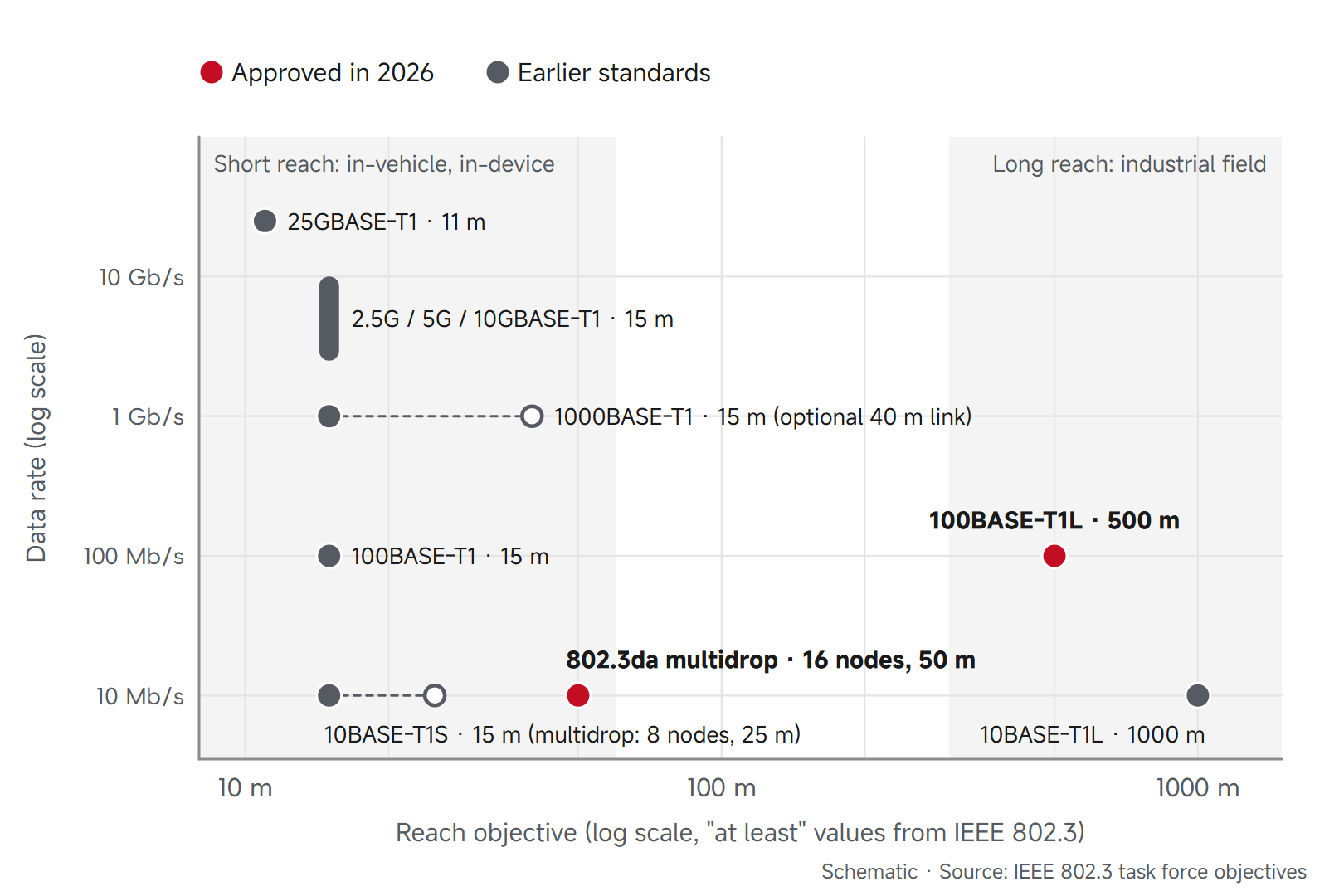
It depends on the PHY. The table lists the reach objective adopted by each IEEE 802.3 task force; every distance is an "at least" value.
#10BASE-T1L vs 10BASE-T1S vs 100BASE-T1: can they connect to each other?
No. All of them use a single pair, but both ends of a link must run the same PHY, so a 10BASE-T1L device cannot link to a 100BASE-T1 device. To put both on one network, use a switch with the matching ports.
In process automation, Ethernet-APL is built on 10BASE-T1L: trunks up to 1,000 m, spurs up to 200 m, and intrinsic safety in hazardous areas designed to IEC TS 60079-47 (2-WISE).
#What do IEEE 802.3da and 802.3dg add in 2026?
IEEE 802.3da: more nodes on one bus, with power
IEEE 802.3da was approved in February 2026 and published in March 2026. It extends 10BASE-T1S multidrop to a segment of at least 16 nodes and at least 50 m, up from the optional at least 8 nodes and 25 m, and its PHY remains backward compatible with 10BASE-T1S (Clause 147) PHYs on segments that meet the 10BASE-T1S specification.
It adds three more capabilities: optional plug-and-play power distribution over the bus, with a powered device detected before full power is applied; a bounded interruption when nodes are added or removed on a live segment; and an optional time synchronization service interface. The objectives target the noise environments of buildings, industrial sites and transportation, where RS-485 or CAN buses have long connected many devices on one cable.
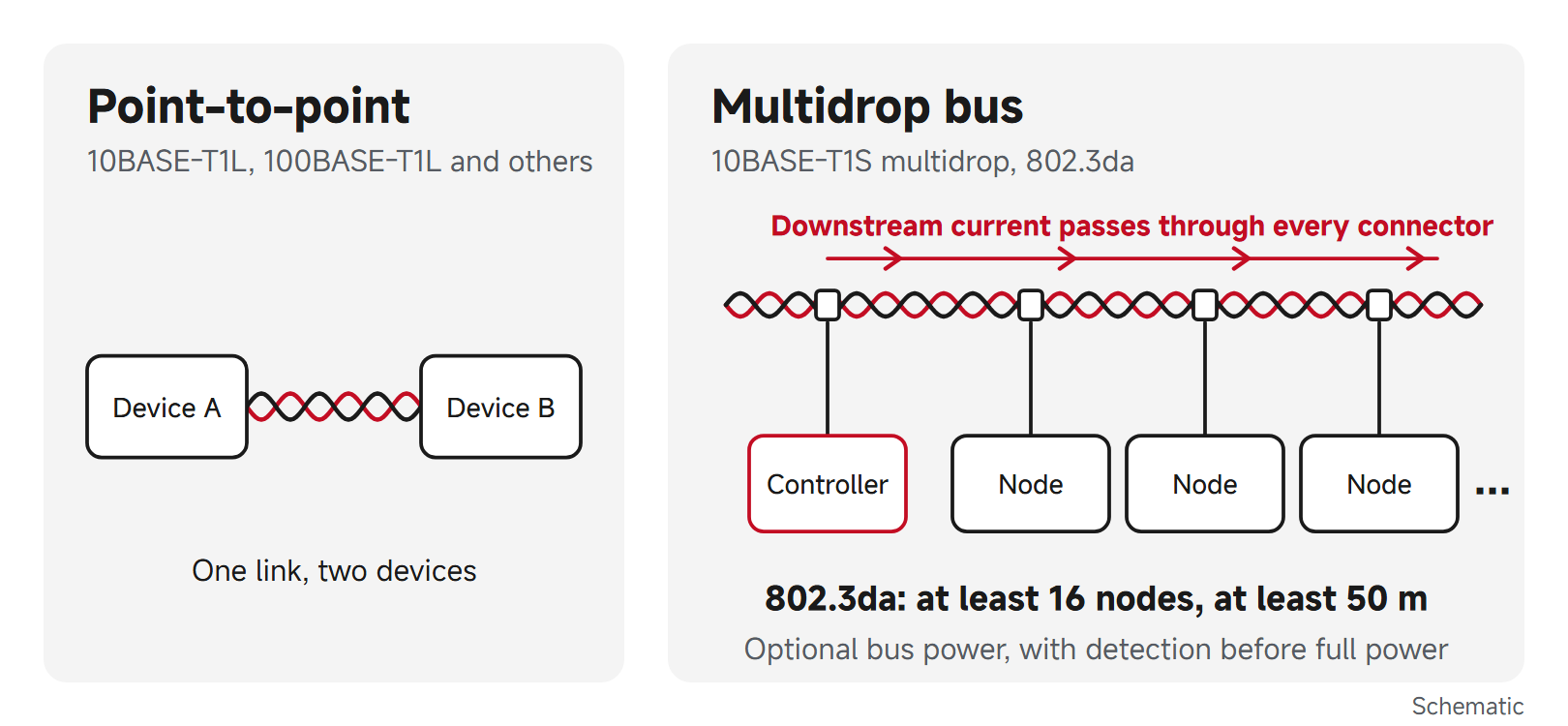
The hardware impact is power: with several powered devices on one bus, downstream current flows through every connector along the way, so connector current rating and temperature rise have to be checked against the maximum current of the whole segment.
IEEE 802.3dg: 100 Mb/s over hundreds of meters
IEEE 802.3dg was approved and published in June 2026 and defines 100BASE-T1L. Its project authorization request states that IEEE 802.3 did not support more than 10 Mb/s over a single balanced pair longer than 40 m. The objectives are point-to-point full duplex, up to 5 inline connectors, at least 500 m and optional power, without precluding use in intrinsically safe devices (IEC 60079). It sits between 10BASE-T1L, which has the reach but only 10 Mb/s, and 100BASE-T1 / 1000BASE-T1, which have the speed but target 15 m to 40 m.
#Where should a Single Pair Ethernet design start?
The order stays the same with the new standards: choose the PHY from distance, data rate and topology; choose the interface parts from isolation and power needs; then choose the connector by mating interface and termination. Part 2 covers the last two steps.
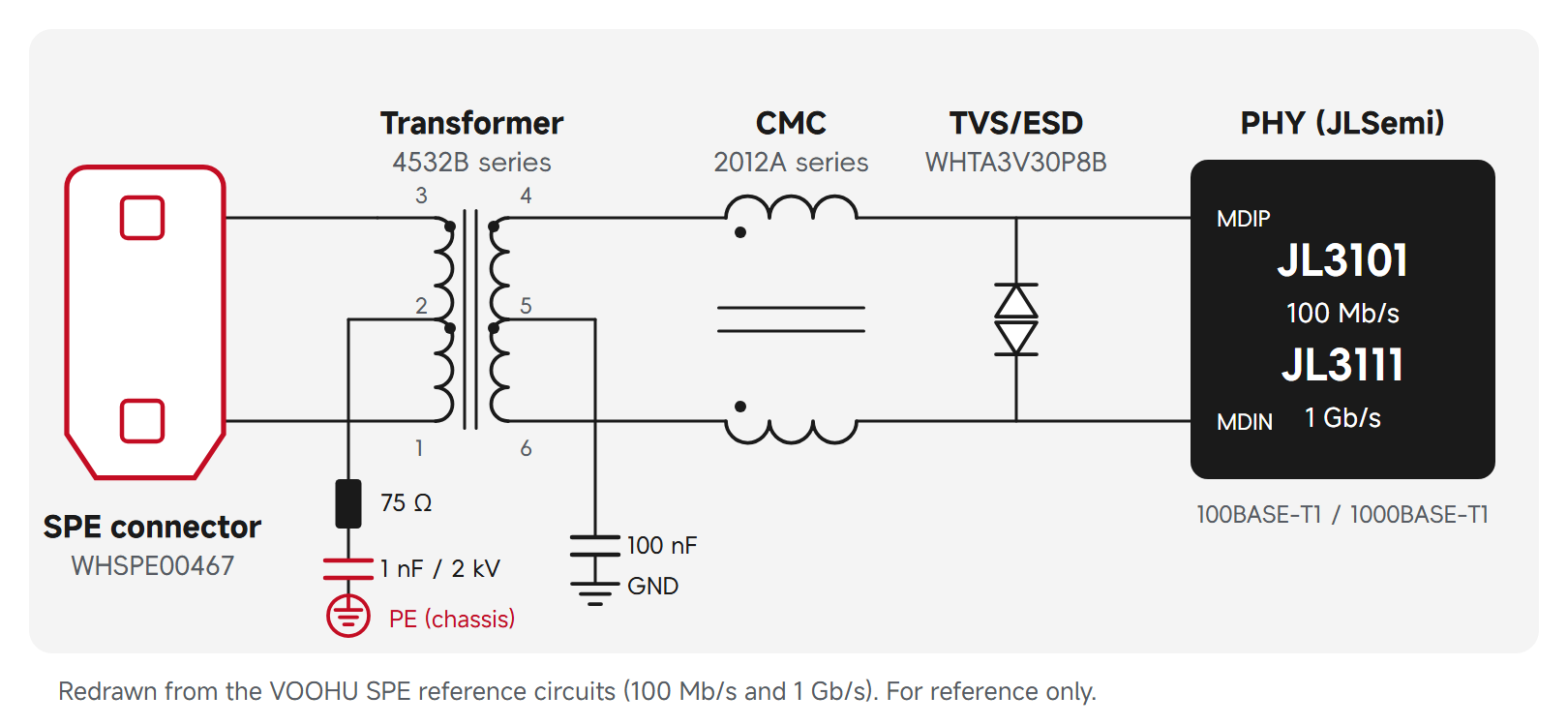
For the connector step, compare SPE plugs and sockets in the VOOHU SPE connector selector. The VOOHU SPE solution page has a system block diagram and 100 Mb/s and 1 Gb/s standard circuit design PDFs built on JLSemi PHYs.
#FAQ
How far can Single Pair Ethernet go?
It depends on the PHY. 10BASE-T1L reaches at least 1,000 m and 100BASE-T1L at least 500 m; 100BASE-T1 and 1000BASE-T1 target 15 m, with an optional 40 m link segment for 1000BASE-T1.
Single Pair Ethernet vs CAN bus and RS-485: can SPE replace them?
The wiring maps across; the protocol stack changes. 10BASE-T1L matches long point-to-point runs, and 10BASE-T1S and 802.3da match one bus with many nodes. Both ends need Ethernet PHYs and an Ethernet stack, and existing cable should be qualified against the link requirements of the target PHY before it is reused.
What connector does Single Pair Ethernet use?
Industrial SPE uses the IEC 63171 series, and both ends of a link must use the same part of it. Part 2 compares IEC 63171-1, -2, -4, -5, -6 and -7 and lists the VOOHU SPE board socket and cable plug.
Can a 10BASE-T1L device connect directly to a 100BASE-T1 device?
No. Both ends of a link must run the same PHY, and the two differ in data rate, reach objective and interface circuit. Connect them through a switch with matching ports.
Request SPE connector samples
Building an SPE prototype? Send your PHY, cable length and mating interface in the sample and support request form. Our FAE team can suggest the board socket and cable plug for your port and check the interface parts around them. Samples are available for evaluation, and selected parts are free of charge. Our FAE team will be glad to confirm the options for your project.
VOOHU supplies RJ45, SFP and SPE connectors, LAN and PoE transformers and common mode chokes from Suzhou, China, to more than 1,500 customers.
Need a quote, samples or selection support?
Part number WHSPE00467 is filled in for you. Add the quantity and lead time and submit. Our FAE team will be glad to confirm the options for your project.
Before you order: samples, MOQ, lead time and import duties in our ordering guide →