A unidirectional TVS diode clamps surges in one direction only: when the line goes positive past its breakdown voltage it clamps, and when the line goes negative it conducts like an ordinary forward-biased diode. A bidirectional TVS diode clamps at about the same voltage in both directions. Use a unidirectional TVS diode on a line that stays at one polarity, such as a DC rail or a logic signal referenced to ground. Use a bidirectional TVS diode on a line that swings above and below ground in normal operation, such as an AC or audio signal or a bus that can go negative. A unidirectional part on a line that goes negative would clamp the signal itself. VOOHU supplies TVS diodes and low-capacitance TVS arrays, and our FAE team can confirm the direction and voltage for your line.
#What is the difference between a bidirectional and a unidirectional TVS diode?
A unidirectional TVS diode is a single avalanche junction. With the cathode positive it stays off below its reverse stand-off voltage (VRWM), starts to conduct at its breakdown voltage (VBR, usually specified at 1 mA) and holds the line near its clamping voltage (VC) at the peak pulse current (IPP). With the anode positive it conducts like a rectifier diode once the voltage passes about one diode drop.
A bidirectional TVS diode breaks down in both directions, for example as two junctions back to back. Its V-I curve is close to symmetrical: it stays off between minus and plus VRWM, clamps on either polarity and has no polarity band.
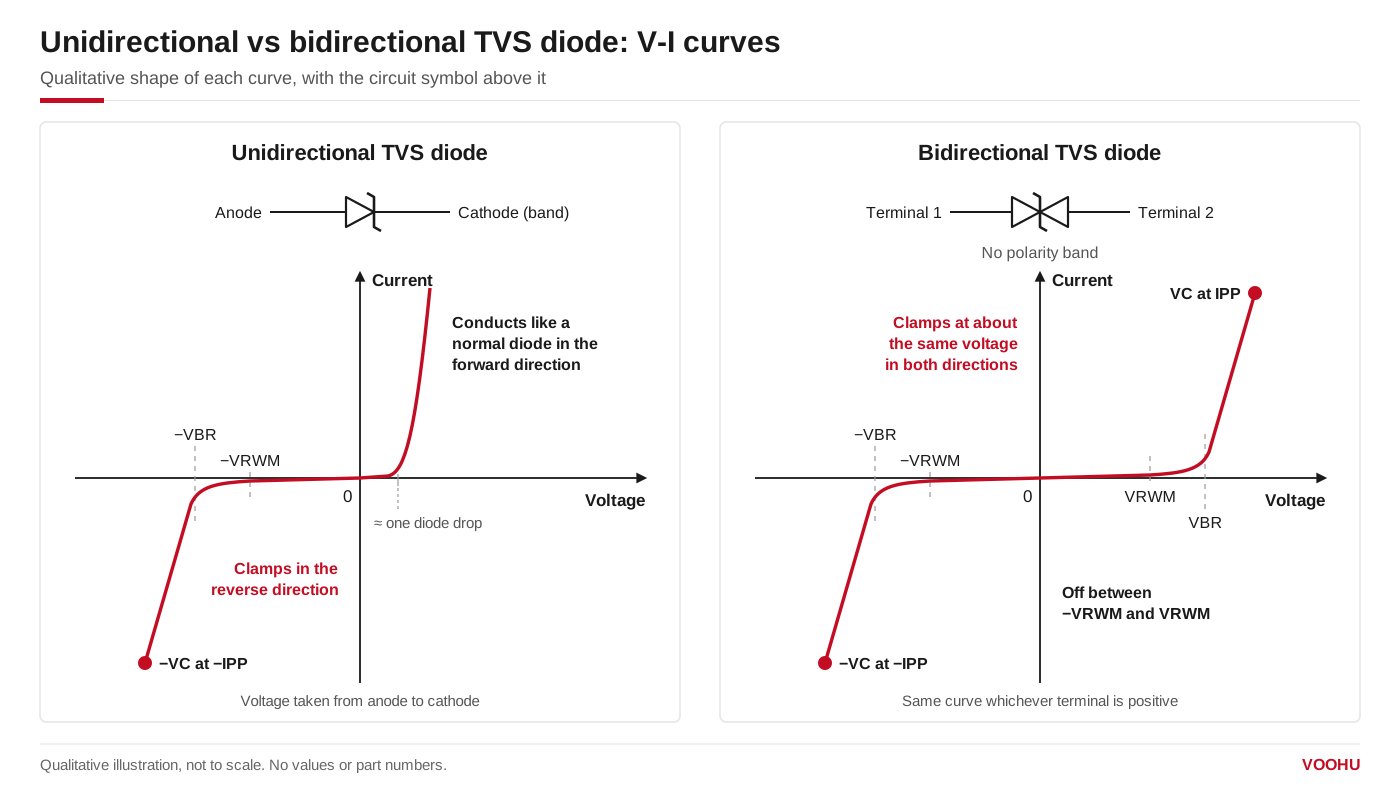
Left: a unidirectional TVS diode clamps in its reverse direction and conducts like a normal diode in its forward direction. Right: a bidirectional TVS diode clamps at about the same voltage in both directions. Illustration only, not to scale.
#What is a unidirectional TVS diode used for?
A unidirectional TVS diode suits lines that should never go below ground, such as DC power rails and logic, control and data lines, where its forward conduction clamps negative transients close to ground.
Low-capacitance arrays for data lines are often unidirectional. The WHTA5V01P2C is an example: its datasheet describes it as protecting four unidirectional lines, in SOT-363, with a 5 V working voltage, 6 V minimum breakdown voltage, 1.2 pF typical capacitance from I/O to ground and 8 A peak pulse current at 8/20 µs.
#Why use a bidirectional TVS diode?
Use a bidirectional TVS diode when the normal signal goes both above and below ground. Examples are AC and audio signals, bipolar analog inputs, and bus lines whose voltage relative to the local ground can go negative when the ground potential differs between two nodes on a long cable. A unidirectional part would start conducting at the first negative swing; a bidirectional part stays off on both polarities until a surge exceeds its breakdown voltage.
For AC, audio and bipolar analog signal lines, the WHALD30E2B protects two lines in SOT-23, with a 30 V working voltage, 31 V minimum breakdown voltage, 0.9 pF typical capacitance and 8 A at 8/20 µs (typical clamping voltage 55 V at 8 A). Where higher voltage and pulse power are needed, the WHTB058VA is a discrete 1500 W bidirectional TVS diode in DO-214AB, with a 58 V stand-off voltage, 64.4 to 71.2 V breakdown voltage at 1 mA and a maximum clamping voltage of 93.6 V at 16.1 A; its pulse ratings use the 10/1000 µs waveform. For bus lines, our FAE team can confirm a part for your bus voltage and transceiver.
#How do you connect a unidirectional TVS diode?
Connect the cathode to the line or the positive rail and the anode to ground, so that the part is reverse-biased in normal operation. The cathode is the end with the band; VOOHU's 1500 W TVS datasheet, for example, states that the color band denotes the cathode except on bidirectional models such as the WHTB058VA, which has no band.
A bidirectional TVS diode has no orientation. On arrays, follow the pin assignment: the WHALD30E2B uses pins 1 and 2 as I/O and pin 3 as ground, and the WHTA5V01P2C also needs its VCC pin tied to the supply.
#What happens if a TVS diode is connected backwards?
Fitted backwards on a DC rail, a unidirectional TVS diode is forward-biased as soon as power is applied and conducts like a short, limited only by the source and the fuse. The rail collapses, the fuse opens or the part overheats and fails short or open. On a signal line, a reversed part clamps the signal at about one diode drop.
So a unidirectional TVS diode is not reverse polarity protection; see Q4 below for DC inputs that may be connected in reverse. A bidirectional part cannot be fitted backwards, because both directions are the same.
#How to choose a TVS diode: start with the direction
After the direction, check that the minimum breakdown voltage stays above the line voltage, the clamping voltage at your test current stays below what the IC can take, and the peak pulse current is rated on your test waveform. Filter the TVS selector to bidirectional TVS, see the bidirectional TVS diodes page or the full TVS and ESD protection range. For Ethernet ports, see how to choose an ESD protection diode for Ethernet.
#How do you tell the direction from a datasheet?
- The description. The first page usually says unidirectional or bidirectional.
- The marking. A band on the body marks the cathode of a unidirectional part; bidirectional parts have none.
- The internal circuit. Two diodes back to back between the pins mean bidirectional, as in the WHTA3V30P8B. Steering diodes with one avalanche diode to a VCC pin mean a unidirectional array, as in the WHTA5V01P2C.
- The leakage limit. The WHTB058VA datasheet, for example, notes that for bidirectional types with a stand-off voltage of 10 V or less the leakage current limit is doubled.
If you are not sure which direction your circuit needs, our FAE team can confirm it.
#FAQ
Are TVS diodes bidirectional?
Some are, some are not. A unidirectional TVS diode has polarity: it clamps with its cathode positive, conducts like a normal diode the other way and carries a cathode band. A bidirectional TVS diode clamps symmetrically and fits either way round. The datasheet states which a part is.
How do you test a bidirectional TVS diode?
On a multimeter's diode range, a bidirectional TVS diode with a breakdown voltage above the meter's test voltage reads open both ways, while a unidirectional part shows a forward drop one way. To check breakdown, raise the voltage slowly from a current-limited supply to the datasheet test current, often 1 mA, in each polarity, and compare with the datasheet range.
Can a unidirectional TVS diode to ground conduct a negative transient?
Yes. A negative transient forward-biases it, so it conducts like an ordinary diode and holds the line about one diode drop below ground, a little more at high current. That helps on a single-polarity line and is a problem only when the normal signal goes below ground.
Should I use a unidirectional or bidirectional TVS diode on a 12 V or 24 V DC input?
A unidirectional TVS diode is the usual choice, with its stand-off voltage at or above the highest input voltage including tolerance. If the input can be connected in reverse and nothing in front of the TVS diode blocks it, add reverse polarity protection, or use a bidirectional part whose stand-off voltage covers the reversed supply; it then clamps negative transients near its breakdown voltage rather than at one diode drop.
Get help choosing a TVS diode for your line
Tell us the line, its highest normal voltage in each direction, the surge or ESD level and whether the input can be reversed, in the sample and support request form. Our FAE team can confirm unidirectional or bidirectional, suggest the stand-off voltage and package, and check the clamping voltage against your IC. Samples are available for evaluation, and selected parts are free of charge. Our FAE team will be glad to confirm the options for your project.
VOOHU supplies RJ45 and SFP connectors, LAN and PoE transformers, common mode chokes and TVS, ESD, GDT and MOV protection devices from Suzhou, China, to more than 1,500 customers.
Need a quote, samples or selection support?
Part number WHTB058VA is filled in for you. Add the quantity and lead time and submit. Our FAE team will be glad to confirm the options for your project.
Before you order: samples, MOQ, lead time and import duties in our ordering guide →