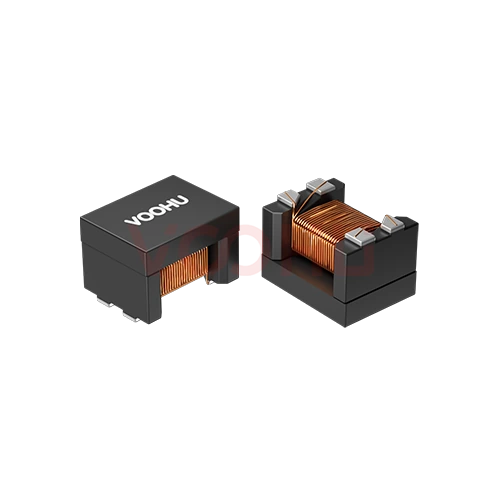
A ferrite bead and a common mode choke both add impedance at high frequency, but they treat the signal differently. A ferrite bead sits in one conductor and adds impedance to everything that flows through it, the signal included, turning high-frequency energy into heat. A common mode choke has two windings on one core: the opposite currents of a differential signal cancel in the core, so the signal sees a low impedance, while noise flowing the same way on both lines sees a high impedance. Two beads, one on each line of a pair, do not make a common mode choke. Use a bead on power rails and single-ended lines where the signal sits well below the noise frequency. Use a common mode choke on differential pairs where the noise is common-mode and the signal edges must stay intact. VOOHU signal-line chokes such as the WHAC-2012A-900T0 offer 90 Ω typical at 100 MHz.
#Is a ferrite bead a common mode choke?
No. A chip ferrite bead carries one conductor, so it cannot tell a differential signal from common-mode noise: it impedes both. A common mode choke couples two (or more) windings so that it responds only to the current they share in the same direction; its purpose is to suppress common-mode noise while passing the differential signal (see what is a common mode choke). Ferrite does act as a common mode choke in one familiar form, a ferrite core clamped around a whole cable: every conductor passes through the same core, so the signal and its return cancel and only common-mode current is impeded.
#Ferrite bead vs inductor: what does a bead actually do?
A ferrite bead is a conductor surrounded by ferrite. At low frequency it behaves mostly like a small inductor; near its self-resonant frequency it becomes mainly resistive, and above that, capacitive. In its resistive range it dissipates noise as heat, whereas an inductor stores energy, as TI explains in its application brief The Use and Benefits of Ferrite Beads in Gate Drive Circuits (SLUAAI2). The same note warns that a bead's attenuation changes well before its rated saturation current, so DC current through a bead on a power rail reduces its effect.
#When to use ferrite beads
A bead is usually enough when all of these are true:
- the line is single-ended or a power rail, so there is no differential pair to protect;
- the wanted signal or supply frequency is far below the frequency where the bead's impedance rises, so the bead barely touches it;
- the noise is conducted on that one line, not induced equally on two lines of a pair or on a whole cable;
- the DC current leaves the bead enough impedance at the noise frequency.
Typical places are the supply pin of an IC, the supply to an analog section, and slow single-ended control lines.
#Is a common mode choke better than chip beads for an EMI filter?
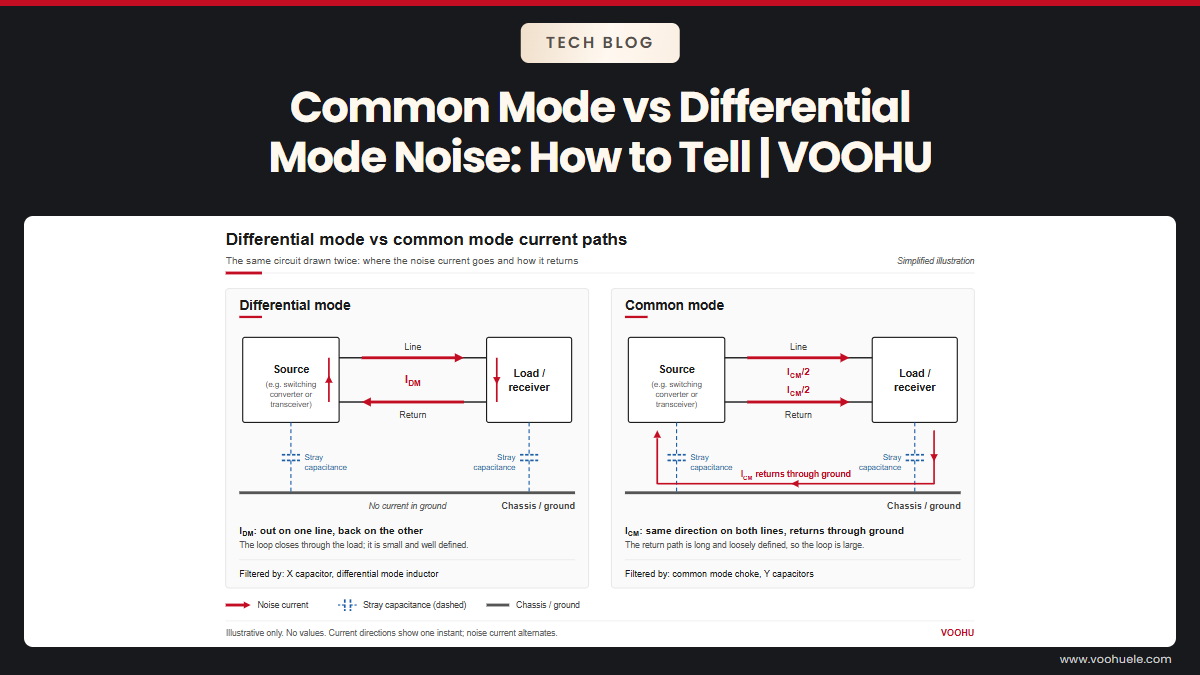
On a differential pair, usually yes. Radiated emissions from a cable are driven mostly by common-mode current, the small part of the current that flows the same way on both wires (see common mode vs differential mode noise). Two beads, one per line, put the same impedance in front of the signal and the noise, so to reach the noise frequency they also slow the signal edges. A common mode choke separates the two: high impedance to the common-mode current, much lower impedance to the differential signal.
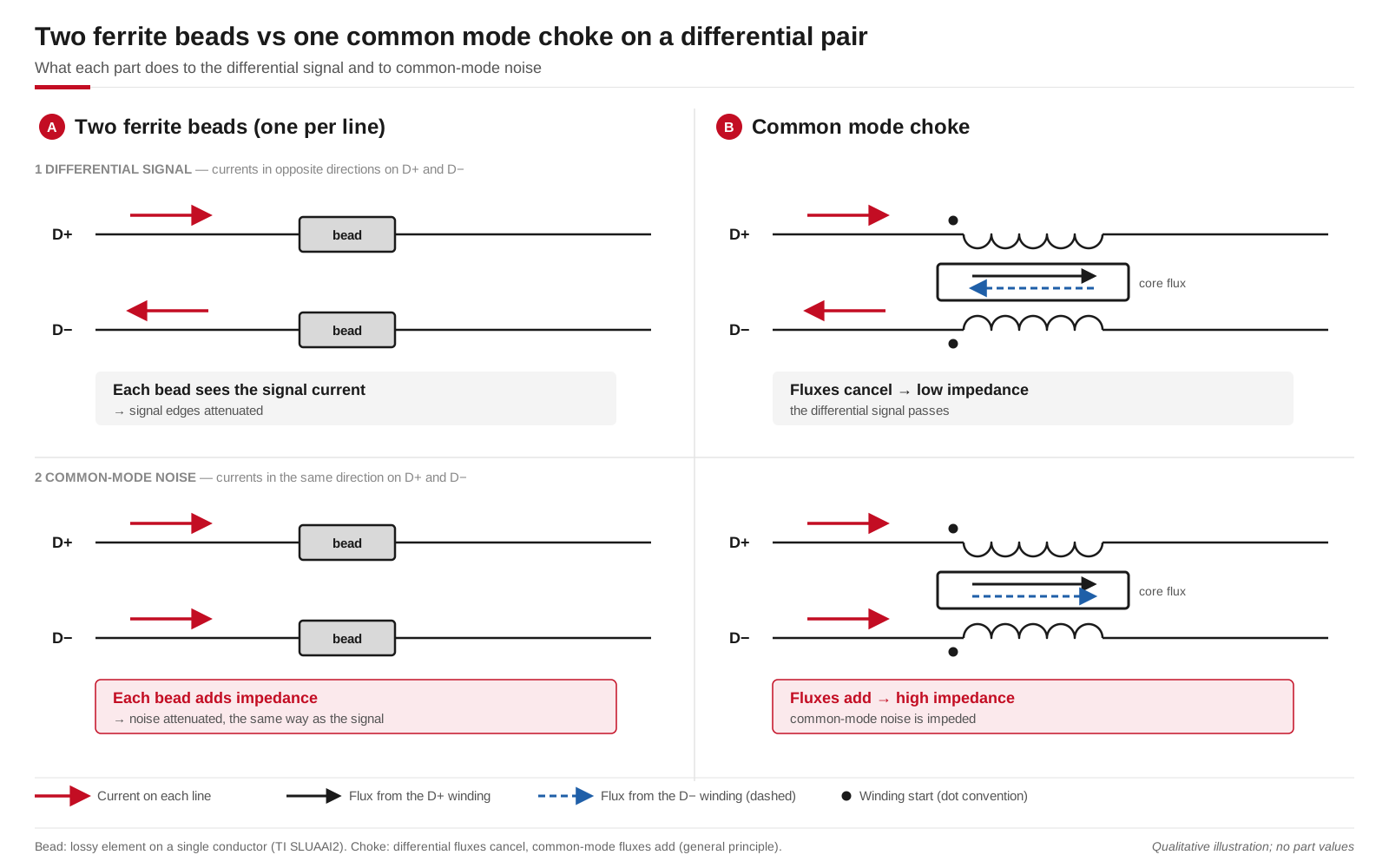
Two beads, one per line, impede the differential signal and the common-mode noise alike. In a common mode choke the signal's fluxes cancel and the noise's fluxes add. Qualitative illustration; no part values.
You can see this on a VOOHU datasheet. The WHAC-2012A-900T0 is specified at 90 Ω typical common-mode impedance at 100 MHz, and its impedance-vs-frequency curve shows a differential-mode impedance of only about 7 Ω at the same frequency, more than ten times lower. The datasheet states the design aim as "Suppression of Common Mode Noise Without Attenuating The Signal". The differential curve is not zero, though, and it rises toward the GHz range, so for a fast interface compare that curve with your signal's bandwidth, or ask our FAE team to check it for your data rate.
#Bead vs choke characteristics: reading impedance vs frequency
Both parts are usually specified by impedance at 100 MHz, but the curves answer different questions. A bead datasheet shows one impedance curve, often split into its resistive and reactive parts; pick a bead whose resistive part is high at the noise frequency and whose impedance is low at the signal or switching frequency. A common mode choke datasheet shows a common-mode curve and, where given, a differential-mode curve; pick a choke whose common-mode impedance is high at the noise frequency and whose differential-mode impedance stays low across the signal bandwidth. Always read impedance together with its test frequency.
#Which VOOHU common mode chokes to start with
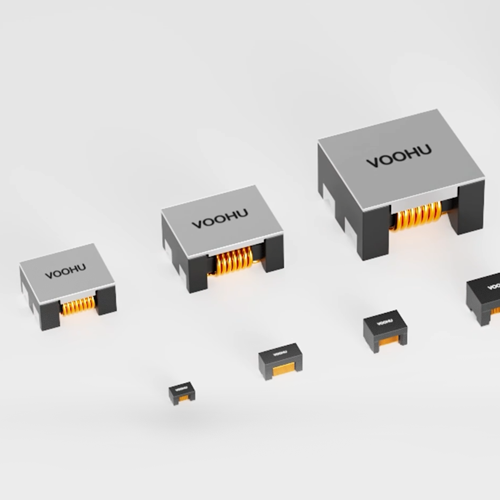
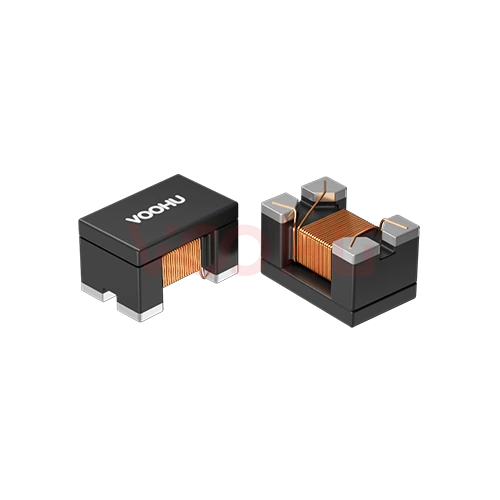
VOOHU does not supply EMI ferrite beads; when the answer is a choke, our signal-line common mode chokes cover differential data lines, and our power line common mode chokes cover common-mode noise on supply inputs. Three signal-line starting points:
The WHAC-2012A-900T0 is the low-impedance end, with the datasheet curve shown above. The WHLC-2012A series runs from 90 to 1200 Ω typical at 100 MHz in the same 2012 size; the WHLC-2012A-102T0 is its 1000 Ω option, and in this series higher impedance comes with higher DCR (0.35 Ω max at 90 Ω, 1.3 Ω max at 1000 Ω). For in-vehicle networks, the WHAC-3225B series datasheet lists CAN FD, CAN bus, A2B and other in-vehicle high-speed differential lines; the WHAC-3225B-110U0 is specified at 10 MHz. Compare sizes in the signal-line choke selector, and for USB 2.0 see how to choose a USB 2.0 common mode choke; for Ethernet magnetics, where the choke sits in a LAN transformer.
#FAQ
Can I put a ferrite bead on each line of a differential pair instead of a common mode choke?
Only if the signal is slow compared with the noise. Two separate beads give the differential signal the same impedance as the common-mode noise, so they round off fast edges and can upset the pair's impedance. If the noise is common-mode and the signal is fast, a common mode choke filters the noise while leaving the signal largely intact.
Does a ferrite bead or a common mode choke have polarity?
A ferrite bead has no polarity. A common mode choke has winding phasing: both windings must carry the differential signal in opposite directions so their fluxes cancel. If one winding is connected the other way round, the choke blocks the signal instead of the noise. Follow the pin-out on the datasheet.
Do I need a common mode choke?
You need one when a differential interface, especially one with a cable leaving the board, fails or nearly fails emissions or immunity tests because of common-mode current, and a bead would slow the signal too much. If the problem is noise on a supply rail or a single-ended line, a ferrite bead or other filtering is usually the simpler fix.
Can I use a common mode choke as an inductor?
Not as a normal differential or power inductor. Differential current cancels in its core, so the choke shows only a small leakage inductance to it; its high impedance applies to common-mode current. For a filter or converter inductor, use a part designed and rated for that job.
Send us the line that is failing
Send the interface, data rate, package you can fit and, if you have them, the noise frequencies from your pre-scan through our sample request form. Our FAE team can suggest a VOOHU common mode choke with a suitable impedance at your noise frequency and check its differential-mode curve against your signal. Samples are available for evaluation, and selected parts are free of charge. Our FAE team will be glad to confirm the options for your project. VOOHU supplies RJ45 and SFP connectors, LAN and PoE transformers and common mode chokes from Suzhou, China, to more than 1,500 customers.
Need a quote, samples or selection support?
Part number WHAC-2012A-900T0 is filled in for you. Add the quantity and lead time and submit. Our FAE team will be glad to confirm the options for your project.
Before you order: samples, MOQ, lead time and import duties in our ordering guide →