Compiled from both manufacturers' published datasheets. Verify with samples and the PCB footprint before production.
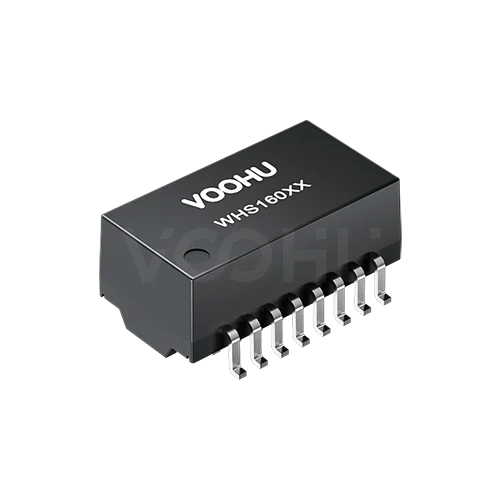
Need an equivalent for the Bourns PT61017PEL? VOOHU WHS16013LF is a functional alternative — verify with samples in your design. Both datasheets describe a 10/100BASE-TX, 16-pin surface-mount LAN transformer with two 1CT:1CT channels (±5%), 350 µH minimum OCL at 8 mA DC bias, 1500 V AC isolation and a 0 to +70 °C operating range. The printed numbers also agree on the mechanical side: a 12.80 × 6.90 × 5.65 mm body, 1.27 mm pin pitch, the same pin numbers and signal names, and a recommended land pattern of 7.10 mm inner and 10.50 mm outer span with 0.76 mm pads. Where the two documents part ways is in test conditions, which are set out line by line below.
#PT61017PEL vs. WHS16013LF: the two datasheets row by row
Bourns publishes every PT61017PEL figure on page 1 of its datasheet (REV. 02/16). The WHS16013LF figures come from VOOHU datasheet 13874: mechanical data, schematic and land pattern on page 1, electrical data on page 2. Values are in millimetres unless a unit is given, and "not stated" marks an item one datasheet leaves out.
#Which numbers match, and which are written differently?
Outline and pads: same printed values, different tolerances. Body length, width and height, width over leads, lead width, lead length and standoff carry the same nominal figures on both drawings, and both measure the land pattern from the same reference points — inner pad edges 7.10 mm apart, outer pad edges 10.50 mm apart, pin 1 to pin 8 at 8.89 mm along the body. The tolerances are written differently: Bourns gives ±0.25 mm on body length with ±0.05 mm for untoleranced figures, while VOOHU gives ±0.50 mm on the body dimensions. Matching nominal figures on paper are a reason to sample, not a release decision; run a short reflow build on your existing pads and inspect the joints.
OCL: same limit, different test voltage. Both datasheets give 350 µH minimum at 100 kHz with 8 mA DC bias. Bourns measures it at 0.2 Vrms on pins 1-3 and 6-8; VOOHU states 0.1 V. If your incoming inspection measures OCL, set the test voltage from the datasheet of the part being inspected so the reading is taken under its own condition.
Hipot: the same 1500 V AC at 1 mA, held for different times. Bourns lists 1500 V AC, 1 mA, 2 seconds, primary to secondary. VOOHU lists 1500 V AC, 1 mA, 60 seconds. Each figure belongs to its own datasheet's test method, so this page quotes both as printed and does not rank them. Check the condition your safety standard or customer drawing names, and use the datasheet of the part you actually build with when you fill in the isolation section of your test report.
Insertion loss: start frequency differs. Bourns states −1.15 dB maximum over 0.3–100 MHz; VOOHU states −1.1 dB maximum over 1–100 MHz. The upper frequency is the same; the lower edge of the band is not.
DCR: per side versus one figure. Bourns splits winding resistance by side, 0.6 Ω maximum on pins 1-3 and 6-8 and 1.1 Ω maximum on pins 9-11 and 14-16. VOOHU gives a single 1400 mΩ maximum without naming a side. If your PHY reference design sets a DCR budget for the centre-tap supply path, our FAE team can go through the WHS16013LF figure with you.
Temperature: same operating range, different storage range. Both parts are rated 0 to +70 °C in operation. For storage, Bourns states −25 to +125 °C and VOOHU states −40 to +85 °C. Check your storage and shipping requirements against the datasheet of the part you order.
Return loss, crosstalk and common-mode rejection. Bourns gives these as spot values at 30, 60 and 100 MHz or over two bands; VOOHU gives return loss in bands with spot values at 40 and 50 MHz, and crosstalk and common-mode rejection as one limit across 1–100 MHz. Since the frequency points differ, read each of these rows against what your PHY vendor's design guide asks of the magnetics. VOOHU also lists leakage inductance (0.5 µH maximum), which the Bourns datasheet does not state.
#Where the WHS16013LF fits
WHS16013LF belongs on boards with one 10/100 copper port and a discrete transformer between the PHY and an RJ45 jack without magnetics, in products that operate between 0 and +70 °C — office and retail equipment, printers and label printers, set-top and media boxes, and embedded controller boards built around a microcontroller with a 10/100 MAC and an external PHY.
For a product that has to run below 0 °C or above +70 °C, or for a gigabit port, filter the LAN transformer selector instead of starting from this part. For help mapping the 16 pins to your PHY, see how to connect a LAN transformer to the PHY.
#FAQ
What is an alternative to Bourns PT61017PEL?
VOOHU WHS16013LF is a functional alternative to the Bourns PT61017PEL — verify with samples in your design. Both are 16-pin SMD LAN transformers for 10/100BASE-TX with two 1CT:1CT channels, 350 µH minimum OCL, 1500 V AC isolation and 0 to +70 °C operation, and both datasheets print a 12.80 × 6.90 × 5.65 mm body and the same pin numbering. Their Hipot hold times are written as 2 s (Bourns) and 60 s (VOOHU).
What does an Ethernet transformer such as the PT61017PEL or WHS16013LF do?
It passes the 10/100 transmit and receive signals between the PHY and the cable through two windings per channel while keeping the two sides electrically isolated; both datasheets test that barrier at 1500 V AC. In these two parts the PHY side sits on pins 1 to 8 and the cable side on pins 9 to 16, and each channel has a centre-tapped 1CT:1CT winding.
How is the Ethernet transformer center tap connection made on these parts?
Both datasheets bring out four centre taps: pin 2 (transmit) and pin 7 (receive) on the PHY side, pin 15 (transmit) and pin 10 (receive) on the cable side. PHY-side centre taps go to the bias or decoupling network your PHY vendor specifies, and cable-side centre taps go to the line termination in your RJ45 circuit. The pin numbers are the same on both datasheets; the land pattern still needs its own check on your board, as described above.
How should I read the Hipot and OCL lines on these LAN transformer datasheets?
Read each value together with its test condition. "1500 VAC, 1 mA, 2 sec" (Bourns) and "1500VAC 1mA 60S" (VOOHU) are the voltage, the leakage current limit and the hold time of each maker's test. "350 µH min at 100 kHz, 0.2 Vrms, 8 mA" and "350 µH min at 100 kHz, 0.1 V, 8 mA" give the inductance limit with frequency, test voltage and DC bias. More on this in how to read a LAN transformer datasheet.
#Qualify WHS16013LF as a second source for PT61017PEL
Use the sample request form and include your current PT61017PEL land pattern and the isolation condition your safety file quotes. Samples are available for evaluation, and selected parts are free of charge. Our FAE team will be glad to confirm the options for your project. Our FAE team can suggest suitable parts and help check the design — for WHS16013LF, the pad dimensions on your board, the centre-tap connections to your PHY and the Hipot condition you need to document. VOOHU supplies RJ45 and SFP connectors, LAN and PoE transformers and common mode chokes from Suzhou, China, to more than 1,500 customers.
Other 16-pin 10/100BASE-TX parts are in the LAN transformer selector, which opens with the speed and pin-count filters applied.
Related product: WHS16013LF — 10/100BASE-TX single-port LAN transformer, 16-pin SMD, 1CT:1CT, 350 µH minimum OCL, 1500 V AC isolation, 0 to +70 °C. Another Bourns part we have compared: PT61020EL.
SolutionEthernetInterface + magneticsView solution →Need a quote, samples or selection support?
Part number WHS16013LF is filled in for you. Add the quantity and lead time and submit. Our FAE team will be glad to confirm the options for your project.
Before you order: samples, MOQ, lead time and import duties in our ordering guide →