For a gigabit port designed around the Mentech G2401CG, VOOHU WHSG24002G is a functional alternative — verify with samples in your design. Both are single-port 1000BASE-T Ethernet transformers in a 24-pin SMD package on a 1.0 mm pitch, 15.1 × 7.1 mm in body size and 10.0 mm across the leads, with four 1CT:1CT channels, 350 µH minimum OCL and 1500 V isolation. The difference to plan for is the recommended land pattern: Mentech draws 1.78 × 0.64 mm pads with an 11.2 mm outer edge across the two rows, while VOOHU draws 1.35 × 0.60 mm pads with a 10.70 mm outer edge.
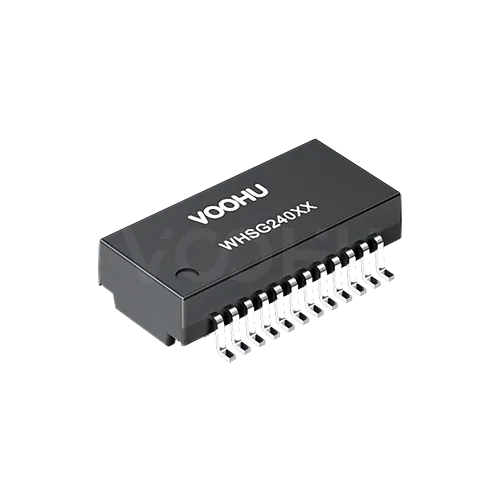
#G2401CG vs. WHSG24002G: what the two datasheets list
Mentech values are read from the single-page G2401CG datasheet (no revision or date printed). VOOHU values are read from the WHSG24002G datasheet, revision A0, where page 1 carries the outline, suggested pads and schematic and page 2 the electrical characteristics. Mentech loss and rejection limits are copied as printed, without min or max labels; OCL and all VOOHU limits keep the labels on their sheets. Lengths are in millimetres.
#PCB layout guidelines for moving from G2401CG pads to WHSG24002G
Pad size is the main gap. Mentech recommends pads 1.78 mm long and 0.64 mm wide; VOOHU recommends 1.35 mm long and 0.60 mm wide, both on a 1.0 mm pitch. Across the two rows, the outer pad edges sit 11.2 mm apart on the Mentech drawing and 10.70 mm apart on the VOOHU drawing, and most of that difference comes from pad length. The parts themselves measure the same 10.0 mm across the leads with a 0.90 mm foot on both drawings, so the question is how the larger G2401CG pads behave under the WHSG24002G leads, not whether the leads reach them.
Paste and inspection on existing pads. A stencil cut for 1.78 × 0.64 mm pads prints more solder paste per lead than the VOOHU pattern assumes, and at a 1.0 mm pitch that affects both fillet shape and the gap between neighbouring pads. If you keep the G2401CG pads, ask your assembler to review the aperture size, then check fillets and bridging on a sample build. If the board is being re-spun anyway, draw the pads from the WHSG24002G suggested pad layout and send the new footprint to our FAE team for a check.
Height and body. Body length and width are 15.1 × 7.1 mm on both drawings. Height is given as 4.5 mm max by Mentech and 4.00 ± 0.50 mm by VOOHU, so the WHSG24002G upper limit is also 4.5 mm and a clearance already set for the G2401CG maximum still applies. Standoff is 0.3 ± 0.15 mm on the Mentech drawing and 0.25 ± 0.15 mm on the VOOHU drawing; take it into account if a trace or via runs under the body.
The 24 pin names. The two public datasheets give the same signal name to each of the 24 pins: TD and TCT for the four PHY-side channels on pins 1 to 12, and MX and MCT for the line side on pins 13 to 24, with each MCT taken from the transformer's line-side centre tap ahead of the common mode choke. This is a comparison of published documents; our FAE team has not confirmed it as a basis for swapping parts, so it does not mean the WHSG24002G can replace the G2401CG without the checks above. Route each MCT to the termination network your PHY reference design specifies.
AC limits and test conditions. OCL is 350 µH minimum on both sheets, measured at 100 kHz with 8 mA of DC bias, but with a 0.2 V test signal on the Mentech sheet and 0.1 V on the VOOHU sheet. Insertion loss (−1.1 dB) and common mode rejection (−30 dB) carry the same values; the bands start at 0.5 MHz for Mentech and 1 MHz for VOOHU. Return loss and crosstalk are divided into different frequency bands, and the VOOHU sheet adds a −10 dB return loss point at 100 MHz. All of these are published limits, not measured results.
Hipot, operating range and PoE. Isolation is listed as 1500 Vrms by Mentech, with no test time or current, and as 1500 VAC at 1 mA for 60 s by VOOHU. Both parts are specified for 0 to +70 °C operation. Where the port has to work from −40 to +85 °C, look at the WHSG24002TG, whose datasheet gives that operating range; compare its own drawing with your pads before using it. Neither G2401CG nor WHSG24002G states a PoE rating, and LED and shield items do not apply to a discrete transformer.
#Where the WHSG24002G gigabit Ethernet transformer fits
The WHSG24002G suits one locally powered 1000BASE-T port between a gigabit PHY, or a switch or SoC with an integrated gigabit PHY, and a separate RJ45 jack without magnetics, in equipment kept within 0 to +70 °C — for example desktop switches, router LAN ports and network cameras installed indoors. Where the same board design goes into a cabinet or enclosure that can drop below 0 °C, the WHSG24002TG is the version to evaluate.
#FAQ
What is an alternative to the Mentech G2401CG gigabit LAN transformer?
VOOHU WHSG24002G is a functional alternative to the Mentech G2401CG — verify with samples in your design. Both are 24-pin, 1.0 mm pitch SMD parts for one 1000BASE-T port, 15.1 × 7.1 mm, with 1CT:1CT windings, 350 µH OCL, 1500 V isolation and 0 to +70 °C operation. Their recommended pads differ: 1.78 × 0.64 mm with an 11.2 mm outer edge for Mentech, 1.35 × 0.60 mm with a 10.70 mm outer edge for VOOHU.
What is the Ethernet magnetics pinout of the G2401CG and WHSG24002G?
In both datasheets, pins 1 to 12 are the PHY side, in groups of three per channel: TCT1, TD1+, TD1− on 1–3, then channels 2, 3 and 4 on 4–6, 7–9 and 10–12. Pins 13 to 24 are the line side, running from MX4−, MX4+, MCT4 on 13–15 to MX1−, MX1+, MCT1 on 22–24. The names match between the two published datasheets; treat that as a starting point and confirm your layout with samples.
What does the gigabit Ethernet transformer schematic show for these two parts?
Each of the four channels has a 1CT:1CT transformer on the PHY side followed by a two-wire common mode choke toward the cable. The PHY-side centre taps come out on TCT1 to TCT4, and the line-side centre taps of the transformers come out on MCT1 to MCT4. Both schematics are drawn this way.
Can the WHSG24002G be soldered onto G2401CG pads?
The leads are drawn 10.0 mm across with a 0.90 mm foot on both parts, so they fall within the larger G2401CG pads on paper, but the pads and stencil were sized for 1.78 × 0.64 mm rather than the 1.35 × 0.60 mm VOOHU recommends. Check paste volume, fillets and bridging on a sample build, and send your footprint to our FAE team for review before production.
#Request WHSG24002G samples and a footprint review
Use the sample request form to ask for WHSG24002G parts, and include your G2401CG pad drawing, stencil thickness and the operating temperature of the product. Samples are available for evaluation, and selected parts are free of charge. Our FAE team will be glad to confirm the options for your project. Our FAE team can suggest suitable parts and help check the design — here, how 1.35 × 0.60 mm recommended pads compare with the 1.78 × 0.64 mm pads already on your board, and whether the WHSG24002G or the WHSG24002TG matches your temperature range.
VOOHU supplies RJ45 and SFP connectors, LAN and PoE transformers and common mode chokes from Suzhou, China, to more than 1,500 customers.
To compare other single-port gigabit parts with 24 pins on a 1.0 mm pitch, open the LAN transformer selector with those filters already applied, then add a temperature or PoE filter if needed.
Related products: WHSG24002G, a four-channel gigabit transformer for one port, 24-pin SMD on a 1.0 mm pitch, 15.10 × 7.10 × 4.00 mm, rated 0 to +70 °C. WHSG24002TG, the gigabit version whose datasheet gives −40 to +85 °C operation, for ports that see low temperatures.
SolutionEthernetInterface + magneticsView solution →Need a quote, samples or selection support?
Part number WHSG24002G is filled in for you. Add the quantity and lead time and submit. Our FAE team will be glad to confirm the options for your project.
Before you order: samples, MOQ, lead time and import duties in our ordering guide →