The current rating on a common mode choke datasheet is the maximum continuous current the windings can carry, and it is best read as a heating limit, not a saturation limit. The load current flows out through one winding and back through the other, so its flux cancels in the core. What saturates the core is current that does not cancel: return current on another path, large common mode current, leakage flux at high load, or a reversed winding. So check heating from DCR at your worst-case RMS current and ambient, how much current can return elsewhere, and whether noise suppression holds at full load. The VOOHU chokes compared below list rated current, maximum DCR and 100 MHz impedance in their datasheets, and our FAE team can check them against your load.
#What does the current rating on a common mode choke datasheet mean?
Most datasheets give one current per part, labelled rated current or rated DC current, often as a maximum. Read it as the continuous current at which copper losses keep the choke within its temperature limits under the datasheet's test conditions. Three points decide how you compare it with your own design:
- Use RMS current, not average current. Heating follows I²R, so take the RMS value of the worst-case current, including switching ripple, pulsed loads and the lowest input voltage at full power.
- Check the reference temperature. VOOHU WHACM datasheets reference all test data to 25 °C ambient and state that the −40 °C to +125 °C operating range includes self-temperature rise: your highest ambient plus the choke's own rise must stay within 125 °C. The WHAL-4520A datasheet gives its electrical specifications at 25 °C.
- Ask how the rating was defined when your margin is small. A datasheet column rarely states the temperature rise behind the rating, or whether it applies per winding. If you will run close to it or in a hot enclosure, ask the supplier; for VOOHU parts, our FAE team can confirm the conditions.
A quick estimate helps before you order samples. Suppose each winding has 10 mΩ of DCR and carries 5 A RMS: each dissipates 5² × 0.01 = 0.25 W, or 0.5 W for the choke. At 10 A the loss quadruples to 2 W. Copper resistance also rises with temperature, so the hot loss is higher than the 25 °C figure suggests. If the estimate looks tight, measure the choke temperature at full load inside the enclosure.
#Why doesn't the load current saturate a common mode choke?
A common mode choke has two windings on one core, wound so that the supply current and its return current create opposite flux. When the two currents are equal, the flux cancels and the core sees almost none of the load current. That is why a small choke can carry several amps and still present hundreds of ohms to common mode noise. Common mode noise flows in the same direction on both lines, so its flux adds, and the high permeability of the core turns that flux into impedance.
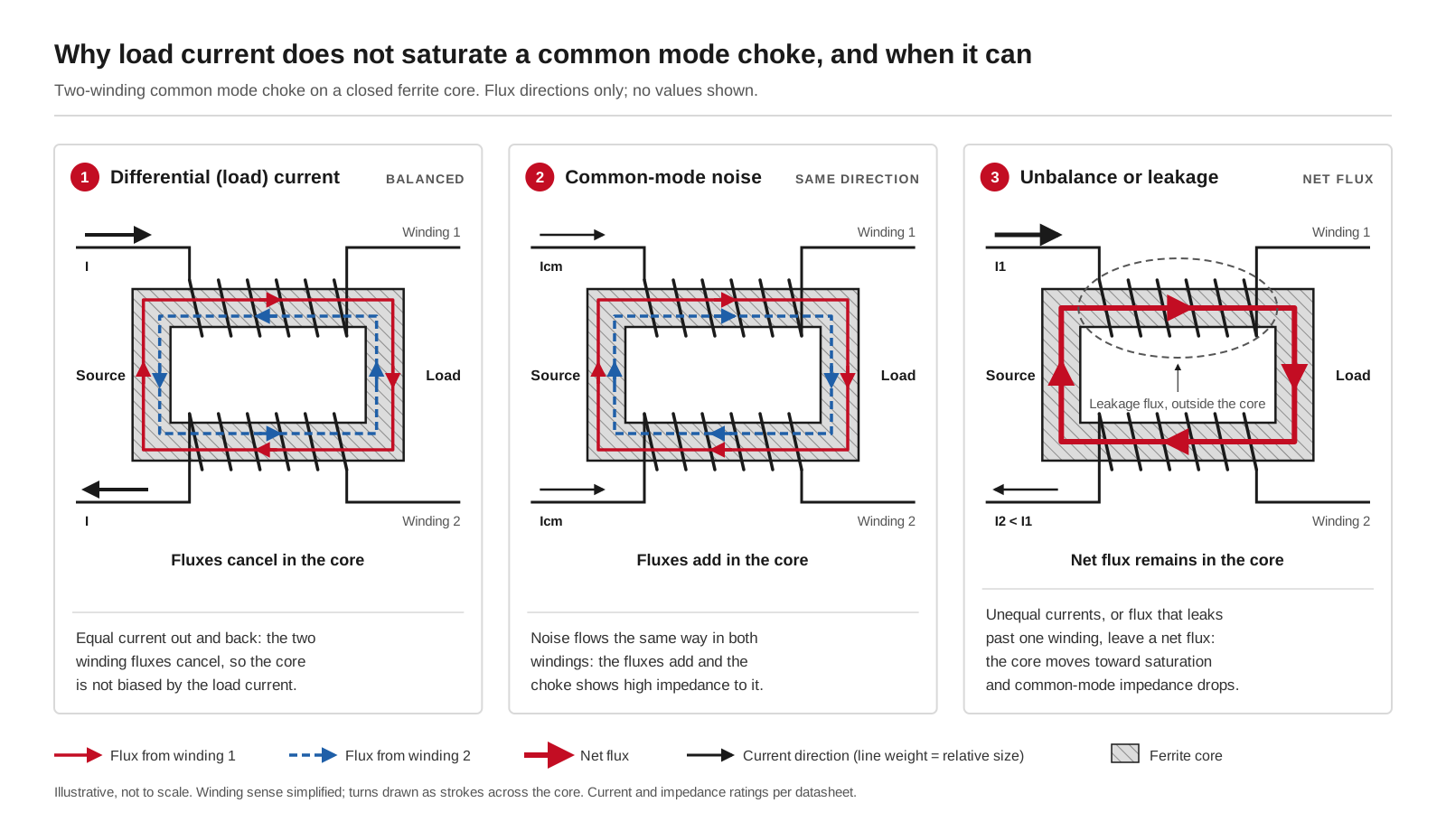
Left: equal supply and return currents cancel in the core. Middle: common mode noise flows the same way in both windings, so its flux adds. Right: current that returns by another path, and leakage flux, leave net flux that can push the core toward saturation. Illustration only.
The cancellation is never perfect. Part of each winding's flux does not link the other winding. This is the leakage flux, and it is what gives the choke a small differential mode inductance. Any difference between the two currents also magnetizes the core directly. These two effects are where saturation starts.
#When does a common mode choke saturate?
A high-permeability ferrite core reaches its saturation flux density with relatively few ampere-turns, so the current that does not cancel matters far more than the size of the load current. Look for these causes:
- 1.Unbalanced current. If part of the return current takes another path, such as a chassis connection, a cable shield or a second ground, the windings no longer carry equal current. The difference acts like a DC common mode current and biases the core.
- 2.Large low-frequency common mode current. Common mode current at DC or low frequency, for example between two units at different ground potentials, adds flux in the same way.
- 3.Leakage flux at high load. Leakage flux grows with load current. In some designs part of it closes through the core and saturates it locally, so impedance falls at full load even with balanced currents: one cause of what engineers describe as unexpected common mode choke saturation.
- 4.A winding connected the wrong way. If the footprint or wiring reverses one winding, the load current flux adds instead of cancelling, and the core can saturate at a small fraction of the rated current.
- 5.High temperature. Ferrite's saturation flux density falls as the core heats up, so a choke running warm from DCR losses saturates sooner.
#Why don't common mode choke datasheets give a saturation current?
A power inductor datasheet gives a saturation current because all of its current magnetizes the core. In a correctly wired common mode choke the load current cancels, so only the current that does not cancel pushes the core toward saturation, and how much of it there is depends on your circuit more than on the part. That is why many common mode choke datasheets, VOOHU's included, list rated current, DCR and impedance, with common mode and differential mode impedance curves for reference. If your design carries a known imbalance, send that figure to the supplier and ask whether the part tolerates it. For power inductors, see inductor saturation current vs rated current.
#Common mode choke leakage inductance: help or problem?
Leakage inductance, also called differential inductance, is the part of each winding's inductance that does not couple to the other. It cuts both ways. It adds a little differential mode filtering, which some designs pair with X capacitors. It is also flux from the load current that does not cancel, so more leakage means more differential filtering and less margin at high current. On VOOHU parts, read it from the differential mode impedance curve; the datasheets do not list a separate leakage value. If your filter depends on it, short one winding of a sample and measure the other with an LCR meter at your frequency, or ask our FAE team.
#Unexpected common mode choke saturation: how to check at full load
If conducted emissions pass at light load and fail at full load, or the choke runs hotter than your estimate, suspect the choke before you redesign the whole filter. Work in this order:
- 1.Check the winding orientation. Compare the pin numbering or dot marking on the datasheet with your footprint and placement. A reversed winding is the fastest way to saturate a choke.
- 2.Measure the imbalance. Clamp a current probe around the supply and return conductors together. Balanced currents read close to zero; what you see is the net current the core really carries. Measure at full load and in the worst-case operating mode.
- 3.Compare emissions at light and full load. Change only the load. If common mode peaks rise sharply at full load and step 2 showed a significant net current, the choke's impedance is likely dropping.
- 4.Measure the choke temperature with a thermocouple at full load inside the enclosure, and add the rise to your highest ambient.
- 5.Change one thing at a time. Remove the unbalanced return path, move to a part with more current margin or lower DCR, or add a separate differential stage. For a DC input that fails conducted emissions, see our guide to the power line common mode choke for DC conducted emissions.
#Which VOOHU common mode chokes to compare by current?
The three parts below cover 2.1 A to 10 A. Values are taken from each datasheet; impedance is common mode impedance at 100 MHz, and test data is referenced to 25 °C.
Read the table in this order. Start from your worst-case RMS current and highest ambient, and keep a margin below the rated current that your temperature measurement confirms. Compare DCR next: at the same current, the 6 mΩ maximum of the WHACM15A60R501 dissipates a tenth of what a 60 mΩ part would. Check rated voltage against your rail, including transients, and impedance at your failing frequency on the reference curves. The WHACM15A60R501 fits lines of several amps where heating sets the limit; the WHACM07A40R102 pairs 3 A with 800 Ω minimum and 125 V; the WHAL-4520A-102T0 is the compact option for about 2 A or less, with AEC-Q200 compatibility stated in its datasheet.
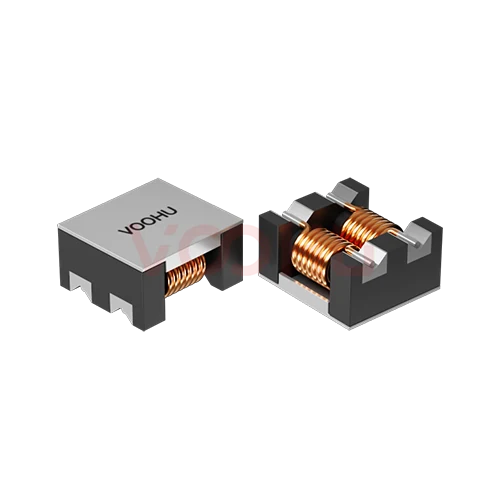
To compare more current steps, open the power line common mode choke selector, or browse the WHACM15A60R series, the WHACM07A40R series and the WHAL-4520A series. For a walkthrough of one part in a design, read WHACM15A60R choke selection; for how signal line and power line chokes differ and how to read the impedance curve, read signal and power line common mode chokes.
#Common mode choke current rating FAQ
Is the rated current of a common mode choke a thermal limit or a saturation limit?
Treat it as a thermal limit. Balanced load current cancels in the core, so the rated current mainly tells you how much current the windings can carry before DCR losses heat the choke beyond its limits. Saturation comes from current that does not cancel, such as return current on another path or a reversed winding, and staying below the rated current does not protect you from it.
How much unbalanced current can a common mode choke handle?
There is no general figure. It depends on the core material, the number of turns and the temperature, so rules of thumb quoted as a percentage of the rated current are not safe to rely on. Measure the net current with a current probe around both conductors at full load, then ask the supplier to check that figure against the part. For VOOHU chokes, send it to our FAE team.
Do common mode chokes have polarity?
The two windings have a phase relationship, shown by the pin numbering or a dot on the datasheet drawing. Both lines must pass through the choke in the same sense so that the load current flux cancels. If one winding is reversed, the choke stops suppressing common mode noise and the load current magnetizes the core, which can saturate it well below the rated current. Check the marking against your footprint before the first board build.
Can I use a common mode choke as a differential mode inductor?
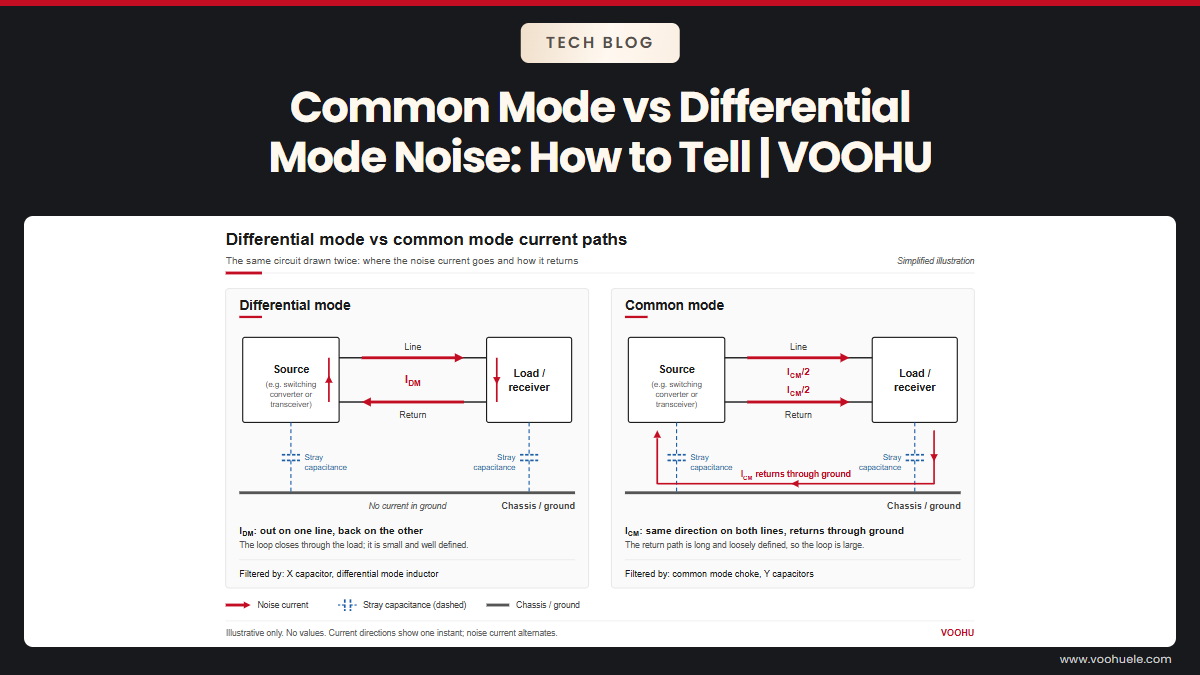
Only its leakage inductance acts on differential current, and that is small. If you connect the two windings in series, aiding each other, to make a single inductor, the full current flux goes into the core, the rated current no longer applies and the core can saturate at low current. Use a differential mode or power inductor for that job; see common mode vs differential mode noise for which filter treats which noise.
Check a common mode choke against your load current
Send us your rail voltage, worst-case RMS current, highest ambient temperature and the frequencies that fail through our sample request form. Our FAE team can suggest suitable parts and help check the design, from current margin and DCR heating to the winding orientation on your footprint. Samples are available for evaluation, and selected parts are free of charge. Our FAE team will be glad to confirm the options for your project. VOOHU manufactures these common mode chokes and makes its magnetics in its own factory in Mianyang. VOOHU supplies RJ45 and SFP connectors, LAN and PoE transformers and common mode chokes from Suzhou, China, to more than 1,500 customers.
Sources
- VOOHU WHACM15A60R501 common mode choke datasheet, Rev. A0: dimensions and test conditions on sheet 1, electrical characteristics on sheet 2.
- VOOHU WHACM07A40R102 common mode choke datasheet, Rev. A0: test conditions and applications on sheet 1, electrical characteristics on sheet 2.
- VOOHU WHAL-4520A series automotive power line choke datasheet, V0.1 (2025-05-23): electrical specifications at 25 °C, page 1 of 6.
Need a quote, samples or selection support?
Part number WHACM15A60R501 is filled in for you. Add the quantity and lead time and submit. Our FAE team will be glad to confirm the options for your project.
Before you order: samples, MOQ, lead time and import duties in our ordering guide →