An RJ45 current rating per pin is not one number. A plain RJ45 jack datasheet gives a connector line; the VOOHU jack datasheets below print "CURRENT RATING 1.5 A" next to a 125 V AC voltage rating. A MagJack (RJ45 jack with integrated magnetics) is set by its transformers instead, and its datasheet gives a balanced DC line current: 720 mA or 1.5 A at 57 V DC continuous on the two VOOHU PoE jacks below. To check a design, work out the current in each pair from your PoE type or DC load, halve it for each contact, then compare it with the datasheet line that actually applies to your jack, and confirm what that line covers, per contact, per pair or per port, and at what temperature.
#How much current can an RJ45 carry?
The RJ45 connector current rating depends on which kind of jack you are reading, because the two kinds print different lines. A jack without magnetics only has contacts, so its datasheet rates the contacts. In a MagJack, PoE or DC power enters through the transformer center taps, so its datasheet rates the magnetics, and the two VOOHU MagJack datasheets below do not add a separate contact line.
The table puts four VOOHU datasheets side by side: two plain jacks, the SYT59211488AB2A1DY1006 (1×4 with LEDs) and the WH56A31882021103 (1×1 with LEDs), and two PoE MagJacks, the SYT411Q211DB2A1DP2 (2.5G, 1×1) and the SYT4A11Q855HWA10DPB1359 (10G, 1×1). Names and values are as printed.

Two things follow from the table. First, a plain jack's 1.5 A and a MagJack's 1.5 A are different quantities: one rates contacts, the other rates the DC that the windings can carry. Do not add one to the other or swap one for the other. Second, none of these lines says whether it applies to one contact, one pair or the whole port, and the plain-jack lines give no temperature-rise condition. None of the four VOOHU drawings above states it, so it is the first question to put to any supplier before you treat the number as margin. Our FAE team can confirm the scope for the part you pick.
#Which RJ45 pins carry power?
IEEE 802.3 groups the eight contacts into four pairs and the pairs into two pairsets. Pins 1-2 and 3-6 form one pairset (Alternative A at the power source, Mode A at the powered device); pins 4-5 and 7-8 form the other (Alternative B, Mode B). The two conductors of a pair are always at the same polarity, so a pair's current splits across two contacts. For wiring, center taps and polarity, see PoE pinout: Mode A vs Mode B.
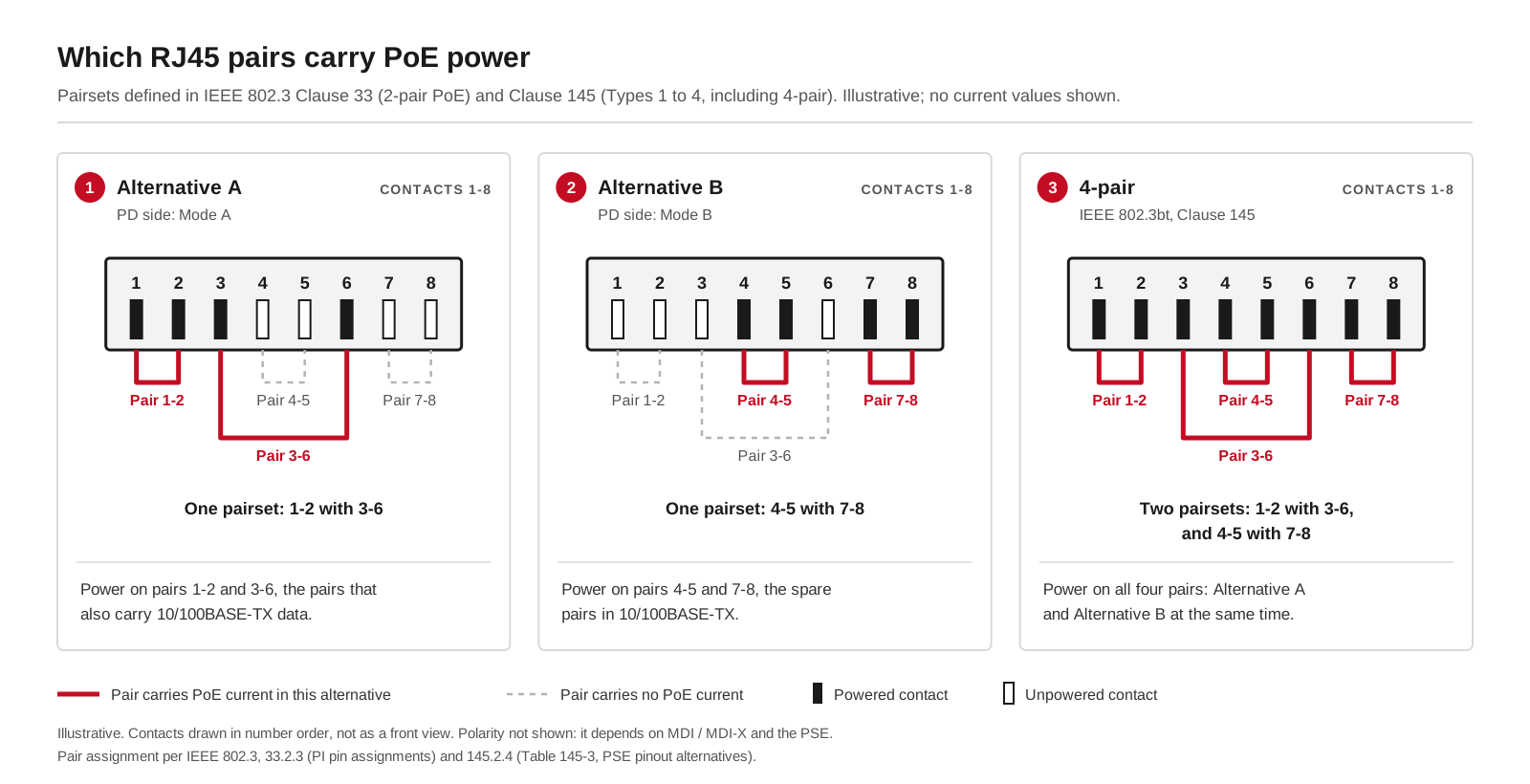
The eight contacts of an RJ45 jack, grouped into the four pairs and two pairsets that PoE uses. Each pair's current is shared by its two contacts. Illustration.
#How much current does PoE put on each pair?
The standard sets the per-pair figures by device type and, for four-pair power, by class. Type 1 and Type 2 power over two pairs only; Classes 5 to 8 use all four pairs.
The unbalance figures matter for the jack. In four-pair power the two pairs of the same polarity sit in parallel, and resistance differences in the power source, cable, connectors and powered device push more current into one of them. The contact budget therefore starts from the unbalanced number, not the balanced one. Take Class 8: one pair may carry up to 938 mA, so each of its two contacts carries roughly 469 mA if the two wires share it evenly. The standard sets these limits per pair, not per wire, so treat the halving as an estimate and keep margin above it.
#RJ45 voltage rating: is it the same as dielectric strength?
No. The voltage rating is the working voltage the contacts are rated for; on both plain VOOHU jacks above it is 125 V AC. Dielectric strength is a one-minute insulation test, 1000 V AC RMS at 50 or 60 Hz, that shows the insulation holds; it is not a voltage to run at. PoE is DC, and the MagJack notes give 57 V DC continuous as the operating figure. Their Hi-Pot lines test the isolation between the cable side and the board side, and the two VOOHU MagJacks state different conditions, 6 seconds at 1 mA on one and a 60-second minimum on the other, so compare each against the test your product standard calls for rather than against each other. For what Hi-Pot does and does not prove, see Ethernet isolation and Hi-Pot failures.
#How do you check a jack for 12 V or 24 V DC power?
Custom DC over RJ45, outside the PoE standard, has no per-pair table to lean on, so the numbers are yours to work out. With a plain jack you choose the contacts, and two things decide whether it works. One is current per contact: total current divided by the number of contacts on each polarity, plus margin for uneven sharing. The other is the heat and voltage drop in the contacts themselves. Suppose 0.5 A flows through one contact of the SYT59211488AB2A1DY1006, whose datasheet gives 30 mΩ maximum per terminal when new and 50 mΩ maximum after the durability test: that is 15 mV and 7.5 mW per contact new, and 25 mV and 12.5 mW after wear. How contacts hold up over many matings is covered in RJ45 gold plating: 3U vs 6U vs 50U. Multiply by the contacts in the loop, both ways, and add the cable and the mating plug, which have their own resistance and limits.
A short checklist before the design review:
- 1.Write down the current per pair from your PoE class (the table above) or your DC load, using the unbalanced figure where there is one.
- 2.Halve it for the current per contact, and keep margin for uneven sharing.
- 3.Pick the datasheet line that applies: the contact line for a plain jack, the balanced DC line current for a MagJack.
- 4.Ask the supplier what that line covers (per contact, pair or port) and the temperature condition behind it, and check it against your highest ambient inside the enclosure.
- 5.For a MagJack, match the PoE standard printed on its datasheet to your PoE type; PoE MagJack selection by af, at and bt walks through that match.
#What does "balanced DC line current" on a MagJack datasheet mean?
It is the DC the magnetics are built to carry through the center taps while still passing data. "Balanced" means the current divides equally between the two halves of a winding, so their magnetic fields cancel and the core is not pushed toward saturation. The SYT411Q211DB2A1DP2 datasheet states 720 mA max at 57 V DC continuous and describes its magnetics as "acc. To IEEE802.3at for PSE or PD applications"; the SYT4A11Q855HWA10DPB1359 states 1.5 A max at 57 V DC continuous. Neither says whether the figure is per pair or per port, so confirm that before you compare it with the per-pair table above. For DC magnetics in four-pair designs, see 802.3bt PoE magnetics selection.
#Which VOOHU jack fits which job?
- Plain jack with external PoE magnetics, or custom DC on chosen contacts: SYT59211488AB2A1DY1006 (1×4) or WH56A31882021103 (1×1). Both list 1.5 A, 125 V AC and 1000 V AC dielectric strength; the SYT59211488AB2A1DY1006 datasheet also gives contact resistance before and after durability testing, which you need for the drop calculation. The jack itself does not limit or provide PoE; the external transformer decides that.
- PoE through the jack, 2.5G: SYT411Q211DB2A1DP2, 720 mA balanced DC line current, magnetics to IEEE 802.3at per its datasheet.
- PoE through the jack, 10G, higher DC current: SYT4A11Q855HWA10DPB1359, 1.5 A balanced DC line current at 57 V DC continuous.
To compare more parts, the RJ45 jack selector filtered to integrated magnetics lists MagJacks with their PoE current, and the full RJ45 selector includes jacks without magnetics.
#FAQ
Can RJ45 be used for power?
Yes. PoE sends DC over the same pairs that carry data, through the transformer center taps, and IEEE 802.3 Clauses 33 and 145 define it. Custom DC over unused or dedicated contacts also works, but it sits outside the standard, so you set the current per contact and the voltage drop yourself and keep other Ethernet equipment from being plugged into that port.
Does an RJ45 jack support PoE?
A jack without magnetics only passes current through its contacts; it does not limit or provide PoE, and the external LAN transformer and the PoE controller decide what the port can deliver. A MagJack has the magnetics inside, so its datasheet carries the PoE current and, often, the IEEE 802.3 amendment it was designed to.
Is the 1.5 A rating per pin?
Not necessarily. A single current rating on a connector drawing does not always say whether it covers one contact, one pair or the whole jack, or the temperature rise behind it. Ask before you count on it; for VOOHU jacks our FAE team can confirm both for the part you pick.
What is the maximum current that an RJ45 cable can handle?
That depends on the cable, not the jack: conductor gauge, run length, how many cables are bundled together and the temperature around them. The plug at each end has its own rating too. Check all three, the jack, the plug and the cable, because the lowest one sets the limit.
Have the current scope confirmed for your design
Send us your PoE type or DC load, the number of contacts you plan to use and your highest ambient temperature through our sample request form. Our FAE team can suggest suitable parts and help check the design, from the scope of the current rating and the balanced DC line current to the PoE standard of the magnetics. Samples are available for evaluation, and selected parts are free of charge. Our FAE team will be glad to confirm the options for your project. VOOHU supplies RJ45 and SFP connectors, LAN and PoE transformers and common mode chokes from Suzhou, China, to more than 1,500 customers.
#Sources
- VOOHU SYT59211488AB2A1DY1006 datasheet, Rev. A0
- VOOHU WH56A31882021103 datasheet, Rev. A0
- VOOHU SYT411Q211DB2A1DP2 datasheet, Rev. A0, sheet 3
- VOOHU SYT4A11Q855HWA10DPB1359 datasheet, Rev. A0, sheet 3
- IEEE Std 802.3-2022, Clause 33 (Power over Ethernet over 2 Pairs), Table 33–1
- IEEE Std 802.3-2022, Clause 145 (Power over Ethernet), 145.2.4 PSE PI and 145.2.10.6.1 PSE pair-to-pair current unbalance
- Ethernet Alliance, "Overview of 802.3bt – Power over Ethernet standard", v2.1, December 2019
Need a quote, samples or selection support?
Part number SYT59211488AB2A1DY1006 is filled in for you. Add the quantity and lead time and submit. Our FAE team will be glad to confirm the options for your project.
Before you order: samples, MOQ, lead time and import duties in our ordering guide →