Compiled from both manufacturers' published datasheets. Verify with samples and the PCB footprint before production.
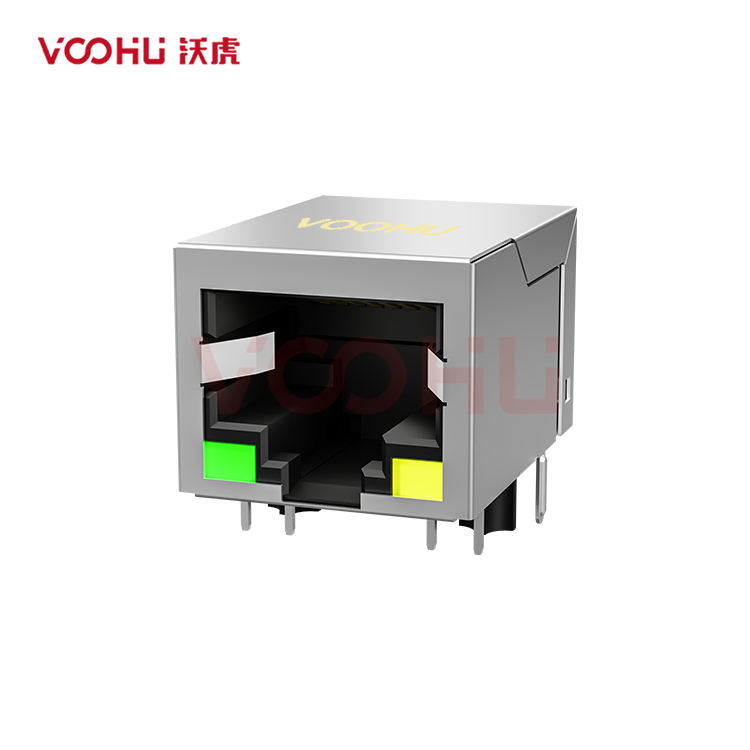
Moving from the HanRun HR913550A to the VOOHU SYT111B002BA2A1D starts in the quality office rather than on the board. The SYT111B002BA2A1D is a functional alternative to the HR913550A — verify with samples in your design. Both are single-port, through-hole RJ45 connectors with magnetics and LEDs for 10/100Base-T, green on the left and yellow on the right. The two drawings give the same pin functions, the same 350 µH minimum OCL and the same signal and LED hole positions. The differences that need action first are on paper. The two datasheets define the isolation test with a different duration and a different leakage-current limit, so a hi-pot procedure written for the HanRun part has to be rewritten, and the published operating range starts at 0 °C on the HanRun sheet and at −40 °C on the VOOHU sheet. The suggested panel cut-out and two PCB hole dimensions also differ.
#HR913550A datasheet vs. SYT111B002BA2A1D datasheet
Every figure below comes from one of two documents. On the HanRun side that is the HR913550A datasheet, revision 00, four pages long: electrical data on page 1, outline and LED data on page 2, the recommended PCB layout and panel cut-out on page 3, and materials and mechanical ratings on page 4. On the VOOHU side it is the SYT111B002BA2A1D datasheet, revision A0, also four pages: drawing, hole layout, materials and temperature on page 1, panel cut-out on page 2, schematic, electrical table and LED data on page 3, and a wave-solder profile on page 4. Dimensions are in millimetres. A cell reads "not stated" when that datasheet gives no value.
#Hi-pot test time and leakage limit: what changes for incoming inspection
Look at the isolation row closely, because it differs in four ways at once. HanRun applies 2250 V DC for 60 s, allows 0.5 mA, and measures from the UTP side to the chip side. VOOHU lists two voltages, 1500 V AC and 2250 V DC, applies them for 6 s, allows 1 mA, and measures primary to secondary. The voltage is the only number the two rows share. A 60 s program with a 0.5 mA trip and a 6 s program with a 1 mA trip are two different acceptance tests. A lot accepted under one of them has simply not been tested under the other, which tells you nothing about the parts either way.
In practice, three documents usually need editing. The incoming inspection instruction should carry the VOOHU definition: voltage, AC or DC, dwell time, trip current and the two points the tester connects to. The tester recipe on the inspection bench should be saved as a separate program, so HanRun and VOOHU lots are never run on each other's settings. Third, the safety file: where a CB report or critical-component list records this jack with an isolation rating, rewrite that line in the approved part's own words. Do not judge VOOHU lots against the HanRun 60 s, 0.5 mA program. If your end-product standard sets its own hi-pot step for the finished port, run that step on assembled boards with samples; our article on why Ethernet ports fail hi-pot tests shows which parts sit across the isolation barrier.
#0 to +85 °C or −40 to +85 °C: does the temperature line matter for your design?
The HanRun datasheet gives an operating range of 0 to +85 °C and a storage range of −40 to +85 °C. The VOOHU datasheet gives −40 to +85 °C for both. If your product is specified at 0 °C or above, nothing in your design changes, but the temperature column on the BOM line does, and whoever maintains the component database should copy it from the VOOHU sheet. If your product is specified below 0 °C, say an outdoor cabinet or an unheated industrial enclosure, the HanRun part's published operating range does not cover that part of your specification. Any cold testing you ran with it sat outside the supplier's rating. With the SYT111B002BA2A1D, the datasheet covers the range down to −40 °C, and the sensible step is to repeat your cold-start and link test on sample boards so the qualification record rests on the part you will actually build with.
#RJ45 panel cut-out and PCB holes on a design drawn for the HR913550A
The front panel is the part of the change-over most likely to be overlooked, because it is often drawn by a mechanical engineer who never sees the BOM. HanRun suggests a cut-out of 16.54 × 14.00 mm (±0.13 mm). VOOHU suggests 16.30 × 13.75 mm (±0.10 mm) and marks its figure as reference only. On paper, a panel cut for the HanRun part is 0.24 mm wider and 0.25 mm taller than the VOOHU suggestion; if the opening is centred on the jack, that is roughly 0.12 mm more gap on each side. Whether that matters depends on what touches the jack at the panel. If the panel only frames the opening, check the look of the gap on a sample. If a grounding finger or gasket at the panel is meant to contact the shield, check that it still does with the sample fitted, and include the port in your next radiated-emission scan. The reverse direction matters too: a new panel cut to the VOOHU suggestion should be checked with a HanRun part as well if both stay approved.
On the PCB, the eight signal holes, the four LED holes and the 11.43 mm peg spacing land in the same places once both layouts are viewed from the same side. Two hole dimensions do not match. The shield-tab holes are Ø1.63 mm on both, centred 15.49 mm apart on the HanRun layout and 15.75 mm apart on the VOOHU layout, a difference of 0.26 mm across the pair. The locating-peg holes are Ø3.25 mm (HanRun) and Ø3.20 mm (VOOHU). Neither drawing tells you how the tab width sits against your finished-hole tolerance, so the useful test is physical: push a sample into a bare board from your current production lot before any soldering, and note whether the tabs enter without force and the body seats flat on the board.
The schematic needs less attention. Pins 1 to 8 carry the same functions on both drawings, and the LEDs keep their colours, positions and pin directions. The forward-voltage window is written differently: one range of 1.8–2.8 V on the HanRun sheet, separate ranges of 1.85–2.45 V for green and 1.7–2.2 V for yellow on the VOOHU sheet. If your LED resistors were sized for a particular forward voltage, recalculate the current at the ends of the VOOHU ranges for your supply rail. The transformer data reads the same for OCL, return loss and crosstalk; insertion loss starts at 0.3 MHz on one sheet and 1 MHz on the other, and common-mode rejection is split into different bands, so copy those lines from the VOOHU sheet rather than editing the old ones.
#Change-over checklist: HR913550A to SYT111B002BA2A1D
Quality and incoming inspection
- 1.Write the hi-pot item to the VOOHU definition: 1500 V AC and 2250 V DC, 6 s, 1 mA, primary to secondary.
- 2.Save it as a separate tester program and label it with the VOOHU part number.
- 3.Update the isolation entry in the safety report or critical-component list to the approved part's wording.
Hardware design
- 1.Change the BOM temperature column to −40 to +85 °C.
- 2.If the product is rated below 0 °C, repeat cold-start and link tests on sample boards.
- 3.Recalculate LED current against 1.85–2.45 V (green) and 1.7–2.2 V (yellow).
Layout and mechanical
- 1.Fit a sample behind the existing front panel (16.54 × 14.00 mm cut-out) and check the gap and any grounding contact at the shield.
- 2.Dry-fit a sample in a bare production board: shield tabs at 15.49 vs 15.75 mm spacing, pegs in Ø3.25 vs Ø3.20 mm holes.
- 3.If both parts stay approved on one design, agree the panel cut-out and hole sizes with our FAE team.
Purchasing
- 1.Enter the SYT111B002BA2A1D as a functional alternative pending sample approval, on its own line for the HR913550A.
#Where the SYT111B002BA2A1D fits
Single 10/100 copper ports that do not carry power: network interface cards, embedded controller boards, access-control and building-automation units, small gateways. The product page gives the jack no PoE rating, so keep it to ports without power. Equipment that has to start and hold a link below 0 °C, such as outdoor or shop-floor controllers, is where the temperature line above becomes a design point rather than a database edit. If your BOM shows the HanRun HR911105A instead, read our HR911105A comparison, which covers the same VOOHU part.
Industry solutionIndustrialPLC · ServoView solution →#FAQ
What is an equivalent to the HanRun HR913550A?
VOOHU's SYT111B002BA2A1D is a functional alternative to the HanRun HR913550A — verify with samples in your design. Both are 1×1 through-hole 10/100Base-T RJ45 connectors with integrated magnetics and green/yellow LEDs, with the same pin functions and LED pins on their drawings. Rewrite the hi-pot inspection to the VOOHU datasheet: 1500 V AC and 2250 V DC, 6 s, 1 mA.
What is the difference between the HanRun HR913550A and HR911105A?
The HR913550A and HR911105A are different HanRun part numbers, each with its own datasheet, and only the first is compared here. VOOHU has published a separate comparison of the HR911105A against the same SYT111B002BA2A1D. Check the operating temperature and the suggested panel cut-out on each HanRun datasheet rather than assuming the two are interchangeable on your BOM.
Does this comparison cover the HR913550AE?
No. The HR913550AE is a separate HanRun part number with its own datasheet, and none of its figures were used here. If the AE version is on your BOM, read its datasheet first, especially the temperature range, before reusing any line from this comparison.
Is the HR913550A tab up or tab down?
Take the orientation from the front view and recommended layout on the HanRun drawing. Per the front view, its contact and pin 1 positions match the SYT111B002BA2A1D drawing, which is titled tab-down. Plug a sample into your board to confirm.
#Send your HR913550A hi-pot procedure with the sample request
Request SYT111B002BA2A1D samples through the sample request form, and attach the hi-pot procedure you use for the HR913550A and the front-panel cut-out drawing. Samples are available for evaluation, and selected parts are free of charge. Our FAE team will be glad to confirm the options for your project. Our FAE team can suggest suitable parts and help check the design — for this pair, translating your isolation test into the VOOHU conditions, reviewing the panel cut-out and the shield-tab and peg holes, and confirming the temperature line for your BOM.
VOOHU supplies RJ45 and SFP connectors, LAN and PoE transformers and common mode chokes from Suzhou, China, to more than 1,500 customers.
Looking at other single-port jacks with magnetics? The RJ45 connector selector opens filtered to integrated magnetics and tab down.
Related product: SYT111B002BA2A1D — 1×1 through-hole RJ45 jack with integrated magnetics, 10/100BASE, green / yellow LEDs, hi-pot 1500 V AC and 2250 V DC, −40 to +85 °C.
Need a quote, samples or selection support?
Part number SYT111B002BA2A1D is filled in for you. Add the quantity and lead time and submit. Our FAE team will be glad to confirm the options for your project.
Before you order: samples, MOQ, lead time and import duties in our ordering guide →