Compiled from both manufacturers' published datasheets. Verify with samples and the PCB footprint before production.
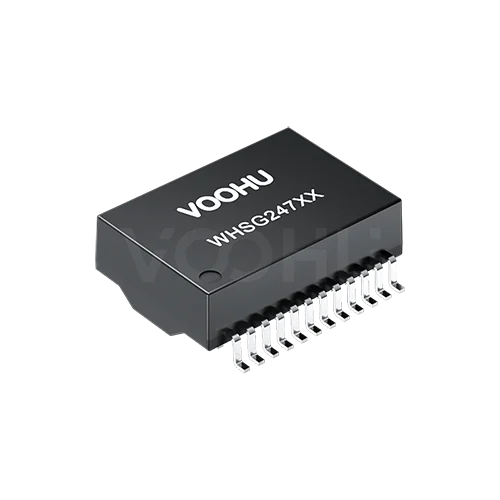
Ask one question about the port before anything else: does it carry PoE? If it does not, the VOOHU WHSG24701G is a functional alternative to the Mentech G2497CG for that non-PoE gigabit port — verify with samples in your design. The two share a 24-lead wide-body SMD package (1.27 mm pitch, 13.97 mm first to last lead, 16.00 mm across the leads), 1CT:1CT ± 5% windings, 350 µH minimum OCL, 1500 VAC isolation for 60 s and a 0 to 70 °C operating range, and the pin numbers carry the same functions. What a pin table will not show you is inside the package: on the cable side, Mentech routes each center tap through a third winding of its common mode choke, while VOOHU brings the center tap straight out of the transformer. That changes how common-mode current reaches your Bob Smith termination, so plan an EMC comparison as part of the evaluation.
#G2497CG vs. WHSG24701G: datasheet values side by side
Mentech's document for the G2497CG is a seven-page approval specification, version A0, issued 27 April 2020. Its mechanical table gives minimum, nominal and maximum for most dimensions; VOOHU's WHSG24701G datasheet, revision A0, gives a nominal value with a tolerance. Mentech page numbers below are PDF page order (the footer prints 2/6, 3/6 and so on). Lengths are in millimetres, and anything a datasheet does not give is marked not stated.
#Is the Mentech G2497CG PoE compatible? What the two datasheets actually say
On the Mentech side there is exactly one line about PoE: "Compliant with IEEE 802.3af ANSIX3.263 standards", printed above the electrical table on page 4. Search the other six pages and you will not find a DC current per pair, a PoE class, or any mention of PSE or PD. On the VOOHU side there is nothing at all: the WHSG24701G datasheet has no PoE statement, the only DC current in it is the 8 mA bias used to measure OCL, and the product page lists the part as Not PoE rated. So this comparison covers non-PoE ports. It also means the Mentech line should not be read as a current rating; it gives no number, and neither does this article.
Why the transformer matters on a PoE port: Texas Instruments' PoE PD Schematic Review Guidelines (SLVAF59) describes the Ethernet PHY transformer as the part that separates data from power, and warns that a transformer with its power side and data side swapped will not support the current. Power on the data pairs flows through the cable-side windings and center taps, so the magnetics there need a DC rating you can design against. To check your own board, follow pins 24, 21, 18 and 15 on the schematic. If they lead to a PSE controller, a diode bridge or a PD controller, the port carries PoE, and the WHSG24701G is not the part for it; start from our PoE transformer model guide instead. If they lead only to a termination network, carry on with the next section. For purchasing, write the same condition into the approved vendor list: WHSG24701G as an alternate for G2497CG on non-PoE ports only, so the entry does not drift onto a PoE variant of the board later.
#Ethernet transformer center tap connection: the one internal difference
Pin numbers and functions match on all 24 pins, and the in-phase pairs Mentech lists (2-23, 5-20, 8-17, 11-14) correspond to TD+ and MX+ on the VOOHU schematic. The difference is how the cable-side center taps leave the package. On the G2497CG schematic each cable-side center tap, pin 24 for the first channel, runs through the middle winding of a three-wire common mode choke before it reaches the transformer's center point. On the WHSG24701G schematic the choke has two wires, on the data lines only, and MCT1 on pin 24 comes straight from the center of the cable-side winding. In a non-PoE design those center tap pins usually go to the Bob Smith termination: a resistor per pair to a common node, and a capacitor from that node to chassis ground. That network is there to give common-mode energy on the cable a defined path. With the G2497CG, that path includes a choke winding; with the WHSG24701G, it does not.
Neither datasheet can tell you whether that moves your emissions or immunity margin, or in which direction; it depends on your board, cable, chassis bond and termination values. So treat the change as an EMC-relevant one and measure it. Run your pre-compliance radiated and conducted scans with the WHSG24701G using the same cable, link partner, traffic and chassis setup that the G2497CG build passed with, and compare the two results directly rather than against a limit line alone. If your product standard calls for ESD or surge on the Ethernet port, repeat those too. On the schematic side, update the library symbol if it draws the three-wire choke, so the documentation matches the part you build with. Our guide to Ethernet port test failures covers the Bob Smith network itself in more depth.
#Pads, height and test conditions on the 16 mm wide body
Both suggested pads are 0.76 mm wide on a 1.27 mm pitch, so the pads line up along each row. Across the rows, Mentech draws 2.29 mm long pads with the outer edges 17.20 mm apart; VOOHU draws pads about 1.95 mm long between 12.70 mm and 16.60 mm. A board built to the Mentech pattern therefore has copper reaching 0.60 mm further out across the two rows. Lay the WHSG24701G lead outline (16.00 ± 0.50 mm across the leads, 1.10 ± 0.15 mm foot) over those pads at both tolerance limits to see where the toe lands, and check heel and toe fillets on the first articles. We have no written FAE confirmation that the Mentech pads can stay, so let the sample build decide. For clearance, the WHSG24701G is 6.00 ± 0.50 mm tall, so size anything above it from 6.50 mm rather than from Mentech's 6.20 mm maximum.
Three test conditions differ, and each one ends up in someone's incoming inspection sheet. OCL and leakage inductance are measured at 0.2 V on the Mentech specification and at 0.1 V on the VOOHU datasheet, so set the LCR meter to the condition of the part on the bench. Mentech lists a second hipot condition, 1650 VAC for 6 s, alongside the 1500 VAC, 60 s test that both datasheets share; if your line copied the 6 s test from the Mentech sheet, confirm the test with us before applying it to the WHSG24701G. And Mentech rates the G2497CG MSL 1 with a 245 °C reflow peak, while the WHSG24701G datasheet states neither. Do not carry MSL 1 across by assumption; ask us for the MSL and reflow conditions in writing and enter them in your moisture-control system before the first reel goes to the line.
#Before the WHSG24701G replaces a G2497CG: a checklist
#Where the WHSG24701G fits
The WHSG24701G belongs on a single gigabit RJ45 port that does not carry power and stays within 0 to 70 °C in operation: routers, gateways, network storage, embedded controllers and similar boards laid out for a 24-lead, 16 mm wide transformer. If your board uses Mentech's narrow-body G2401CG on a 1.0 mm pitch instead, our G2401CG comparison covers that package. For a port that does carry PoE, our PoE transformer model guide is the better starting point.
SolutionEthernetInterface + magneticsView solution →#FAQ
Is Mentech G2497CG PoE compatible?
The G2497CG specification carries one line, "Compliant with IEEE 802.3af ANSIX3.263 standards", at the head of its electrical table, but it gives no DC current per pair, PoE class or PSE / PD details. The VOOHU WHSG24701G datasheet gives no PoE rating, and its product page lists it as Not PoE rated, so the WHSG24701G is offered as a functional alternative to the G2497CG on non-PoE gigabit ports only — verify with samples in your design.
How is the Ethernet transformer center tap connection different on the G2497CG and WHSG24701G?
The chip-side center taps sit on pins 1, 4, 7 and 10 and the cable-side center taps on pins 24, 21, 18 and 15 on both parts. On the G2497CG schematic each cable-side center tap passes through a third winding of a three-wire common mode choke; on the WHSG24701G schematic it comes directly from the transformer winding. The termination network sees a different common-mode path, so compare EMC pre-scan results before release.
Can the WHSG24701G be placed on G2497CG pads?
The pads share a 0.76 mm width and 1.27 mm pitch, but Mentech's pattern is 2.29 mm long with a 17.20 mm outer span, while VOOHU's is about 1.95 mm long between 12.70 mm and 16.60 mm. Overlay the WHSG24701G leads (16.00 ± 0.50 mm across, 1.10 ± 0.15 mm foot) at both tolerance limits and confirm with a sample build; no written FAE confirmation covers these pads yet.
What MSL is the G2497CG?
Mentech rates the G2497CG moisture sensitivity level 1, lists shelf life as unlimited with storage at ≤ 30 °C / 85% RH, and gives a 245 °C reflow peak with 60 to 150 s above 217 °C. Neither the MSL nor a reflow profile appears on the WHSG24701G datasheet; get both from VOOHU in writing before the part is booked into stores.
#WHSG24701G samples: what to include in the request
When you request samples of the WHSG24701G, include the port schematic from the RJ45 to the PHY, with the center tap and termination network visible, and the land pattern from your G2497CG board. Samples are available for evaluation, and selected parts are free of charge. Our FAE team will be glad to confirm the options for your project. Our FAE team can suggest suitable parts and help check the design — for this pair, whether the port is truly non-PoE, how the center taps and Bob Smith network are wired, and how the WHSG24701G leads sit on the Mentech pads.
VOOHU supplies RJ45 and SFP connectors, LAN and PoE transformers and common mode chokes from Suzhou, China, to more than 1,500 customers.
The LAN transformer selector opens here filtered to gigabit, 24-pin, 1.27 mm pitch, non-PoE parts, if you want to see the alternatives side by side.
Related product: WHSG24701G. Use it on gigabit ports without PoE: it is a single-port 100/1000BASE-T SMD transformer with 24 leads on a 1.27 mm pitch, 16.00 ± 0.50 mm across the leads and 6.00 ± 0.50 mm tall, rated for 350 µH minimum OCL, 1500 VAC isolation for 60 s and 0 to +70 °C operation.
Need a quote, samples or selection support?
Part number WHSG24701G is filled in for you. Add the quantity and lead time and submit. Our FAE team will be glad to confirm the options for your project.
Before you order: samples, MOQ, lead time and import duties in our ordering guide →