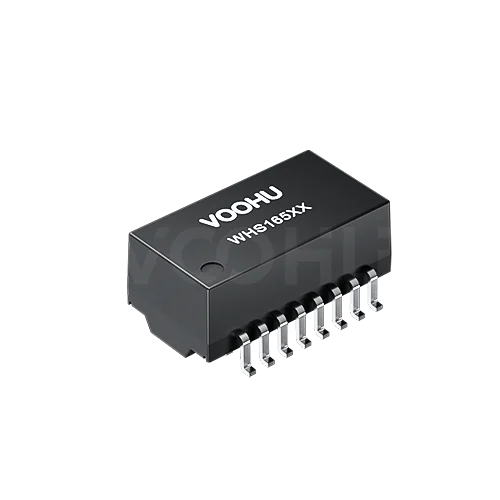
VOOHU WHS16503G is a functional alternative to the Mentech H1601CG — verify with samples in your design. Each is a single-port 10/100 LAN transformer in a 16-pin, 1.27 mm pitch surface-mount package, with 1CT:1CT windings, 350 µH minimum OCL at 8 mA DC bias, 1500 V isolation and a 0 to +70 °C operating range, and the two datasheets print the same pin numbers and signal names. Three dimensions need attention on the board: the recommended pads reach 10.50 mm across both rows for Mentech and 10.60 mm for VOOHU (inner edges 7.10 mm on both), the body is 7.10 mm wide against 6.85 mm, and height is 6.4 mm max against 4.95 ± 0.50 mm.
#H1601CG and WHS16503G datasheets, row by row
The Mentech column comes from the one-page H1601CG datasheet, which carries no revision or date. The VOOHU column comes from the WHS16503G datasheet, revision A0: page 1 holds the drawing, pad layout and schematic, page 2 the electrical items. Dimensions are in millimetres, with tolerances only where a drawing prints them next to the value. "Not stated" means the datasheet gives no figure.
#Layout checks when an H1601CG footprint gets a WHS16503G
Pad outer edge: 10.50 mm against 10.60 mm. Both recommended land patterns leave 7.10 mm between the inner edges of the two pad rows, and both use 0.76 mm wide pads on a 1.27 mm pitch. The two drawings part at the outer edge, measured across both rows: 10.50 mm on the Mentech drawing, 10.60 mm on the VOOHU drawing. So the difference sits at the toe end of each pad, beyond the tips of the leads, which reach 9.40 mm across on the H1601CG drawing and 9.50 ± 0.50 mm on the WHS16503G drawing. Overlay the WHS16503G pad layout on your existing H1601CG pads, then judge the toe fillets on a sample build before deciding whether to keep the pads or redraw them.
The 8.89 mm figure. On both drawings, 8.89 mm is the distance from the centre of pin 1 to the centre of pin 8 along the same row — seven 1.27 mm steps. It describes how far the pins run along the body, not how far apart the two rows are, so it cannot be used to place one row against the other. Row placement comes from the 7.10 mm and 10.50 / 10.60 mm pad dimensions above.
Body outline and height. The WHS16503G body is 6.85 ± 0.50 mm wide where the H1601CG drawing shows 7.10 mm; length is 12.70 mm on both. Height is 4.95 ± 0.50 mm for the WHS16503G and 6.4 mm max for the H1601CG. Update the component outline on the silkscreen and courtyard layers, and the body size held in the placement machine's part library, from the VOOHU drawing. If you plan to use the lower body to bring a lid, heat sink or stacked board closer, size that gap from the WHS16503G upper limit rather than from 4.95 mm.
Pin names and the four undrawn pins. Both schematics put TD± on pins 1 and 3 with its centre tap on pin 2, RD± on pins 6 and 8 with the centre tap on pin 7, and the cable-side pairs on pins 14/16 and 9/11 with centre taps on 15 and 10. Pins 4, 5, 12 and 13 appear on neither schematic. That match comes from comparing two published datasheets; it is not a statement from our FAE team. If your board routes anything to pins 4, 5, 12 or 13, ask our FAE team about those pins before reusing the layout.
How the electrical limits are written. Turns ratio, minimum OCL, insertion loss and common mode rejection carry the same numbers on both sheets, but the OCL test signal is 0.2 V for Mentech and 0.1 V for VOOHU, and the frequency bands start at 0.5 MHz for Mentech and 1 MHz for VOOHU. Return loss and crosstalk are split into different bands and formulas, as the table shows. These are published limits, not measurements, so the table does not rank one part above the other. If your incoming inspection measures OCL, set it up with the test condition printed in the datasheet of the part you actually receive.
Isolation, temperature and PoE. Mentech lists 1500 Vrms without a test time or current; VOOHU lists 1500 VAC at 1 mA for 60 s. Both datasheets give 0 to +70 °C operating, and only the VOOHU sheet gives a storage range (−40 to +85 °C). Neither datasheet states a PoE rating, and the WHS16503G product page lists the part as not PoE rated; a powered port needs a part with a PoE rating. LED and shield rows are absent because both are discrete transformers, not RJ45 jacks.
#Which 10/100 boards suit the WHS16503G?
The WHS16503G is aimed at a single 10/100BASE-TX port that is powered locally and stays within 0 to +70 °C, with the transformer placed between a discrete PHY (or a microcontroller with a built-in PHY) and a separate RJ45 jack. Its 4.95 ± 0.50 mm body height is useful where the space above the transformer is limited, for example under a low enclosure lid or beneath a mezzanine board. For a port that must run below 0 °C, or one that carries PoE, filter the LAN transformer selector by temperature or PoE instead.
#FAQ
What is an alternative to Mentech H1601CG?
VOOHU offers the WHS16503G as a functional alternative to the Mentech H1601CG — verify with samples in your design. Both are 16-pin, 1.27 mm pitch SMD transformers for one 10/100 port, rated 0 to +70 °C, with 1CT:1CT windings and 350 µH minimum OCL. The datasheets differ on the recommended pad outer edge (10.50 mm against 10.60 mm), body width (7.10 mm against 6.85 mm) and height (6.4 mm max against 4.95 ± 0.50 mm).
Is the H1601CG an IC?
No. The H1601CG is a 10/100 Ethernet pulse transformer module: two 1CT:1CT transformers with common mode chokes in a 16-pin SMD body, with no active circuitry. It sits between the PHY and the RJ45 jack to provide isolation and coupling. Its outline looks like a 16-pin IC package, which is why it is often searched for as one.
How should the Ethernet transformer center taps be connected on the H1601CG or WHS16503G?
On the H1601CG and WHS16503G schematics, pin 2 is the center tap for TD± and pin 7 the center tap for RD±; facing the cable, pin 15 serves TX± and pin 10 serves RX±. Wire pins 2 and 7 as your PHY vendor's reference design shows for its transmit and receive pairs, and take pins 15 and 10 to the termination network beside the RJ45 jack in that same design.
Can the WHS16503G be placed on an existing H1601CG layout?
Possibly, but confirm it rather than assume it. The pad inner edges (7.10 mm), pad width (0.76 mm) and pitch (1.27 mm) carry the same values in both datasheets; the outer edge does not (10.50 mm Mentech, 10.60 mm VOOHU). Overlay the VOOHU pad drawing on your board, send the layout to our FAE team, and check the solder joints on a sample build before release.
#Evaluate WHS16503G samples on your H1601CG board
Attach the H1601CG pad drawing from your PCB and the PHY you use to a sample request for the WHS16503G. Samples are available for evaluation, and selected parts are free of charge. Our FAE team will be glad to confirm the options for your project. Our FAE team can suggest suitable parts and help check the design — for this pair, the 10.50 / 10.60 mm pad outer edge on your board, the body outline and height near your enclosure, and any traces on pins 4, 5, 12 and 13.
VOOHU supplies RJ45 and SFP connectors, LAN and PoE transformers and common mode chokes from Suzhou, China, to more than 1,500 customers.
To see other single-port 16-pin parts for 10/100 ports, open the LAN transformer selector, already filtered to 10/100 Base-TX and 16 pins, and narrow it by height, temperature or PoE.
Related product: WHS16503G — single-port 10/100BASE-TX SMD LAN transformer, 16 pins on 1.27 mm pitch, 12.70 × 6.85 mm body, 4.95 ± 0.50 mm high, 1CT:1CT, 350 µH minimum OCL, 1500 VAC isolation, 0 to +70 °C.
SolutionEthernetInterface + magneticsView solution →Need a quote, samples or selection support?
Part number WHS16503G is filled in for you. Add the quantity and lead time and submit. Our FAE team will be glad to confirm the options for your project.
Before you order: samples, MOQ, lead time and import duties in our ordering guide →