Compiled from both manufacturers' published datasheets. Verify with samples and the PCB footprint before production.
If your SFP+ port uses the TE Connectivity 1888247-1, the VOOHU WH81-151-Y0002-1 is a functional alternative — verify with samples in your design. Both are 20-position, 0.8 mm pitch, right-angle surface-mount host connectors in black LCP rated UL 94V-0, and both drawings give the same nominal recommended pad (0.50 × 2.00 mm), the same 7.20 / 9.60 / 8.20 / 4.10 mm layout dimensions and two Ø1.55 mm locating holes. The real decision sits in the contact plating: the two parts specify different contact gold thickness. How much that matters depends on how often modules go in and out of your port, so settle that number first, then check the low end of your operating temperature range.
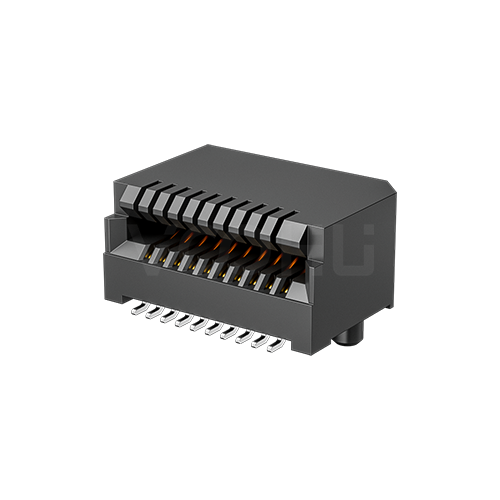
#1888247-1 datasheet and WH81-151-Y0002-1 drawing compared
TE figures are taken from the 1888247-1 product page, where the part is listed as active, and TE customer drawing 1888247, revision N1. That drawing covers more than one suffix, so wherever a value depends on the suffix, the product page for the -1 is used. VOOHU figures come from the WH81-151-Y0002-1 drawing, revision A0, two pages. Millimetres unless noted.
Conversion used in this article: 0.76 µm ≈ 30 µin and 15 µin ≈ 0.38 µm (1 µin = 0.0254 µm).
#Does SFP+ connector gold plating thickness matter here?
It is the first thing to settle with this pair. TE's product page gives the 1888247-1 0.76 µm of gold on the contact mating area, which is about 30 µin. The WH81-151-Y0002-1 drawing title gives 15 µin gold (AU 15U) without naming the plated area, roughly half that figure. Mating-area gold thickness is normally chosen against two things: how many insertions the contact must survive and the environment the port lives in. So the useful question is not which number is larger but what your port actually sees. A connector under a cage on a switch line card may be populated once at assembly and rarely touched again. A port on an evaluation board, a production test fixture or a field-service position may see modules swapped every day. The VOOHU drawing rates the WH81-151-Y0002-1 at 100 mating cycles minimum; the TE product page and drawing used here do not give a cycle figure, so there is nothing to set beside it.
What to do with that: write down the number of module insertions your port must handle over the product's life, including test and service, and put it in your sample request. If it is above the 100-cycle figure on the VOOHU drawing, tell our FAE team so the options can be reviewed before qualification. On samples, cycle a module to your own count and measure contact resistance afterwards against the 40 mΩ maximum on the VOOHU drawing. If an intermittent link is the symptom you are trying to prevent, our article on SFP connector intermittent links covers where to look. For quality teams there is a paperwork side as well: if your incoming inspection or approved-vendor file calls for 0.76 µm mating-area gold, that line has to be rewritten for the VOOHU part, and if you verify plating by thickness measurement, the target becomes 15 µin. Neither the solder-area gold nor the nickel underplate is stated on the VOOHU drawing; if your inspection checks those layers, ask our FAE team for the figures.
#Other points before the 1888247-1 comes off the BOM
Cold end of the range. TE lists −55 °C at the low end and 85 °C at the high end, per the TE product page; the VOOHU drawing gives −40 to +85 °C. On the product-page figure the high ends agree, so this only matters if your product is specified below −40 °C. In that case, raise it with our FAE team before approval.
Pad tolerances. The nominal pad and hole values match, but TE holds the pad to ±0.03 × ±0.05 mm while the VOOHU drawing allows ±0.05 × ±0.1 mm with a 0.08 mm position tolerance. Keep your existing land pattern for the first build, size the stencil to the tighter of the two, and inspect all 20 joints and both locating posts on the first article.
Height. TE dimensions 5.4 mm max and VOOHU 5.33 +0.05 / −0.1 mm. The drawings do not show that the two are measured from the same reference, so check the stack-up with your cage and bezel on a sample board instead of reading one number against the other.
Line rate. The two parts carry different rated data rates: TE lists 16 Gb/s maximum for the 1888247-1, and VOOHU lists 10 Gb/s for the WH81-151-Y0002-1 on its product page (the VOOHU drawing does not print a rate). A 10G SFP+ port is the case the VOOHU rating describes. Where the port was laid out for a lane faster than 10 Gb/s, for example a 16G Fibre Channel link, VOOHU gives no rating at that speed. Put the lane rate in the sample request, and before approval run signal-integrity checks on a sample board at that rate: insertion and return loss through the connector footprint, then your eye or bit-error test with the modules you plan to ship.
Suffix. TE also lists 1888247-2 and 1888247-3, and TE drawing 1888247 lists more than one gold thickness. Confirm which suffix your BOM and quality file actually reference before you compare plating.
#Verification list for replacing 1888247-1 with WH81-151-Y0002-1
Design
- 1.Define the port's lifetime insertion count, lowest operating temperature and lane rate; put all three in the sample request.
- 2.If the lane runs above 10 Gb/s, the VOOHU 10 Gb/s rating does not cover it: test insertion loss, return loss and eye or bit-error performance on a sample board at your lane rate.
- 3.Check the connector, cage and bezel stack-up on a sample board.
Quality and incoming inspection
- 1.Rewrite plating requirements in the incoming specification for the part being approved: 0.76 µm (TE -1) or 15 µin (VOOHU).
- 2.After insertion cycling on samples, measure contact resistance against 40 mΩ max.
- 3.If solder-area gold or nickel is inspected, request those values from our FAE team; the VOOHU drawing does not list them.
Purchasing
- 1.Confirm the TE suffix in use (-1, -2 or -3).
- 2.Enter the WH81-151-Y0002-1 on the AVL as a functional alternative pending sample approval, with a note that contact gold thickness differs.
#Where the WH81-151-Y0002-1 is used
SFP+ optical and copper ports on switches, network interface cards and optical-module evaluation boards that already carry a 20-position, 0.8 mm SMT host connector under a cage, where the operating range sits within −40 to +85 °C and your sample evaluation confirms the contacts handle the port's insertion count. If your board uses TE 1367073-1 instead, we compared that part with the same VOOHU connector in a separate 1367073-1 article. For the signal on each of the 20 contacts, see the SFP connector pinout guide.
#FAQ
What is an alternative to TE 1888247-1 SFP+ connector?
VOOHU's WH81-151-Y0002-1 is a functional alternative to the TE 1888247-1 — verify with samples in your design. Both are 20-position, 0.8 mm pitch, right-angle SMT SFP+ host connectors with matching nominal pad and locating-hole values. Contact gold differs (TE 0.76 µm on the mating area per its product page, VOOHU 15 µin per its drawing title), so judge it against your port's insertion count.
Does gold plating thickness matter on an SFP+ connector?
It matters in proportion to how often the port is mated and the environment it sits in. For a connector populated once and left alone, the insertion count is low; for test fixtures and field-swap ports it is high. Compare your required count with the figure on the connector's own drawing and verify on samples.
Why gold-plated connectors?
Gold does not form an oxide film, so the contact interface stays low and stable in resistance at the small signal currents a pluggable module uses. TE specifies its gold on the mating area, where the module's edge contacts wipe; the VOOHU drawing gives its 15 µin figure without naming the plated area.
Is the 1888247-1 an SFP or SFP+ connector?
TE lists it as an SFP+ connector with a 16 Gb/s maximum data rate on its product page, and its drawing title reads SFP+. The WH81-151-Y0002-1 drawing is titled SFP+ CONN 20PIN, and VOOHU's product page rates it at 10 Gb/s; the drawing itself does not print a rate. For a lane above 10 Gb/s, give the rate in your sample request and verify signal integrity on samples.
#Tell us how often your port is mated, and we will help check the fit
In the WH81-151-Y0002-1 sample request, include the TE suffix you use now, the lifetime insertion count of the port, the lowest operating temperature and the lane rate. Samples are available for evaluation, and selected parts are free of charge. Our FAE team will be glad to confirm the options for your project. Our FAE team can suggest suitable parts and help check the design — for this pair, whether the WH81-151-Y0002-1 plating and cycle rating cover your port's duty, and how your existing pads compare with the VOOHU drawing.
VOOHU supplies RJ45 and SFP connectors, LAN and PoE transformers and common mode chokes from Suzhou, China, to more than 1,500 customers.
To compare other SFP+ host connectors, open the SFP connector selector, filtered to SFP+ connectors.
Related product: WH81-151-Y0002-1 — 20-position, 0.8 mm pitch, right-angle SMT SFP+ host connector, 15 µin gold (AU 15U), LCP UL 94V-0 housing, −40 to +85 °C.
Need a quote, samples or selection support?
Part number WH81-151-Y0002-1 is filled in for you. Add the quantity and lead time and submit. Our FAE team will be glad to confirm the options for your project.
Before you order: samples, MOQ, lead time and import duties in our ordering guide →