Compiled from both manufacturers' published datasheets. Verify with samples and the PCB footprint before production.
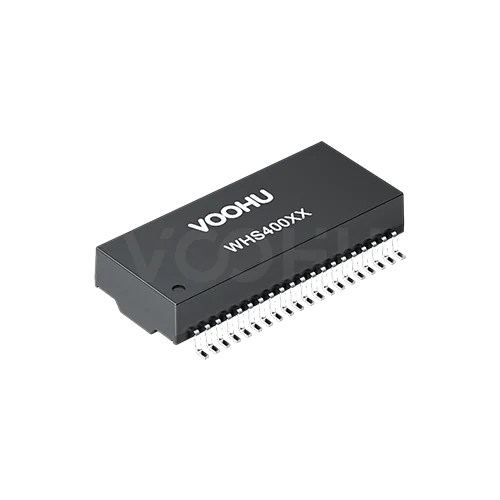
If the Pulse H1164NL is on your BOM and you need a second source, the VOOHU WHS40005G is a functional alternative — verify with samples in your design. Each part packs four 10/100BASE-TX ports into a 40-lead SMD body on a 1.27 mm pitch, isolates to 1500 V and runs from 0 to 70 °C. Put the two schematics side by side and every one of the 40 pin labels matches, as does the polarity dot on each transformer and common mode choke. So the schematic is not where the work is. The work is on the board: Pulse suggests 1.02 mm wide pads with only 0.25 mm between neighbours, VOOHU suggests 0.76 mm pads, and the outer span across both pad rows is 16.76 mm against 17.00 mm. Decide on pads and stencil before the first build.
#H1164NL vs. WHS40005G: the two datasheets side by side
The Pulse H1164NL is listed on a two-page Pulse datasheet, H328.G (7/09), that also covers the H1140NL, H1141NL and HX1234NL. Read the H1164NL row carefully: the −40 to +85 °C range in note 1 belongs to the HX1234NL only, and the H1164NL is rated 0 to 70 °C, so take the range from the H1164NL row rather than from a note further down the page. The VOOHU column comes from the WHS40005G datasheet, revision A0. Lengths are in millimetres. Where a datasheet does not give a value, the table says so instead of filling the gap.
#Can the H1164NL land pattern stay? Pad width, stencil and solder bridging
Start with what is the same. Both drawings place 20 pads per row on a 1.27 mm pitch, 24.13 mm from the first pad to the last, so every WHS40005G lead lands over a pad on a board drawn for the H1164NL. What changes is how much copper sits around each lead. The Pulse pattern uses 1.02 mm wide pads, which leaves 0.25 mm of bare board between neighbouring pads. The VOOHU pattern uses 0.76 mm wide pads under a lead that is 0.46 ± 0.10 mm wide. Across the rows, the Pulse pads run from 12.57 mm (inner edges) to 16.76 mm (outer edges); the VOOHU pads span 17.00 mm at the outer edges and are 2.54 mm long.
For the SMT line, the 0.25 mm gap is the number to watch. If the stencil apertures were cut to the full 1.02 mm Pulse pads, each WHS40005G joint gets paste sized for a pad about a third wider than the 0.76 mm pad VOOHU draws for the same lead. On a 1.27 mm pitch with a quarter of a millimetre between pads, paste beyond what the joint needs raises the risk of solder bridging between neighbouring leads. Two ways to handle it: keep the copper and have your process engineer review the aperture width for this part, or move the footprint to the VOOHU pattern at the next board revision. If the board has to accept the H1164NL and the WHS40005G interchangeably, check one land pattern against both drawings rather than tuning it for one supplier. Either way, look at the first boards under AOI or a microscope for bridges between adjacent leads and for side and toe fillets.
Then check the toe. The outer pad span is 16.76 mm on the Pulse drawing and 17.00 mm on the VOOHU drawing, both measured outer edge to outer edge across the two rows. The WHS40005G measures 16.00 ± 0.50 mm across its leads, with a 1.25 ± 0.15 mm foot. In CAD, overlay that lead outline on the Pulse pads at both ends of the tolerance and see how much pad is left beyond the lead tip and behind the heel. That margin decides whether a visible toe fillet can form, which matters if your inspection criteria call for one.
#MSL 4 floor life: what the H1164NL rating means for storage and baking
The moisture sensitivity level (MSL) tells the line how long a part may sit out of its moisture barrier bag before it must be reflowed or dried. Pulse rates the H1164NL MSL 4 (note 3 on page 1 of its datasheet). Under IPC/JEDEC J-STD-033, as tabulated in Texas Instruments' application report AN-2029, Handling and Process Recommendations, MSL 4 allows a floor life of 72 hours at or below 30 °C / 60% RH. Parts that overrun it, or whose humidity indicator card has changed colour, need baking before reflow. The same report points packages thicker than 4.5 mm to Appendix B of J-STD-033 for bake conditions, so with a part this tall, take the bake time from the standard rather than from a generic table.
The WHS40005G datasheet does not state an MSL, and that gap needs closing before the alternate goes into production, not after. Your moisture-control records probably carry the H1164NL as MSL 4; the WHS40005G needs its own entry, and nobody on the line should guess it. Ask us for the MSL rating, the peak reflow temperature and the dry-pack details (bag, desiccant, humidity indicator card) in writing, and check the bag label on the first reels you receive. Until that answer is in your system, handle the WHS40005G under controls at least as strict as the ones you already use for the H1164NL.
#Height and clearance: 5.84 mm max against 5.70 ± 0.50 mm
Both drawings measure height from the seating plane to the top of the body. The H1164NL is 5.84 mm maximum. The WHS40005G is 5.70 ± 0.50 mm, so its upper limit is 6.20 mm, 0.36 mm above the Pulse maximum. On an open board that rarely matters. Under a shield can, a heat spreader, a stacked board or a low enclosure lid, size the clearance from 6.20 mm, and measure the height of your evaluation samples while you are at it. The body outline also differs slightly (28.58 mm max × 12.19 mm on the Pulse drawing, 28.00 ± 0.50 × 12.00 ± 0.50 mm on the VOOHU drawing), so build the courtyard from the larger of the two at each edge.
#Changeover checklist: H1164NL to WHS40005G
On the schematic side there is less to do than usual for a second source. Comparing the two drawings pin by pin, the labels agree on all 40 pins, and the polarity dots on all eight transformers and eight common mode chokes sit on the same pins. That is a reading of the two published schematics, not a written FAE confirmation, so the netlist check and a link test on samples still have the final word. The rest of the list is about assembly and documents:
#Where the WHS40005G fits
The H1164NL was built for quad-port 10/100 designs with Auto MDI/MDIX, and that is the slot the WHS40005G fills: four ports of magnetics in one 40-lead body between a four-port PHY or switch IC and the RJ45 jacks, in unmanaged switches, multi-port controllers and similar equipment that stays within 0 to 70 °C. Neither part is rated for −40 to +85 °C. If your design needs that range, our HX1234NLT comparison covers the extended-temperature part on the same Pulse datasheet.
#FAQ
What is an alternative to Pulse H1164NL?
The VOOHU WHS40005G is a functional alternative to the Pulse H1164NL — verify with samples in your design. Like the H1164NL it handles four 10/100BASE-TX ports in a 40-lead SMD package at 1.27 mm pitch, rated 1500 V and 0 to 70 °C, and its schematic carries the same pin labels and polarity dots as the H1164NL on all 40 pins. The suggested land patterns differ, with 1.02 mm pads on the Pulse datasheet and 0.76 mm pads on the VOOHU datasheet.
Can the WHS40005G go on a board laid out for the H1164NL?
On both drawings the pads sit on a 1.27 mm pitch and run 24.13 mm from first to last, so each lead lands on a pad. Pad width and outer span are not: 1.02 mm and 16.76 mm on the Pulse drawing, 0.76 mm and 17.00 mm on the VOOHU drawing. Review the stencil apertures for the narrower lead, check toe and heel margins in CAD, and confirm on a sample build. This comes from the two public datasheets, not a written FAE confirmation.
What is the MSL level of the H1164NL?
Pulse rates the H1164NL MSL 4 in note 3 of its datasheet. Under J-STD-033 that means a floor life of 72 hours at or below 30 °C / 60% RH after the moisture barrier bag is opened, with baking before reflow if the time is exceeded. The WHS40005G datasheet does not state an MSL, so ask VOOHU for it in writing before setting up the alternate in your moisture-control system.
Is the H1164NL rated for −40 to +85 °C?
No. On the Pulse datasheet the H1164NL is rated 0 to 70 °C; the −40 to +85 °C note applies to the HX1234NL on the same sheet. The WHS40005G is also rated 0 to +70 °C, so a design that needs the wider range should look at extended-temperature parts.
#Request WHS40005G samples with your land pattern and stencil data
When you request samples of the WHS40005G, attach the land pattern and stencil data from your H1164NL board and say which questions your line needs answered. Samples are available for evaluation, and selected parts are free of charge. Our FAE team will be glad to confirm the options for your project. Our FAE team can suggest suitable parts and help check the design — for this pair, the 1.02 mm Pulse pads against the WHS40005G leads, the clearance above the 6.20 mm height limit, and the MSL and dry-pack statement your incoming inspection will ask for.
VOOHU supplies RJ45 and SFP connectors, LAN and PoE transformers and common mode chokes from Suzhou, China, to more than 1,500 customers.
If you would rather see every quad-port, 40-pin VOOHU part for 10/100 designs, the LAN transformer selector is linked here with those three filters (10/100 Base-TX, quad ports, 40 pins) already set.
Related product: WHS40005G, a four-port 10/100BASE-TX LAN transformer for surface mounting: 40 leads at 1.27 mm, body 28.00 ± 0.50 × 12.00 ± 0.50 mm and 5.70 ± 0.50 mm tall, OCL of at least 350 µH, isolation tested at 1500 VAC for 60 s, operating range 0 to +70 °C.
SolutionEthernetInterface + magneticsView solution →Need a quote, samples or selection support?
Part number WHS40005G is filled in for you. Add the quantity and lead time and submit. Our FAE team will be glad to confirm the options for your project.
Before you order: samples, MOQ, lead time and import duties in our ordering guide →