A pulse transformer is a small transformer built to carry fast pulses or digital data across an isolation barrier while keeping the pulse shape, rather than to deliver power at one fixed frequency. Its windings are tightly coupled so that edges pass quickly, and its primary inductance is high enough that the flat top of each pulse does not sag. Pulse transformers, often called signal transformers, couple and isolate data in Ethernet ports, carry isolated communication between battery monitor ICs, and trigger power switches in gate drive circuits. This article covers these signal pulse transformers, not the 12-, 18- or 24-pulse transformers used for multi-pulse rectifiers in large drives. VOOHU supplies LAN transformers, chip LAN transformers whose datasheets title them pulse transformers, and BMS isolation transformers.
#What is the purpose of a pulse transformer?
A pulse transformer does four jobs at once:
- Galvanic isolation. There is no conductive path between primary and secondary, so the two sides can sit at different ground potentials. This protects people and circuits, breaks ground loops and lets a link cross a large voltage difference, which is what a battery stack needs. The isolation is verified with a hi-pot (dielectric withstand) test.
- Signal coupling with DC blocking. Only changes in voltage pass through, so a DC offset on one side does not reach the other.
- Common mode rejection. The receiver sees the voltage across the winding, not the voltage of the cable to ground, so noise common to both wires is largely left behind. In a LAN transformer, center taps and common mode chokes improve this further.
- Impedance and level matching. The turns ratio sets the voltage and impedance ratio between the two sides; Ethernet and BMS links usually use 1:1 with center taps, written 1CT:1CT; the four VOOHU parts below are all 1CT:1CT.
#How does a pulse transformer work?
When a voltage step is applied to the primary, the tightly coupled secondary reproduces it almost at once. How faithfully it does so depends on three properties:
- Leakage inductance and winding capacitance set the rise time and any overshoot or ringing on the edges. Pulse transformers keep both low with small cores and interleaved or twisted windings.
- Primary (magnetizing) inductance sets the droop. During the flat top of a pulse, magnetizing current ramps up and the output sags; the longer the pulse, the more inductance is needed. That is why datasheets give the open-circuit inductance (OCL) as a headline specification, with its test frequency, voltage and DC bias.
- Volt-seconds set the limit. Core flux grows with the applied voltage multiplied by the time it is applied. Push it past what the core can hold and the core saturates, so the line codes used on Ethernet and isolated buses are kept balanced and the flux does not build up from pulse to pulse.
LAN transformer datasheets measure OCL with a small DC bias current flowing, because some DC current can flow through the winding in a real port and lowers the effective inductance.
#Pulse transformer vs power transformer
Both are transformers and follow the same physics. What differs is what each is designed to get right:
When people compare a pulse transformer with a "normal" transformer, they usually mean a power transformer. A power transformer cannot stand in for a pulse transformer: its leakage inductance and winding capacitance are too high for fast edges, and it is not specified for pulse fidelity.
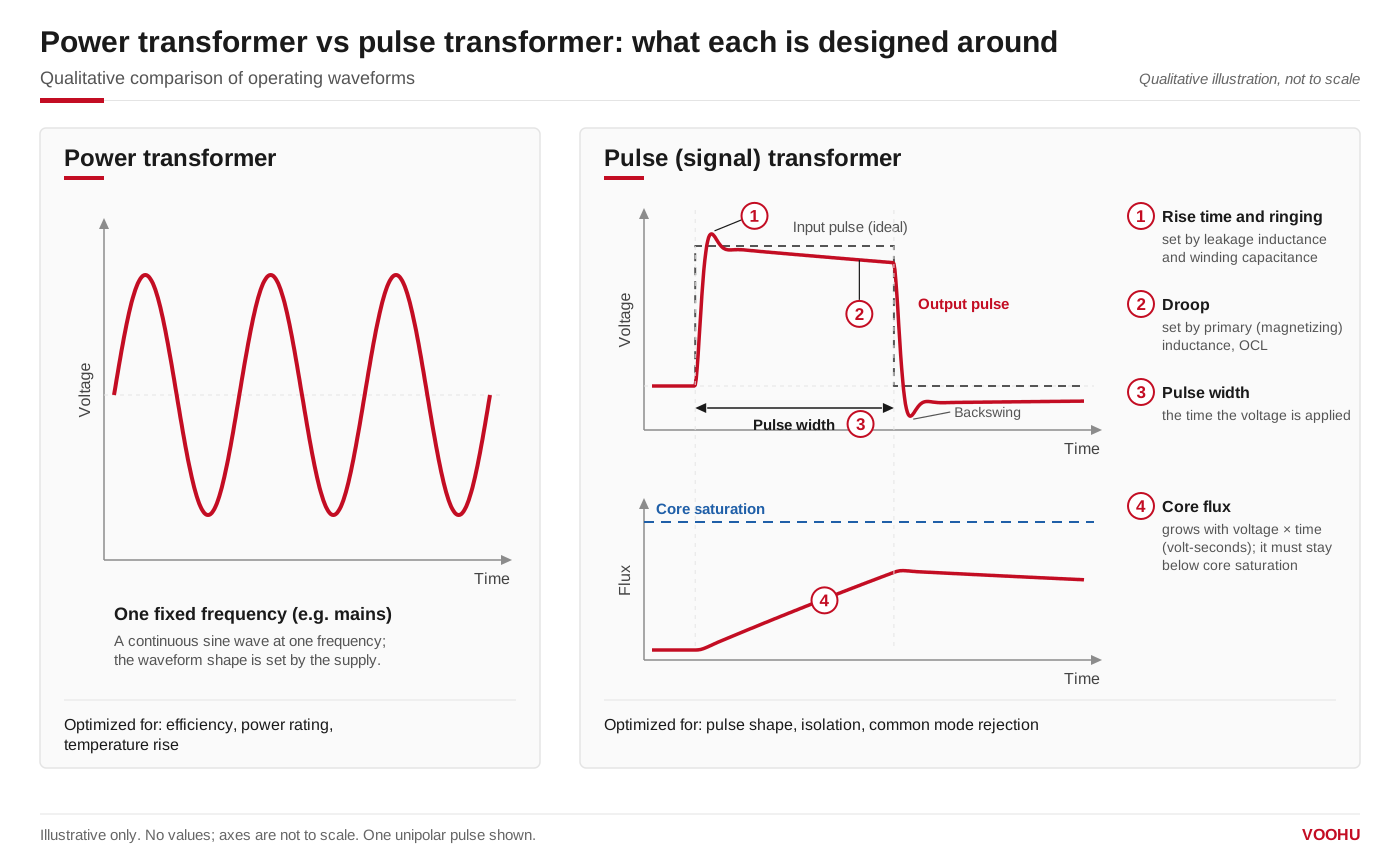
A power transformer is designed around one frequency and its power rating. A pulse transformer is designed around the pulse: rise time set by leakage inductance and winding capacitance, droop set by primary inductance, and core flux that grows with volt-seconds. Qualitative illustration, not to scale.
#What is a pulse transformer used for?
- Ethernet ports. Each pair that a 10/100BASE-TX or 1000BASE-T port uses (two pairs for 10/100BASE-TX, four for 1000BASE-T) passes through a pulse transformer between the PHY and the RJ45 connector, either as a discrete LAN transformer, a small chip LAN transformer, or built into an RJ45 jack with integrated magnetics. Ethernet ports are required to be isolated, and the transformer provides that isolation while passing the data. Many LAN transformers also include a common mode choke in each channel; see where the common mode choke sits.
- Battery management systems. In a battery stack, monitor ICs on different modules sit at different voltages and talk to each other over an isolated daisy chain or isolated SPI link. A BMS isolation transformer couples the data and holds off the stack voltage between modules. See isolated SPI for battery management systems.
- Gate drive and triggering. In power electronics, pulse transformers carry turn-on pulses to thyristors and transistor gates that sit at a different potential from the controller.
- Other isolated data interfaces. Telecom lines and industrial buses use signal transformers for the same reasons: isolation and noise rejection.
#How do you read a pulse transformer datasheet?
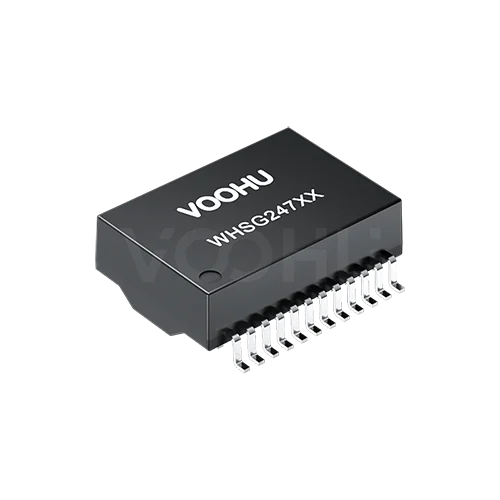
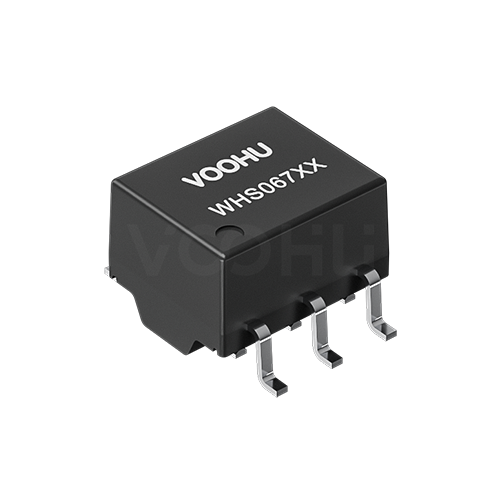
Three entries matter most on a signal or pulse transformer datasheet: the OCL with its test conditions, the turns ratio, and the isolation test. The table shows how they are stated on four VOOHU datasheets.
- Read OCL with all its conditions. Test frequency, test voltage, DC bias and temperature all change the measured inductance. Compare two parts only when the conditions match.
- Check the turns ratio and the center taps against the PHY or transceiver reference design.
- Read the isolation test as three numbers: voltage (AC or DC), leakage current limit and duration. A DC test and an AC test, or a 60-second test and a 2-second test, are different tests; compare parts only on the same one, and match it to the test your product standard requires.
- A hi-pot test is not a working voltage. It shows the insulation survives a short overstress. Where a datasheet also states a working voltage and insulation grade, as the WHST06202E0 does with reinforced insulation at a working voltage of 1500 VDC, use that for your insulation design; otherwise ask our FAE team to confirm it for your application.
For Ethernet parts, insertion loss, return loss and common mode rejection matter as well; see how to read a LAN transformer datasheet.
#Which VOOHU pulse transformer should you start with?
Compare parts in the LAN transformer selector for 10/100/1000BASE-T, the 4532E chip LAN transformers and the single-channel BMS isolation transformers. If you are deciding between one and two channels per link, see single vs dual channel BMS isolation transformers.
#FAQ
How do you check a pulse transformer with a multimeter?
A multimeter can confirm continuity and a low DC resistance on each winding, and an open circuit between primary and secondary windings. It cannot measure the inductance or prove the isolation rating. OCL needs an LCR meter set to the test frequency, voltage and DC bias on the datasheet, and the isolation rating needs a hi-pot tester.
What is a signal transformer used for?
A signal transformer couples a signal from one circuit to another while isolating them, blocking DC and rejecting common mode noise. Pulse transformers for Ethernet, BMS and other data links are signal transformers, and so are audio transformers, which carry analog audio instead of pulses.
What happens if a pulse transformer is overdriven?
If the voltage is applied for too long, or more DC current flows through the winding than the part is designed for, the core flux exceeds what the core can hold and the core saturates. The inductance collapses, magnetizing current rises sharply and the output pulse falls away. Use each transformer with the interface it is specified for, such as the Ethernet PHY or BMS transceiver, and ask our FAE team to check any other drive condition. The WHSG24701G and WHLT-4532E-201MGN LAN transformers state their OCL with an 8 mA DC bias current.
Is a pulse transformer the same as a 12-pulse transformer?
No. A 12-pulse, 18-pulse or 24-pulse transformer is a power transformer with phase-shifted secondary windings that feeds a multi-pulse rectifier in large motor drives and power converters, to reduce harmonics on the supply. A pulse transformer in the sense of this article is a small signal transformer for pulses and data.
Ask our FAE team to check your transformer choice
Tell us the interface, Ethernet speed or BMS link, the number of channels, and the isolation test and working voltage your product must meet in the sample and support request form. Our FAE team can suggest a LAN, chip LAN or BMS isolation transformer that matches, and check the footprint, turns ratio and center-tap connections against your PHY or transceiver. Samples are available for evaluation, and selected parts are free of charge. Our FAE team will be glad to confirm the options for your project.
VOOHU supplies RJ45 and SFP connectors, LAN and PoE transformers and common mode chokes from Suzhou, China, to more than 1,500 customers.
Need a quote, samples or selection support?
Part number WHSG24701G is filled in for you. Add the quantity and lead time and submit. Our FAE team will be glad to confirm the options for your project.
Before you order: samples, MOQ, lead time and import duties in our ordering guide →