Compiled from both manufacturers' published datasheets. Verify with samples and the PCB footprint before production.
Amphenol's UE76-A20-2000T is a right-angle, 20-position SFP+ receptacle with a 0.80 mm pitch, surface-mounted on the board inside the cage. The VOOHU WH290Z019D0S01 is a functional alternative to it — verify with samples in your design. Both drawings give 2.00 × 0.50 mm pads, two Ø1.55 mm locating holes 9.60 mm apart, an 11.00 mm wide body, Ø1.40 mm locating posts and 0.10 mm coplanarity. The two drawings dimension the pads from different starting points; once both are converted to the same reference, the figures agree. The decision that needs the most thought is plating. The -2000T suffix selects Amphenol plating option 2, with 30 µin of gold on the contact area, while VOOHU specifies 15 µin. The rated operating range is −40 to +85 °C for Amphenol and −40 to +95 °C for VOOHU, and only the Amphenol drawing marks keep-out areas.
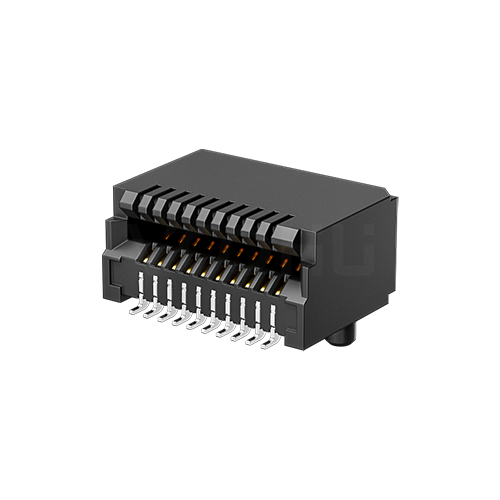
#UE76-A20-2000T drawing and WH290Z019D0S01 datasheet compared
There is no separate datasheet for the -2000T. Amphenol publishes one customer drawing, P-UX76-A20-X00XX revision C, for the whole UE76-A20 range: sheet 1 carries the outline, materials and part-number key, sheet 2 the cage assembly section, PCB pads and keep-out areas, sheet 3 the module-side layout. Its dimensions are in inches with millimetres in brackets; the millimetre values are quoted here. The VOOHU column comes from the WH290Z019D0S01 datasheet, revision A0, three pages: outline, materials and ratings on page 1, recommended PCB pads on page 2, module-side layout on page 3. "Not stated" means the document gives no value.
#30 µin or 15 µin of gold: why the -2000T plating code matters
The Amphenol part number is a code, and the plating sits in it. Sheet 1 decodes UX76-A20-X00XT as follows: UE76 is the RoHS version, the first X is the contact plating option (2, 3, 5 or 6) and the last X is contact lubrication (0 for none, 1 for lubricated). UE76-A20-2000T therefore means plating option 2 without lubricant: at least 30 µin (0.76 µm) of gold on the contact area, a 2 µin gold flash on the solder tails and at least 50 µin of nickel underneath. The VOOHU WH290Z019D0S01 has 15 µin of gold on the contact area, a gold flash on the tails and 50 µin of nickel. Watch the suffix when you read listings: the -3000T has the same 30 µin contact gold but matte tin on the solder tails, so its data does not describe the -2000T.
Gold thickness alone will not tell you how many module insertions a connector survives, and here the documents do not help either: the Amphenol drawing gives no durability rating at all. The VOOHU datasheet rates 100 mating cycles minimum, with 40 N maximum insertion force, 11.5 N maximum extraction force and 20 mΩ maximum initial contact resistance. So the useful question for a reliability engineer is a different one: why did the original design call out option 2? The drawing lists four plating options, so the choice may be recorded in the design file, a customer requirement or a corrosion-environment class. If it traces back to a module insertion count, run that count on WH290Z019D0S01 samples in your own fixture, measure contact resistance before and after, and add a humidity or mixed-gas exposure if the environment was the reason. If no reason can be found, the qualification plan can follow your normal connector change process. For incoming inspection, take the plating acceptance value from the VOOHU datasheet.
#SFP+ 20-pin connector footprint at 0.8 mm pitch: two datums, one set of numbers
Put detail F of the Amphenol drawing next to page 2 of the VOOHU datasheet and the numbers look unrelated. That is because Amphenol dimensions the pads from the cage hole row and VOOHU from the Ø1.55 mm locating hole. Converting takes three steps. Across the connector, Amphenol gives 3.20 mm from the left pad column to a small cage hole and 0.90 mm from there to the locating-hole centre, which is 4.10 mm; from the same cage hole to the right column is 5.00 mm, so 4.10 mm on that side too. VOOHU states 4.10 + 4.10 mm directly, and both put the columns 8.20 mm apart. Along the connector, the VOOHU cage hole row lies 11.93 − 9.60 = 2.33 mm from the upper locating hole. Adding the VOOHU figures from that hole to pads 10 and 11 gives 2.33 + 8.60 = 10.93 mm and 2.33 + 8.20 = 10.53 mm, which are the two Amphenol values, so both drawings offset the two pad columns by 0.40 mm. The converted figures agree, but that is a paper check. Overlay the two land patterns in your CAD tool before you build a board, and with 0.50 mm pads at 0.80 mm pitch, ask your EMS partner for X-ray or AOI of the first articles.
Keep-out areas are the other half of the layout. Sheet 2 of the Amphenol drawing marks four stand-off areas where neither components nor traces may go, a keep-out under the cage that allows only chassis ground, and a component keep-out under the connector where traces are allowed. Page 2 of the VOOHU datasheet shows pads, holes and the outline, with no keep-out. That leaves nothing to compare, so keep the Amphenol keep-outs on your board and ask our FAE team for keep-out guidance for the WH290Z019D0S01 if you want to change them. The VOOHU datasheet also shows no mating cage, so check how the connector sits inside the cage you use with samples of both parts; our SFP+ cage selection guide covers the cage side of the layout.
#Temperature, soldering and what neither drawing says about speed
The Amphenol drawing rates the connector for −40 to +85 °C. The VOOHU datasheet rates −40 to +95 °C in operation and −55 to +105 °C in storage, and gives a reflow limit of 255–265 °C for 5–10 s, where the Amphenol drawing gives no profile. Write the BOM temperature and the soldering profile check from the VOOHU sheet. Speed is a different matter. "SFP+" and "high speed" in the Amphenol title are the only hints, and the VOOHU datasheet gives no data rate either; neither document publishes insertion loss, return loss or crosstalk. Signal integrity at your line rate therefore has to be confirmed on your own board, with the modules or cables you ship: eye diagram and error count on a prototype, across your temperature range. If your channel budget needs S-parameters for the connector, ask our FAE team whether such data is available.
#Change-over checklist: UE76-A20-2000T to WH290Z019D0S01
Quality and reliability
- 1.Find the reason the original BOM specified plating option 2 (30 µin contact gold).
- 2.Run your module insertion count on samples and measure contact resistance before and after (VOOHU rates 20 mΩ max initial).
- 3.Take plating, temperature and reflow acceptance values from the VOOHU datasheet.
Layout and EMS
- 1.Overlay the VOOHU pads on your existing land pattern using the Ø1.55 mm locating hole as the common reference (8.20 mm column spacing, 0.40 mm offset, 9.60 mm hole spacing, 11.93 mm to the cage hole row).
- 2.Keep the Amphenol stand-off and under-cage keep-outs.
- 3.Check the stencil against the 2.00 × 0.50 mm pads and inspect the first articles by X-ray or AOI.
- 4.Fit samples of the connector and your cage together and check the seating.
Hardware
- 1.Confirm signal integrity at your line rate on a prototype with the modules or cables you ship.
- 2.Ask our FAE team whether connector S-parameters are available if your channel budget needs them.
Purchasing
- 1.List the WH290Z019D0S01 as a functional alternative to the UE76-A20-2000T, pending sample approval.
#Where the WH290Z019D0S01 fits
Any board with a single SFP+ port whose 20-pin connector is reflow-soldered under a 1×1 cage: uplink ports on access and aggregation switches, routers and gateways, OLT and media-converter boards, and industrial switches that need a fibre port. The cage is a separate part and is chosen on its own. If your BOM lists the Molex 74441-0001 rather than the Amphenol part, read our 74441-0001 comparison, which covers the same VOOHU connector.
Industry solutionDatacomONU · SwitchView solution →#FAQ
What is an alternative to Amphenol UE76-A20-2000T?
VOOHU's WH290Z019D0S01 is a functional alternative to the Amphenol UE76-A20-2000T — verify with samples in your design. Both are 20-position, 0.80 mm-pitch SFP+ SMT receptacles with 2.00 × 0.50 mm pads and Ø1.55 mm locating holes 9.60 mm apart. Contact gold differs: 30 µin on the -2000T, 15 µin on the VOOHU part.
How do the UE76-A20-2000T and WH290Z019D0S01 footprints compare at 0.8 mm pitch?
The pad size, pitch, pad count and locating holes carry the same values on both drawings. Amphenol dimensions the pads from the cage hole row and VOOHU from the locating hole; converted to one reference, both give 8.20 mm between pad columns and a 0.40 mm offset. Overlay the two patterns in CAD and keep the Amphenol keep-outs, which the VOOHU drawing does not show.
How many mating cycles is the UE76-A20-2000T rated for?
The Amphenol drawing P-UX76-A20-X00XX rev C does not state a durability rating; it specifies the plating, 30 µin of gold for option 2. The VOOHU WH290Z019D0S01 datasheet rates 100 cycles minimum. If your product has an insertion requirement, test it on samples.
Does the WH290Z019D0S01 datasheet give a data rate?
No. The WH290Z019D0S01 datasheet gives mechanical, material and basic electrical ratings but no data rate or high-frequency parameters, and the Amphenol drawing for the UE76-A20-2000T gives none either. Confirm signal integrity on your own board with the modules you ship, and ask our FAE team whether S-parameter data is available if you need it.
#Send your UE76-A20-2000T land pattern with the sample request
Request WH290Z019D0S01 samples through the sample request form, and attach the land pattern and keep-out layer you drew for the UE76-A20-2000T, plus the module insertion count your product has to meet. Samples are available for evaluation, and selected parts are free of charge. Our FAE team will be glad to confirm the options for your project. Our FAE team can suggest suitable parts and help check the design — for this connector, overlaying your pads and keep-outs on the WH290Z019D0S01 layout and planning the plating and insertion checks.
VOOHU supplies RJ45 and SFP connectors, LAN and PoE transformers and common mode chokes from Suzhou, China, to more than 1,500 customers.
The SFP connector selector, filtered to SFP+ board connectors, lists the other options side by side.
Related product: WH290Z019D0S01 — 20-position SFP+ SMT connector, 0.80 mm pitch, 15 µin contact gold, −40 to +95 °C.
Need a quote, samples or selection support?
Part number WH290Z019D0S01 is filled in for you. Add the quantity and lead time and submit. Our FAE team will be glad to confirm the options for your project.
Before you order: samples, MOQ, lead time and import duties in our ordering guide →