Compiled from both manufacturers' published datasheets. Verify with samples and the PCB footprint before production.
The VOOHU WHSG24002TG is a functional alternative to the HanRun HR682430E — verify with samples in your design. Both are single-port gigabit LAN transformers in a 24-pin SMD package with a 15.10 × 7.10 mm body and four channels, each a 1CT:1CT transformer followed by a two-wire common mode choke, and as drawn the pin numbers carry the same functions on both schematics. OCL of 350 µH minimum with 8 mA of DC bias, the five return loss bands, −30 dB crosstalk and the −40 to +85 °C operating range are written with the same values on both datasheets. Two lines need a decision before release. Height is 4.32 mm maximum on the HanRun drawing and 4.00 ± 0.50 mm on the VOOHU drawing. The hipot is 1500 V for 60 s on both, with a leakage current criterion of 0.5 mA for HanRun and 1 mA for VOOHU.
#HR682430E vs. WHSG24002TG: the two datasheets line by line
The HanRun column comes from the HR682430E datasheet, titled 10/100/1000Base-T Magnetics Modules, revision 00, as hosted by LCSC: a single page with the electrical table, schematic, outline and recommended pads. Dimensions on that drawing without their own tolerance follow its general tolerance of ± 0.25 mm. The VOOHU column comes from the WHSG24002TG datasheet, revision A0: outline, suggested pads and schematic on page 1, electrical items 1 to 11 on page 2. Lengths are in millimetres, not stated means the document does not give the value, and figures marked calculated are worked out from printed dimensions rather than printed themselves.
#4.32 mm maximum or 4.00 ± 0.50 mm: is there room above the transformer?
Start with whatever sits over the part. A shield can lid, a low enclosure cover, a light pipe or a board stacked above the port may have been spaced from the HanRun figure, and HanRun writes height as a ceiling: 4.32 mm, maximum. VOOHU writes it as 4.00 mm nominal with ± 0.50 mm, so the drawing allows anything from 3.50 to 4.50 mm (calculated from the tolerance). The nominal WHSG24002TG is lower than the HanRun ceiling, but the tolerance band reaches 0.18 mm above it (calculated). Length, width and the 10.00 mm span across the leads have the same nominal values on both drawings, so height is the one body dimension that needs a fresh look.
The practical work happens in the CAD library. If the 3D model and height attribute of your transformer footprint were built from the HanRun drawing, they carry 4.32 mm, and any height check in the board or enclosure model will keep passing against that number. Build the WHSG24002TG part with a 4.50 mm body height, run the clearance check again, and keep the result with the change record. If the gap above the part cannot take 4.50 mm, tell us the clearance you have when you request samples and ask for written height data before the design is frozen; a few measured samples show what one lot looks like, not what the drawing allows.
#Hipot test acceptable leakage current: 0.5 mA on one sheet, 1 mA on the other
Both datasheets test primary to secondary at 1500 V for 60 s; HanRun writes the voltage as 1500 Vrms, VOOHU as 1500 VAC. The difference is the leakage current that counts as a failure. On a hipot tester that figure is the trip current: the tester flags a failure when the leakage goes above it. An inspection sheet copied from the HR682430E sets the tester to 0.5 mA, while the WHSG24002TG datasheet defines its pass criterion at 1 mA and gives no result at 0.5 mA, so a 0.5 mA setting is not the condition the WHSG24002TG is specified to. Write the WHSG24002TG line as 1500 VAC, 1 mA, 60 s. If a customer specification or a safety file asks for 0.5 mA, ask us for written data at that limit before you change anything, and record the voltage, time and trip current next to every result. Our article on why an Ethernet port fails the Hi-Pot test covers the rest of the isolation path.
The rest of the inspection sheet is quicker. OCL is specified at the same 100 kHz, 0.1 V and 8 mA DC on both parts, so that line can stay, and the return loss bands and the −30 dB crosstalk limit carry the same digits. Insertion loss does not: −1.0 dB maximum for HanRun, −1.1 dB maximum for VOOHU, both over 1 to 100 MHz, so the WHSG24002TG line takes −1.1 dB. Leakage inductance, DCR, the ± 5% turns ratio tolerance and the storage range appear only on the VOOHU sheet; if your approval document has no lines for them, nothing has to be carried over, and if you add them, take them from the WHSG24002TG datasheet. For height, inspect against 4.00 ± 0.50 mm rather than the 4.32 mm ceiling.
#Differential to common mode rejection and common mode rejection: keep the two lines apart
The table gives these two parameters separate rows on purpose. HanRun lists differential to common mode rejection at three frequencies: −40 dB at 30 MHz, −35 dB at 60 MHz and −30 dB at 100 MHz. VOOHU lists common mode rejection at −30 dB minimum from 1 to 100 MHz. The parameter names differ, and neither datasheet defines its test method or fixture, so the two sets of numbers cannot be set against each other. If your approval document quotes the HanRun line, mark it as not stated for the WHSG24002TG rather than writing the HanRun figures under the new part number, and let the EMC and link tests on your own board decide.
#HR682430E footprint and the 0.99 mm pitch: what to watch at the end pads
Across the rows the two recommended patterns agree: outer edges 10.70 mm apart, pads 1.35 mm long (printed by VOOHU, calculated from HanRun's 10.70 and 8.00 mm edges), 0.61 against 0.60 mm wide. Along the rows they are labelled differently. HanRun prints a 0.99 mm pitch and 10.89 mm from the first pad to the last; VOOHU prints 1.00 ± 0.20 and 11.00 ± 0.20 mm. At nominal values, the end leads of a WHSG24002TG would sit about 0.055 mm further out at each end of an HR682430E pad row. That figure is calculated from the two drawings, not printed on either, and it is smaller than the ± 0.20 mm VOOHU allows on its own first-to-last span. On the same nominal basis, the outer side of an end lead lands about 0.05 mm inside the pad edge (calculated). Nominal arithmetic cannot settle a difference that sits inside the tolerance, so let a first-article build on your existing board decide, with a side view of the joints on pins 1, 12, 13 and 24. No written FAE confirmation covers the HanRun pattern yet.
#Before the WHSG24002TG goes on the approved list: nine checks
#Where the WHSG24002TG fits
The WHSG24002TG suits a single gigabit port laid out for a 24-pin SMD transformer on a 1.0 mm-class pitch, in equipment rated for −40 to +85 °C, the operating range on both datasheets, where the space above the transformer takes a 4.50 mm body or the height has been confirmed in writing. The same VOOHU part is compared with a Pulse transformer in our HX5084NLT comparison, and other HanRun parts are listed in our HanRun cross reference.
SolutionEthernetInterface + magneticsView solution →#FAQ
What is an alternative to HanRun HR682430E?
The VOOHU WHSG24002TG is a functional alternative to the HanRun HR682430E — verify with samples in your design. Both are single-port gigabit, 24-pin SMD LAN transformers with a 15.10 × 7.10 mm body, four 1CT:1CT channels with a two-wire common mode choke, 350 µH minimum OCL at 8 mA DC bias, a 1500 V, 60 s hipot and −40 to +85 °C operation. Check the height, 4.32 mm maximum against 4.00 ± 0.50 mm, and the hipot leakage criterion, 0.5 mA against 1 mA.
How tall are the HR682430E and the WHSG24002TG?
The HanRun drawing gives the HR682430E a maximum height of 4.32 mm. The VOOHU drawing gives the WHSG24002TG 4.00 ± 0.50 mm, which works out to a range of 3.50 to 4.50 mm. Size any shield lid or enclosure clearance above the part from 4.50 mm, or ask VOOHU for written height data.
What leakage current is acceptable in a hipot test of these two transformers?
The acceptable leakage current is the limit written in each part's own datasheet. For the HR682430E it is 0.5 mA at 1500 Vrms for 60 s, primary to secondary; for the WHSG24002TG it is 1 mA at 1500 VAC for 60 s. Set the tester to the limit of the part you are testing, and ask VOOHU for written data if your specification requires 0.5 mA on the WHSG24002TG.
Is differential to common mode rejection the same as common mode rejection on these two datasheets?
Treat them as two different lines. The HR682430E datasheet lists differential to common mode rejection at −40, −35 and −30 dB at 30, 60 and 100 MHz; the WHSG24002TG datasheet lists common mode rejection at −30 dB minimum from 1 to 100 MHz. The parameter names differ and neither datasheet defines its test method or fixture, so the figures should not be compared directly.
Can the WHSG24002TG go on an HR682430E footprint with a 0.99 mm pitch?
Plan it as a trial. Both recommended patterns put the outer pad edges 10.70 mm apart with pads 1.35 mm long, but HanRun labels the pitch 0.99 mm and VOOHU 1.00 ± 0.20 mm. Calculated at nominal values, the end leads sit about 0.055 mm further out, which is within the VOOHU tolerance, so a first-article build should confirm the joints on pins 1, 12, 13 and 24. No written FAE confirmation covers the HanRun pattern yet.
#Send your clearance and hipot settings with the sample request
When you request WHSG24002TG samples, tell us how much room there is above the transformer on your board and how your hipot test is set today: voltage, time and trip current. Samples are available for evaluation, and selected parts are free of charge. Our FAE team will be glad to confirm the options for your project. Our FAE team can suggest suitable parts and help check the design — for this pair, whether the 4.00 ± 0.50 mm height fits under your shield or cover, which hipot limit to write on the inspection sheet, and how the end leads sit on your HR682430E pads.
VOOHU supplies RJ45 and SFP connectors, LAN and PoE transformers and common mode chokes from Suzhou, China, to more than 1,500 customers.
To look at other 24-pin, 1.0 mm-pitch parts, the LAN transformer selector opens with the pin count and pitch already filtered.
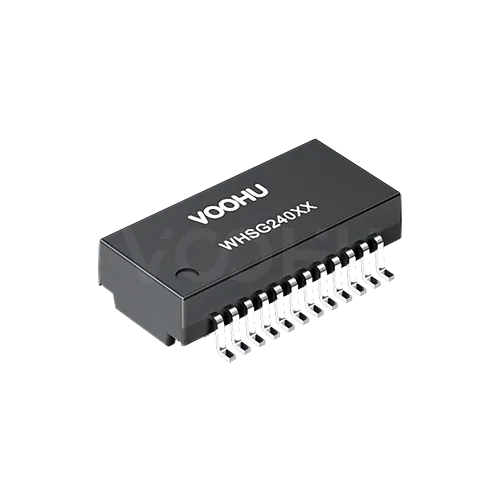
Related product: the WHSG24002TG single-port LAN transformer for 100/1000BASE-T, in SMD. Four 1CT:1CT channels, each with a two-wire common mode choke, sit in a 24-lead package on a 1.00 mm pitch, 15.10 × 7.10 mm and 4.00 ± 0.50 mm tall. Per its datasheet, OCL is at least 350 µH with 8 mA of DC bias, isolation is tested at 1500 VAC for 60 s, and the operating range is −40 to +85 °C.
Need a quote, samples or selection support?
Part number WHSG24002TG is filled in for you. Add the quantity and lead time and submit. Our FAE team will be glad to confirm the options for your project.
Before you order: samples, MOQ, lead time and import duties in our ordering guide →